Author: David, Deep Tide TechFlow
Deep Tide Guide: With the strong rise of China's large models, more and more Western VCs are turning their attention eastward, personally crossing the ocean to gauge the real capacity of China's AI.
Previously, we published another article "A Western VC's Notes on AI in China: Shenzhen Hardware Shocked Me, Pessimistic on Chinese Software", authored by a partner from the renowned crypto institution Delphi Digital. Just today, a completely different note on the Chinese investigation has gone viral in the English tech circle and X (Twitter).
This time, the perspective is more hardcore, led by the top-tier venture capital firm in frontier technology and biotechnology in Silicon Valley, Dimension.
As a heavyweight capital with significant influence in the hard tech field, Dimension's partners Nan, Adam, and Zavain led a team to deeply investigate the top AI laboratories and infrastructure ecosystems in cities like Beijing, Shanghai, and Hong Kong over a week in August this year.
Different from the previous VC's discussion of "consumer-grade software and hardware manufacturing," this long internal letter written by Dimension to LPs (limited partners) directly hits the core battleground of the Sino-US AI game: underlying computing power, model open sourcing, and technological decoupling.
Under the grand narrative that mainstream Western media and political circles continuously dramatize about the "complete decoupling of Sino-US AI," this group of Silicon Valley insiders saw a completely different magical reality on the ground:
The US chip export control not only did not halt China's AI progress but instead, like a pressure cooker, forced out an extremely terrifying "underlying performance extraction machine." The AI industries of both countries are not severed; rather, they are firmly welded together at the base through distillation, open sourcing, and data.
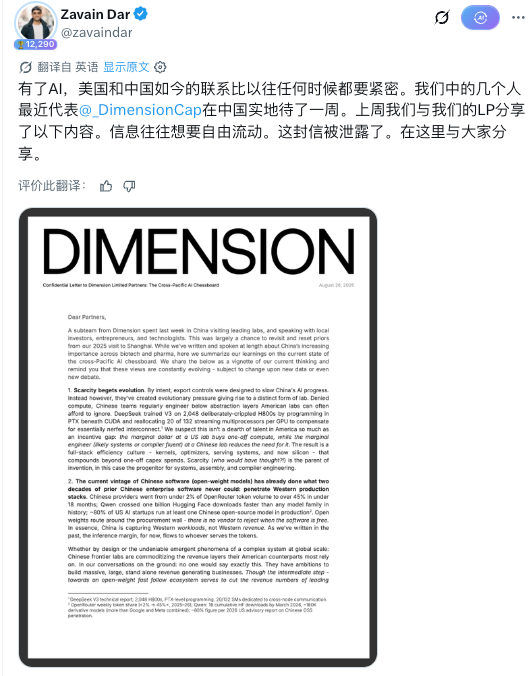
Due to the length of the letter, we have compiled and distilled the key contents, organizing some interesting observations on China's AI industry from a Western perspective as follows.
Scarcity Breeds Evolution, Sanctions Force Limits
The original intention of US export controls was to slow down China's AI progress, but the result has been counterproductive. It has created massive evolutionary pressure, giving rise to a wholly different form of AI laboratory.
Due to a severe lack of high-end computing power, Chinese teams have been forced to perform extreme engineering optimizations at code levels that American laboratories disdain.
The most extreme example is: DeepSeek's V3 model, which was forcibly trained on 2048 deliberately "castrated" performance H800 chips. To compensate for the deficiency in interconnect performance, their engineers directly bypassed the mainstream CUDA framework, writing code at a lower PTX level, and reallocated 20 (out of a total of 132) streaming multiprocessors specifically for inter-node communication for each GPU.
This is not due to a lack of talented engineers in the US, but because the incentive mechanisms on both sides are entirely different.
In US laboratories, spending an extra dollar is to purchase more disposable computing power; while in Chinese laboratories, hiring an additional engineer is to eliminate the demand for computing power from the ground up.
This extreme scarcity has fostered a unique full-stack efficiency culture in China—from kernels, optimizers, service systems to chips, they are extracting system performance to the utmost limit.
Highly Intense Arena, Not Just External but Internal
In Silicon Valley, it seems that China's AI is merely competing against the US. However, after field investigations, it was found that the internal competition in China's frontier AI field is much more fierce than the West imagines.
The strengths of the five leading laboratories—DeepSeek, Alibaba (Qwen), Dark Side of the Moon (Kimi), ByteDance (Doubao), and Zhipu (GLM)—are so closely contested that their rankings are almost reshuffled every quarter.
These five laboratories not only have to fight to the death over model capabilities and iteration speeds but are also crazily open sourcing.
This high-pressure internal "arena" environment is completely different from the ecosystem dominated by only two closed-source giants (OpenAI and Anthropic) in the US, and the innovative drive it brings is no less than the multinational competition between China and the US.
Emerging New "AI Data Assessment Dark Horse"
American data providers such as Mercor, AfterQuery, and Turing have already recorded business relationships with Ant Financial, Alibaba, and ByteDance. On the ground, they observed a group of emerging new Chinese elites building assessment and validation infrastructure, rather than data labeling services.
In particular, in Beijing and Shanghai, they had initially expected to see a large number of cheap "data labeling factories," but instead found a batch of highly explosive, young startups focused on other aspects of AI.
For example, an AI evaluation and prediction company called UniPat, founded by a PhD from Peking University, has achieved rapid revenue growth to over $100 million, leveraging extremely high quality manual supervision to compensate for computing power disadvantages, all within 24 months.
Insufficient Computing Power? More Human Resources
What surprised Silicon Valley investors the most was that during their visits, they discovered a group of top Chinese researchers who were achieving "weak forms of self-improvement (RSI)" in a very primitive but effective manner.
Due to the extreme lack of computing power, researchers personally intervened to accelerate model training through manual intervention and assistance.
Investors marveled that this was akin to the early "Centaur Chess" (the combination of human and machine defeating a pure machine), where human effort and time were used to bridge the gap in computing power.
Unburdened Commercial Realization and Pragmatism
There remains a significant gap of nearly two orders of magnitude in revenue size between China and the US AI sectors. By August 2026, the ARR (annual recurring revenue) of Anthropic had exceeded $6.5 billion, while OpenAI reached $40 billion;
whereas the strongest large model business in China (ByteDance's video model) has an annual revenue of about $2-3 billion, and pure large model laboratory revenues are generally in the hundreds of millions level.
However, the pragmatic and penetrating ability of Chinese enterprises is impressive.
As Dimension's investors walked through the crowded and noisy streets of Hong Kong, with their earbuds listening to a well-known Silicon Valley podcast analyzing why American laboratories high-handedly refuse advertisements and e-commerce monetization, the reality in front of them created a strong contrast.
ByteDance's Doubao has already amassed 345 million monthly active users, surpassing the sum of Qwen and DeepSeek.
Although its daily revenue is currently less than 1 million RMB, almost all of it comes from e-commerce commission. Chinese entrepreneurs exhibit a blatant pragmatism and do not care at all whether the "monetization approach is low or not."
Extremely Magical "Pacific Data Circulation," A Cycle of Sino-US AI
Although hardware decouples at the semiconductor level and below, the speed of integration of software and data layers is faster than any government can respond. They believe the current real technical cycle chain of AI is an extremely magical "cross-ocean technology circulation":
Top US laboratories train top models → Chinese teams distill and open source weights → US vertical AI companies fine-tune the Chinese open-source models → package and sell to US enterprises.
Thus, the so-called American vertical AI applications are increasingly running on Chinese open-source weights, harboring the intelligence of advanced American models within.
For example, the popular coding tool Cursor's Composer 2 is fundamentally based on Kimi's K2.5; while the new legal AI enterprise Harvey's Harvey Tenet is based on Kimi's open-source model K3 for post-training.
Although China has not directly earned money from the West, it is rapidly occupying the "workflow" of the Western AI era. Open source models bypass the stringent procurement review walls of European and American enterprises; when software is freely open, there is simply no reason to reject a supplier.
7. Even More Frantic Valuation Bubble
Western capital markets often discuss the AI bubble, but in China, the boiling degree of this bubble far exceeds Silicon Valley.
Considering the enormous disparity in revenue between Sino-US model companies, the valuations of leading Chinese laboratories often range from 5 to 10 times that of their American counterparts. For example, Moonshot completed a $3.5 billion financing round at a $35 billion valuation by the end of July, which is approximately 115 times its $300 million ARR, and is currently operating a $50 billion valuation financing prior to IPO (compared to only 20 times for Anthropic).
The secondary market is even more frenzied and volatile, with the market value of companies like Zhipu AI and MiniMax experiencing dramatic roller coaster trends before and after their listings.
Ultimately, when this long letter was published on overseas social media, a sharp comment in the comment section pointed out the entire industrial ecology under the Sino-US AI competition:
"The chips are decoupling, but intelligence can still flow."
In this intensely competitive cycle, the so-called "hard decoupling of technology" is entirely a false proposition.
As Dimension stated at the end of the letter, using administrative orders to forcibly cut off connections will most likely just stifle the innovation speed of American enterprises. The US and China are already deeply intertwined at the levels of distillation, open sourcing, data, and reasoning.
Rather than blindly enjoying the hype, understanding the real flow of chips and technological trump cards on the table is what top capital and practitioners should truly focus on.
免责声明:本文章仅代表作者个人观点,不代表本平台的立场和观点。本文章仅供信息分享,不构成对任何人的任何投资建议。用户与作者之间的任何争议,与本平台无关。如网页中刊载的文章或图片涉及侵权,请提供相关的权利证明和身份证明发送邮件到support@aicoin.com,本平台相关工作人员将会进行核查。


