Original | Odaily Planet Daily (@OdailyChina)
Author | jk
In the ongoing US-Iran conflict that has lasted nearly half a year, a military operation on August 30 (local time) broke a month-long period of relative calm. This war, which began in February, had entered a hiatus due to diplomatic mediation and economic sanctions. However, this past weekend, both sides exchanged fire again, causing Brent crude oil to break through $90, while the three major US stock indices collectively declined, which also put the market on high alert once more.
Why the Conflict Resurfaced
Immediate Trigger: Mine-Laying Attempts in the Strait of Hormuz
On August 30 (Sunday), the US Central Command confirmed that US forces struck rocket launchers deployed by Iran on Larak Island. Central Command spokesperson Tim Hawkins stated that the Islamic Revolutionary Guard Corps (IRGC) was preparing to lay mines in the Strait of Hormuz at the time. This was the first public acknowledgment by the US of military action against Iranian targets since the end of July.
The Iranian side responded quickly: Iranian state media reported that Tehran had launched missiles at US bases inside Jordan as retaliation, with two bases reportedly suffering "heavy damage." The IRGC later claimed that a tanker attempting to pass through the southern edge of the strait was hit by two sea mines.
Background: From "Military Confrontation" to "Economic Strangulation"
The reason this exchange of fire has attracted attention is that it has disrupted Washington's previous strategy shift. Since the last round of mutual missile fire at the end of July, the US side has been sending signals that it would shift its focus from direct military strikes to economic sanctions and blockades against Iran—applying pressure on Tehran through tighter sanctions and maintaining a naval blockade to force it back to the negotiating table instead of launching a new round of airstrikes. Trump had previously also stated that the US would "just watch Iran become consumed by inflation and penniless," without rushing to escalate the conflict.
Meanwhile, Iran and Oman had once reached an agreement on a framework for sharing passage fees in the Strait of Hormuz, and the market had temporarily interpreted the situation as an economic stalemate, which was also the reason Brent crude fell more than 5% last week.
Trump's "AI Video" Incident
On August 31, Trump posted a seemingly AI-generated video on Truth Social, claiming that Iran's core oil export hub Kharg Island (which accounts for approximately 90% of Iran's oil exports) had been "blown to smithereens." However, executives from the Iranian National Oil Company publicly called this statement "ridiculous," saying that everything on Kharg Island was operating as usual; the US Central Command also did not confirm any strikes on the island, only acknowledging "limited, precise strikes" aimed at the mine-laying operation on Larak Island.
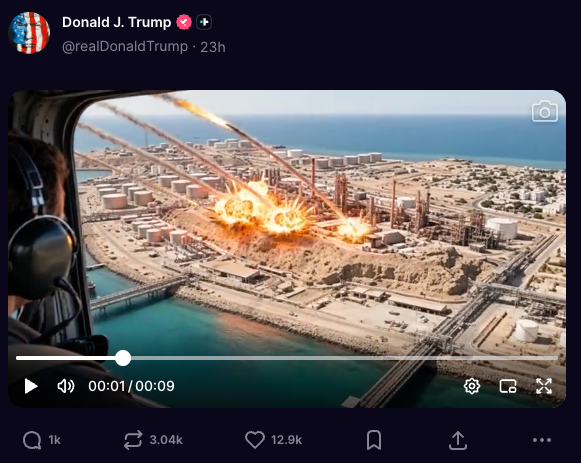
Source: Truth Social
This incident, while not causing new substantial military escalation, further stirred market expectations regarding the direction of the situation. Trump had previously threatened multiple times to "take over" Kharg Island and Iran's oil and gas market, comparing it to the US actions in Venezuela.
Framework negotiations initially scheduled for early September are still progressing, but Washington and Tehran remain publicly opposed on the core issue of "who holds the weapons." In other words, even if both sides still retain channels for dialogue, the conflict has not truly cooled down. The exchanges of fire on August 30-31 appear more like yet another friction under this fragile stalemate, and it remains unclear whether Iran will further retaliate or announce that this round of responses has ended.
Market Impact
Oil Prices: Responding with a Rise, Breaking $90 Again
- Brent crude oil closed on August 31 at approximately $90.69 per barrel, up 2.93% for the day; WTI crude also rose, approaching $86 per barrel.
- This price increase reversed the previous downward trend, where "the Iran situation was viewed as economic sanctions rather than supply threats," as Brent had previously dipped to around $89.3, with a cumulative weekly loss of over 5%.
- Looking at a longer time frame, Brent crude oil is currently up about 33% compared to the same period last year, with a roughly 8% increase over the past month. Oil production in the Gulf region remains significantly below pre-war levels (according to Goldman Sachs, current export volumes from the Gulf are about 15-16 million barrels per day, down from 22-24 million barrels per day pre-war).
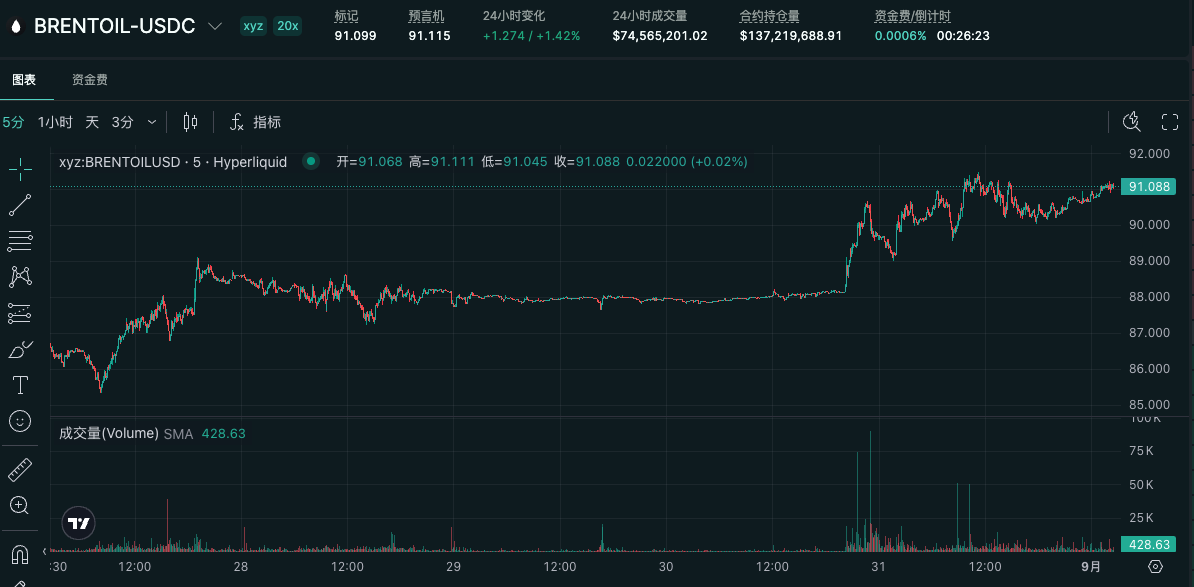
Brent crude suddenly surged. Source: Hyperliquid
US Stocks: Energy Stocks Strengthened, Overall Market Impact Limited
Closing on August 31 (Monday):
- S&P 500 Index fell 0.33%, closing at 7686.14 points
- Nasdaq Composite Index fell 0.12%, closing at 26370.89 points
- Dow Jones Industrial Average fell 374.09 points (-0.7%), closing at 53185.90 points, mainly dragged down by Goldman Sachs and Alphabet
Notably, despite recording a decline on Monday, all three major indices still closed up for the month of August: S&P 500 rose 2.6% for the month, Nasdaq rose 3.9%, and Dow rose 1.3% (up for the fifth consecutive month).
By sector: Energy stocks collectively rose owing to the increase in oil prices, with Halliburton up over 2.5% pre-market, Chevron up 2%, Valero, Occidental both up 2%, and Exxon Mobil up over 1.5%.
Cryptocurrency-related stocks mostly rose, with Bitcoin maintaining above $78,000; stocks like Coinbase, Strategy, CleanSpark saw increases between 1%-2%.
免责声明:本文章仅代表作者个人观点,不代表本平台的立场和观点。本文章仅供信息分享,不构成对任何人的任何投资建议。用户与作者之间的任何争议,与本平台无关。如网页中刊载的文章或图片涉及侵权,请提供相关的权利证明和身份证明发送邮件到support@aicoin.com,本平台相关工作人员将会进行核查。


