ERC-8004 solved identity, ERC-8183 solved custody, then what?
Written by: Thejaswini M A
Compiled by: Saoirse, Foresight News
For a long time in the development of the internet, search engines were only responsible for returning lists of results, while all the remaining work was left for users to handle. What greets the eyes are blue titles and hyperlinks. Then we click on those that seem to match our query needs. Reflecting on this experience feels somewhat strange, and I can't help but feel a sense of the passage of time.
As a writer, I have always been averse to the whole SEO system. Keywords can ruin much of the brilliant content in an article; in Google's ranking logic, external references are also seen as votes. Essentially, if more other web pages point to your page, your page weight will be higher. However, it is also understandable; one cannot complain too much. Some level of credibility is certainly better than being completely dismissed. Advertisements sustain everything on the internet. But content publishers are obviously very unhappy with this mechanism.
Now this model is heading towards extinction. If I want to find a book related to finance or economy, or if I want to know how to deal with ankle pain after walking for a long time, I will directly open Gemini. Some may use Perplexity, others use GPT. Those who are not sensitive to Token consumption will simply choose Claude. Are these tools really more effective than reading an entire article? We do not know… Perhaps not, but they do make life easier. You don’t have to read two articles with completely opposing views; AI has already helped you sort out the issue.
I believe that at least those under 30 no longer regard search engines as entry points that need to be actively accessed.
Then the agents appeared, completely breaking the old pattern. Non-human traffic has now surpassed human traffic. An agent performing research tasks may read thousands of web pages, ultimately only outputting a memo. This is completely different from humans. Therefore, in an agent-driven economic system, ads may lose their value. I once wrote two articles discussing whether software should pay for the resources it consumes. We concluded that the act of paying itself is, in fact, the simplest part.
An agent completing tasks on the web and realizing value settlements needs a mutually independent six-layer tech stack.
An agent needs to find web resources, trust the returned results, trust other bots, confirm task completion, complete payments, and leave corresponding rewards for content creators. Next, we will unfold this layer by layer in the given order.
What is on the real web?
Both machines and humans are using “search,” but their demands on web pages are completely different.
Human searches return complete lists of web pages, allowing users to browse titles and choose to jump. Machine searches for AI agents are different. Agents are limited by the context window (short-term memory) and do not browse web pages in their entirety. They do not return all links sorted by weight, but only extract the few paragraphs that are most useful for the task, directly feeding them to the model, thus avoiding memory overflow, with the entire process taking only milliseconds.
The two main vendors in this space are Parallel and Exa, both independent companies serving agent searches. Parallel was founded by Parag Agarwal after leaving Twitter, completing $100 million in financing in April, with a valuation of $2 billion. Parallel executes searches based on clear objectives, returning compressed content snippets ranked by their contribution to the task, and attaching source citations and confidence scores to each fact.
Looking at Exa, led by a16z, it completed $250 million in funding in May, with a valuation of $2.2 billion. It serves over 5,000 businesses and 40,000 developers, providing foundational capabilities for products like Cursor, Cognition, HubSpot, OpenRouter, and Monday.com. Exa focuses on semantic understanding rather than keyword matching, capable of returning matched content even when the query words do not appear in the original text, while also directly returning clean versions of the web pages.
According to Parallel’s official documents, the cost for a set of high-speed licenses for a thousand search requests is $1, while a low-speed set costs $5. Regardless of the length of the web page, the cost for extracting URL content is standardized at $1 per thousand. Exa charges $7 for a thousand search requests, which is seven times that of Parallel; for extracting content from a thousand pages, it’s $1, with a thousand question-and-answer interface with citations costing $5.
Is the search performance good or not?
Google mostly completes internal assessments of search quality: judging whether users click on the top result, stay on the page, or bounce immediately; simultaneously employing human raters to score the results. In the past, there were tests like RTEC, but there were no publicly available, purchasable rankings. Google Analytics and Similarweb track traffic, not search quality.
In the realm of agent-based internet, experimental benchmark test sets have already emerged, specifically measuring whether search tools can help AI obtain correct answers.
OpenAI released BrowseComp in April 2025, containing 1,266 reverse-engineered exam questions. The questioner first verifies an objective fact and then designs questions that hide the facts under multiple constraints. If the questions are posed first, as in typical knowledge Q&A, the model is likely to answer correctly relying on its memory or through a stroke of luck during a search. Only by first establishing the fact and then packaging the question can the tool’s web retrieval capability be properly tested.
The native GPT-4o scored only 0.6%; GPT-4o with browsing capabilities scored 1.9%; OpenAI’s Deep Research achieved 51.5%.
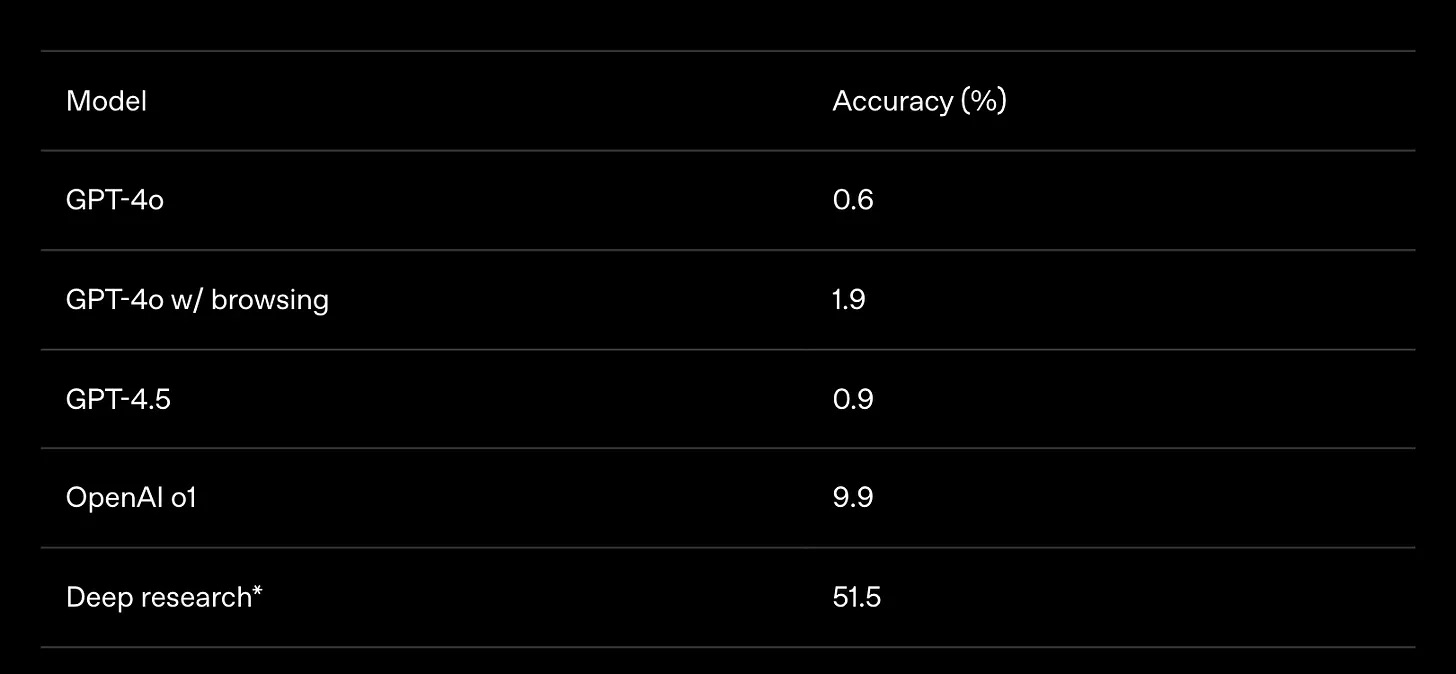
The test aimed to verify whether the system could find a hidden verifiable fact on the real internet and output it. All 1,266 questions have brief standard answers, and the model has only one chance to answer; matching earns a score, while non-matching does not. The final score equals the percentage of correctly answered questions out of the total number of questions. The 0.6% for the native GPT-4o indicates that the model can hardly obtain facts through its inherent memory; the 1.9% for the browsing-enabled GPT-4o suggests that the improvement brought by basic search tools is minimal; the 51.5% achieved by Deep Research shows a longer search-reading cycle, with about half the probability of finding the target fact.
In addition to BrowseComp, there are other evaluation sets: SimpleQA (OpenAI, 4,326 questions), a set of easily graded factual tests; as browsing tools sped up, SimpleQA's difficulty was easily overcome by the models, which is why BrowseComp emerged. GAIA (Meta / Hugging Face, 466 artificial tasks), aimed at real assistant scenarios, might require web browsing, tool invocation, reading documents, and multi-step reasoning, not just simple searches. DeepSearchQA is a multi-round research dataset, and Artificial Analysis will conduct comprehensive assessments based on that dataset. FRAMES (Google DeepMind, 824 samples), a multi-hop question set that requires extracting facts from multiple sources for integration.
The private institution Artificial Analysis was co-founded by George Cameron and Micah Hill-Smith, releasing the search index on August 18, 2026. This evaluation fixes the AI model and assessment rules used for answering, only changing the search API that the agent invokes. Changes in scores indicate that the difference comes from the search tool itself, rather than the model's capability.
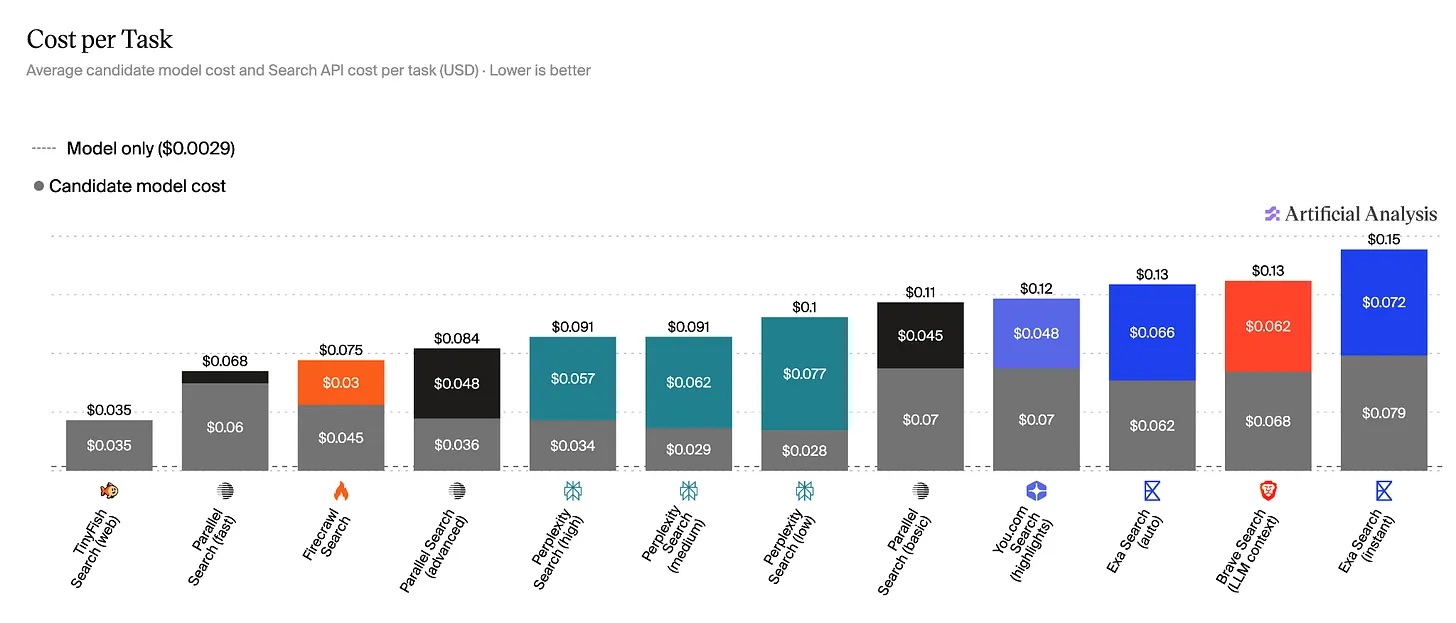
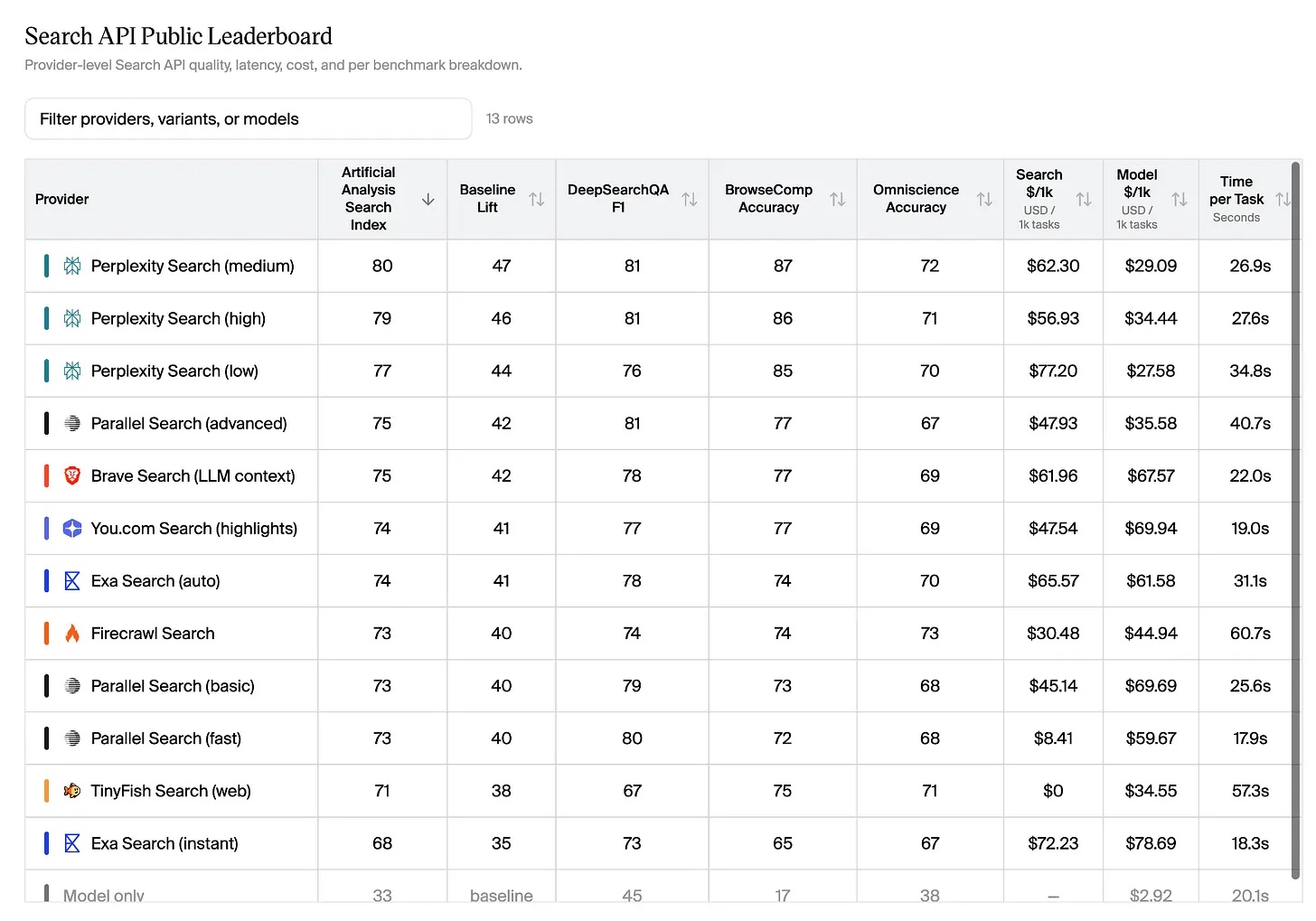
Source: @artificialanalysis
Without using search at all, the same model scored 33 in this index baseline, while the BrowseComp subset baseline score was 17. Even when the rankings of various search service providers change, the baseline scores have not changed.
As of August 27, the Artificial Analysis search index shows: the mid-range version of Perplexity scored 80, ranking first; Parallel's advanced tier and Brave both scored 75, tying for second; You.com and Exa scored 74; Firecrawl, Parallel’s basic version, and Parallel's high-speed version all scored 73.
If the search tool scores above baseline, it means the search has indeed helped the model obtain new information. The logic is as follows: if AI answers relying solely on memory, it receives the baseline score; if the score increases after accessing search, it indicates that the search found information the model originally did not know; if the score does not improve, the search did not work.
However, the evaluation itself has limitations: the test questions and the models used are not exclusive to business scenarios. Service providers can specifically optimize for known test sets (such as DeepSearchQA), similar to how websites previously optimized for Google SEO.
Who is the robot on the other side?
When two AI agents delegate work to each other, merely having a wallet address and a profile is insufficient to establish trust. A wallet address can only prove that the account has funds, and description texts can easily be forged, failing to prove the identity of the robot's developer or to verify the authenticity of its past work record. The ERC-8004 standard is designed to address the verification of agents' authentic identities and reputations.
ERC-8004 was co-authored by personnel from MetaMask, the Ethereum Foundation, Google, and Coinbase, and launched on the Ethereum mainnet on January 29, 2026, comprising three major registries.
First, the identity registry is realized in the form of an NFT. Each agent corresponds to a numbered token, and the token's uniform resource identifier points to a registration document that records the agent's name, service endpoints, whether it supports x402 payments, and which trust models it supports. The token holder is the owner of the agent; when the token's ownership is transferred, the old payment wallet information is cleared, and the new holder must re-sign to demonstrate control.
Second, the reputation registry receives signed feedback, constituting an on-chain public evaluation system. After using an agent, users can leave ratings on-chain, along with task labels (for example, search, scoring). The owner of the agent cannot write evaluations for themselves, and evaluations can be retracted. Anyone can add comments below the evaluations, with refund records and spam warnings possibly attached beside scores. This is a public comment area bound to the agent ID, not a private star system within a particular application.
Third, the verification registry integrates independent third-party verification. An agent initiates a verification request, and the verifier's smart contract returns a score from 0-100, along with a link to evidence; the sources of evidence may include task rerun results, zero-knowledge proofs, or proofs issued by security chips.
The specification itself does not handle payment logic, and this is clearly stated in the document. It only records the agent's identity, external evaluations, and third-party verification results; payments are handled by other protocols. The data quality of the registries is not ideal. According to 8004scan statistics from July, a total of 385,998 agents were registered across 29 public chains, with over 460,000 evaluations. The vast majority of IDs are merely empty badges; 89.2% have not publicly disclosed callable standard service interfaces; only 8,631 agents have available services, accounting for merely 2.24%.
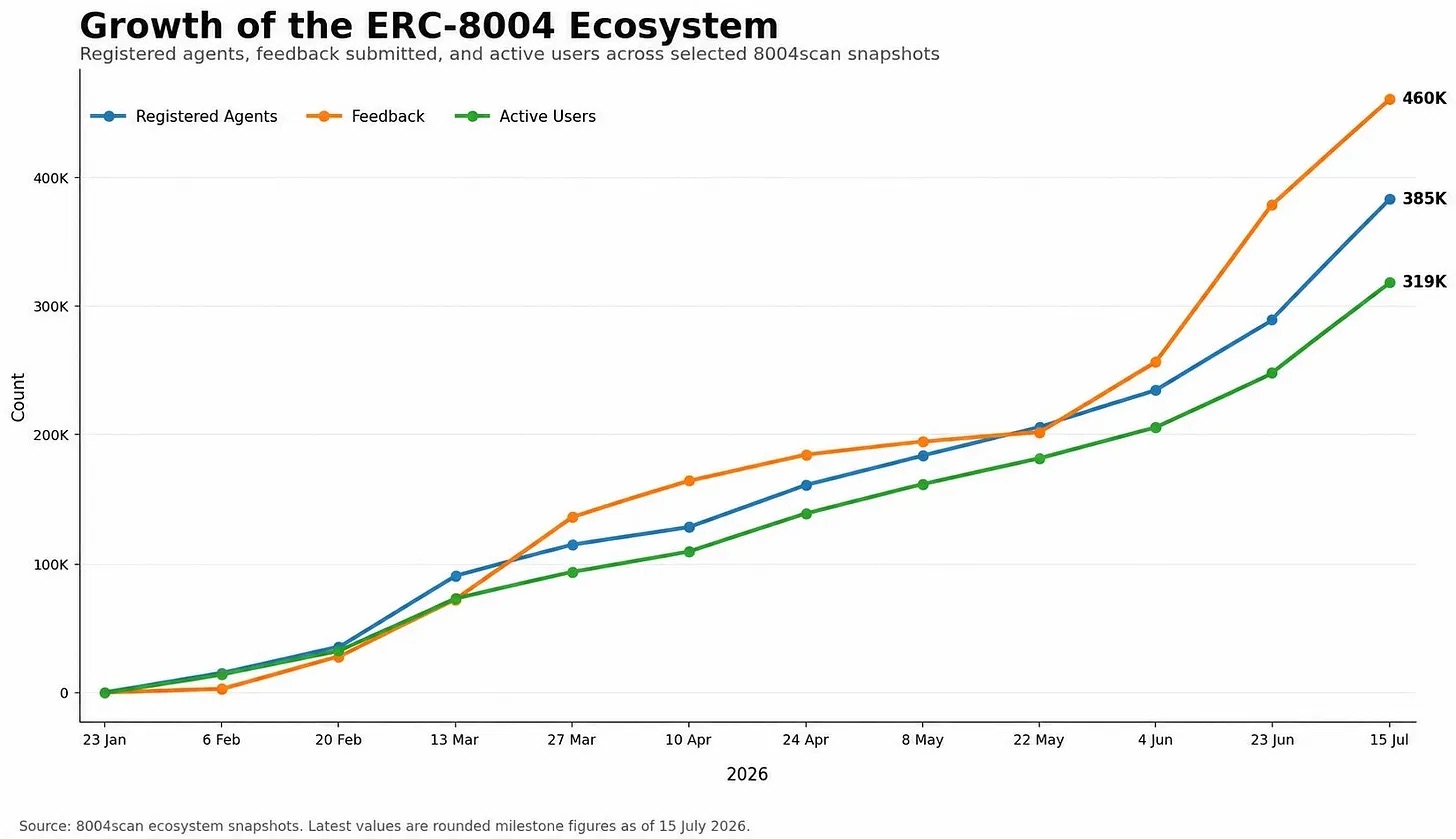
Source: @8004_scan
In May, a crawling survey regarding Ethereum, BNB Chain, and Base Chain found that on-chain ratings cannot be compared horizontally among different agents. Most feedback is not bound to any results that can be verified by anyone, and the cost of faking evaluations is very low. After filtering out suspicious reviews, a large number of agents that received ratings have no usable or effective evaluations left. The standard only unifies the output format of evaluation data, leaving the determination of what evaluations are genuine and trustworthy to external systems. ENS, EigenLayer, The Graph, and Taiko all indicated they would integrate this standard, but have yet to develop evaluation filtering tools.
Did the agents really complete the work?
The Agentic Commerce architecture, jointly designed by the Ethereum Foundation and Virtuals Protocol, aims to achieve mutual hiring and collaboration between autonomous AI agents with on-chain settlements, without human intermediaries throughout the process. ERC-8004, along with ERC-8183 (the custody standard), jointly implements this system. The ERC-8183 standardizes the entire process of task publishing, fund custody, result verification, and settlement between agents.
The workflow is as follows: the client agent initiating the task publishes the task, specifying the task description, deadline, budget, and designates an evaluator. The client deposits funds into a smart contract, locking the funds so that neither party can unilaterally access them.
The service-providing agent completes the computation offline and uploads the final results to decentralized storage like IPFS or Arweave, submitting only hashes or resource locators on-chain. The evaluator (which can be a dedicated judging agent, an automated oracle, or a zero-knowledge proof verifier) checks the delivered output.
If the evaluator determines that the task is completed, it processes the payment to the service provider after deducting fees; if it fails to pass, the funds are returned to the client. If the service provider goes offline, or if the evaluator stalls past the deadline, the contract will trigger an open refund logic, returning funds to the client to avoid permanent asset lock-up.
The evaluator can also be the client itself; the document presents this mode as the conventional option without third-party involvement. Meanwhile, it is stated in the specification: This agreement does not provide dispute resolution and arbitration mechanisms; refusal of results or timeout expiration is deemed final. If the scoring robot you choose maliciously deceives you, there are no administrators or customer service to appeal to. You are left in a helpless situation; moreover, regarding the earlier mentioned issue, you cannot rely on on-chain evaluations to select reliable evaluators, as most evaluations are false.
Systems like UMA, Kleros, and Bittensor can alleviate the single-point malicious risks of evaluators, but at the cost of speed and increased expenses. Pure automated custodial settlements can be completed in seconds with very low fees; whereas upgrading dispute processes through UMA or Kleros requires challenging windows, staking deposits, and involving human voting.
Has the fund transfer been completed?
Recently, there has been a lot of discussion in the industry about this, so let’s briefly elaborate.
x402, launched by Coinbase, is a layer built on existing public chains, charging based on requests and completing transfers using stablecoins.
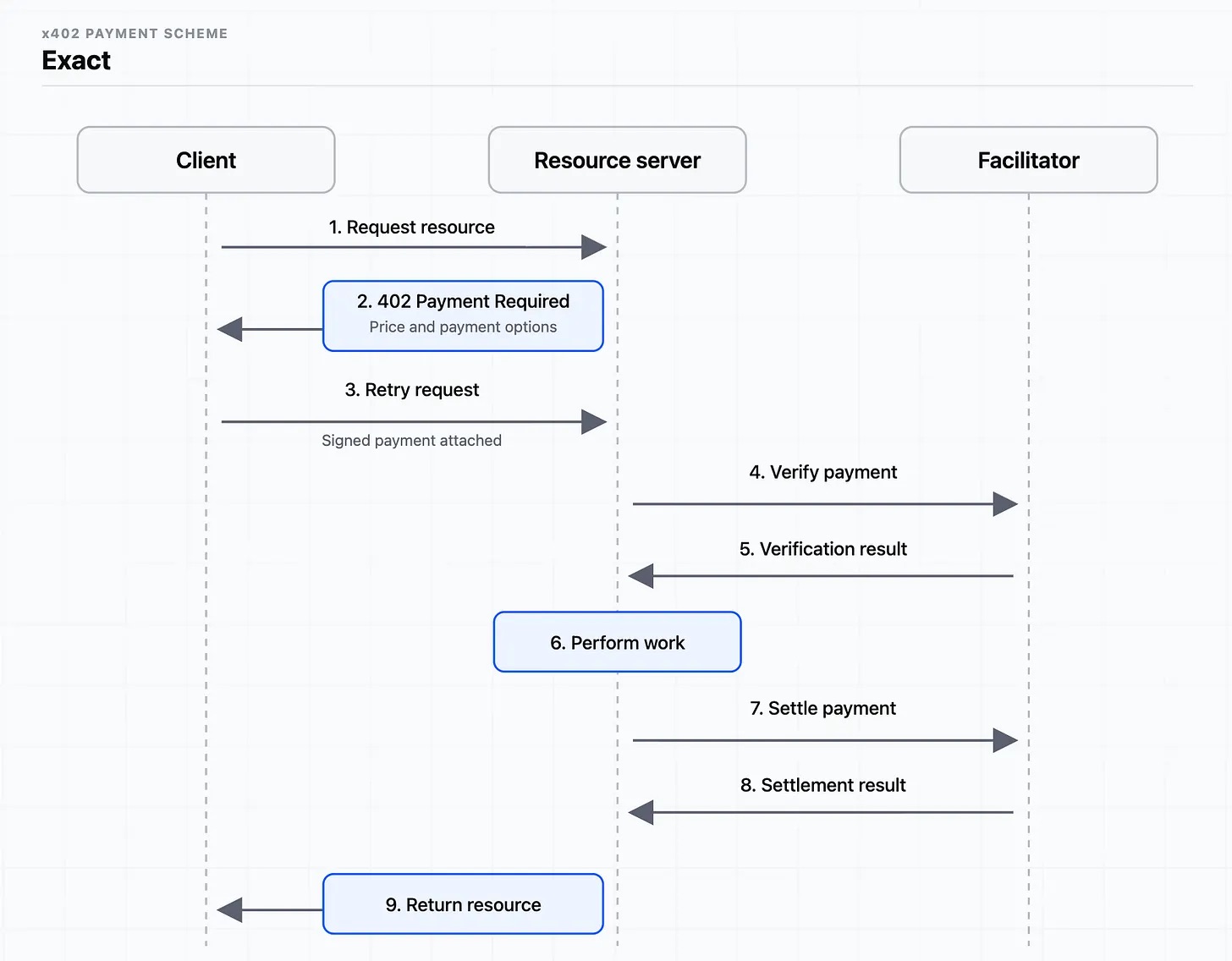
Source: @coinbase
Another set is the Machine Payment Protocol (MPP), jointly released by Stripe and Tempo in March 2026, with Tempo's mainnet officially going live on the same day. MPP is a set of HTTP standards. The server returns a 402 payment required response along with challenge information; the agent resubmits requests carrying payment proofs; the server then returns resources along with payment receipts.
The actual flow of funds depends on the underlying channels. A single transaction on the Tempo chain settles in about 0.5 seconds. In the face of a series of small calls, the agent can pre-lock a sum of money, continuously keeping track during the process, and finally unify on-chain settlement instead of initiating a chain transaction for each individual call. The payment limit is controlled by the locked amount for the current session or access key, rather than a “one-time authorization, perpetual deduction” model.
MPP supports various underlying channels: Visa has released card specifications, allowing agents to pay using tokenized cards; Lightspark implements a lightning network payment scheme based on the same 402 process, along with a Visa card plan. Merchants who have already integrated Stripe card payments can accept MPP card payments directly, with funds going into a regular Stripe account; the lightning network is another optional channel under the MPP rules. Stripe also supports x402. Both x402 and MPP utilize the HTTP 402 “payment required” status code, but the two belong to different protocols.
Are content creators getting paid?
If creators cannot earn money, there won’t be new content available for retrieval. If creators cannot profit, they will stop publishing their works, and AI agents will ultimately exhaust new reading material.
Cloudflare, Parallel, and OpenLedger are three representative projects in this field.
Cloudflare initially charged a fixed fee for crawling web pages, which was too crude, as crawling the homepage and comprehensive investigative reporting incurred the same charges. Now, Cloudflare has shifted to a value-based billing model: payment is only settled to publishers when content genuinely provides value. Additionally, for sites that earn from advertisements, if AI service providers refuse to pay, Cloudflare will block AI crawlers.
Parallel launched its Index product on May 19, drawing from the Shapley value algorithm in cooperative game theory to calculate each information source's contribution to the agent's ultimate task result, thereby completing revenue sharing. Payment is no longer uniform per click but is assessed through a mathematical model regarding a single article's actual contribution to the task. Cooperative partners include The Atlantic, Fortune, PR Newswire, PitchBook, ZoomInfo, Tracxn, RocketReach, Enigma, and Fiscal AI.
Currently, Index will settle only when agents use Parallel's proprietary search tool. Unless all other AI platforms integrate, it cannot become a universally applicable standard.
OpenLedger is another scheme that utilizes a token system. It assesses the degree of impact of datasets on AI models and rewards contributors with its native tokens. This scheme targets developers of AI training data rather than compensating journalists for their regular articles.
I attempted to find real monetary data on how much these projects actually paid to creators. Cloudflare has not disclosed payout figures; Parallel has also not revealed; OpenLedger settles with OPEN tokens but has not publicly disclosed independent total payout amounts. Therefore, at present, we do not have definitive facts to evaluate the actual effectiveness of this mechanism.
In the history of human commercial development, cash registers were actually a late invention. Humans spent many years establishing verbal agreements and local reputation systems before inventing low-friction payments. The developmental path of machine internet is completely reversed: it has achieved instantaneous, streaming global settlement since its inception. Now the agent economy is frantically trying to establish on-chain small dispute courts to prevent two robots from defrauding each other over a few dollars' worth of tasks.
In conclusion, I quote a passage from Terry Pratchett:
“Talking endlessly about pure logic and saying that machines merely execute the commands received may sound easy. But people are entitled to expect that machines should have a little common sense.”
免责声明:本文章仅代表作者个人观点,不代表本平台的立场和观点。本文章仅供信息分享,不构成对任何人的任何投资建议。用户与作者之间的任何争议,与本平台无关。如网页中刊载的文章或图片涉及侵权,请提供相关的权利证明和身份证明发送邮件到support@aicoin.com,本平台相关工作人员将会进行核查。


