In August, Bitcoin experienced an unexpectedly strong market trend, with monthly gains exceeding 24%, creating a remarkably impressive single-month performance in recent years. More noteworthy is that despite the escalating tensions between the U.S. and Iran, oil prices surpassing $90, and traditional risk assets being under pressure, BTC did not follow the market in showing significant weakness; instead, it fluctuated around $78,000.
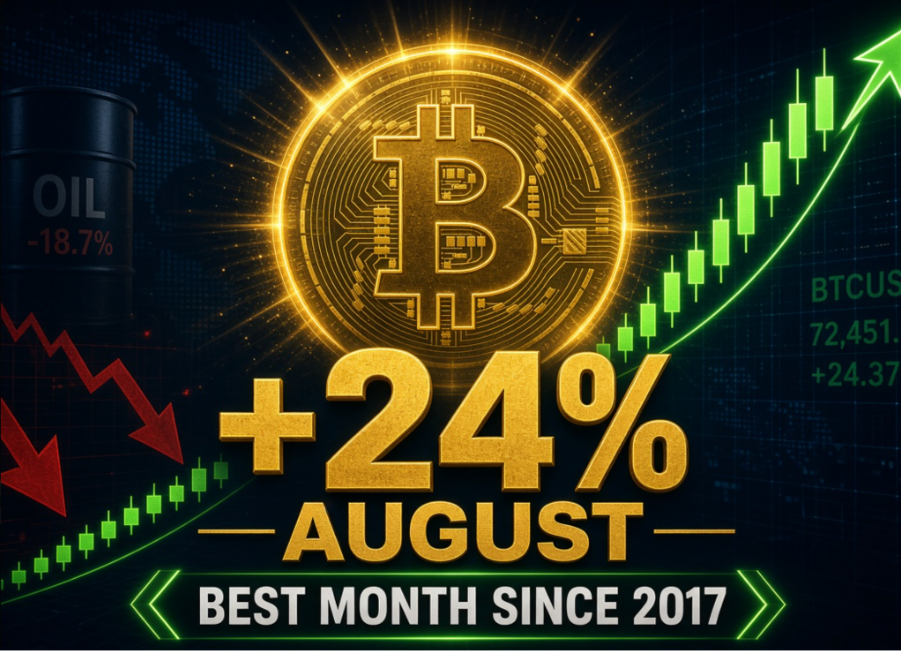
This time, Bitcoin's strength is no longer merely a "risk asset rebound."
From short-seller liquidations to ETF funds, and to institutions continuously accumulating coins, multiple financial forces are collectively reinforcing Bitcoin's narrative as an institutional asset.
And the question that the market is truly focusing on has shifted to:
Is this increase the beginning of a new trend, or is it a phase of adjustment after a strong market?
How strong was Bitcoin in August?
The BTC market in August can be summarized in one word:
Strong.
- Monthly gains: Over 24%
- Price performance: Gradually rising from low points at the beginning of the month, briefly surpassing $81,000, and fluctuating back to around $77,000-$79,000 by month's end
- Relative performance: Clearly outperformed some traditional risk assets during the same period
From the perspective of asset performance, Bitcoin's advantages are becoming more evident.
Amidst heightened geopolitical tensions, rapid increases in energy prices, and suppressed global risk appetite, BTC not only avoided a significant safe-haven sell-off but also maintained strong price resilience.
This suggests that the market's pricing logic for Bitcoin may be changing.
In the past, BTC was often viewed as a "high-volatility risk asset"; however, as ETF, institutional funds, and corporate holdings continue to increase, the narrative of "digital gold" and institutional allocation assets is regaining market attention.
Where did this round of increases come from?
The August market was not driven by any single factor.
From the market structure perspective, it looks more like a rise driven by liquidation, capital, and institutional narratives.
1. Short-seller liquidations provided the first "fuel" for the rise
In the early stages of the market launch, short positions were relatively concentrated.
As BTC quickly broke through key price ranges, some leveraged shorts were forced to liquidate, further pushing prices up.
This price increase then triggered more short-stop losses and liquidations, forming a classic:
Price increase → Short covering → Increased buying → Further price increases
This positive feedback mechanism significantly accelerated the market in a short period.
In other words, some of the rise did not come from new long-term capital, but from buying pressure generated by passive liquidation of leveraged positions.
2. ETF funds are becoming an important source of incremental capital for BTC
Compared to the past where the market relied solely on retail sentiment to drive trends, one of the biggest changes in the BTC market today is that institutional capital is increasingly deeply involved.
During August, BTC spot ETFs maintained strong capital attractiveness overall.
Though the end of the month saw a temporary weakening in ETF funds, including instances of net outflows, in the longer term, ETFs still provide important capital access for BTC.
Meanwhile, institutional products related to Ethereum and other cryptocurrency assets also garnered attention.
This signals a change:
Institutions have not left the crypto market; rather, they are seeking new allocation opportunities across different assets.
3. Improved liquidity expectations provide breathing room for risk assets
In August, market discussions about the U.S. liquidity environment notably intensified.
Actions by the U.S. Treasury and the market's re-pricing of liquidity temporarily alleviated investor concerns regarding persistent liquidity tightening.
Despite some Fed officials signaling a hawkish stance and the market wavering on interest rate expectations, overall, macro liquidity expectations did not deteriorate further.
For BTC, this environment means:
As long as liquidity expectations do not continue to worsen, there is room for capital to return to high-volatility assets.
4. Corporate accumulation of coins is reawakening, reinforcing long-term institutional narratives
Another noteworthy change is the increased activity in corporate Bitcoin allocations.
Strategy resumed buying BTC after a two-month hiatus, and companies like Strive continue to increase their positions.
The significance of this behavior is not just "how many BTC were bought."
More importantly, it further strengthens a market consensus that is forming:
More and more companies are beginning to view BTC as a long-term asset allocation rather than merely a trading target.
As ETFs and publicly listed companies become significant holders of BTC, Bitcoin's capital structure is also changing.

Why didn't BTC drop significantly when oil prices broke $90?
This may be the most noteworthy aspect of the August market.
The logic of traditional markets is not particularly complicated:
Geopolitical conflict escalates → Oil rises → Inflation pressure increases → Interest rate cut expectations are suppressed → Risk assets come under pressure.
But BTC's performance did not completely follow this pathway.
When oil prices rose rapidly and some traditional risk assets came under pressure, Bitcoin remained at relatively high levels.
This does not mean BTC has completely detached from its risk asset attributes.
More accurately:
The market is beginning to give BTC more "independent pricing" space.
ETF funds, corporate accumulation, and long-term institutional allocations have made BTC's buying structure distinctly different from the past.
Therefore, when also facing macro risk shocks, BTC is no longer merely passively following fluctuations in the U.S. stock market.
This relative resilience may indeed be the true signal worth paying attention to in the August market.
But don't be too optimistic: there are several hidden worries with the August rise
A strong market does not mean that risks have vanished.
On the contrary, after experiencing over 24% in monthly gains, BTC may face even greater pressures in September.
① Spot trading volume did not completely keep pace
Prices surged rapidly, but spot trading volumes did not exhibit a corresponding explosion.
This suggests that some of the increase may still be driven by leveraged funds and position adjustments.
If there is no new spot capital to take over afterwards, the sustainability of the trend will need further observation.
② $80,000 remains a key psychological level
$80,000 has become a crucial battleground in the current market.
After multiple attempts, if it cannot effectively stabilize, it indicates that there are still significant profit-taking and selling pressures above.
Conversely, if BTC can break through and confirm support above the $80,000 level, market sentiment may strengthen further.
③ September macro data may re-emerge as the main focus
Entering September, the market's attention will shift back to U.S. employment, inflation, and Fed policy paths.
If macro data shows renewed signs of strong economic resilience, market expectations for accommodative policies may cool.
For BTC, which has risen more than 24%, a weakening of macro expectations could significantly amplify short-term volatility.
④ ETF funds are beginning to show divergence
By the end of August, BTC spot ETF funds experienced a phase of outflow, while some other crypto asset products maintained capital attractiveness.
This means institutional funds are not simply "buying BTC across the board," but are reallocating between different assets.
This is also a key funding signal to monitor in September.
What to focus on in September?
Rather than guessing Bitcoin's next target price, the more worthwhile focus is on several key variables.
First, see if $80,000 can truly stabilize.
Breaking through is not difficult; the challenge is forming new support after the break.
Second, see if ETF funds can flow back in.
If ETFs show sustained net inflow again, it indicates institutional buying pressure still exists, and the market's bottom support will be stronger.
Third, check if spot trading volume can expand.
If prices continue to rise while spot trading volume simultaneously increases, the credibility of this market trend will significantly improve.
Fourth, observe if corporate coin accumulation continues.
ETFs represent the allocation demands of financial institutions, while continuous purchases by corporations signify another type of long-term capital entering the market.
Fifth, monitor if the macro environment turns back.
September's employment, inflation, and Fed policy expectations all could become important variables influencing BTC's next stage of movement.
August proved resilience; September determines the quality of this rise
August's Bitcoin left the market with a signal that merits significant attention:
When traditional markets were impacted by geopolitical risks and rising oil prices, BTC did not exhibit the obvious weakness it used to.
The over 24% monthly gain was driven by short-seller liquidations providing short-term push and structural support from ETF funds and corporate accumulation.
However, at the same time, insufficient volume, repeated struggles at the $80,000 mark, and the phased weakening of ETF funds also remind the market:
Strength does not equate to a confirmed trend.
If in September BTC can break through $80,000 with volume and ETF funds start flowing in consistently, the increase in August may simply have been an acceleration within a larger trend.
Conversely, if prices consistently fail to breach key resistance while capital and volume continue to cool, then the surge in August might usher in a wave of profit-taking.
In August, BTC proved its relative resilience.
In September, the market will look to see if this resilience can translate into a genuine trend.
Data as of the end of August 2026 public market performance, for reference only, does not constitute investment advice.
免责声明:本文章仅代表作者个人观点,不代表本平台的立场和观点。本文章仅供信息分享,不构成对任何人的任何投资建议。用户与作者之间的任何争议,与本平台无关。如网页中刊载的文章或图片涉及侵权,请提供相关的权利证明和身份证明发送邮件到support@aicoin.com,本平台相关工作人员将会进行核查。