Written by: Minara AI
Translated by: Luffy, Foresight News
In the past week, we researched the Hyperliquid trading leaderboard to answer one question: What is the most frequently occurring trading strategy among accounts that actually make a profit?
The answer is far from the simple notion of "buying quality coins early." Among the 12 top accounts we selected, the most mainstream pattern leans toward a complete trading system: 8 accounts belong to high-turnover, two-way executing traders; 3 are active day traders / ultra-short-term traders; and only 1 belongs to a one-sided heavy position trend trader.
Signals with real reference value come from the complete behavioral characteristics of addresses in the market: trading rhythm, balance of long and short trades, turnover rates, position concentration, selection of trading targets, and the level of returns that can be generated per unit of risk.
Filtering process: From 43,618 addresses, we identified 1,681 candidate addresses that met the criteria.
The entire filtering process is divided into 5 steps:
- Export complete leaderboard CSV data. Import all 43,618 account records, including address, ranking, nickname, account net worth, as well as 1-day, 1-week, 1-month, overall profit and loss, returns, and total trading volume, using a complete snapshot sample rather than manually selecting small samples.
- Eliminate low-quality samples. Retain accounts that meet all of the following conditions: account net worth of no less than $10,000, overall profit and loss and return are positive, historical cumulative trading volume ≥ $1 million, monthly trading volume ≥ $100,000. Filter out accounts that make high returns with small capital, long-dormant wallets, and one-time lucky profit accounts.
- Validate recent performance sustainability. Compare account profit and loss and return across four time dimensions: 1-day, 1-week, 1-month, and overall period, focusing on weekly and monthly performance. Even if historical performance is impressive, if recent profitability is no longer present, it will not be retained.
- Construct a comprehensive robust scoring system. Score each address based on overall profit and loss, overall return, account net worth, cumulative trading volume, monthly trading volume, and the number of recent profitable periods. Multi-indicator weighted evaluations can avoid data distortion issues arising from a single ranking dimension.
- Determine trading strategies based on transaction details. For high-scoring top accounts, retrieve Hyperliquid’s public transaction records; analyze their trading targets, trading frequency, whether they execute buy and sell operations simultaneously, nominal transaction scale, and trading concentration, with the analysis no longer limited to "who made money," but deeply exploring "how they profit."
Through this filtering mechanism, we ultimately obtained 1,681 profitable candidate accounts, from which we selected 12 high-scoring addresses for in-depth analysis of transaction details.
This research method serves only as an approximate inference. The CSV file only provides snapshot data for different periods, not a complete daily net worth curve. We cannot prove that a particular account can smoothly compound returns for an entire year. However, compared to relying solely on leaderboard rankings, the filtering criteria are more stringent: positive profit and loss, positive returns, sufficient account capital, effective trading volume, enduring profitability, along with observable real trading behavior.
The strategy distribution of the 12 accounts is 8-3-1. A more critical point is that the differences among the three types of strategies are not merely in trading speeds; their underlying logic for profitability is entirely different.
First Category: High Turnover, Two-Way Executing Trading (8 addresses)
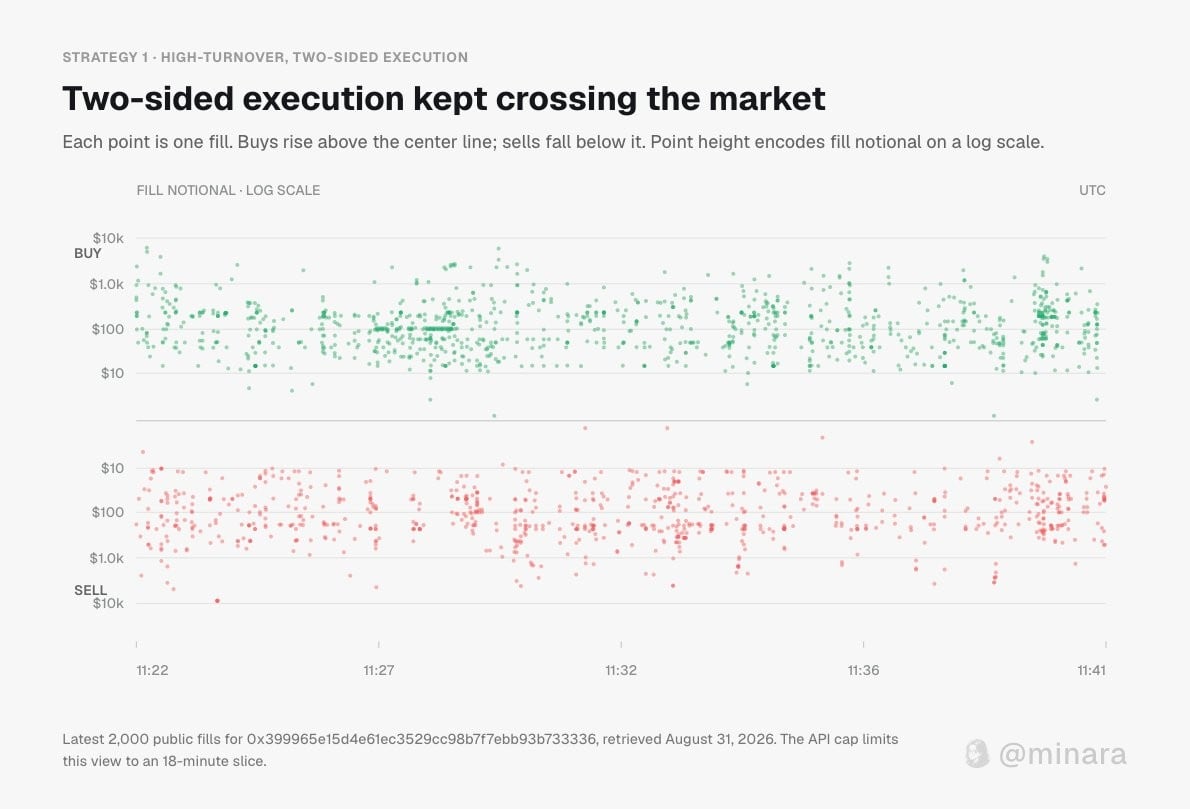
The 8 accounts produced a total of 16,000 transaction records, with a total nominal transaction amount of $51.37 million. The overall order flow is almost perfectly balanced: buy transactions account for 49.4%, while sell transactions account for 50.6%.
In the sampled transaction segments, 6 of the 8 accounts ended with a positive net profit, realizing a total net profit of $156,464.
These data represent a strategy centered around trading volume: the profit per transaction is minimal relative to the transaction size, but the account executes this trading logic thousands of times. This type of strategy does not rely on significant market fluctuations; it only needs to maintain a slight execution advantage through numerous trades.
Based solely on public transaction records, we cannot confirm that these addresses are market makers. The study cannot obtain order book records, identities of takers/makers, complete inventory positions, or hedging operations in other markets. However, the observable trading behavior corresponds with the following characteristics of various trading methods:
- Simultaneously quoting on both sides in the market and executing two-way trades;
- Catching tiny bid-ask spreads or brief price deviations;
- Timely reducing positions after short-term unilateral trends;
- Short-term mean-reversion trading;
- Cross-asset and cross-market hedging operations.
We selected 3 addresses to demonstrate the different variants of this operational model:
- 0xe4c6ae25959d7fc66cf2dd5965fb78c5e09c4048 returned 2,000 transaction records, with a total nominal transaction amount of $24.92 million and a net profit of $113,079, with a return of 45.4 basis points. Bitcoin accounted for 69.2% of the observed transaction amount, with buy transactions making up 56.7%. This account favors executing large order trading strategies in the most liquid markets.
- 0x523852be2db1a76a0e088ecbff32e849544054e5 (account name perpfumbler) uses the same high turnover pattern covering multiple targets including Bitcoin, S&P 500 index contracts, HYPE, and XYZ100 index contracts. The sampled nominal transaction scale is $12.27 million, with a net profit of $28,864 and a return of 23.5 basis points, with buy transactions making up 43.4%. This account does not bet on the rise and fall logic of a single asset but reuses this high-frequency turnover trading model across multiple markets.
- 0x399965e15d4e61ec3529cc98b7f7ebb93b733336 is the fastest sample account. The time span for returning 2,000 transaction records is only about 20 minutes, with a median interval between transactions of 0.21 seconds; buy transactions account for 49.85%, while sell transactions account for 50.15%. The sampled nominal amount is $1.44 million, netting a profit of $2,187 and a return of 15.2 basis points.
The three accounts exhibit differences in trading varieties and order sizes, but their underlying profit logic is highly consistent: seeking tiny trading advantages, strictly controlling positions to enable two-way trading, and continuously repeating execution.
Second Category: Active Day Trading and Ultra-Short-Term Trading (3 addresses)
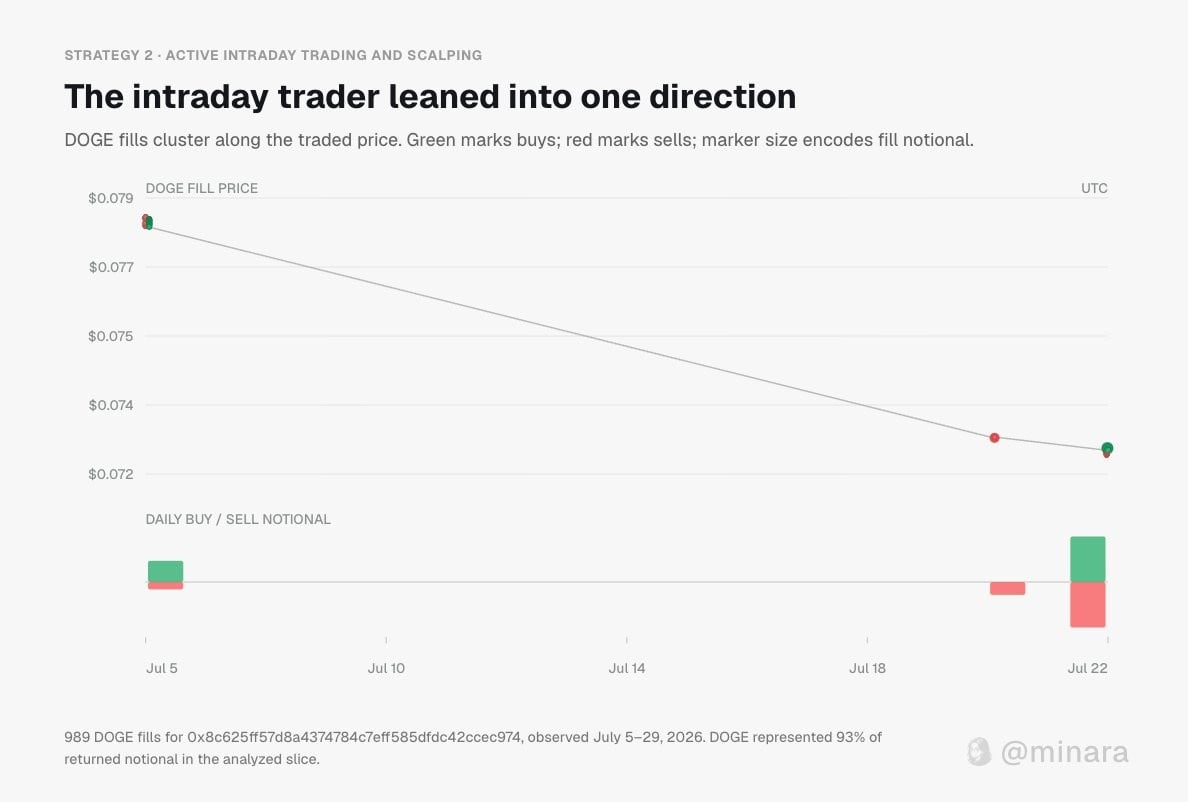
The 3 accounts also trade frequently, but do not exhibit balanced two-sided characteristics. The order flow is noticeably biased toward one side, and profit and loss performance relies more on short-term price fluctuations.
The 3 accounts collectively returned 5,071 transaction records, with a total nominal transaction amount of $15.35 million, and the weighted buy ratio reached 70.1%. Although these three accounts achieved a total of $61.43 million in overall profitability on the leaderboard, the sampled transaction segments all resulted in negative net profits.
This data contrast is crucial: the accounts are overall profitable, but recent sampled transactions have not continuously and steadily profited as the two-sided trading group did; instead, profits manifest characteristics of periodic explosive phases. Unilateral day traders may incur losses during a trend, then recover profits based on subsequent price movements; meanwhile, strategies similar to market making will have earnings evenly dispersed across each turnover trade.
The three accounts exhibit different characteristics of day trading:
- 0x8c625ff57d8a4374784c7eff585dfdc42ccec974 shows a high concentration of trading targets in DOGE, with DOGE accounting for 93.0% of the sampled transaction amount. It returned 1,071 transaction records over 23.35 days, with a buy ratio of 30.1% and sell ratio of 69.9%. This account does not lean toward neutral liquidity provision but seems to repeatedly execute unilateral trend trades within a single high-volatility target.
- 0x77375a8c9d13bf79afb2a87f1b0ac1dfd5f5bf66 includes assets such as ETH, SOL, PUMP, and BTC, but 94.7% of the sampled transaction records are buy orders. The nominal transaction scale is $14.09 million, with segment closing losses of $142,648, while the account’s overall profitability reached as high as $47.06 million. This observation could represent a round of aggressive chip accumulation behavior, external hedging positions, or a loss branch within the overall profitability strategy.
- 0xc926ddba8b7617dbc65712f20cf8e1b58b8598d3 has smaller individual transaction amounts, with an average of about $161 per transaction. In the 2,000 returned transaction records, buys accounted for 67.1%, and the trading pattern belongs to rapid short-term or short-sided trend systems; this sampled segment incurred a loss of $14,572.
The common feature of this group of accounts is not merely high-frequency trading; rather, it is high-frequency trading combined with unilateral position imbalance. This strategy requires both trading execution advantages and must rely on price movements to generate market fluctuations.
Third Category: Heavy One-Sided Trend Trading (1 address)
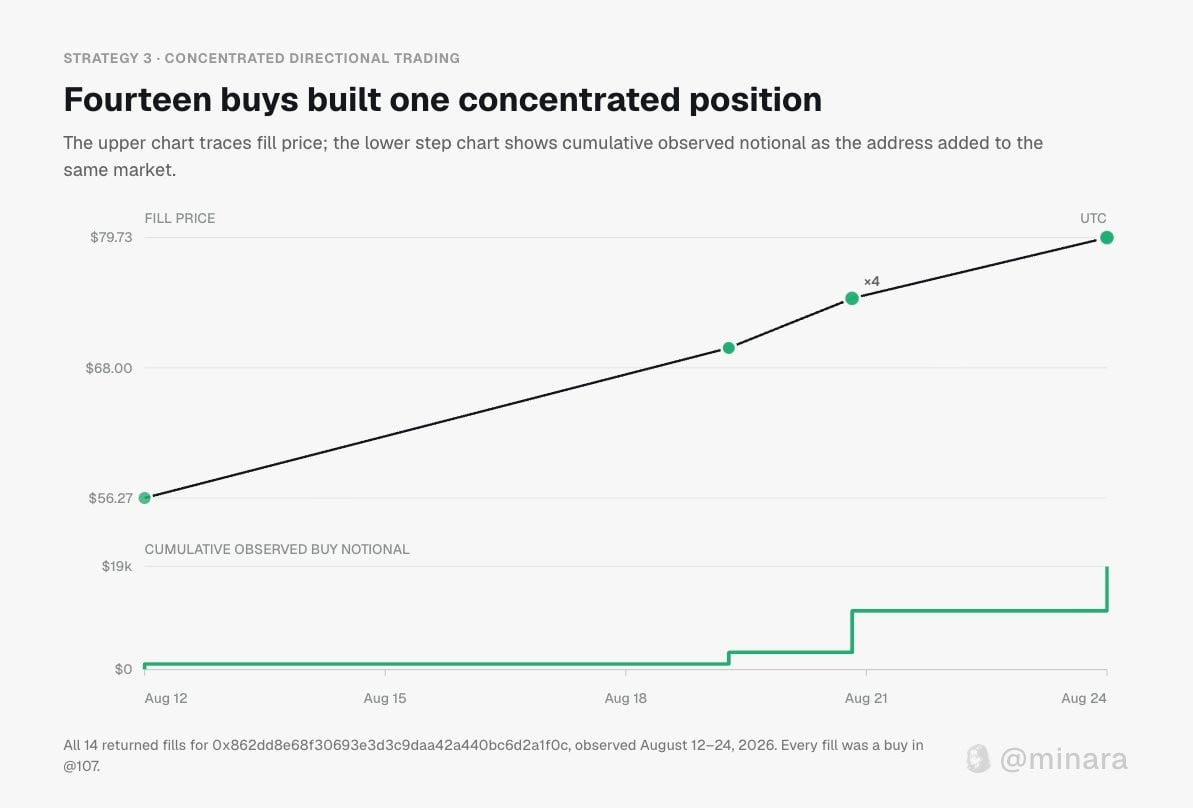
Among the 12 accounts, only 1 address belongs to the heavy one-sided trading type.
0x862dd8e68f30693e3d3c9daa42a440bc6d2a1f0c returned only 14 transaction records over a period of 12.05 days, with all transactions being buy orders for the same target. The observed nominal transaction amount is $18,504, and there was no realized profit or loss from this segment.
This account achieved an overall profit of $6.45 million, but public transaction data cannot prove that this long-term profit comes from these 14 trade orders. Observable behavior can only indicate that during the sampling period, this account continuously accumulated heavy positions rather than engaging in rolling trades around short-term inventory.
From the transaction data, one-sided trend strategies exhibit these characteristics: low trading frequency, one-directional opening, a high concentration of targets, and profitability relying on subsequent price increases being realized rather than profiting through frequent turnover.
Although this type of strategy can generate massive profits, it is a minority among this batch of top accounts that balance profit stability, capital volume, and trading activity.
Selection of Targets Serves Trading Strategies
These profitable accounts do not prefer any single cryptocurrency; market selection entirely depends on the trading advantages the traders wish to capture.
BTC, ETH, and SOL account for a significant portion of the observed nominal transaction amounts: these markets can accommodate large orders, have ample liquidity, and facilitate rapid opening and closing. HYPE, PUMP, xyz:SKHY, and xyz:CRCL have a relatively higher count of transactions compared to their transaction amount, representing smaller individual orders and faster capital turnover.
The difference is stark; the average transaction size for BTC is about 8 times that of HYPE; S&P 500 contracts have the highest average transaction size, while xyz:CRCL has a low average transaction size.
For the high-turnover two-way trading group, Bitcoin's transaction volume is $21.66 million, followed by ETH, S&P 500 contracts, HYPE, xyz:SKHY, and xyz:CRCL. These types of accounts will take large orders in major cryptocurrencies while seeking more concentrated short-term trading opportunities in smaller coins.
The day trading group has a greater concentration in ETH, SOL, PUMP, BTC, and DOGE; the asset mix aligns with the need to capture short-term trends and volatility, rather than purely pursuing market depth.
The truly valuable conclusion of this research is not that profitable accounts all prefer Bitcoin, but that the selection of currencies itself is part of strategy design: volume trading strategies require sufficient liquidity; short-term strategies need enough price volatility; one-sided heavy position strategies only need the trader to have strong confidence in price judgments in a single market.
True Commonality Among Profitable Accounts
The long and short judgments of the 12 leading accounts vary, with different trading targets and completely different trading time periods.
The core factor that really differentiates profit margins is the way in which profits are generated. Two-sided trading accounts earn approximately 30.5 basis points of thin profit through a trading volume scale of $51.37 million; their trading advantages are small, repeatable, and depend on systematic execution. Day traders accept higher unilateral exposure, with greater short-term profit fluctuations and erratic profit and loss results. The last category of accounts concentrates all risk in a single market, patiently waiting for the market to realize profits.
Thus, the most mainstream strategy among these profitable accounts is not simple high-frequency trading. Rather, it is a high-turnover, two-way executing trading system that obtains small trading advantages by managing position sizes through thousands of transactions.
This also means that merely copying trades is not very meaningful; holding positions is just one output of a trading system, while a truly complete strategy is hidden in the trading rhythm, balance of buying and selling, order sizes, market choices, capital turnover rates, and the entirety of risk cycle management.
免责声明:本文章仅代表作者个人观点,不代表本平台的立场和观点。本文章仅供信息分享,不构成对任何人的任何投资建议。用户与作者之间的任何争议,与本平台无关。如网页中刊载的文章或图片涉及侵权,请提供相关的权利证明和身份证明发送邮件到support@aicoin.com,本平台相关工作人员将会进行核查。


