Original | Odaily Planet Daily (@OdailyChina)
Author|Azuma (@azuma_eth)

On August 30, the largest lending protocol in the Crypto.com affiliated blockchain Cronos ecosystem, Tectonic, was attacked by hackers.
The attack itself was not particularly complex; the attackers inflated the price of Tectonic's governance token TONIC, which had very low liquidity, by about 100 times within approximately 20 minutes. They then used these inflated TONIC tokens as collateral to borrow other assets from Tectonic, involving an amount of approximately $75 million, of which about $6 million has been cross-chained to Ethereum.
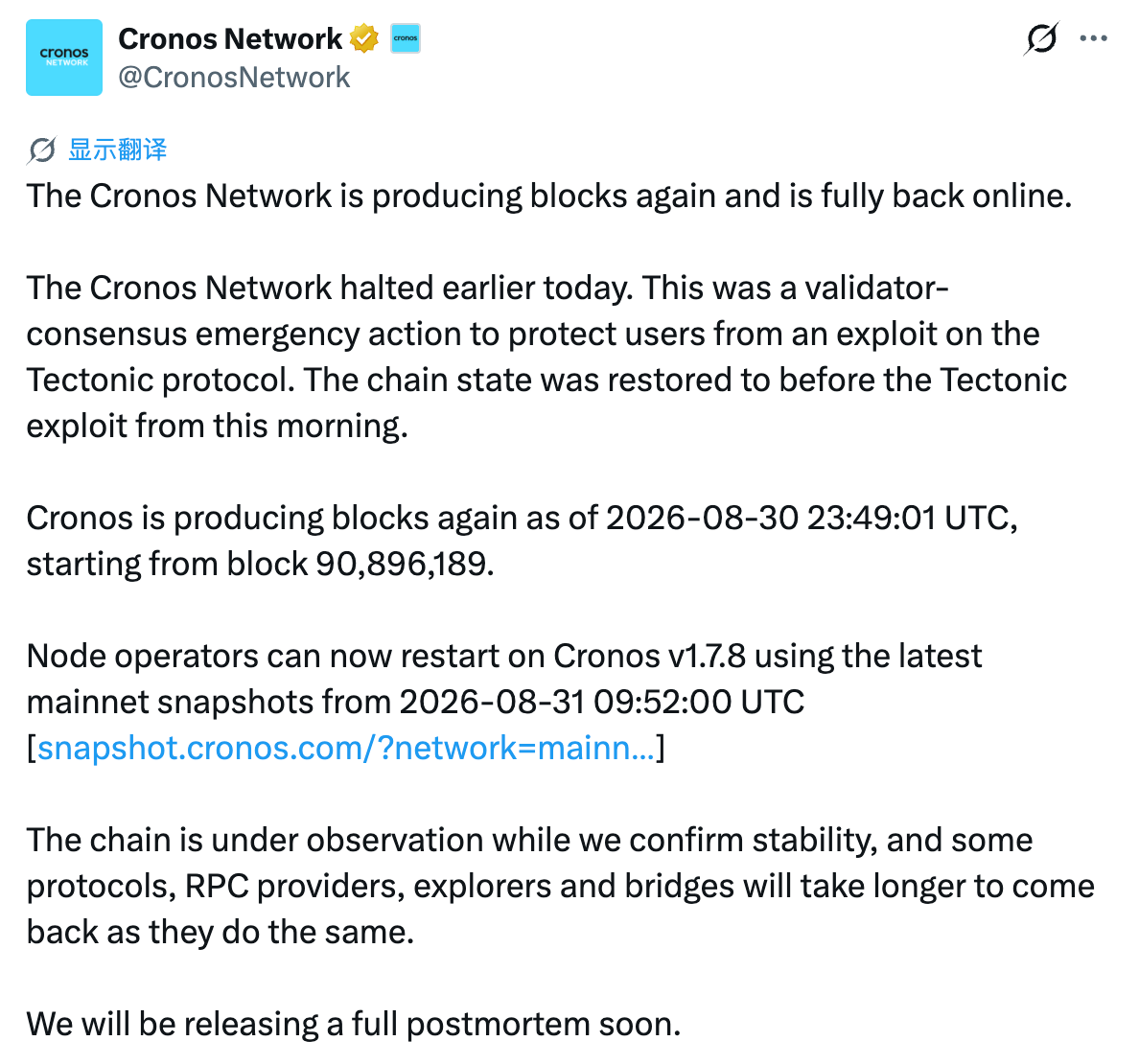
More dramatic than the attack method was Cronos's handling plan. After the attack occurred, Cronos first suspended the network on the evening of August 30 (as if it had just identified the issue), blocking the outflow of other illicit funds; then on August 31, they announced a network restart plan, stating that they would roll back the chain state to before the theft on August 30, restarting the network from block height 90896189.
Huge Controversy Over Rollback
The so-called blockchain rollback can simply be understood as "reading the network state" back to a certain point in the past, meaning that any transactions, fund transfers, and smart contract operations occurring afterward will, in principle, disappear from the new chain history.
This was also Cronos's choice. From the result standpoint, this was indeed the most convenient and potentially the most effective solution. When the attack occurred, approximately $75 million in assets were affected, but before Cronos suspended the chain, only about $6 million successfully escaped through cross-chain. The remaining majority was still on the Cronos chain. Since the money hadn't run away yet, they decided to directly delete the on-chain history following the attack — theoretically, the majority of the losses would then be gone.
From the perspective of protecting user funds, Cronos's choice is hard to argue against. If they hadn't done this, they might have been helplessly watching the attackers transfer funds layer by layer, and how much could be recovered by the security team following, freezing, and negotiating would rely entirely on luck.
Of course, the cost of the rollback is also quite apparent. The attackers' transactions can disappear, but the normal transfers, trades, and settlements of regular users during this time will also vanish. In this incident, the Cronos network restarted from block height 90896189, but just before the suspension, the network had reached block height 90907150, leaving a gap of 10,961 blocks — this also means that all normal transactions conducted within these more than ten thousand blocks have been canceled.
Taking an extreme example, if you happened to be using the Cronos network for a transfer during this period (for instance, A was paying B an amount of money on-chain in exchange for B's goods or services), then as the rollback was executed, the original payment transaction would be canceled, leading to the extreme situation where the goods have been delivered but the payment has disappeared.
The greater controversy lies in the "finality of transactions". The reason why blockchain can be utilized as a value settlement network is significantly due to the fact that once a transaction has received enough confirmations, participants believe that the transaction is irreversible — the money you received truly belongs to you, and the payment I completed won't suddenly disappear hours later.
Cronos's operation this time undoubtedly undermines its "transaction finality"; as long as a sufficiently severe incident occurs, transactions that have already been finally confirmed may not actually be final.
Of course, choosing a rollback in extreme situations is not without precedent; there have been public chains in the past that modified chain states through community coordination following major security events. But the problem is, once this door is opened, it becomes challenging to avoid the question: if $75 million is worth rolling back, then what about $50 million? $10 million? Or, apart from hacker attacks, what kind of events would be sufficient to prompt validators to press the "read file" button again?
This is precisely where the largest controversy of rollback lies. It can indeed solve problems in the present, but also makes every blockchain participant realize - the so-called immutability is not an absolute rule of Cronos.
This Is Not Cronos's First Time "Modifying History"
If this rollback can still be explained with "special circumstances, special treatment", then looking a year back, Cronos's attitude towards history can actually be traced.
In 2021, Crypto.com boldly announced the destruction of 70 billion CRO, significantly reducing the total supply from 100 billion to around 30 billion. This destruction was considered one of the largest token burns in cryptocurrency history at the time.
Then in 2025, Cronos proposed a rather straightforward plan to re-mint the already burned 70 billion CRO and redistribute it to strategic reserves, restoring the total supply of CRO back to 100 billion. The official rationale at that time was "to reshape the golden era of Cronos, substantial funds would need to be invested to support the Cronos roadmap," including driving expansion into the U.S. market, supporting ecological development, institutional progress, and potential CRO ETF, among others.
This decision sparked considerable controversy at the time. After all, when the tokens were originally destroyed, it was explicitly stated as a "permanent destruction," and who would have thought that years later, there would be a "re-minting process." More dramatically, despite the community's strong opposition, the voting was reversed just before the poll closed due to concentrated voting by large holders, ultimately allowing the proposal to pass.
- Odaily Note: Refer to "CRO's most absurd governance farce unfolds, with 70 billion tokens magically minted".
Cronos's "Single Player Philosophy"
Looking at these two events together reflects Cronos's unique style. 70 billion CRO burned? No problem, re-mint. $75 million stolen? No problem, rollback.
The first changes the supply, and the latter alters the on-chain state. One allows already "permanently destroyed" tokens to reappear; the other makes transactions that have already occurred, or even been confirmed, vanish from history.
Cronos has a reason for every operation — re-minting 70 billion CRO is to support the long-term development of the ecosystem; rolling back the chain state is to reclaim user assets as much as possible. Viewed separately, neither of these actions is entirely incomprehensible.
But the question is, when similar events happen consecutively, it becomes quite difficult for people to regard "immutability" as Cronos's guiding principle. The blockchain history as perceived by others appears more like a draft that can be modified based on actual circumstances at Cronos. This may be Cronos's "single-player philosophy": rules are certainly important, decentralization is of course essential, but if modifying rules, adjusting supply, or even altering history can resolve issues faster, then there is no need to pretend such changes are impossible.
More starkly, in the face of centralization controversies, Cronos seems to have never hesitated or concealed its stance.
This style makes it a unique presence in a blockchain world where "decentralization" is regarded as the absolute political correctness.
免责声明:本文章仅代表作者个人观点,不代表本平台的立场和观点。本文章仅供信息分享,不构成对任何人的任何投资建议。用户与作者之间的任何争议,与本平台无关。如网页中刊载的文章或图片涉及侵权,请提供相关的权利证明和身份证明发送邮件到support@aicoin.com,本平台相关工作人员将会进行核查。


