
Author: BITWU.ETH , Crypto KOL
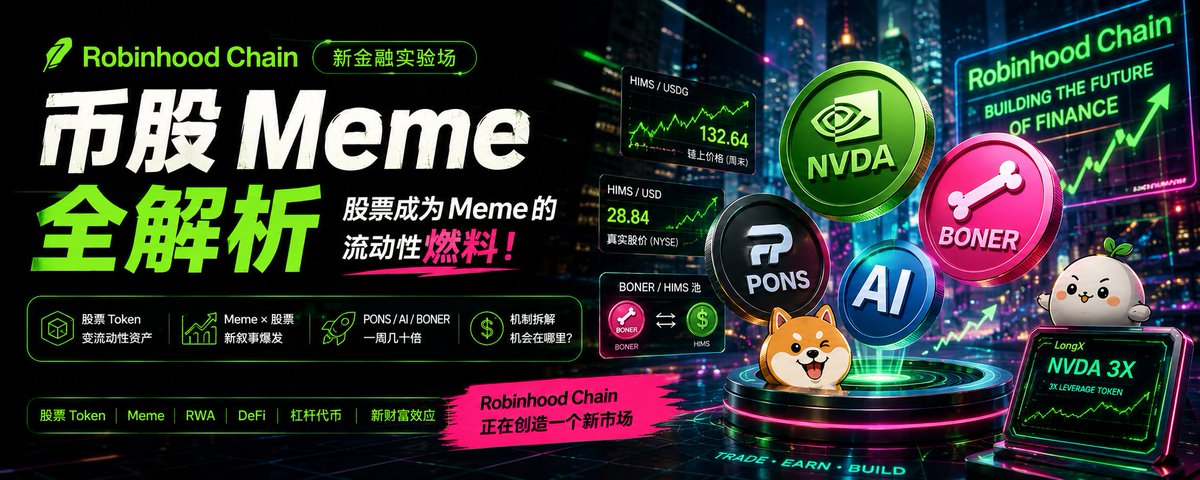
What is the research on Robinhood Chain "Coin Stock Meme"!
Today, the Robinhood chain issuance platform Long.xyz launched the 3x leveraged token pairing function for Nvidia;
Robinhood Chain has become the main battlefield for memes, $PONS $AI $BONER have all reached historical highs, with weekly surges in multiples.
It’s that time again when many people are rapidly accumulating wealth.
Below, I will break down this sector from several aspects: underlying assets, trading mechanisms, recent data, and participation opportunities, to see where the real opportunities lie?
1. First, let's provide a basic definition:
Coin Stock Meme is not "buying memes equals buying stocks",
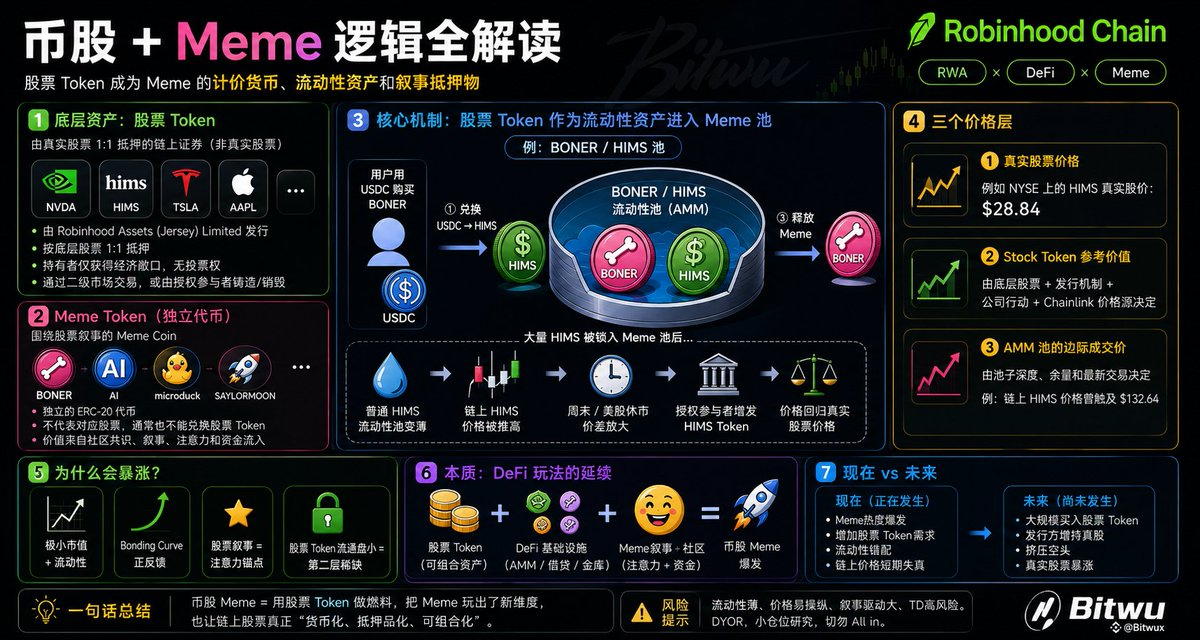
rather, it turns stock tokens into the pricing currency, liquid assets, and narrative collateral of memes.
The real valuable innovation is that it allows stock tokens to track not just "US stock prices," but to be put into trading pools, lending protocols, treasuries, and derivatives, becoming foundational financial assets on-chain like ETH, SOL, USDC.
Essentially, it is still a continuation of DeFi play.
What is actually happening now is: Meme heat → increases demand for stock tokens → large amounts of stock tokens are locked in meme pools → liquidity in ordinary stock token pools thins out → on-chain packaged asset prices become temporarily distorted → authorized participants mint additional stock tokens to restore prices.
What has not yet really happened is: Meme buying pressure → large-scale purchases of real US stocks → squeezing Wall Street shorts → real stock prices soaring.
There are several orders of magnitude between the two.
2. What exactly is a Coin Stock Meme?
The term "Coin Stock Meme" is not a strict official term; I prefer to define it as: a meme that uses stock tokens as quoted assets, liquid assets, fee assets, or treasury assets.
To understand it, we must separate the following four layers.
First layer: Robinhood Chain
Robinhood Chain is the public chain mainnet launched by Robinhood on July 1, 2026. It is essentially a Layer 2 based on Arbitrum technology, settled on Ethereum, and using ETH to pay for gas, with Chain ID 4663.
Robinhood positions it as a financial services and RWA public chain, supporting stock tokens, lending, collateral, trading, and derivatives;
Second layer: Robinhood Stock Token
HIMS, NVDA, TSLA, AAPL are not real company stocks but are tokenized debt securities issued by Robinhood Assets (Jersey) Limited.
They are 1:1 collateralized by corresponding underlying stocks according to official rules, but holders do not directly own company equity, voting rights, or shareholder rights; they only gain economic exposure to the underlying securities.
Ordinary users mainly buy and sell through the secondary market; direct minting and burning on the primary market is mainly handled by authorized participants or market makers.
So: holding an NVDA Stock Token does not equal holding Nvidia stock in a US brokerage account; it is an on-chain security product issued by RHJ, collateralized by real stocks, tracking Nvidia’s economic value;
Users also bear risks related to the issuer, custody, smart contracts, chains, oracles, and liquidity.
Third layer: Meme Token
BONER, AI, microduck, SAYLORMOON are part of a separate independent ERC-20 token set.
They may tell stories around stocks like HIMS, NVDA, MSTR, but holding these memes: does not mean holding the corresponding Stock Tokens; does not mean owning real stocks; usually cannot be exchanged for Stock Tokens at a fixed ratio.
Fourth layer: Meme / Stock Token liquidity pools
The real connection between the two is the AMM trading pool.
For example:
BONER / HIMS
AI / NVDA
microduck / NVDA
SAYLORMOON / MSTR
SHRUB / TSLA
Long.xyz launched the stock token pairing issuance function on July 14, with Bankr following up on July 20, supporting over 90 types of stocks and ETF tokens as quoted assets.
The innovation here is not that "stocks provide a safety net for memes," but that stock tokens have replaced ETH, SOL, or USDC, becoming the pricing and liquidity assets for memes.
AI/NVDA means that AI and NVDA Stock Tokens can be exchanged at market prices in the pool, but does not imply that one AI corresponds to a fixed amount of NVDA.
3. What actually happened in a BONER transaction?
Take BONER/HIMS as an example.
A user buys BONER using USDC, a typical routing might be:
USDC ↓ first exchanged for HIMS Stock Token ↓ HIMS enters the BONER/HIMS liquidity pool ↓ the pool releases BONER to the user ↓ more HIMS is locked in the meme pool
As BONER buying pressure continues to grow: the amount of HIMS in the BONER/HIMS pool increases; the HIMS once used for normal pricing against HIMS/USDG, HIMS/ETH shrinks; HIMS's normal liquidity pool diminishes; a small amount of trading can push on-chain HIMS AMM quotes very high;
Over the weekend’s actual US stock market closure, arbitrage mechanisms weaken, and price differentials may further widen; when the US stock market opens again, authorized participants will increase the supply of HIMS Tokens and prices will once again align closely with real stock prices.
The Robinhood Stock Token is a standard ERC-20, which can be directly put into AMM pools like Uniswap; each Stock Token also has an independent Chainlink price source. The official also provides a read-only API for underlying stock quotes, corporate actions, and asset information.
It is important to note: the underlying stock quotes, Chainlink oracle prices, and the actual transaction prices in an AMM pool belong to different pricing levels.
Robinhood must clarify three prices
1. Real stock price
For example, HIMS stock price on the New York Stock Exchange.
2. Reference value of Stock Token
Determined by underlying stocks, issuance mechanisms, corporate action multipliers, and Chainlink price sources.
3. Marginal transaction price in a specific AMM pool
Determined by how much HIMS, USDG, ETH are left in the pool, along with the magnitude of the last trade.
For example, suppose:
Real HIMS: $28.84;
On-chain HIMS: $61.15;
This does not mean that real HIMS stock has risen to $61.15, but rather that a thin liquidity on-chain pool is exchanging HIMS Tokens at a marginal price of $61.15.
Later, this price difference became even more exaggerated: on-chain HIMS reached $132.64 over the weekend, while real HIMS closed at $28.84 on the previous trading day.
4. How did Robinhood Chain Meme become popular?
This wave of popularity did not appear suddenly but went through three phases.
First phase: New chain bonanza and CASHCAT
Robinhood Chain went live on July 1. By mid-July, there were about 800,000 active addresses on-chain, with daily transactions reaching about 3.6 million, with native memes like CASHCAT becoming the primary source of traffic, despite the on-chain tokenized RWA scale being only about $12.8 million.
This phase was essentially: Robinhood brand + new chain airdrop expectations + cheap gas + new ecosystem attention vacuum.
Robinhood also covered gas fees for eligible wallet users for the first 90 days post-launch, and provided a period of zero fees for the Lighter perpetual contracts, greatly reducing the cost of trading, issuing tokens, bot trading, and small speculations. This subsidy will enter a significant observation period around the end of September.
Second phase: Launch platform wars
The early dominant player was Noxa.
Noxa completed about 60,000 token launches in a very short time, generating nearly $12 million in fees, but suddenly stopped issuing new tokens on July 11, leading to chaos in its website and operations. Assets like CASHCAT experienced a notable decline afterward.
Noxa’s exit highlighted an important issue:
The early prosperity of Robinhood Chain did not solely belong to the "fundamentals of the public chain" but was highly dependent on individual launch platforms and trading robots creating order flow.
Subsequently, Pons took over the primary traffic.
Pons V2 introduced:
Bonding Curve;
Uniswap V4;
Permanent lock of liquidity after graduation;
ETH, USDG, and stock tokens as quoted assets;
Programmable fees and trading tax mechanisms.
This made Pons not just a Robinhood Chain version of Pump.fun, but began to connect meme token issuance, stock tokens, and Uniswap liquidity in one system.
Third phase: Coin Stock Memes emerge
Long.xyz, Bankr, and Pons V2 successively launched stock token pairing functions.This step was crucial.
Previously, Robinhood Chain memes were essentially no different from memes on Solana or Base; but after the emergence of AI/NVDA and BONER/HIMS, Robinhood Chain first had its unique play:
Using the most recognized stocks in the real world to provide memes with pricing units, liquidity, and narratives.
This connected two groups of people:
Crypto users speculating on memes;
Investors familiar with NVDA, TSLA, HIMS, MSTR stocks.
By August 30, Robinhood Chain handled about 5.52 million transactions in one day, Pons launched around 22,600 tokens in a single day, DEX transaction volume was about $875 million, and on-chain application revenue was around $2.66 million, with GMGN, Pons, and Uniswap collectively contributing approximately 88%. CoinDesk
5. Why are their price increases so exaggerated?
Because they possess four amplifiers simultaneously.
1. Extremely small initial market caps and real liquidity
A meme's apparent market cap can be $10 million, but the liquidity in the pool might only be a few hundred thousand or even a few tens of thousands of real liquidity.
The way market cap is calculated is:
Last marginal transaction price × total token amount.
This does not mean there is actually an equal scale of funds flowing in.
Therefore, a few tens of thousands of net buys can easily create apparent market cap increases of millions or even tens of millions of dollars. Conversely, a position with a market cap of a few million may not be sellable at screen prices at all.
2. Bonding Curve provides positive feedback on prices
Early buyers entering along the Bonding Curve find prices increasing the further back they go.
Thus forming:
Price increase → ranking exposure → KOLs and bots discover → more users buy → transaction volume rises → back onto the rankings → prices continue to rise
Once Pons V2 tokens reach graduation thresholds, liquidity will shift to Uniswap V4 and be locked permanently, reducing traditional withdrawal rug risks, but it does not solve token plunges, concentrated holdings, and buy/sell issues.
3. Stock narratives provide familiar attention anchors
“A new animal meme” is hard to explain.
However:
On-chain memes for NVDA;
HIMS short squeeze;
MSTR and Bitcoin;
TSLA and Musk;
SPY and US stock index;
Ordinary investors can understand them at a glance.
Coin Stock Memes do not need to recreate a culture; they directly borrow from the brands, news, controversies, and communities that publicly listed companies have accumulated over the past decade.
4. The small circulating supply of stock tokens creates second-layer scarcity
Ordinary memes only face liquidity scarcity themselves.
Coin Stock Memes simultaneously exist with:
Meme Token liquidity scarcity;
Stock Token on-chain circulating supply scarcity.
When meme pools lock away large amounts of stock tokens, supply shortages and price deviations may also arise for stock tokens, thereby generating new narratives and news.
BONER completed a strong reflexivity loop:
BONER rises → more people buy BONER → more HIMS lock into BONER/HIMS → HIMS Token liquidity becomes thin → HIMS Token sees huge premiums → “Meme squeezes Wall Street” spreads → more people buy BONER
This is a beautiful narrative machine, but it is also a very dangerous pricing machine.
6. This market cannot be viewed merely as a meme
Currently, it can be roughly divided into five categories.
1. Pure Robinhood Chain Memes
Represents: CASHCAT, Thinking Cat, YOLO.
No stock assets or protocol revenues, mainly trading on the Robinhood Chain’s attention, community consensus, and new chain beta.
2. Stock Pairing Memes
Represents:
AI/NVDA;
BONER/HIMS;
microduck/NVDA;
SAYLORMOON/MSTR;
SHRUB/TSLA.
This is the most typical "Coin Stock Meme". Stock tokens are quoted and liquid assets but do not provide a fixed value baseline for memes.
3. Stock Treasury or Transaction Tax Memes
For example, some projects tax meme transactions and then use the fees to purchase NVDA, AAPL, MSFT, and other Stock Tokens, placing them in community treasuries or distributing them to specific holders.
Such projects seem like on-chain ETFs, but fundamentally differ:
Typically there is no standardized creation or redemption;
Meme Tokens do not necessarily represent legal ownership of the treasury;
Treasury growth relies on the meme continuously generating trading volume;
Once excitement wanes, cash flow for purchasing stock tokens will also diminish.
Similar to The Index's design, which charges fees on trading and purchases a basket of stock tokens, it should not be understood simply as a traditional redeemable index fund. 巨亨網
4. Launch platforms and shovel asset sales
Represents: PONS.
PONS is not a pure meme; it represents launch platforms, trading volume, fee income, and buyback and burn expectations.
As of August 31, Pons had cumulatively launched about 389,000 tokens, at one point accounting for nearly 80% of trading volume on the launch platform; cumulative user fees were about $46.06 million, with protocol income of about $10.14 million and approximately $3.61 million used for buybacks and burns. In the last 30 days, protocol income was about $5.2 million, and buybacks and burns were around $1.62 million. 巨亨網
However, it must be noted:
Buyback and burn do not equal cash dividends for token holders; recent income is also in an extreme fervor phase, and shouldn’t be calculated mechanically on an annualized basis.
As of the search on September 1, the PONS market cap was about $294 million, with a price increase of about 361% over the past seven days and 24-hour trading volume of about $106 million. Assuming recent 30-day income is annualized mechanically, it might superficially seem around 4.7 times the "annualized protocol income," but this valuation only makes sense if the current income can be sustained.
5. Tokenization of leveraged positions
The LongX NVDA3X in the screenshot is not an ordinary Stock Token.
It is a three times leveraged exposure to NVDA based on the Lighter liquidity engine, packaged into an ERC-20 that can be directly held and transferred, with the protocol managing positions and rebalancing. Foresight News
It is closer to:
"On-chain automatically managed three times leveraged ETP," rather than three times collateralized Nvidia stocks.
Risks include:
Perpetual contract funding rates;
Automatic rebalancing;
Volatility loss and path dependence;
Liquidation or underlying position management risks;
Oracle and smart contract risks;
Risks from third-party protocols related to Lighter and LongX.
Using NVDA3X to pair a meme means:
Meme volatility × stock volatility × three times leverage × liquidity risk.
This type carries the highest risk in the entire sector and should not be considered an ordinary NVDA Token.
Robinhood’s official statement also clearly states that projects appearing on the ecological page do not represent Robinhood’s endorsement of their safety, legitimacy, or applicability. 罗宾汉
7. How hot is the market right now?
As of the search on September 1, 2026, Robinhood Chain:
DeFi TVL is about $723 million;
Stablecoin scale is about $797 million;
RWA Active Market Cap is about $164 million;
24-hour DEX trading volume is about $1.403 billion;
24-hour application fees are about $14.4 million;
24-hour application revenue is about $3.01 million;
Bridged TVL is about $2.381 billion. DefiLlama
According to CoinGecko, the market cap of Robinhood Chain's native meme sector is about $535 million, with a 24-hour trading volume of about $11.9 million; this classification does not necessarily include PONS, categorized under Launchpad, nor does it comprehensively cover all stock-pairing memes, thus the “total market cap” across different platforms cannot be directly summed. CoinGecko
This data indicates two things:
First, Robinhood Chain is no longer a new chain without funds; stablecoins, TVL, and trading volume have all reached considerable scales.
Second, current activities are highly dependent on memes, launch platforms, and trading bots. Huge trading volumes do not equate to equal net inflows, as they include high-frequency trading, bot trading, arbitrage, and repeated trades.
8. Which projects are worth studying?
Below is a priority list for research, not a buying ranking.
First: PONS - Selling shovel logic
PONS is currently the most worthwhile asset to study systematically because it has at least verifiable business indicators:
Token issuance amounts;
Platform trading volume;
User fees;
Protocol income;
Buyback and burn;
Market share.
However, the biggest issue now is not “Is there any income?” but rather:
Has the current market price already factored in a continuous Meme fervor forever?
When researching PONS, focus on:
How much trading volume remains after gas subsidies end;
Whether income collapses synchronously after token issuance decreases;
Whether PONS buybacks are real, sustainable, and verifiable;
Whether Pons can upgrade from a meme launchpad to a stock token asset issuance and trading infrastructure;
Whether competitors can quickly replicate its functions.
Noxa's rapid stop in token issuance after earning nearly $12 million in fees has already proven that a market's platform position can change within days. CoinDesk
Second: AI - The leading sample of stock pairing memes
AI/NVDA is one of the first stock pairing memes to emerge, also representing Long.xyz ecosystem.
As of the search, OpenSea data shows AI’s FDV at about $156 million and approximately 26,300 holders, with a seven-day price increase exceeding 400% at one point. OpenSea
What is worth studying about AI is not just that it is named AI, but:
Whether it consistently occupies the primary meme traffic for NVDA Stock Tokens;
Whether the fee distribution mechanism from LongX to AI is sustainable and verifiable;
Who exactly owns the assets in the AI community treasury;
Whether AI holders have clear redemption or governance rights over the treasury;
Whether Long.xyz can continue to launch products that generate trading volume.
One shouldn't directly add treasury assets to AI's valuation just because the project has a "community treasury." Unless holders have clear and enforceable claims or redemption rights, the treasury is more about narratives and protocol resources.
Third: CASHCAT - The ecological beta of Robinhood Chain
CASHCAT resembles a cultural symbol of Robinhood Chain.
It may not have fundamentals, but it usually directly reflects:
The heat of Robinhood Chain;
Whether funds are still retained in the ecosystem;
Whether meme traders are pulling out;
Whether Robinhood’s officials and community continue to support meme culture.
It is suitable as an indicator of ecological sentiment, rather than as a cash flow asset.
Fourth: BONER - The strongest event narrative, but also the most dangerous
BONER's value comes from:
The high proportion of HIMS short interest;
Sex health-related memes that spread easily;
Extremely small circulating supply of Stock Tokens;
Also having created genuine price distortions on-chain;
The narrative of "Meme squeezes Wall Street" being very infectious.
But its problems are equally evident:
The real squeeze capability can almost be neglected;
Post vertical rises, the holding structure may become poor;
Narratives rely on the continuous scarcity of HIMS Tokens;
If authorized participants continue to mint HIMS Tokens, scarcity will diminish;
When selling pressure forms on BONER, HIMS in the pool may be quickly drawn away, and liquidity may simultaneously deteriorate.
It is more suitable as a sample for observing market mechanisms rather than treating promotional narratives as fundamentals after a price surge.
Fifth: LongX - Worth researching technology, not to be mistaken as low-risk StockFi
LongX represents the direction of "any position can be tokenized."
In the future, there may not only be NVDA3X but also:
TSLA3X;
BTC and stock combinations;
Long and short strategy tokens;
Volatility strategies;
Yield enhancement strategies;
On-chain automatically managed structured products.
This might be a more long-term direction than mere memes, but it requires extremely clear net value, liquidation, funding rates, rebalancing, and redemption mechanisms.
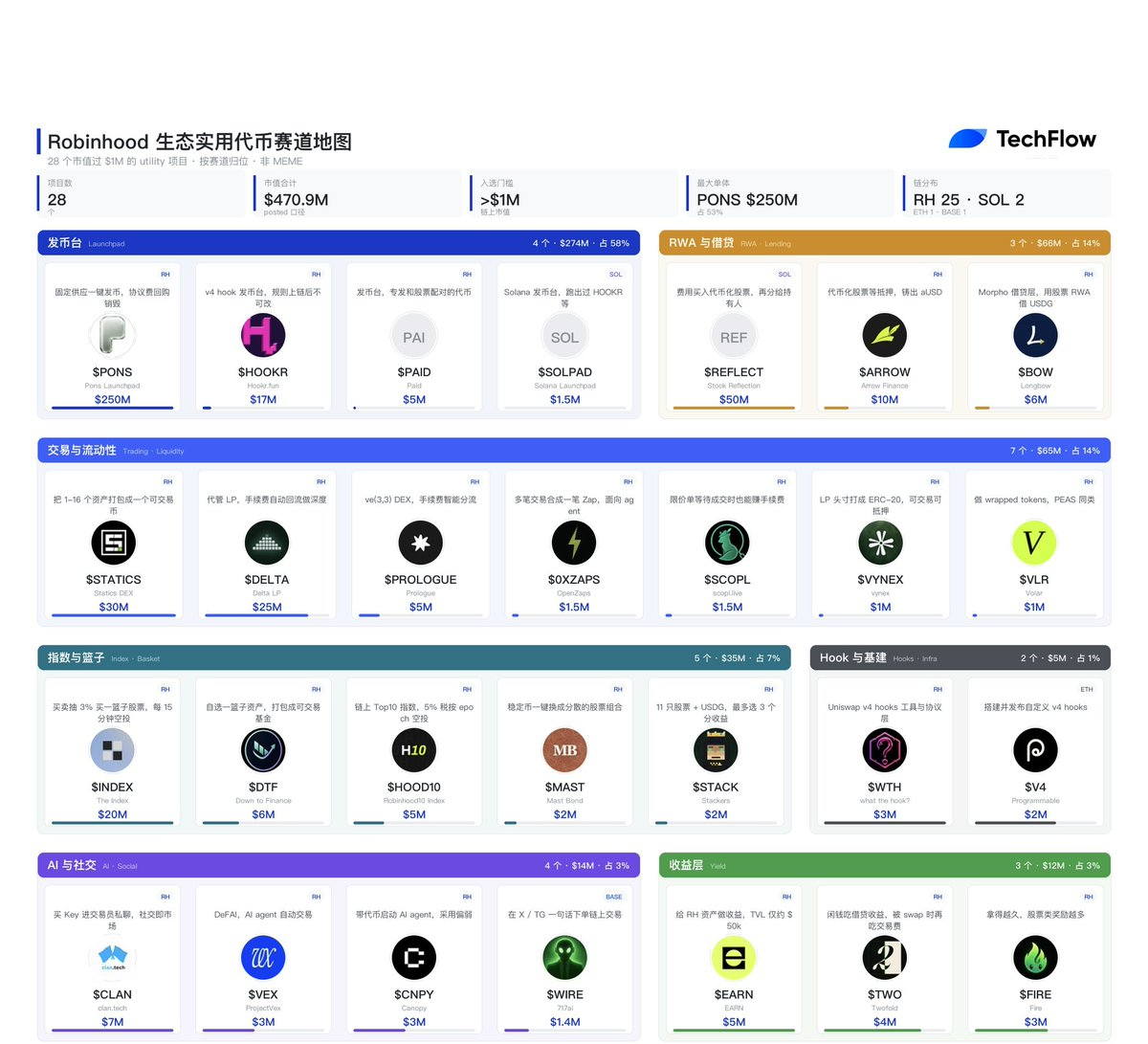
Everyone can look at the excellent summary chart from 深潮 @TechFlowPost:
9. For research, content, and investment participants like us, where are the opportunities?
The entire Robinhood Chain Meme experimental account does not exceed 0.1%—0.3% of liquid investment assets; individual memes should not exceed 10%—20% of this experimental account;
I can only mention my style here for reference, not necessarily as a model: I personally do not use leverage; do not average down; do not participate in robot competition in the first few minutes after opening; my main wallet and multi-signature long-term assets do not touch any meme contracts.
The focus is not to make big money on the first trade but to gain real insights at the lowest cost.
Therefore, I will continuously test to provide feedback for myself and others.
My final judgment on this sector, in the short term, is definitely real and valuable, and with the backing of Robinhood, which will certainly want to sustain this initiative, allowing stock tokens to evolve from "on-chain stock mirrors" into:
Quoted assets; collateral; lending assets; liquidity assets; meme pricing units; community treasury assets; underlying assets for leverage and structured products;
This is a long-term valuable financial experiment. The most valuable aspect is not merely memes going on-chain but rather the monetization, collateralization, and composability of stock tokens.
However, at the current stage: there is fervor and extreme reflexivity, and the current market is still highly dependent on: new chain bonanzas; gas subsidies; launch platforms; trading bots; small circulating supply; KOL dissemination;
Therefore it resembles more of a meme casino growing out of RWA infrastructure.
The casino may ultimately bring users, liquidity, and infrastructure for genuine financial applications, but it may also quickly migrate to another chain once subsidies end.
“Reverse effect on Wall Street”: the mechanism is established, but the scale is not
The most accurate expression is: Coin Stock Memes have begun to affect the transaction volume, usage, liquidity, and short-term pricing of on-chain stock tokens but currently lack the ability to substantively influence real stock prices.
To genuinely impact US stocks in the future, we need to see: Stock Token total supplies grow dozens to hundreds of times; authorized participants continuously increase real stock inventories; Coin Stock Memes and DeFi lock up hundreds of millions or even billions of Stock Tokens; the marginal trading volume of real stocks to be small enough; and issuance, redemption, and arbitrage mechanisms to be smooth.
I suggest treating it first as a research topic.
Buy in small positions and study PONS's platform cash flow, then research the stock pairing mechanism of AI/NVDA, understand supply and price differentials with BONER/HIMS, and finally complete real transactions with a very small experimental account.
免责声明:本文章仅代表作者个人观点,不代表本平台的立场和观点。本文章仅供信息分享,不构成对任何人的任何投资建议。用户与作者之间的任何争议,与本平台无关。如网页中刊载的文章或图片涉及侵权,请提供相关的权利证明和身份证明发送邮件到support@aicoin.com,本平台相关工作人员将会进行核查。


