Money is flowing in, yet prices remain stagnant.
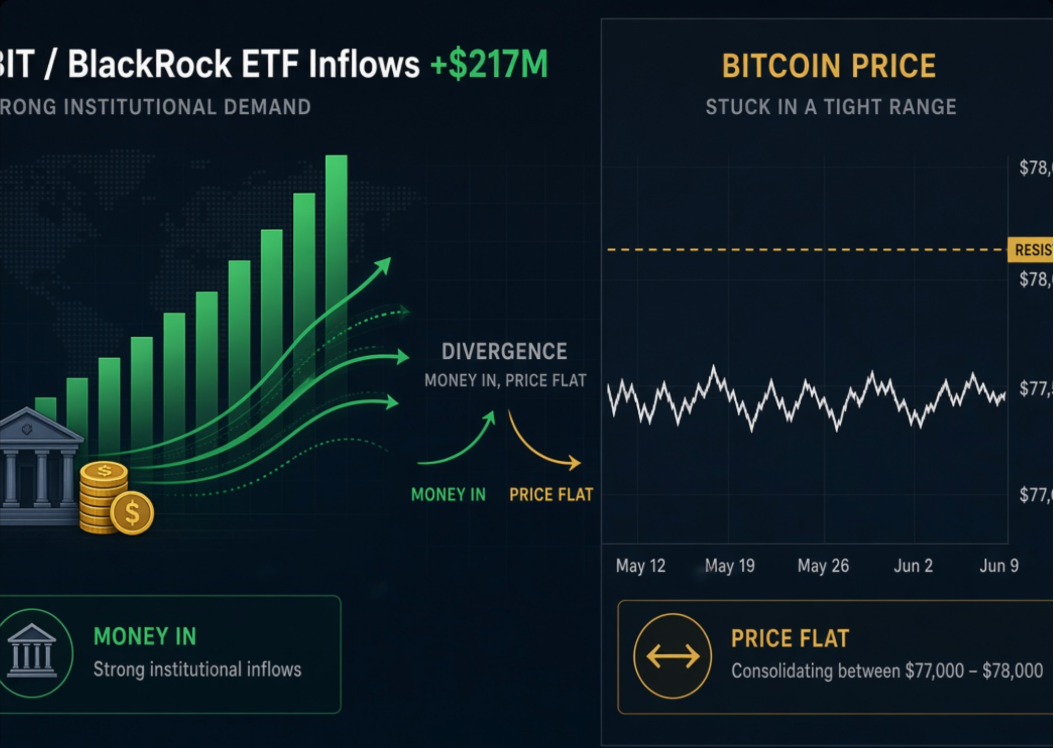
Latest data shows that the US spot Bitcoin ETF has seen a significant inflow of funds, with BlackRock's IBIT making a notable contribution, driving the overall daily net inflow to approximately $217 million.
At the same time, the Ethereum spot ETF has maintained net inflows for 11 consecutive trading days, and funds related to XRP and Solana have also continued to see inflows.
Logically, continuous institutional buying should serve as a crucial support for BTC's rise.
However, the answer given by the market appears somewhat abnormal:
Bitcoin has not continued to rally but has instead fluctuated around the $77,000-$78,000 range.
After registering a strong increase of about 25% in August, entering September with a return of inflow into ETFs, BTC is still unable to break through.
Thus, a more concerning question has arisen:
Who exactly is selling? And what are institutions waiting for?
ETF funds are flowing back: institutions have not exited the market
From the end of August to the beginning of September, US spot Bitcoin ETF funds have shown a clear rebound.
Notably, BlackRock's IBIT has performed exceptionally well, driving the US spot Bitcoin ETF to record a daily net inflow of about $217 million, reversing the previous phase of capital outflow.
This at least indicates one thing:
The demand for BTC allocation by institutions has not disappeared.
Moreover, this time it's not just Bitcoin garnering attention for funds.
The Ethereum spot ETF has maintained net inflows for over 10 consecutive trading days, and related products for XRP and Solana have also continued to attract funds.
Funds are gradually expanding from a single BTC allocation to a broader range of crypto assets.
As an important compliant channel for traditional capital entering the crypto market, continued inflows from ETFs indicate a core issue has been resolved:
The market is not lacking buyers.
Therefore, the question becomes——
Why are there buyers, yet prices still cannot rise?
The most concerning signal: funds and prices are showing a "divergence"
Under normal circumstances, sustained net inflows into ETFs indicate that there is incremental buying pressure in the market.
As buying pressure increases, prices should receive upward support.
However, the current market displays a clear contrast:
While the ETF is buying, BTC has not surged correspondingly.
After experiencing approximately a 25% surge in BTC in August, it is now in a consolidation phase at around $77,000-$78,000, consistently lacking sufficient momentum to break upward.
This does not imply that ETF funds are ineffective.
A more plausible explanation is:
Institutional buy pressure is being continuously absorbed by other sell pressures in the market.
In other words, it is not that "no one is buying," but rather:
There are many buyers, but there are also quite a few sellers.
This stage often appears after a significant rise during the period of chip rebalancing.
Previous low-position holders begin to take profits while new funds step in at higher levels.
The resultant effect is price stagnation while funds continue to flow in.
Who is selling? Four forces are offsetting institutional buy pressure
1. Previous profit-takers are cashing out
BTC rose nearly 25% in August, briefly touching above $81,000.
For funds that previously held BTC, this is evidently a good cash-out window.
Some medium to long-term holders, short-term traders, and funds that had taken positions at low levels may choose to gradually take profits within the $78,000-$81,000 range.
So what you might be seeing is:
The ETF is buying, while old funds are selling.
These two forces are offsetting each other, making it difficult for the price to break through quickly.
2. Whales and miners may still create temporary supply
After BTC rises, the transfer of funds from large addresses on-chain often becomes more active.
Whales may choose to cash out some profits, and miners may use the price recovery to improve cash flow.
These funds do not necessarily indicate a long-term bearish outlook for BTC.
More often, they simply signify a periodic position adjustment.
However, for short-term prices, these chips may ultimately translate into selling pressure.
3. Leverage makes the market more sensitive
The spot ETF buys BTC, but there is also a large-scale futures and perpetual contract market.
When prices oscillate around critical levels, both long and short parties tend to continuously increase or adjust their leveraged positions.
If the price fails to break through, shorts may increase;
If prices suddenly drop, longs may be forced to liquidate.
Therefore, even with continuous inflows of spot funds, changes in leverage within the derivatives market may lead BTC to experience:
"Funds flowing in, but prices not rising; even a brief drop."
This is why the current market cannot solely rely on ETF data.
4. The macro environment still suppresses risk appetite
Another variable that cannot be ignored is the macro environment.
Expectations of Federal Reserve policy, movements of the dollar, oil prices, and the geopolitical situation in the Middle East are all influencing institutional risk appetite.
Especially as the market reassesses "high interest rates lasting longer," institutions, even if willing to allocate BTC, may not be eager to aggressively increase risk exposure in the short term.
Thus, inflow into ETFs resembles more of:
"Gradually building positions," rather than "immediately pushing prices up."

ETF inflows ≠ BTC immediately rises
This might be the most easily misunderstood point in the current market.
Net inflows into the ETF are just one of the necessary conditions for a rise; they are not sufficient conditions.
Whether BTC can truly initiate a rally depends on three variables.
First, when will the sell pressure diminish?
If profit-taking continues to be realized, then ETF funds will need to continuously absorb these chips.
Only when sell pressure clearly decreases will new funds find it easier to convert into actual price increases.
Second, has leverage been cleared?
If high-leverage positions in the market have not been sufficiently digested, BTC may easily undergo false breakouts or breakdowns at crucial levels.
Once the leverage bubble is cleared, the market could actually become cleaner.
Third, can macro liquidity improve?
This is crucial in determining whether institutions dare to further increase risk exposure.
If pressures from interest rates and the dollar ease, the marginal impact of ETF funds may significantly increase.
In other words:
Institutions are already buying, but there is not yet enough reason to go all in.
What are institutions really waiting for?
The answer may not be a specific price.
Institutions are likely waiting for three signals to occur simultaneously:
① Easing macro pressures
More clarity on the Federal Reserve's policy path, with decreasing pressure from interest rates and the dollar, leads to a resurgence in risk appetite.
② BTC breaking key resistance
Currently, the area around $80,000 remains an important psychological barrier for the market.
If BTC can break through in volume and stabilize above $80,000, it indicates that the market has begun to digest previous profit-taking.
③ ETF funds transitioning from "daily inflow" to "sustained inflow"
A daily inflow of $200 million does not determine a trend.
What truly matters is:
Whether institutional funds continue to maintain net inflows in the upcoming week or two.
If funds continue to increase while prices begin to break out, then the "divergence between funds and prices" may officially come to an end.

Next, focus on three key signals
1. ETF: Look for sustainability, not just daily numbers
Daily inflows can only indicate that capital has returned.
Continuous net inflows over multiple days, or even weeks, can better demonstrate that institutional allocation demand is strengthening.
2. BTC: Can it truly hold above $80,000?
Breaking $80,000 is just the first step.
What truly matters is whether new support can be solidified after the breakthrough.
If there are repeated spikes followed by pullbacks, it indicates significant selling pressure remains above.
3. ETH, SOL, XRP: Are funds beginning to spread comprehensively?
Currently, multiple crypto asset-related ETFs are experiencing fund inflows.
If subsequent funds spread further from BTC to high-elasticity assets like ETH and SOL, it may indicate an improvement in market risk appetite.
However, if funds in multiple asset ETFs simultaneously cool down, it would warrant caution that macro factors may be regaining dominance.
Stagnation in price isn't necessarily a bad thing
Continued inflow of ETF funds while BTC prices remain stagnant appears contradictory at first glance.
However, from a different perspective, it might also mean:
The market is completing a round of chip exchange.
Institutional funds are continuously absorbing, while previous profit-takers are gradually exiting.
If subsequent selling pressure is fully digested and ETF funds can maintain sustained inflows, the current “stagnation” may instead serve as a buildup phase before the next rally begins.
Of course, another possibility also exists:
If ETF funds begin to weaken continuously and BTC breaks vital support, then the current divergence between funds and prices could evolve from a “buildup” into a genuine weakening trend.
Thus, rather than being entangled in:
“If ETFs are buying, why isn't BTC rising?”
It might be more prudent to focus on three questions that truly dictate the trend:
Will the ETF continue to buy?
Can $80,000 hold?
When will the selling truly disappear?
When the answers emerge, the market will likely provide direction for the next phase.
免责声明:本文章仅代表作者个人观点,不代表本平台的立场和观点。本文章仅供信息分享,不构成对任何人的任何投资建议。用户与作者之间的任何争议,与本平台无关。如网页中刊载的文章或图片涉及侵权,请提供相关的权利证明和身份证明发送邮件到support@aicoin.com,本平台相关工作人员将会进行核查。