Cryptocurrency derivatives are bidding farewell to the barbaric era dominated by "perpetual contracts."
Written by: Vaidik Mandloi
Translated by: Saoirse, Foresight News
Options products have existed in the cryptocurrency market for several years, but they have been rarely used in the past. Deribit launched its options business in 2016, and Binance also introduced options alongside perpetual contracts; in 2021, a whole generation of options vaults was born in the DeFi space, with the peak total locked value reaching around $500 million. However, these projects have gradually disappeared, with Ribbon Finance, Friktion, and Knox being no exceptions. The reason lies in the simplicity of operating perpetual contracts and their higher capital efficiency, which precisely meets the leverage needs of regular traders.
Now, options are once again gaining popularity! Coinbase has just acquired Deribit; the IBIT options launched on Nasdaq have seen their unfilled contract size exceed the total open interest of Deribit within just a few months. The total open interest of cryptocurrency options has surpassed that of cryptocurrency futures for the first time in history.
Therefore, I aim to delve deeply into what changes have occurred in the market. Is the current transformation real? Has the cryptocurrency options industry truly reached a turning point? Let's seek answers together.
Why Perpetual Contracts Once Dominated the Market
In the early development of cryptocurrencies, perpetual contracts solved problems that options had never managed to conquer. They integrated the complex logic of derivatives into a single asset trading market, gathering all liquidity into the same fund pool, avoiding the need to spread across hundreds of options contracts with different strike prices and expirations, where the order book depth of each type of options contract varied.

In 2017‑2018, cryptocurrency market liquidity was still weak. Regular traders wanting to trade Bitcoin and leverage their positions didn't need to consider how time decay (θ) would impact their holdings, which strike price to choose, or the overnight changes in various Greek values. The annual trading volume of perpetual contracts now exceeds $90 trillion, largely because they provide regular traders with the core element of derivatives: leverage, with almost no need for complex thinking.
However, in 2021, DeFi still attempted to develop the options track, giving rise to decentralized options vaults (DOV). The model was roughly: ordinary users deposit ETH or BTC, and the vault sells options contracts to market makers on their behalf, allowing users to earn option premiums as returns; Ribbon Finance, Friktion, and Knox were all built upon this model.
This model has two major problems. First, the vaults require full collateralization, losing the leverage advantage compared to perpetual contracts, resulting in very poor capital efficiency. The fatal problem that crushed decentralized options vaults was the defect in the options auction mechanism.
All vaults chose to conduct options auctions on Friday afternoons to match the high liquidity contracts expiring on Deribit that day. A large number of vaults placed orders at the same time and in the same direction, with a predictable scale. Market makers could anticipate the influx of significant options sell orders at the same point every week and only needed to wait for the right moment to lower their bids.
Paradigm has analyzed implied volatility during Friday auction periods and found that the volatility during these periods consistently remained 4 points lower than the weekly average. This indicates that vaults systematically sold options below fair prices; meanwhile, professional institutions taking over the orders were well aware of the auction timings. Users who thought they could earn an annualized return of 15‑20% ended up with an annualized loss of about 5.35% due to pricing discrepancies, not to mention the losses incurred when options expired unexercised.
Yet, the entire cryptocurrency industry’s vaults collectively chose this most unsuitable time to sell options.
As a result, perpetual contracts triumphed, and options gradually fell out of favor in the market. This situation continued until October 10, 2025. On that day, Bitcoin on Binance plummeted 12.6% in ten minutes, with a total liquidation value of $19.37 billion, of which 87% were long positions. The drastic decline stemmed from all the liquidation triggers referencing prices lower than the true trading prices of spot and futures during the volatility, executing liquidation at prices that deviated from the true market.
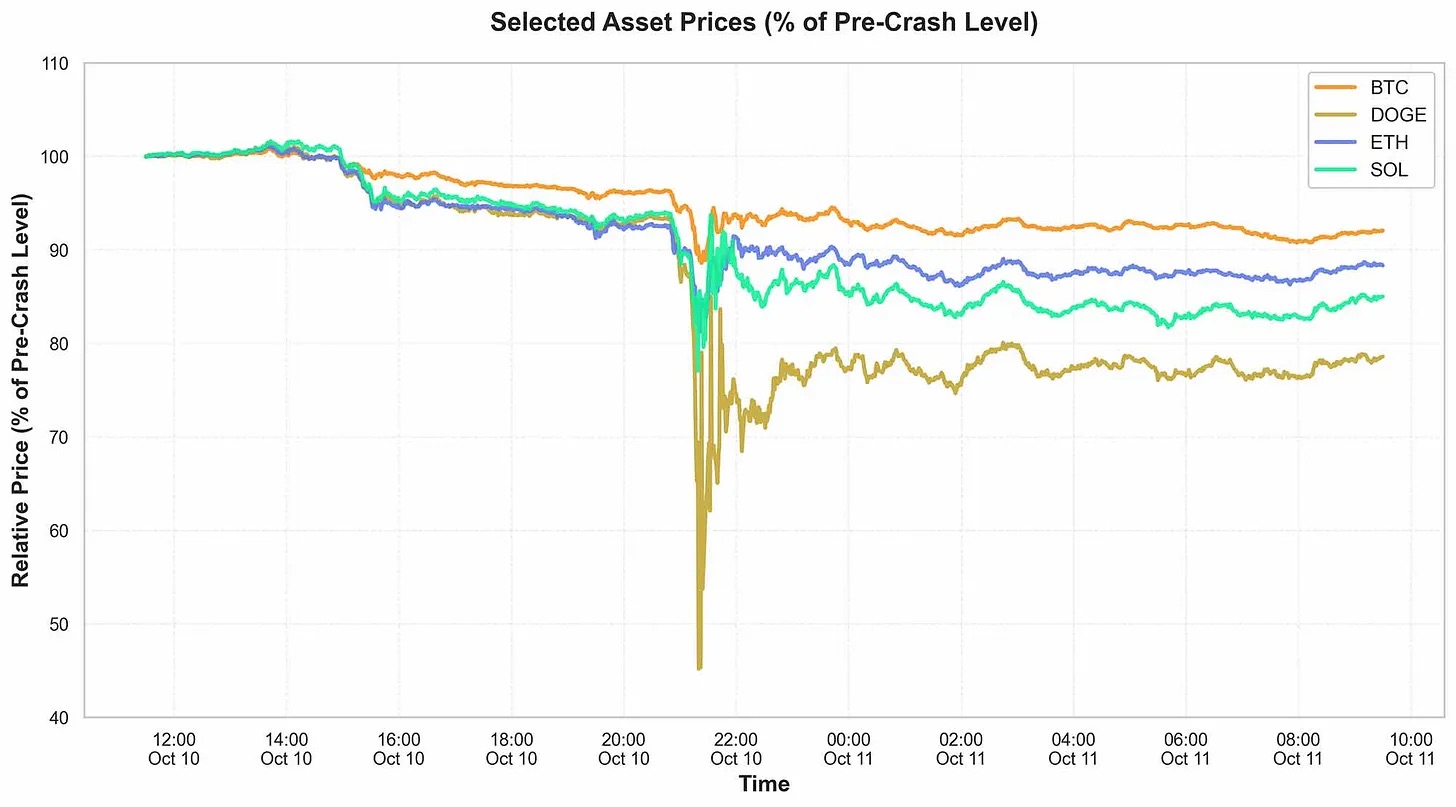
Rounds of liquidations further depressed the market, triggering more liquidations and creating a self-reinforcing negative feedback loop until selling pressure subsided. The Hyperliquid platform faced $2.1 billion in liquidations within 12 minutes; their automatic liquidation mechanism covered $304.5 million of actual losses, resulting in $704.6 million in asset write-downs, with the actual capital consumed reaching eight times the theoretical need.
This crash also changed the discussion around basis trading in institutional circles. Basis trading is the most commonly employed strategy among cryptocurrency institutions: buying Bitcoin spot while shorting perpetual contracts for hedging, earning funding rates, and maintaining market neutrality. However, during the October 10 crash, multiple exchanges' automatic liquidation systems forcibly closed the profitable short positions in this strategy, leaving traders exposed to naked long spot positions in the face of a sharp market drop.
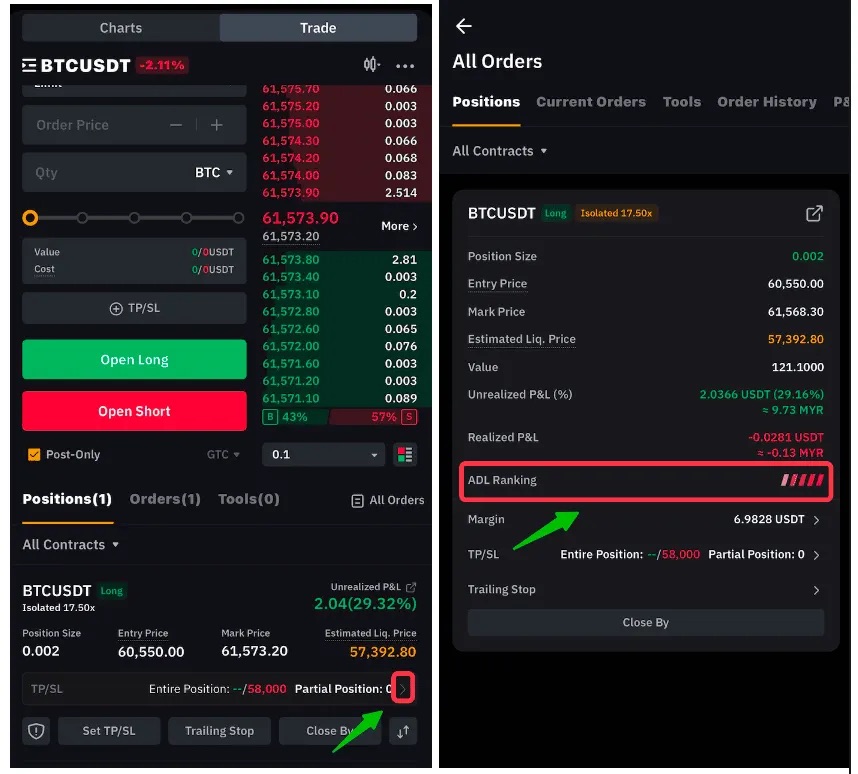
Note: These traders had originally built a delta neutral position, intending to avoid directional risks. Yet, the liquidation mechanisms of the exchanges turned them into unhedged longs at the worst possible moment.
This event exposed the inherent flaws of perpetual contracts: path dependence. This is an issue rooted in the architecture of perpetual contract products – the margin engine evaluates positions per tick rather than setting a fixed expiration date. Even if the weekly closing price and opening price of Bitcoin remain identical, if there’s a 15% drop in between, your position could already be liquidated.
By contrast, put options can completely avoid this risk: you pay the premium in advance, and at the moment you open the position, your maximum loss is already locked in, regardless of how volatile the Bitcoin market is before expiration.
After the October 10 crash, industry infrastructure underwent rapid iteration, as if it had been waiting for such a catalyst to drive the reconstruction of the options track. Derive directly abandoned the old fund pool vault model, restructuring into a central limit order book combined with a quote mechanism and portfolio margin, allowing traders to hold both perpetual contracts and options within the same margin account simultaneously.
This represents a key transformation that the first generation of crypto options has never had: traders can reuse the margin from their perpetual contract positions as collateral for options trading, without needing to lock up separate funds for different products, a model that has been employed by traditional, mature derivatives exchanges for decades. After the transformation, Derive set a new trading volume record of $294 million, with open interest surpassing $1 billion.
At the same time, Nasdaq launched IBIT options, implementing a regulated central clearing mechanism where the central counterparty guarantees every transaction, eliminating concerns over counterparty default risk. In just a few months, the open interest of IBIT options exceeded that of Deribit, causing Deribit’s market share to drop from over 90% to below 39%.
This scene is historically comparable to the founding of the CBOE. The options clearing organization mitigated bilateral counterparty risks in stock options, while the Black-Scholes model provided the market with a unified pricing benchmark; within just five years, stock options grew from over-the-counter trading via phone calls to being a pillar of modern finance. Meanwhile, the cryptocurrency market compressed this institutionalization into just a few months.
Subsequently, Coinbase directly acquired Deribit, bringing this major crypto options platform under the U.S. regulatory framework, providing an easy entry point for American institutions, while prior, Deribit had been almost entirely off-shore business.
A confluence of various factors has led to the most robust development opportunity for cryptocurrency options in history. However, the total trading volume of on-chain options (completed on the blockchain rather than traditional exchanges) still accounts for less than 1%. The current scale explosion of liquidity has almost entirely flowed to regulated centralized clearing platforms like Nasdaq and Deribit, rather than DeFi protocols. This means that the growth narrative of options primarily occurs within the institutional frameworks of traditional finance.
At present, on-chain option products aimed at ordinary users have not brought about an open interest level in the hundreds of billions.
Who Are the Counterparties?
The on-chain options products currently accessible to ordinary users are mostly upgraded covered call strategies following a reform of their underlying architecture. Users deposit BTC or ETH, and the protocol sells call options to market makers using the tokens held by the users, enabling users to earn premium revenues. The product's promotional pitch: while holding crypto assets, one can also gain passive income.
Essentially, deposit users are selling volatility: to reap the regular option premiums, they forgo all profits after the underlying asset exceeds a certain price point; the counterparty is a professional market maker who profits during periods of severe market volatility.
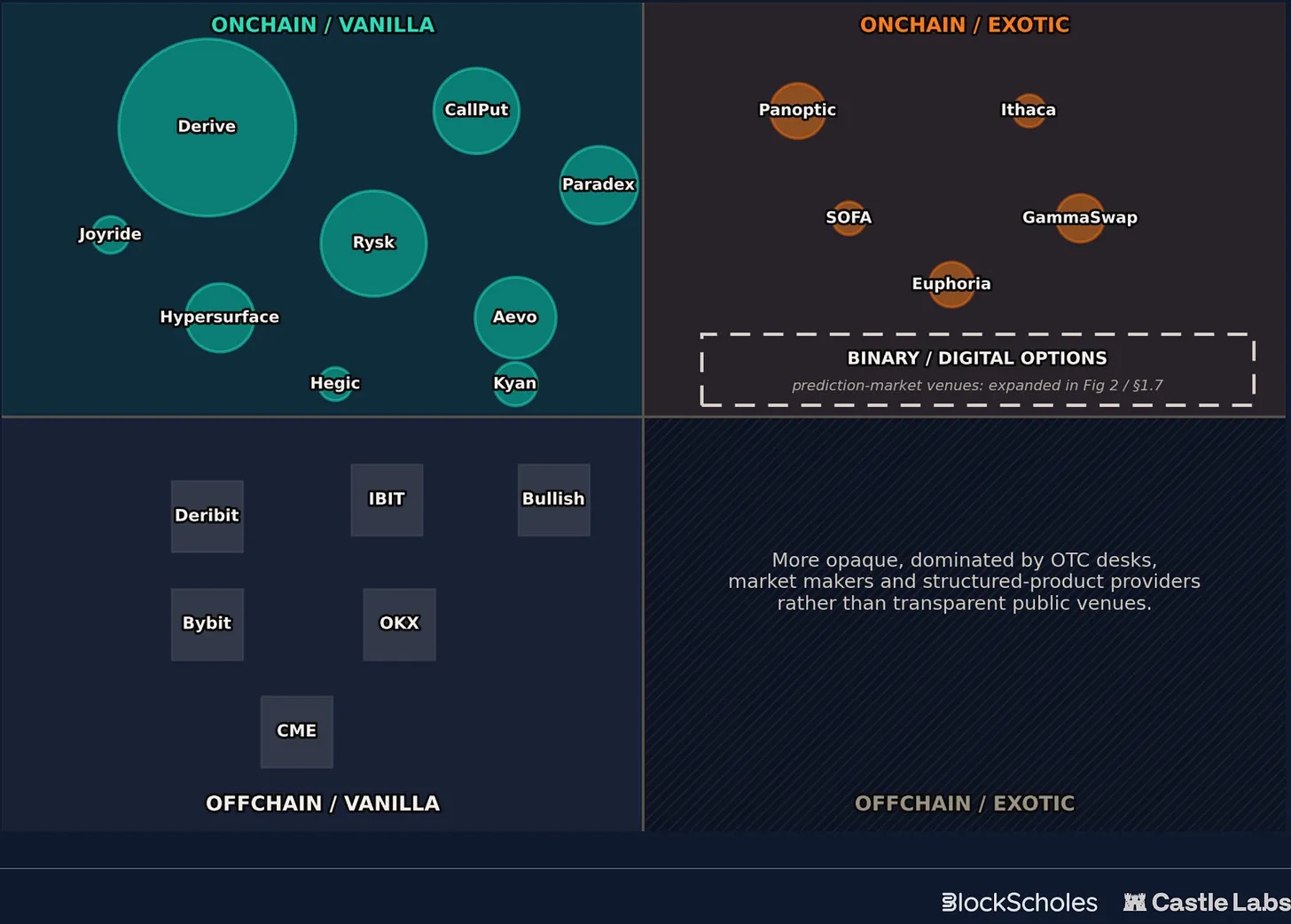
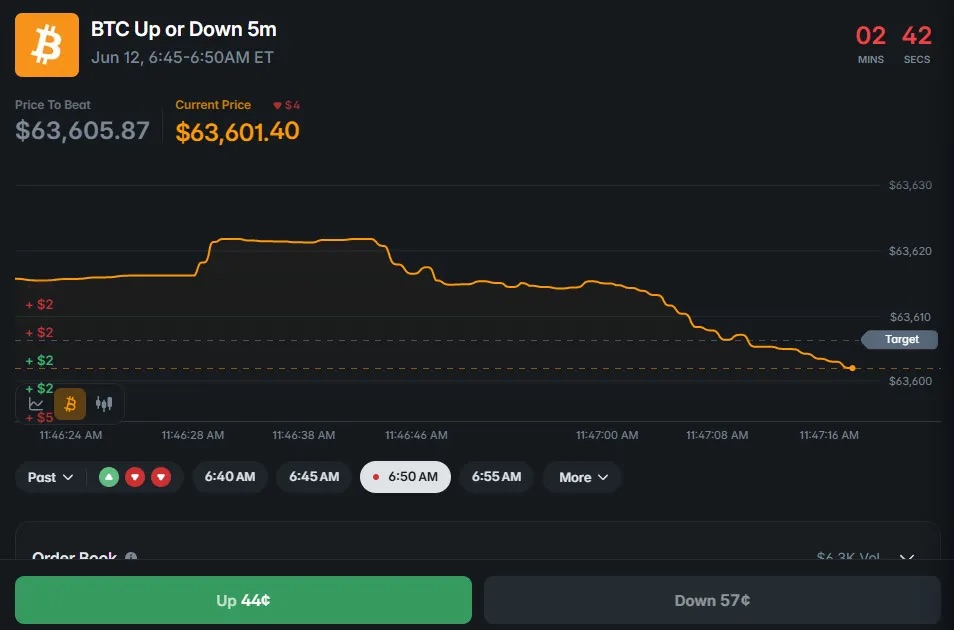
There are also products like Euphoria that adopt a different approach: users click on price-time grid points, and if Bitcoin falls within a corresponding range in five seconds, users receive returns. This essentially amounts to binary options spreads. The European Securities and Markets Authority banned the sale of such products to ordinary investors in 2018; Israel's parliament unanimously passed a ban in 2017; the FBI estimates that the global binary options scam volume reaches $10 billion annually. Meanwhile, Euphoria secured $7.5 million in funding from over 100 investors, bringing this product to the blockchain.
Traditional finance has long understood that packaging volatility sellers as investment returns is a way to sell to ordinary investors. Derivatives income ETFs have been conducting such operations in the stock market for years: selling covered calls and puts against stock holdings and distributing premiums as dividends to investors, with the managed scale quietly reaching $147 billion.
JPMorgan's JEPI and JEPQ are the two largest products, selling options against a long-term slowly rising broad-based index. The cost of these returns is mainly sacrificing upside potential, and typically, the principal does not suffer catastrophic damage. However, applying this strategy to high-volatility assets produces vastly different results.
MSTY is a covered call ETF based on MicroStrategy stock, tracking returns as high as 244%. Ironically, the product has seen its net asset value drop 62% since inception. Breaking down the source of returns shows that 98.54% of MSTY's distributions are capital returns, meaning they merely return investors' own money while investors are still obligated to pay taxes on it.
Accounts receive dividends every month, seemingly generating returns, but the source of returns is continuously shrinking; investors receive back their principal but still have to pay taxes to the tax authorities.

The MSTY case vividly illustrates what can happen when selling volatility strategies are applied to high-volatility assets. Given that cryptocurrency assets are among the highest volatility categories, understanding this layer of risk is crucial to comprehending why this moment marks a turning point for cryptocurrency options. The forces driving this change are not limited to vault upgrades and interface optimizations but also encompass multiple macroeconomic forces converging.
The first and most important factor: shrinking returns. In 2021, basis trading could yield annualized returns of 25% (buying BTC spot, shorting perpetual contracts to earn funding rates), which has now fallen to 4.46%. The no-risk high-yield dividends that once supported the growth of the cryptocurrency industry have disappeared. The option premiums have become one of the few native sources of yield with real economic logic—there are trading counterparties willing to pay to transfer their risks.
When basis trading returns were at 25%, the market didn't need options to generate yields. Now that the yield has dropped to 4.46%, the market has developed a real economic motivation for reasonably pricing risks through options. The demand also comes from institutions genuinely in need of hedging, not retail traders pursuing leverage.
The second factor is the lessons learned from the FTX bankruptcy event. Billions of dollars in derivative positions were locked in the bankruptcy asset pool. Traders had profitable positions on their accounts but could not close them, only submitting claims and waiting years for resolution. On-chain options settle directly to personal wallets, with collateral assets kept in verifiable smart contracts on Etherscan, rather than relying on exchange balance sheets. For institutional trading departments that experienced billion-dollar losses, on-chain derivatives settlement offers tangible appeal and can also pass compliance scrutiny.
The third factor is combinability, which is a unique advantage of on-chain options. Options positions can serve as on-chain tokens that interface with all DeFi infrastructure. Covered call positions can be used as collateral for lending protocols; multiple options contracts can be coded together to form new products and delivered to users with a single click; the portfolio margin for perpetual contracts and options can be calculated in real-time on-chain, without needing to wait for overnight reconciliation by a clearinghouse.
In the Friday auction era of decentralized options vaults in 2021, these functionalities could not be achieved. Nasdaq and Deribit also cannot offer these features, as their settlement structures were not designed from the outset with open, permissionless combinability in mind. The cryptocurrency market is building capabilities that traditional derivatives systems cannot replicate, rather than simply trying to catch up with traditional finance.
Together, Deribit and IBIT have seen the open interest in Bitcoin options grow nearly tenfold since the start of 2024, reaching $80 billion. In cryptocurrency derivatives history, the open interest of options has surpassed that of futures for the first time. This indicates that the total capital allocated to options exposure is now greater than the capital from the previous decade's mainstream leveraged directional trading in the cryptocurrency market.
This is a sign that the industry has reached a turning point: infrastructure maturity, resolution of capital efficiency issues, and the implementation of a regulatory framework have resulted in hundreds of billions of funds being invested as a vote of trust.
免责声明:本文章仅代表作者个人观点,不代表本平台的立场和观点。本文章仅供信息分享,不构成对任何人的任何投资建议。用户与作者之间的任何争议,与本平台无关。如网页中刊载的文章或图片涉及侵权,请提供相关的权利证明和身份证明发送邮件到support@aicoin.com,本平台相关工作人员将会进行核查。


