The RWA market is still rapidly expanding, but the issues of concern in the industry are changing. According to a recent special report by BeInCrypto titled "The $37 Billion Tokenization Boom Has an Ownership Problem," as of August 3, the scale of tokenized RWA on public chains has reached $37.29 billion (excluding stablecoins), with Chinese government bonds and money market products amounting to $16.16 billion, approximately 43% of the overall market; commodities reaching $4.6 billion, and stocks and ETFs reaching $2.16 billion.
However, as more real assets enter the chain, a more fundamental question arises than "which assets can go on-chain": does holding a Token really mean owning the real asset or the associated rights it represents?
BeInCrypto places this question at the core of its latest special report and interviews Eva Meng, head of Matrixdock; Myles Harrison, CPO of AMINA Bank; Billy Miller, COO of Securitize; and Roshan Robert, CEO of OKX US, discussing the real challenges faced by the tokenization market from different angles such as settlement, ownership registration, and 24/7 trading. Among them, Eva Meng highlights the importance of settlement at the core of the ownership issue, further extending the discussion from "how ownership is recorded on-chain" to "whether the relevant rights can be settled in the real world."
From 32.148 XAUm to 1 kilogram gold bar, how does on-chain ownership lead to real delivery?
Blockchain can accurately record how many Tokens an address holds, but for RWA, the ownership record on-chain does not determine whether the underlying asset can be settled when needed. Eva points out that the real test occurs when the relevant rights are exercised: can the underlying asset be settled according to the corresponding mechanism?
The tokenized gold XAUm from BIT's RWA platform Matrixdock provides a practical case for this relatively abstract question. BeInCrypto mentions in the report that in April 2025, a holder destroyed 32.148 XAUm and received a 1-kilogram LBMA gold bar within T+3 after submitting a redemption request, connecting the destruction of the on-chain Token with the release of the corresponding gold from the custody system. The report also used images of physical gold delivery from Matrixdock to illustrate how the rights represented by the Token progress from on-chain balances to real asset delivery.
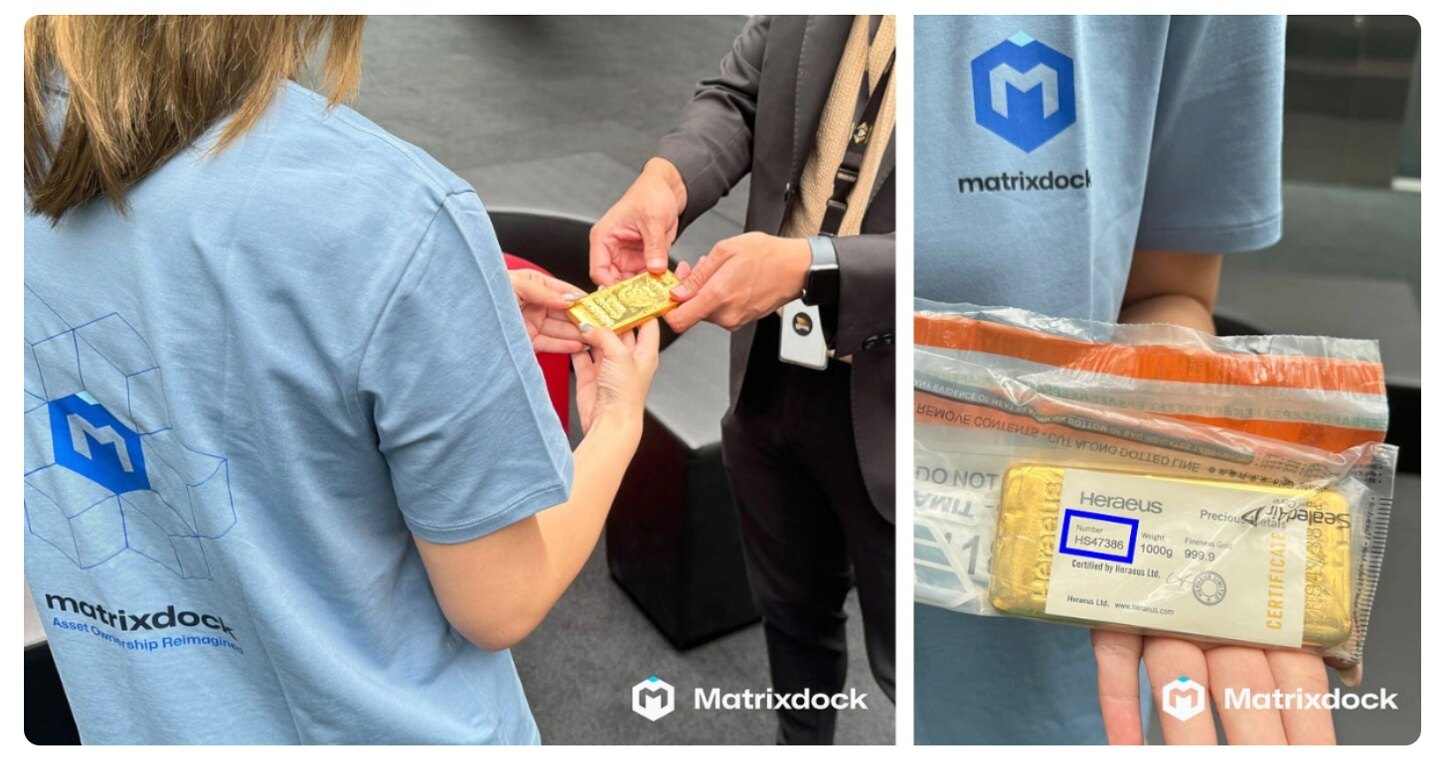
The redeeming aspect that truly deserves attention is not just that "XAUm can be exchanged for gold," but that it illustrates a practical path from on-chain records to real delivery: from holding XAUm, submitting a redemption request, to destroying Tokens, and finally to the corresponding gold being released from custody and completing physical delivery. For physical RWAs like tokenized gold, this also provides a more intuitive observation dimension: whether the recorded rights on-chain can be faithfully realized ultimately depends on whether the underlying asset can be settled or delivered according to the corresponding mechanism when the holder exercises their rights.
As Tokenization extends to securities, the ownership issue becomes even more complex. BeInCrypto notes that securities ownership also involves rights such as dividends, voting rights, and corporate actions. Myles Harrison, CPO of AMINA Bank, emphasizes that institutional investors are more concerned about who bears obligations, what laws apply, and what rights investors have; Securitize COO Billy Miller points out that different tokenization models differ in ownership registration methods. This also means that for securities-type assets, the Token alone is not enough to define a complete ownership relationship; the key still lies in how it connects with legally recognized ownership records and corresponding rights systems.
The physical redemption case of XAUm provides a practically observable result for this issue. Rather than merely proving that "gold has been tokenized," the process from 32.148 XAUm to 1 kilogram LBMA gold bar more directly demonstrates how the destruction of on-chain Tokens is connected with the release of the underlying assets and real delivery. As the focus of the RWA market shifts from "how many assets are on-chain" to "how assets operate after going on-chain," this actual connection from Token to underlying asset also becomes an important dimension in understanding the value of tokenized assets.
Tokens can be traded 24/7, but the underlying markets do not necessarily operate around the clock
When on-chain ownership can further connect to real assets, another question arises: Tokens can trade around the clock, but the underlying markets and traditional financial infrastructure supporting their operation do not necessarily run 24/7.
In her interview with BeInCrypto, Eva also uses gold as an example, pointing out that currently, only part of the entire system truly achieves "always-on." On-chain secondary trading and transfers can continue, but the underlying markets, banks, custodians, hedging, and primary market activities still follow the traditional market operating hours. Therefore, even if the traditional gold market has closed, tokenized gold can continue to form prices on-chain and may reflect new macro information or geopolitical events earlier.
The real challenge occurs when on-chain prices diverge from the prices in the underlying market. She further points out that if at this time arbitrage, hedging, minting, and redeeming, which are typically used to bring the two markets back in line, are temporarily unable to operate, liquidity providers will need to assume more inventory risk, basis risk, and gap risk before the related markets reopen. This means that achieving 24/7 trading on RWA does not imply that the entire asset system supporting the Token's operation has also synchronized to operate around the clock.
For tokenized gold, this also extends the question from "how to tokenize gold" to how it actually operates after assets are on-chain. XAUm can continue to circulate on-chain, but the corresponding gold still exists within the real market system; the on-chain market can extend trading hours but cannot automatically make banks, custodians, hedging, and primary markets switch to 24/7. How to connect a 24/7 operating Token market with an underlying asset system that still follows traditional operating hours has become a pressing issue that RWA must face after issuance moving toward actual operation.
BeInCrypto also extends this issue further to the entire Tokenization market: the choice of blockchain will still impact transaction costs, execution speed, and asset accessibility, but for institutions, legal and operational infrastructures equally determine whether an asset can truly enter a portfolio. The true economic value of Tokenization lies in the on-chain representations improving asset accessibility, settlement, transferability, or collateral use, while the ownership records can continuously retain the executable rights of holders throughout this process.
As the RWA market has already reached $37.29 billion, "putting assets on-chain" is gradually transitioning from an endpoint to a starting point. From BeInCrypto's discussion on ownership and settlement to the actual case of XAUm transitioning from the destruction of 32.148 Tokens to the delivery of 1 kilogram LBMA gold bar, all point to the same question: when Tokens truly enter financial scenarios such as trading, settlement, and collateral, whether on-chain records can continuously connect with executable rights and final settlement in the real world may be the critical question that Tokenization must answer in moving from digital representation to actual financial application.
免责声明:本文章仅代表作者个人观点,不代表本平台的立场和观点。本文章仅供信息分享,不构成对任何人的任何投资建议。用户与作者之间的任何争议,与本平台无关。如网页中刊载的文章或图片涉及侵权,请提供相关的权利证明和身份证明发送邮件到support@aicoin.com,本平台相关工作人员将会进行核查。


