The correlation between Bitcoin and gold has reached a new high since 2020.
Written by: André Dragosch, Head of European Research at Bitwise
Translated by: Luffy, Foresight News
One of the long-standing controversies surrounding Bitcoin is whether it truly qualifies as "digital gold." Supporters of this view mostly argue from a theoretical perspective, claiming that Bitcoin, like gold, possesses scarcity, interchangeability, divisibility, and can be held without third-party custody.
Opponents provide more reality-based arguments: Bitcoin's past price performance is starkly different from gold's. They point out that Bitcoin has experienced several deep pullbacks of 50% to 80%, questioning this narrative; at the same time, Bitcoin has a much shorter history than gold, and its acceptance as a store of value is not on par with gold's.
However, recent changes in the market may help bridge this divide. It turns out that when macro risks truly arise, Bitcoin can indeed play the role of "digital gold," and right now is the moment when this value starts to materialize.
The correlation between Bitcoin and gold rises to a six-year high
The market saw significant macro events in August. The yields on 10-year and 30-year U.S. Treasury bonds rose, and U.S. Treasury Secretary Scott Bessent intervened in the market, increasing long-term bond purchases. This intervention sends a signal that we may enter a new era of financial repression and yield curve control.
Following the intervention, Bitcoin experienced its strongest weekly gain since March 2024, surging by 22.4%. However, most investors overlooked a detail: during this rally, Bitcoin and gold displayed a high degree of synchrony in their movements.
Specifically, gold's weekly increase was about 5%, while the U.S. stock market declined. A deep dive into the data reveals a highly valuable conclusion: the three-month rolling correlation coefficient between Bitcoin and gold has climbed to nearly a six-year peak.
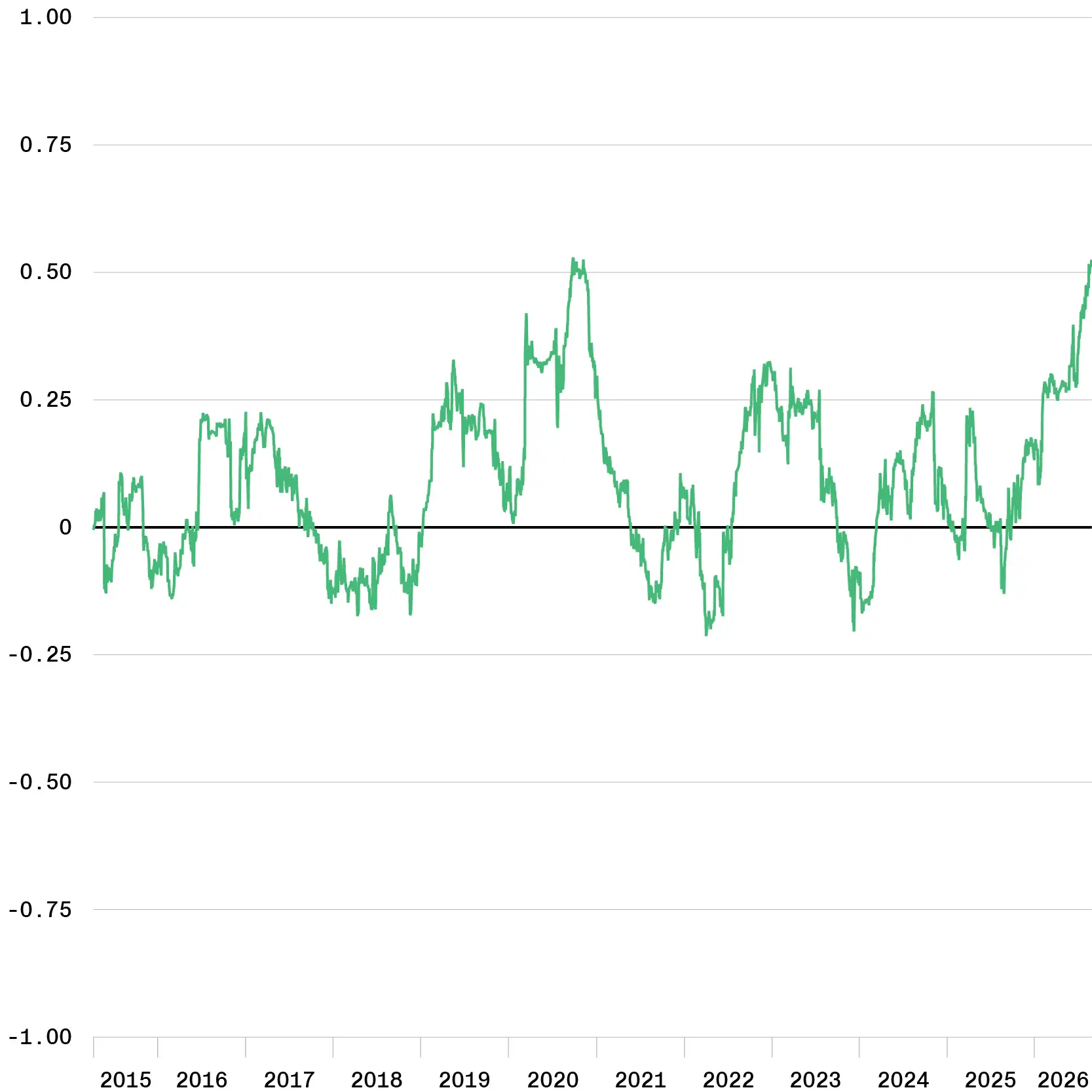
The 90-day rolling correlation of Bitcoin and gold, data source: Bitwise Asset Management, Bloomberg Terminal; statistical range: 2015-04-13 to 2026-08-31; gold uses spot price.
The last time the correlation between the two reached this level was during the pandemic in 2020, when global rounds of fiscal and monetary easing policies were implemented. In other words, the two historical phases of significant government intervention in macro markets coincidentally align with the two peaks in the correlation between Bitcoin and gold.
At the same time, the correlation between Bitcoin and U.S. stocks has fallen to a one-year low, indicating a decoupling between hard assets and the stock market. The notion that "Bitcoin is just a leveraged tech growth stock" may no longer hold true.
The correlation between Bitcoin and the U.S. stock market has dropped from high levels.
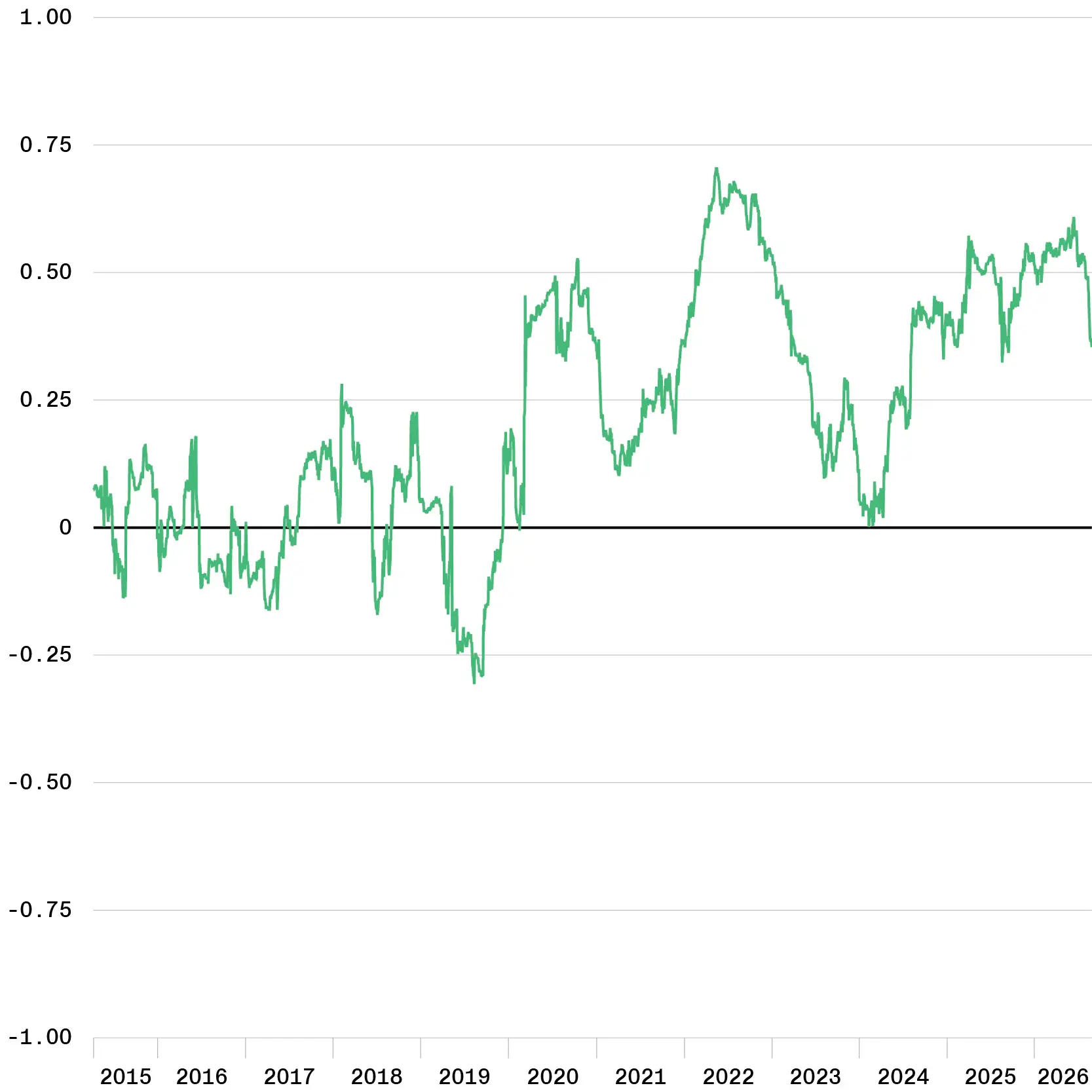
The 90-day rolling correlation of Bitcoin against the Nasdaq 100 index, data source: Bitwise Asset Management, Bloomberg Terminal; statistical range: 2015-04-13 to 2026-08-31; the benchmark uses the Nasdaq 100 total return index.
In addition, Bitcoin displays a significant negative correlation with the U.S. dollar index (DXY). When the dollar is under pressure and weakens, Bitcoin (and gold) tends to experience favorable conditions.
Bitcoin maintains a negative correlation with the U.S. dollar.
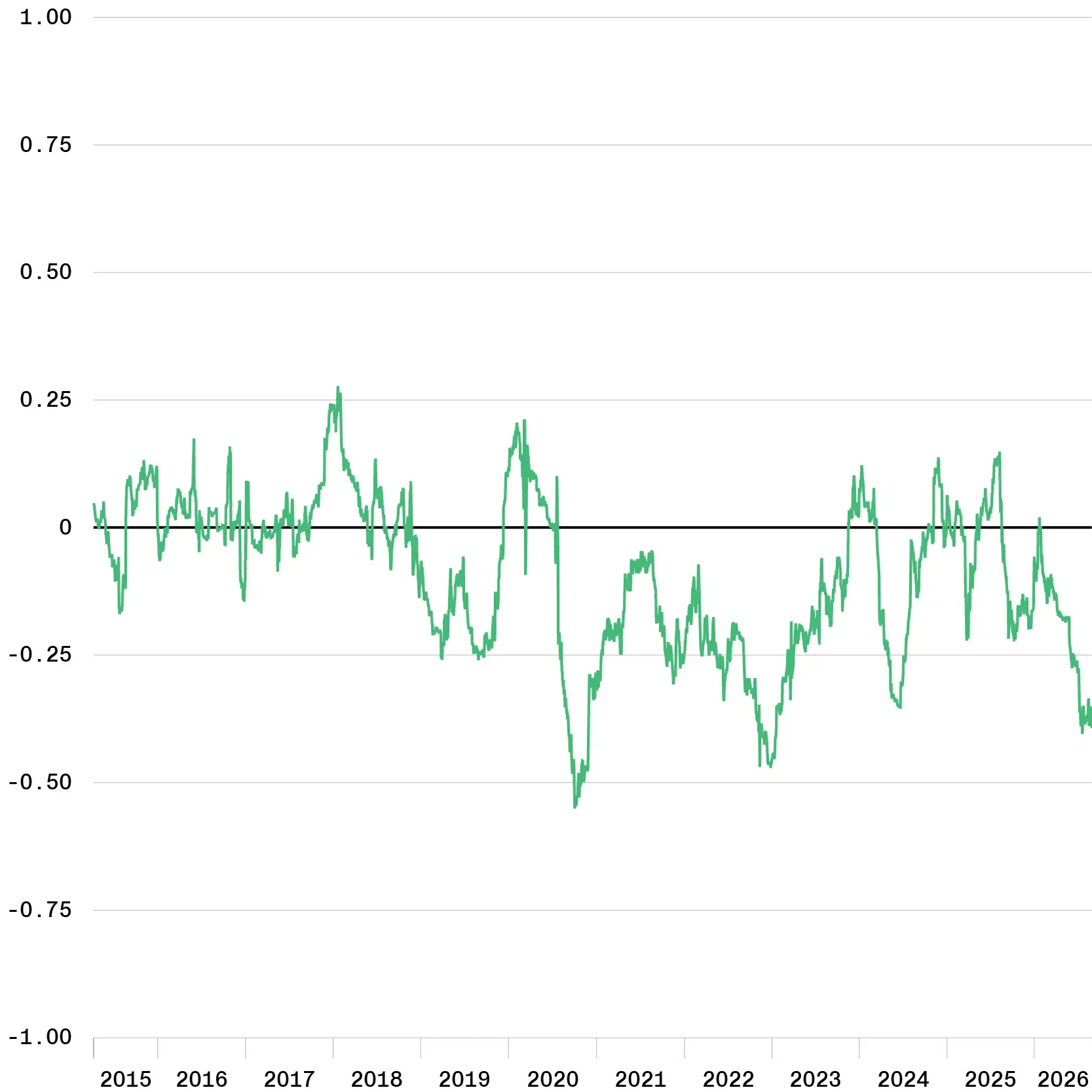
The 90-day rolling correlation of Bitcoin against the U.S. dollar index, data source: Bitwise Asset Management, Bloomberg Terminal; statistical range: 2015-04-13 to 2026-08-31; the dollar uses the U.S. dollar index DXY.
Bitcoin is a tool for hedging against currency depreciation
The data conveys a clear signal. First, Bitcoin is not equivalent to gold. Gold is a mature store of value asset that has been solidified over thousands of years; Bitcoin has existed for less than twenty years and belongs to a completely new category of innovation. When macro risks are no longer the focus of the market, the price trends of Bitcoin and gold will still exhibit clear differentiation.
However, once the macro situation becomes tense and macro variables impose strong constraints, investors' choice between gold and Bitcoin in response to currency depreciation risks is increasingly blurring. In such special circumstances, Bitcoin begins to behave as a more elastic version of gold.
Gold commands a vast market of around $30 trillion, primarily held by central banks, sovereign institutions, and large asset allocation institutions. This pool of funds significantly surpasses the venture capital and native crypto capital that primarily dominated Bitcoin's pricing in its early development. If Bitcoin officially enters this category of store of value assets, its valuation logic will then benchmark a much larger market standard.
The correlation data clearly indicates: investors are no longer torn between choosing gold or Bitcoin to hedge against currency depreciation, but rather are synchronously allocating both types of assets to hedge risks together. Over the past fifteen years, Bitcoin has been priced under the logic of a risk asset; if the strong correlation trend with gold can continue, its narrative of value may be completely rewritten over the next fifteen years.
免责声明:本文章仅代表作者个人观点,不代表本平台的立场和观点。本文章仅供信息分享,不构成对任何人的任何投资建议。用户与作者之间的任何争议,与本平台无关。如网页中刊载的文章或图片涉及侵权,请提供相关的权利证明和身份证明发送邮件到support@aicoin.com,本平台相关工作人员将会进行核查。


