Written by: Rita
The Goldman Sachs Communacopia Technology Conference will take place from September 8 to 11 in San Francisco, featuring 32 global tech companies. Goldman Sachs has released a preview of five major debate themes in the semiconductor industry ahead of the conference, covering digital computing, devices, storage, analog, and EDA software.
The core contradictions among the five themes point to the same direction: how long can the investment frenzy in AI infrastructure last and where are the constraints emerging. Goldman Sachs believes that the power and land supply for data centers, the availability of financing, the rise of open-source weight models, and the substitution of GPUs by custom chips will become the most discussed topics at this year's conference.
Digital Computing: AI Spending Resilience Faces Triple Constraints
Goldman Sachs believes that investors’ focus on digital computing and AI chips centers on five aspects: whether the availability of financing is sufficient to support the sustained construction of AI infrastructure, whether the physical availability of data centers (land, power, facilities) becomes a new bottleneck, the current stage of the adoption cycle for agent-based AI, the competitive landscape between open-source and closed-source models, and the competitive trends between commercial chips and custom chips.
Goldman Sachs expects a generally optimistic tone regarding AI demand from attending companies, emphasizing the strong spending environment from hyperscale vendors and the incremental demand brought by agent-based AI, while also noting that the ongoing decline in token costs and use cases such as coding have shown measurable returns on investment. However, Goldman Sachs also points out that as workloads become increasingly diverse, discussions about AI infrastructure will intensify, and how specialized accelerators can complement GPUs and CPUs by processing tasks more efficiently will be a key point of discussion.
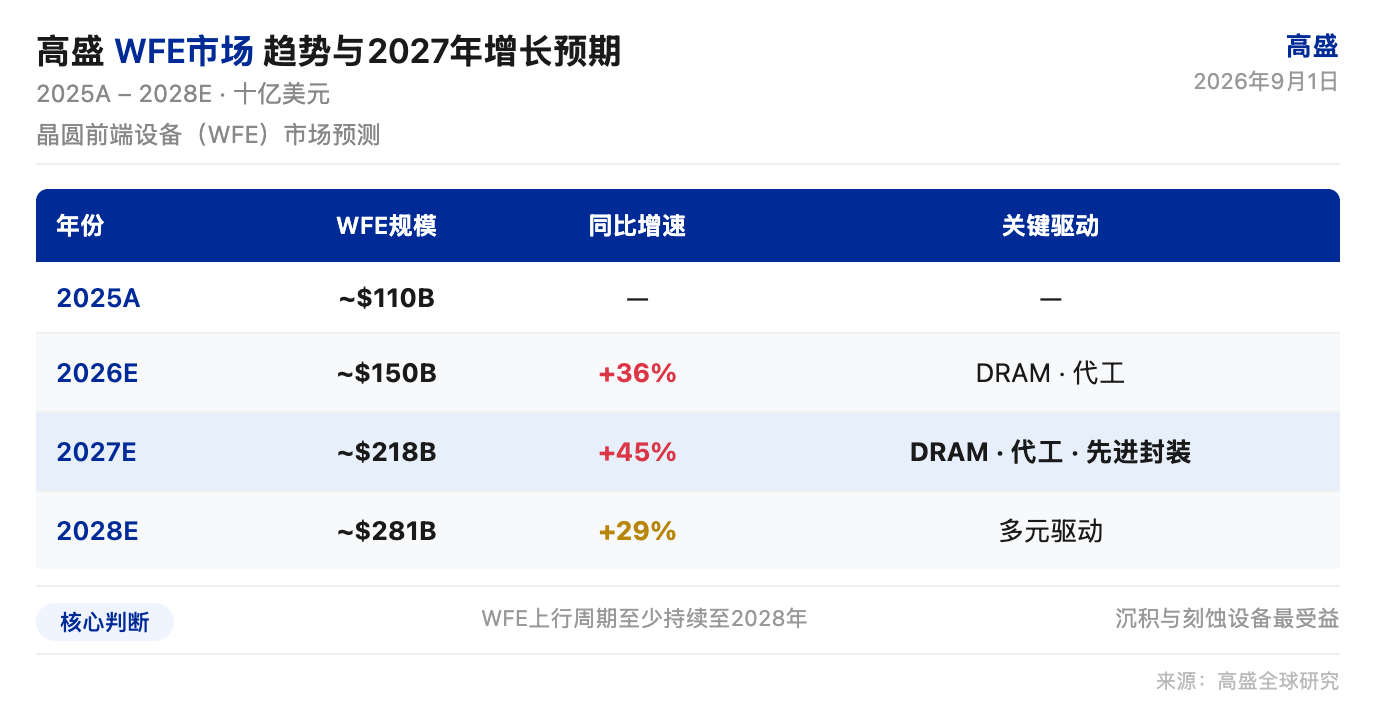
Semiconductor Equipment: Length of WFE Upcycle and Scale in 2027
The core debates in the semiconductor equipment sector revolve around three questions: whether the WFE growth rate can accelerate further from about 35% in 2026, whether the current upcycle can last beyond 2028, and the relative strengths and weaknesses of demand drivers such as DRAM, advanced process foundry, NAND, advanced packaging, and mature process.
Goldman Sachs estimates that attending companies hold an optimistic attitude towards WFE growth in 2027, with DRAM, advanced process foundry, and advanced packaging as the main driving forces. Whether non-traditional customers such as Terafab and Intel can become incremental sources will also be a focus for investors. Goldman Sachs' judgment is that the WFE upcycle will last at least until 2028, and companies most exposed in deposition and etching equipment will benefit the most, with recommendations for Applied Materials and Lam Research in Goldman Sachs' coverage.
Storage: Supply Increment in 2028 and Impact of Chinese Manufacturers
Investor debates in the storage sector focus on: how large the supply increment for DRAM and NAND will be in 2028, how Chinese manufacturers' expansion plans (Longsys DRAM, Yangtze Memory NAND) will affect supply-demand dynamics, the risks posed by memory content rationalization from AI chip and server suppliers, and the impact of capital return plans on valuations.
Goldman Sachs expects storage companies to maintain an optimistic tone following their Q2 reports, emphasizing that supply-demand tension will persist until 2027, while discussing the potential effects of Chinese manufacturers' expansions and attempts by companies like Nvidia to reduce memory content in specific AI server configurations. Goldman Sachs maintains a buy rating on SanDisk and Seagate, optimistic about the short-term supply constraints in the NAND market and the leading position of HAMR technology.
Analog: Can AI Data Center Demand Extend the Recovery Cycle?
The core debate in the analog chip sector is whether the demand for AI data centers constitutes a structural shift that extends the current recovery cycle, what the prospects for traditional end markets are, when a broader recovery in the automotive market will happen, and the impact of recent pricing actions on revenue and profit margins.
Goldman Sachs expects analog companies to emphasize strong end-market demand and improved revenue visibility, with extended delivery cycles, shipments aligning more closely with end demand, and recent pricing actions as key points of focus. Goldman Sachs believes that the analog industry is still in the early stages of a cyclical recovery, with shipments below trend over the past four years leaving plenty of space for recovery, and holds a positive view on NXP and SiTime.
EDA: Can the Custom Chip Trend Accelerate Industry Growth?
The debates in the EDA software sector revolve around two questions: can more chip customization drive accelerated revenue growth in the EDA industry, and can agent-based workflows contribute revenue incrementally?
Goldman Sachs expects Cadence to maintain an optimistic long-term outlook for the EDA and IP markets, with the growth of custom chip design demand and the adoption of agent-based AI tools as primary driving forces. Goldman Sachs believes that the shift toward custom AI chips exacerbates the structural shortage of chip design engineers, and the monetizable incremental opportunities for EDA companies through agent-based AI amount to approximately $3.7 billion annually (by 2030), a forecast not yet fully reflected in market consensus, which may start to materialize in the second half of 2026.
Behind the five major debate topics is a consistent logical thread: the scale of investment in AI infrastructure continues to expand, but market attention to sustainability, constraints, and the competitive landscape is intensifying. The constraints related to power and land for data centers, financing availability, Chinese manufacturers' expansions, and the substitution by custom chips, which were minor topics a year ago, have now become the core agenda of the conference. Goldman Sachs' judgment is that the fundamentals for AI spending remain strong, but the constraints are shifting from “whether there will be” to “how severe it is.”
Disclaimer
This article is a compilation and interpretation of third-party brokerage research reports (Goldman Sachs, September 1, 2026) by Chao Xiang Research, combined with public market information. The ratings, target prices, earnings forecasts, and related judgments quoted in the text are the opinions of the analysts of that brokerage firm and only represent the positions of their respective institutions, do not represent the views of Chao Xiang Research, and do not constitute any investment advice.
The market carries risks, and decisions should be made independently. This article should not be used as a basis for buying or selling any securities.
免责声明:本文章仅代表作者个人观点,不代表本平台的立场和观点。本文章仅供信息分享,不构成对任何人的任何投资建议。用户与作者之间的任何争议,与本平台无关。如网页中刊载的文章或图片涉及侵权,请提供相关的权利证明和身份证明发送邮件到support@aicoin.com,本平台相关工作人员将会进行核查。


