The AEP (Arbitrum Expansion Program) licensing fee is a new variable.
Written by: KarenZ, Foresight News
In the past few days, the fee revenue curve of the Robinhood Chain suddenly steepened. ArbData data shows that from August 31 to September 2, over just three days, the chain generated approximately $10.5 million in fee revenue, accounting for more than half of its total fee revenue since launch.
The excitement brought by Robinhood has also brought Arbitrum back into the market spotlight.
Apart from the excitement, how much cost is required to support a blockchain and its ecosystem for continuous operation, and how much income can be generated?
The latest report released by the Arbitrum Foundation for the first half of 2026 shows that during the reporting period, ArbitrumDAO earned $6.19 million in revenue, while the recorded dollar cost for the foundation was $27.70577 million, along with a cost of 4.6 million ARB.
This report provides a window to observe Arbitrum: on one side are the ongoing expenses from infrastructure, ecological cooperation, and developer projects; on the other side is the income generated from transaction fees, Timeboost, and the AEP licensing fees. The sudden heat brought by the Robinhood Chain has made one of the newer revenue lines begin to scale.
What are the sources of Arbitrum's revenue?
According to the foundation's explanation in the continuous financing proposal, the Arbitrum Foundation is the "growth engine and cost center" of the entire ecosystem: it is responsible for technical infrastructure, strategic cooperation, ecological funding, governance support, and bears the operational costs related to Arbitrum One and Arbitrum Nova; at the same time, the income generated by the protocol is directly allocated to the ArbitrumDAO treasury, and the foundation needs to regularly apply for funding from the DAO.
Therefore, the $6.19 million in the report corresponds to the revenue attributable to ArbitrumDAO in the first half of 2026, sourced from Arbitrum One transaction fees, Timeboost, Arbitrum Expansion Program (AEP) licensing fees, and treasury returns. The report states that the gross margins for these revenue streams are all above 97%; as of June 2026, the DAO also held approximately $125 million in non-native token assets (excluding ARB).
As of June 30, the foundation held liquid and usable assets worth approximately $86.8809 million.
Where did the costs for the half year go?
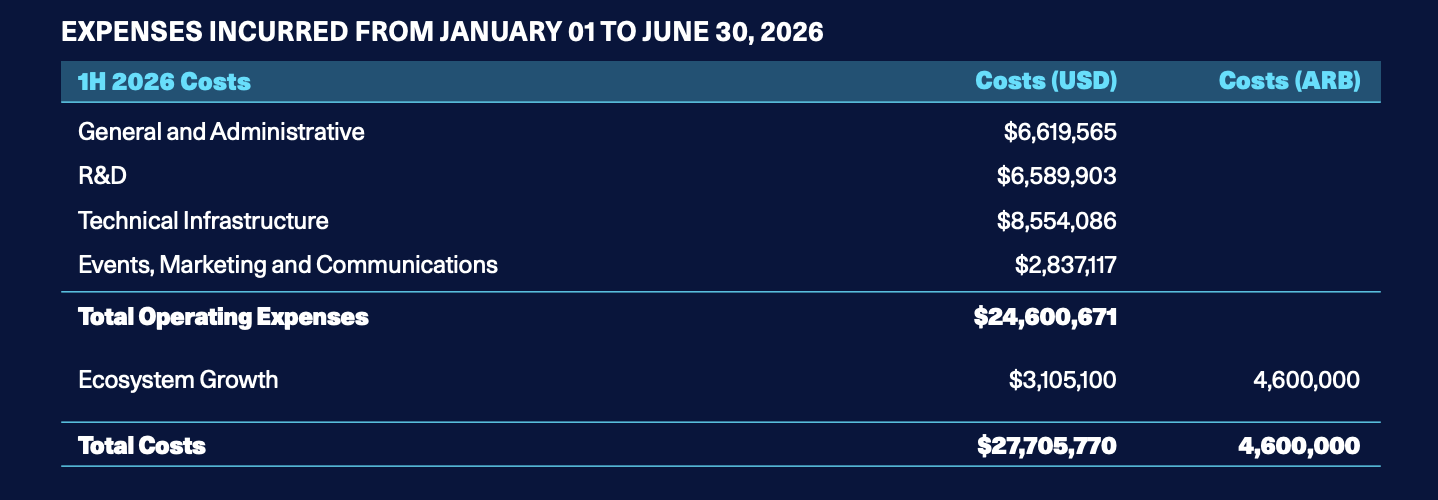
The report shows that from January to June 2026, the foundation's total dollar costs were approximately $27.7 million, along with a cost of 4.6 million ARB.
Among these, the dollar operating expenses were about $24.6 million, mainly divided into four parts: technical infrastructure $8.55 million, the largest single expenditure; general and administrative expenses $6.619565 million; R&D expenses $6.589903 million; and activities, marketing, and communication expenses $2.837117 million. Furthermore, the ecological growth projects recorded costs of $3.1051 million and 4.6 million ARB.
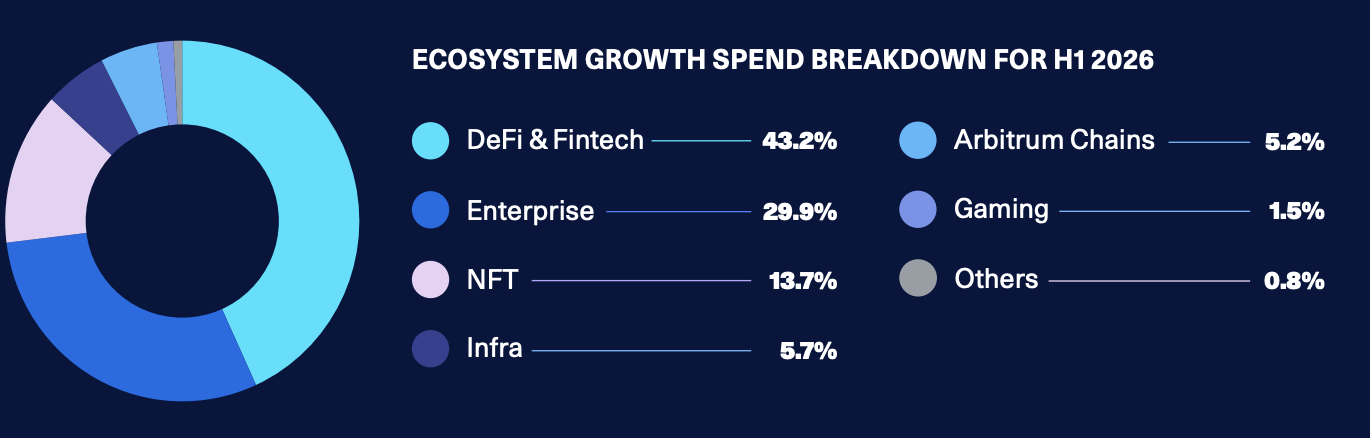
Looking at the direction of the ecological growth funding, DeFi and fintech account for 43.2%, and enterprise business accounts for 29.9%, totaling 73.1%. The remaining funds flow to NFT, infrastructure, Arbitrum Chains, gaming, and other fields. This indicates that the foundation focused its ecological funds mainly on financial applications and enterprise adoption during the reporting period, rather than distributing evenly across all tracks.
The foundation also emphasized that most of its cooperative funds are disbursed based on project milestones. In the first half of the year, a total of 43 cooperations were evaluated, with 11 approved and 32 rejected, yielding an approval rate of about 26%; less than $200,000 was advanced without milestone requirements. As of the end of June, the foundation had a total of 29 signed and ongoing collaborations, of which 20% completed their first payment milestone during the first half of the year.
How much money does the foundation have left?
As of June 30, 2026, the foundation disclosed that its total "liquid and usable assets" amounted to $86.88 million.
Among these, fiat currencies, stablecoins, and RWA products accounted for $50.529435 million, or 59%; approximately 427 million unlocked ARB, valued at $32.476878 million at the day's market price, accounted for 37%; other tokens valued at $3.874595 million, accounting for 4%.
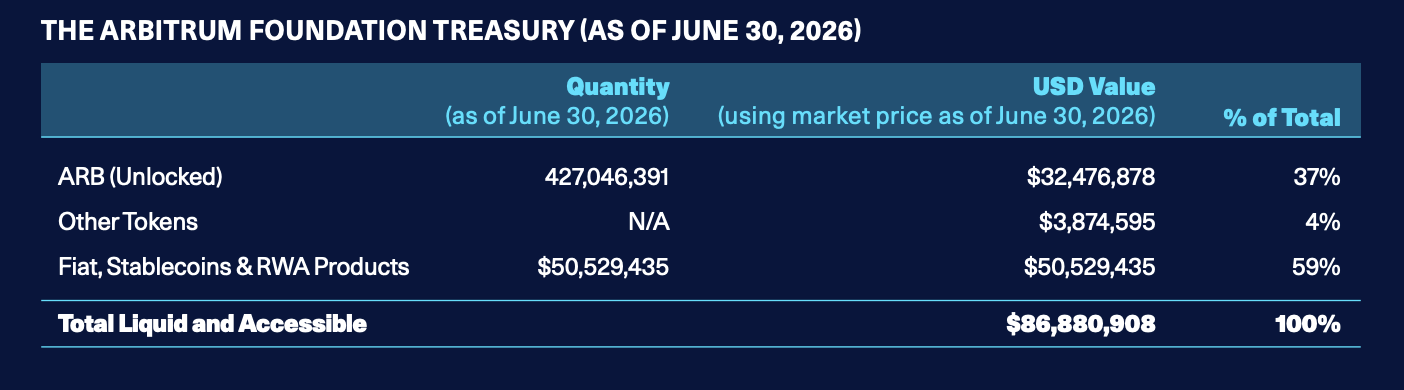
This snapshot of assets indicates which liquid assets the foundation held at that time, but it is insufficient to compute the complete cash consumption cycle alone: the report does not fully list liabilities, unpaid contractual commitments, and future disbursement rhythms on the same table, and the specific allocations of some strategic cooperations are not disclosed.
The report's footnote also indicates that the relevant balance includes the assets involved in the ongoing financing proposal approved by the DAO on June 25. This proposal requested $16 million (to be paid in RWA and stablecoin), 1,740 ETH, and 230 million ARB funds, which had a total value of approximately $43.5 million at that time, to support operations in 2027. The foundation also stated that the requested amount is less than its projected total demand for 2027, and the shortfall will be supplemented by existing assets and ETH obtained from the application.
Arbitrum's half-year business report card
If only looking at the expenditure sheet, it is difficult to determine where the funds ultimately flowed. Combining the entire report, the foundation's investments roughly correspond to five directions: network and financial activities, institutional collaborations, project support, developer ecology, and technical infrastructure. It is essential to emphasize that the following data reflects business progress during the same period, and does not independently prove that each growth item is directly driven by the foundation's investment.
On the network level. In the first half of 2026, Arbitrum processed approximately 478 million transactions, accounting for about 18% of the then 2.7 billion historical cumulative transactions; the average monthly transfer volume of stablecoins exceeded $70 billion, with the number of stablecoin holders increasing by 40% to 10.5 million. The scale of outstanding derivatives contracts grew by 434% within six months, peaking at $1.5 billion. During the same period, Arbitrum had 1,142 active projects, ranking among the top three blockchain networks by protocol count.
RWA and institutional business are the growth areas most prominently showcased in the report. The report stated that Arbitrum, with over 2,000 deployed RWA assets, ranks first in RWA deployment quantity.
In addition to Robinhood Chain, LG Electronics announced its advertising network on the Arbitrum pilot chain, Mastercard expanded its stablecoin settlement support for assets on the Arbitrum chain, and the PYUSD issued by PayPal saw its scale on Arbitrum reach $475 million in the first quarter.
In terms of specific projects, the active loan scale of USD.ai increased from about $500,000 to $188 million; Spiko's TVL on Arbitrum rose from $270 million to about $500 million. The cumulative trading volume of the perpetual contract project Variational surged from $3.75 billion to $16 billion.
In terms of project support, the foundation evaluated 43 cooperation opportunities in the first half of the year, approving 11, rejecting 32, and yielding an approval rate of about 26%. As of June 30, the foundation had a total of 29 cooperations that have been signed and are still in progress, of which 20% completed their first payment milestone during the reporting period. The foundation stated that its cooperative funds are mainly disbursed according to milestones, with less than $200,000 advanced without milestone conditions in the first half of the year.
Additionally, 112 applications were received for ArbiFuel, which subsidizes new user transaction fees, ultimately approving and onboarding 19 teams, with an acceptance rate of 17%; the foundation committed to providing these teams with a Gas quota of $94,500, sponsoring a total of 272,453 user operations. In comparison to a 35% acceptance rate in 2025, the screening criteria for 2026 tightened significantly, which the foundation explained as placing more emphasis on the project’s execution readiness.
The screening for security investments was also more stringent. The Arbitrum Audit Program received 194 applications in the first half of the year, approving only 7 teams, with an acceptance rate of about 4%; as of the end of June, the program had committed approximately $1.42 million in funding, completed audits of 9,168 lines of code, and discovered 50 vulnerabilities. As some audits are still awaiting initiation or in business communication stages, the report anticipates that the committed amount may later rise to about $2 million.
In terms of developer support, the online New York Open House event and the offline Founder House received a total of 1,041 developer applications, leading to 183 projects, and distributed $300,000 in prizes and funding. The subsequent London event received a total of 1,348 applications, leading to 342 projects and allocated $415,000 in prizes and funding. Due to the London Founder House data being counted until July 12, some results have already exceeded H1 and cannot all be counted as accomplishments completed in the first half of the year.
The foundation also launched its first equity-free acceleration program, receiving 902 applications and ultimately selecting 13 teams, resulting in an acceptance rate of 1.4%. Of these, 10 teams completed Demo Day on July 7. Follow-up data provided by the report indicates that within a month after graduation, 5 teams have gone live on Arbitrum or Robinhood Chain, and 3 teams collectively raised $1.2 million. These also belong to follow-up developments provided prior to the report's release rather than completed H1 data as of June 30.
In terms of technical investments, ArbOS 61 Elara has been approved by the DAO and implemented. The upgrade increases the maximum size limit of Stylus smart contracts from 24KB to 96KB, adds support for priority fees needed for future preferential Gas auctions, and provides Arbitrum Chains with alternative data availability interfaces and optional compliance infrastructure.
The report also lists research and development directions for protocol-level compliance, privacy architecture, ZK settlement, yield-bearing cross-chain bridges, and real-time sorter data. However, these projects remain in development stages, and future protocol upgrades will require governance approval from ArbitrumDAO.
AEP licensing fees are becoming a new revenue variable
Current revenues for ArbitrumDAO include Arbitrum One transaction fees, Timeboost, Arbitrum Expansion Program (AEP) licensing fees, and treasury income.
Notably, the AEP allows enterprises or projects to build dedicated chains using Arbitrum technology and return some of the protocol's revenue to the Arbitrum ecosystem. This expands Arbitrum's income sources from a single mainnet to multiple independently operated ecological chains.
Robinhood Chain is currently the most closely watched example of the AEP model. This chain went live on the mainnet on July 1, 2026, just one day after the end of the H1 reporting period, so its mainnet revenue does not belong to the financial data for the first half of the year.
According to the licensing arrangement announced by Arbitrum, Robinhood Chain is required to allocate 10% of its net protocol income for AEP distribution, with 8% going to the ArbitrumDAO treasury and 2% to the Arbitrum Developer Guild. According to the statistical criteria employed by ArbData's economic panel, on-chain fee revenue is first deducted for costs submitted to Ethereum, resulting in net protocol income; of this, 90% is retained by the Robinhood Chain, and 10% is counted as AEP licensing fees.
Recently, the revenue growth curve of Robinhood Chain has been quite steep. By August 30, 2026, this chain had accumulated fee revenue of about $8.118 million; from August 31 to September 2, it generated approximately $2.177 million, $3.833 million, and $4.486 million in fee revenue respectively over three days, adding up to about $10.496 million.
As of September 2, Robinhood Chain's accumulated fee revenue reached approximately $18.614 million, with accumulated Ethereum costs of about $42,000. After deduction, the net protocol income was approximately $18.572 million. Based on the 10% AEP distribution, Arbitrum's ecosystem corresponds to approximately $1.8572 million, with about $1.486 million corresponding to the 8% share of ArbitrumDAO and about $371,000 corresponding to the 2% share of the Developer Guild.
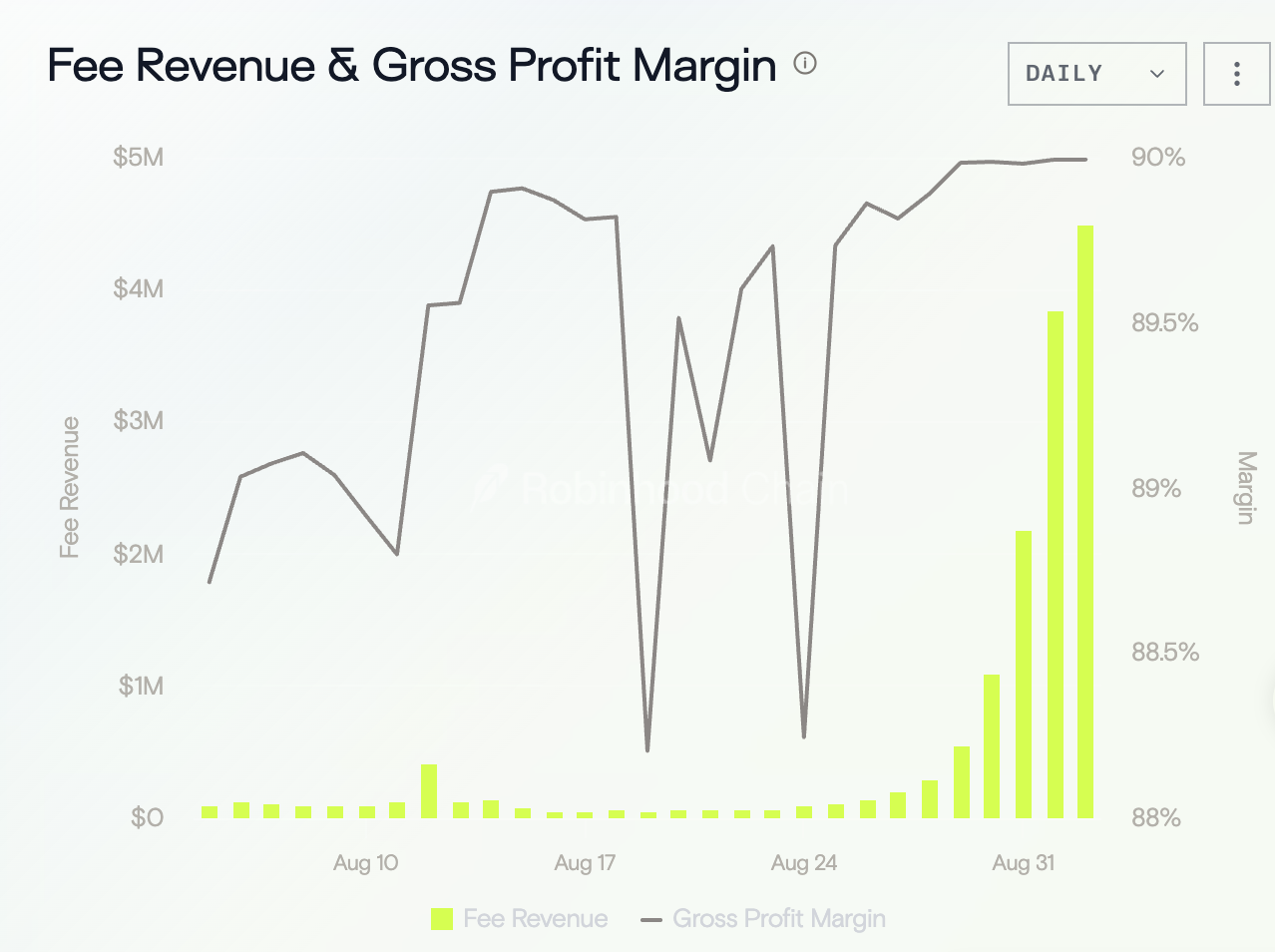
Revenue situation of Robinhood Chain, source: ArbData
The impact of Robinhood on Arbitrum, therefore, is not just brand exposure. A more direct change is that AEP licensing fees are beginning to shift from a smaller new revenue to a business line that could affect DAO revenue composition. The more active the trading on Robinhood Chain, the higher the net protocol income, and the amounts flowing to ArbitrumDAO and the Developer Guild will increase accordingly.
However, currently, over half of the accumulated fee revenue is concentrated in the last three trading days, and short-term data is still insufficient to prove that this level of revenue can be maintained long-term. What is more worth observing next is whether the Robinhood Chain can maintain stable trading volume after the excitement recedes and whether other Arbitrum Chains can replicate this model.
If more dedicated chains by enterprises can generate sustained licensing fees, the significance of Robinhood will shift from a one-time popular collaboration to a practical case of revenue structure expansion for Arbitrum.
免责声明:本文章仅代表作者个人观点,不代表本平台的立场和观点。本文章仅供信息分享,不构成对任何人的任何投资建议。用户与作者之间的任何争议,与本平台无关。如网页中刊载的文章或图片涉及侵权,请提供相关的权利证明和身份证明发送邮件到support@aicoin.com,本平台相关工作人员将会进行核查。


