Original |Odaily Planet Daily(@OdailyChina)
Author|Golem(@web3_golem)
On the evening of September 2, Robinhood Chain put on a good show. The meme coin JINQIAN saw its market cap soar to 80 million dollars within an hour of opening, only to plummet to 10 million dollars in the next hour; as of the time of publication, JINQIAN's market cap was only about 3 million dollars left. Whether it is financial freedom or losing the principal seems to be just a thought away.
Buying stocks to issue memes? A tailored scam in the crypto circle
To clarify what exactly happened in those two hours, we must start with a post from overseas KOL Rune.
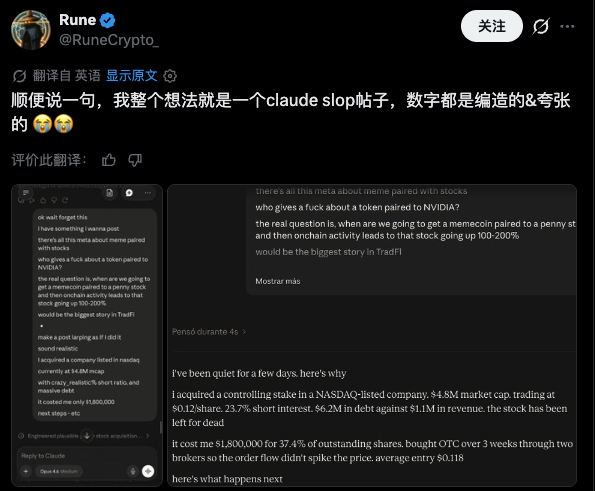
On September 1, Rune wrote that he spent 1.8 million dollars to acquire 37.4% of a Nasdaq-listed company, which had a market cap of 4.8 million dollars, a stock price of 0.12 dollars, and a short ratio of 92.3%. His plan was to tokenize the company's stock for deployment on Robinhood Chain, and then issue a meme coin paired with it; as long as the community traded the meme coin, the demand would flow to the stock token, thereby influencing the issuer to purchase an equivalent amount of real U.S. stocks to drive the stock price up and create a short squeeze in the stock market.
Just this idea sent countless meme players into ecstasy, as it perfectly matched the public's gratifying narrative of "retail investors beating institutions", "crypto defeating Wall Street", "the poor kid turning into a shining hero after rebirth", so the community was waiting for such a coin to appear. A day later, JINQIAN was born.
JINQIAN was paired with the stock token FAMI; Farmmi (FAMI) is a Nasdaq-listed company that primarily sells mushrooms. As JINQIAN's market cap rose, the price of the on-chain stock token FAMI increased, with Farmmi (FAMI) stocks rising to a maximum of 0.47 dollars during U.S. stock trading, a more than 300% increase within an hour.
It was expected that JINQIAN would be the next GameStop, but unexpectedly, it turned out to be a custom scam tailored for retail investors in the crypto circle.
Although the name of the FAMI token is the same as the stock code of Nasdaq-listed Farmmi, it is not the official tokenized stock, and it is not included in the official contract list of Robinhood. In other words, when trading JINQIAN drives up the demand for FAMI, the issuer behind it may have completely failed to buy Farmmi (FAMI) stocks on the stock market; the short squeeze logic envisioned by Rune did not materialize.
After JINQIAN's sudden crash, Rune, who was still demanding community airdrops, quickly posted a clarification, stating that the tweets about acquiring a U.S. listed company were all generated by Claude as “AI slop post”, entirely fabricated.
All predictions right, all processes wrong
Rune's clarification was, of course, to protect himself, as investors who incurred losses were already preparing to contact the FBI to arrest him. Not to evaluate Rune for now, the real question is: since the trading demand for the FAMI stock token triggered by JINQIAN did not transmit to the real stock market, who drove up the price of Farmmi (FAMI) stock?
The answer remains the crypto meme players. The "smart" crypto players wanted to make a move before the market makers and Wall Street elites were "forced" to buy Farmmi (FAMI) stocks, and proactively bought it first. Farmmi (FAMI) is a small-cap stock; retail investors' purchases were enough to make its price soar over 3 times.
The Chinese KOL 0xSun later analyzed and said that under normal circumstances, the logic of on-chain stock short squeezes is that retail investors who do not hold stock tokens buy meme coins, pushing up the price of stock tokens that act as underlying assets in the liquidity pool; market makers buy the real stocks due to arbitrage opportunities, converting and minting those stocks into on-chain tokenized stocks, thus re-anchoring the price; the act of market makers buying real stocks drives up their prices, generating a short squeeze.
However, the situation of JINQIAN/FAMI was not the same; non-compliant project parties issued the FAMI token on-chain while retaining minting authority, and the liquidity pool may not have been locked; FAMI is essentially just an on-chain token with the same name as Farmmi (FAMI). Due to the extremely low market cap of the FAMI company itself, it triggered on-chain sentiment, causing retail investors to buy JINQIAN like crazy, which boosted the price of FAMI as the underlying asset. Some retail investors further sought to directly buy Farmmi (FAMI), which led to the stock price increase.
Therefore, the rise in Farmmi (FAMI) stock price is a typical case of having the right results but the wrong processes.
Is the meme coin paired with stocks a false proposition for a short squeeze?
Language can describe reality and shape reality. Does the narrative of “meme coins squeezing Wall Street” really hold, or is the meme community just hammering away looking for nails?
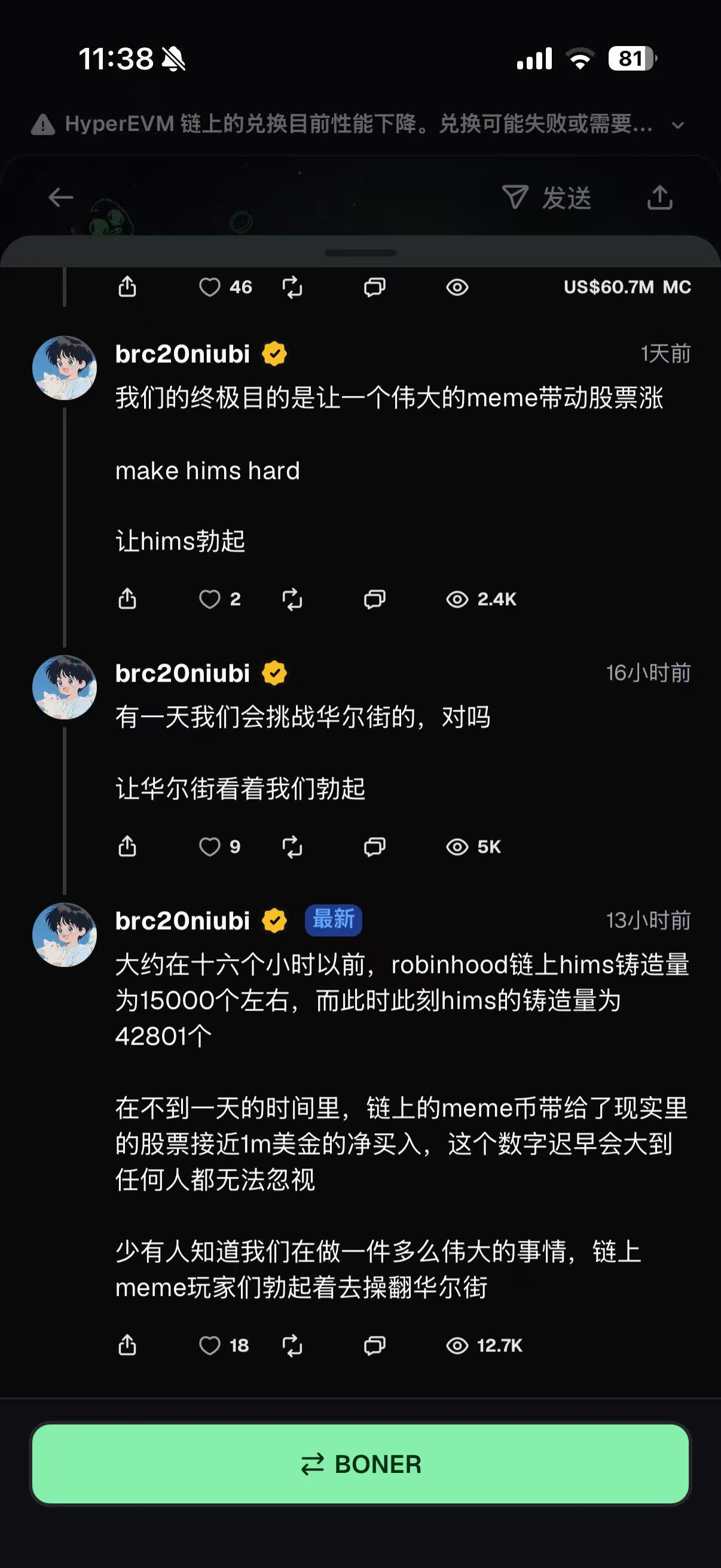
Apart from scams like JINQIAN, other meme coins paired with stock tokens have recently also used the narrative of “meme coins squeezing Wall Street,” the most typical being BONER, with a market cap currently reported at 44 million dollars. BONER is paired with the stock token HIMS, Hims (HIMS) is a company that primarily sells male enhancement drugs. The Chinese Meme KOL Wang Xiaoli actively promoted BONER, stating that its ultimate goal is to make memes drive stock prices up into reality and challenge Wall Street.
Using meme coins to boost the price of their linked stock tokens is essentially a roundabout and inefficient form of market manipulation: its so-called “flywheel effect” is merely market makers or project parties leveraging the speculative impulses of retail investors, injecting the latter's funds into the real stock market to create short-term price discrepancies. However, this demand driven by emotion lacks fundamental support and is extremely fragile; even though the tokens may at one point show significant premiums over the real stocks, they will eventually rapidly anchor back to the real stock prices due to arbitrage and value return mechanisms.
There is only one issuer of stock tokens on Robinhood Chain, and that is Robinhood itself; only authorized participants (AP) can directly subscribe/redeem from Robinhood. When APs subscribe to stock tokens from Robinhood, the funds transmitted to the real stock market are not real-time either; they are constrained not only by U.S. stock trading hours but also by compliance, settlement, custody, and other procedural processes.
Therefore, the logic of stimulating market makers or issuers to buy stocks through so-called meme coin trading demand faces the first reality: the on-chain meme sentiment ended in FOMO within a few hours, while the fund transmission has not yet begun.
Of course, whether the logic of “meme coins squeezing Wall Street” holds in reality may not be important for meme players—Wang Xiaoli has already made over 800,000 dollars on BONER, with a cost of only 226 dollars.
The fastest way to unite the masses in this world is to establish a common enemy, even if it is just a fictional enemy. For retail investors, Wall Street/institutions have always been that "enemy"; making money from or forcing them to do something is always exciting.
But when paying for the “great narrative,” don’t forget that you are in the meme trenches, where there are no brothers, only devils “pouring” onto each other.
免责声明:本文章仅代表作者个人观点,不代表本平台的立场和观点。本文章仅供信息分享,不构成对任何人的任何投资建议。用户与作者之间的任何争议,与本平台无关。如网页中刊载的文章或图片涉及侵权,请提供相关的权利证明和身份证明发送邮件到support@aicoin.com,本平台相关工作人员将会进行核查。