The current probability of a rate hike in September is about 70%, but the final conclusion must await next week's CPI release.
Written by: Dong Jing, Wall Street View
Wall Street is closely watching the upcoming August non-farm payroll report, but Bank of America has issued a new warning: don’t be misled by the non-farm report, as it is merely an appetizer; the real critical factor for a rate hike by the Federal Reserve in September lies in the subsequent CPI data.
According to Wind Trading Desk, Bank of America pointed out in its latest interest rate and foreign exchange research report released on September 2nd that the August non-farm payroll data is merely a "warm-up," and the key variable determining whether the Federal Reserve will raise rates in September is the upcoming CPI inflation data.
The report states that Bank of America expects only 40,000 jobs added in August (35,000 in the private sector), significantly below market consensus, while the unemployment rate remains at 4.1%. Federal Reserve Chairman Waller mentioned at the Jackson Hole annual meeting that inflation-related terms appeared about twice as frequently as labor market terms, clearly indicating that inflation is currently the core anchor of monetary policy. The probability of a rate hike in September is currently about 70%, but the final conclusion must wait for the release of next week's CPI and PPI data.
The bank believes there is an extremely asymmetric risk-return ratio in the current market: the rebound in US Treasuries following worse-than-expected non-farm data will far exceed the selling pressure induced by better-than-expected data. Based on this, Bank of America recommends investors go long on 5-year US Treasuries, construct a 5-year/30-year yield curve steepening trade, and tactically short the dollar.
August Non-Farm Payroll Predictions: Seasonal Weakness, but Unemployment Rate Expected to Remain Stable
Bank of America forecasts 40,000 jobs added in August (35,000 in the private sector), below market consensus but consistent with the historical trend of seasonal weakness in summer. Historical data shows that August non-farm payroll data tends to present downward surprises, especially in recent years influenced by residual seasonal factors from summer, while ADP data has also consistently shown weakness.
Nevertheless, the 3-month average for private sector employment will remain at about 30,000, close to the economic breakeven level. The unemployment rate (U3) is expected to hold at 4.1%, but if the labor force participation rate rebounds, it may rise to 4.2%.
Bank of America clearly points out that, given Waller's latest remarks on the resilience of the labor market, even if the non-farm data is weak, the impact on September's rate hike pricing will be quite limited.
Waller's Jackson Hole Speech Sets the Tone: Inflation Takes Priority Over Employment
Bank of America's analysts conducted a frequency count of Waller's speech at the Jackson Hole meeting, yielding compelling results: inflation-related terms (including inflation, prices, price stability, PCE, CPI, and inflation expectations) appeared a total of 61 times, while labor market-related terms (including labor, employment, unemployment, jobs, wages, and workers) appeared only 30 times, with the former being about twice as frequent as the latter.
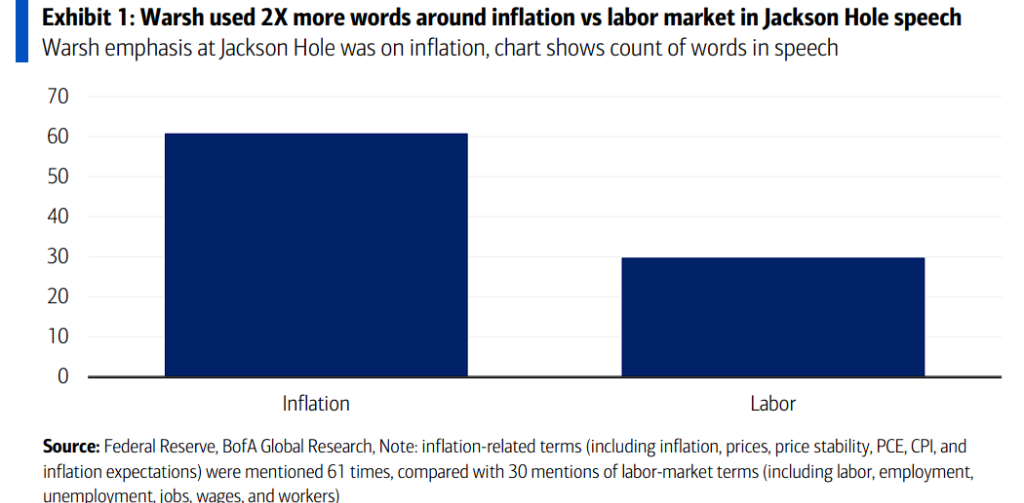
This data directly reveals the current policy priority order of the Federal Reserve: inflation is prioritized over employment. In his speech, Waller described the current labor market as nearing full employment, emphasizing the stability of unemployment claims and the unemployment rate, rather than viewing the weak job addition numbers as significant risk signals.
This means that even if the August non-farm data is weak, the impact on September's rate hike expectations will be quite limited.
Asymmetric Game in the Interest Rate Market: Non-Farm is Just the "Opening Act," CPI is the "Main Show"
In Bank of America's view, non-farm data is at best just the "opening act," while next week’s CPI is the "main show" that will determine the direction of the September FOMC meeting.
It is worth noting that Bank of America has highlighted a key timing window: the August non-farm report is the last important data point before Federal Reserve officials enter the "silent period."
This means that after the non-farm data is released, Fed officials will have a brief opportunity to publicly express their views on the policy implications of labor market data. However, by the time the CPI data is released next week, officials will have entered the silent period and will be unable to provide further guidance to the market.
Therefore, any comments from Federal Reserve officials after the release of non-farm data will have an unusually significant impact on the market’s interpretation of CPI data and the formation of September policy expectations.
Regarding the current interest rate market, Bank of America's core judgment is that the impact of non-farm data on the interest rate market shows obvious asymmetry.
Specifically:
If the unemployment rate rises to 4.2%, the yield on 2-year US Treasuries is expected to decline by 5 to 12 basis points, while the yield on 10-year bonds is expected to decline by 5 to 10 basis points;
If the unemployment rate drops to 4.0%, the yield on 2-year US Treasuries is expected to rise by 5 to 6 basis points, while the yield on 10-year bonds is expected to rise by 5 to 8 basis points;
If the unemployment rate remains at 4.1%, the yields across different maturities will fluctuate in both directions by about 5 basis points.
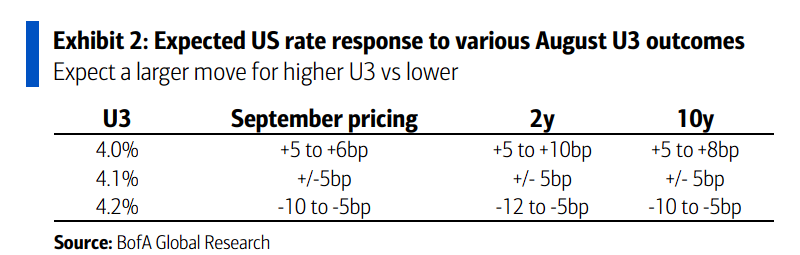
This asymmetry is underpinned by two kinds of logic: first, CTAs (Commodity Trading Advisors) and actively managed bond funds are currently holding a relatively bearish duration exposure, which means that the market is more likely to trigger short covering upon disappointing data; second, even if non-farm data is strong, it is not sufficient to completely lock in a rate hike in September, as the market still harbors uncertainties before the CPI is released.
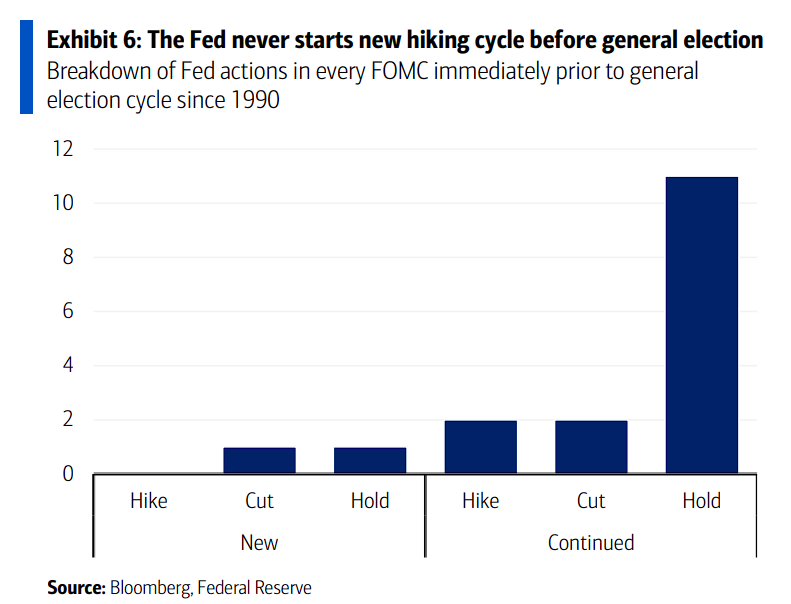
Additionally, historical patterns also constrain rate hike timing. Bank of America pointed out an important political calendar constraint: since 1990, the Federal Reserve has never initiated a new round of rate hike cycles during an FOMC meeting that is closely adjacent to a national election. If there is no rate hike in September, the next "active" meeting window may be delayed until December, as the October meeting is too close to the midterm elections.
Trade Strategy and Forex Outlook: Go Long on 5-Year US Treasuries, Tactically Short the Dollar
Based on the aforementioned asymmetric risks and the reshaped credibility of the Federal Reserve, Bank of America recommends going long on 5-year US Treasuries and constructing a 5-year/30-year yield curve steepening trade. Bank of America expects that weak non-farm data will lead to a bull steepening of the yield curve, while strong data will result in bear flattening.
In terms of foreign exchange, Bank of America’s judgment is consistent with its interest rate strategy logic: the dollar faces asymmetric risks, with greater downside potential than upside potential in scenarios of equal magnitude for data beating or falling short of expectations.
Under the current backdrop, the probability of a rate hike in September is priced at about 70%, speculative long positions in the dollar (IMM data) are still in a net long state, but recent US economic data has continued to show weakness. Bank of America notes that this summer's dollar performance is more driven by US policy events rather than actual data.
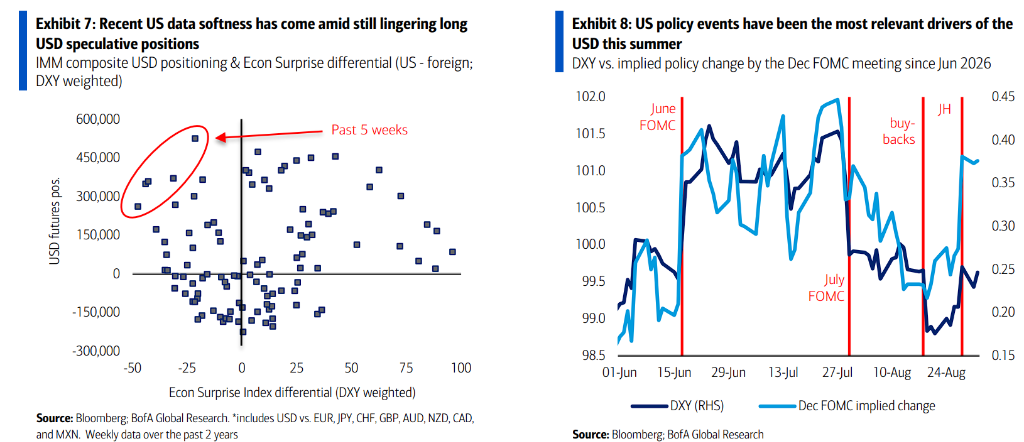
Bank of America also points out that the repricing of the dollar after Jackson Hole showed delays, possibly reflecting the ongoing bearish sentiment brought by the foreign bond repurchase announcement in late August.
If the Fed finally raises rates, it will effectively suppress the narrative of "dollar depreciation"; if it falls back into the dovish pattern of the July FOMC, then the credibility rebuilt at Jackson Hole will quickly collapse, and the dollar will subsequently decline.
免责声明:本文章仅代表作者个人观点,不代表本平台的立场和观点。本文章仅供信息分享,不构成对任何人的任何投资建议。用户与作者之间的任何争议,与本平台无关。如网页中刊载的文章或图片涉及侵权,请提供相关的权利证明和身份证明发送邮件到support@aicoin.com,本平台相关工作人员将会进行核查。


