Cryptocurrency exchanges are turning traditional financial assets into the next trillion-dollar contract market
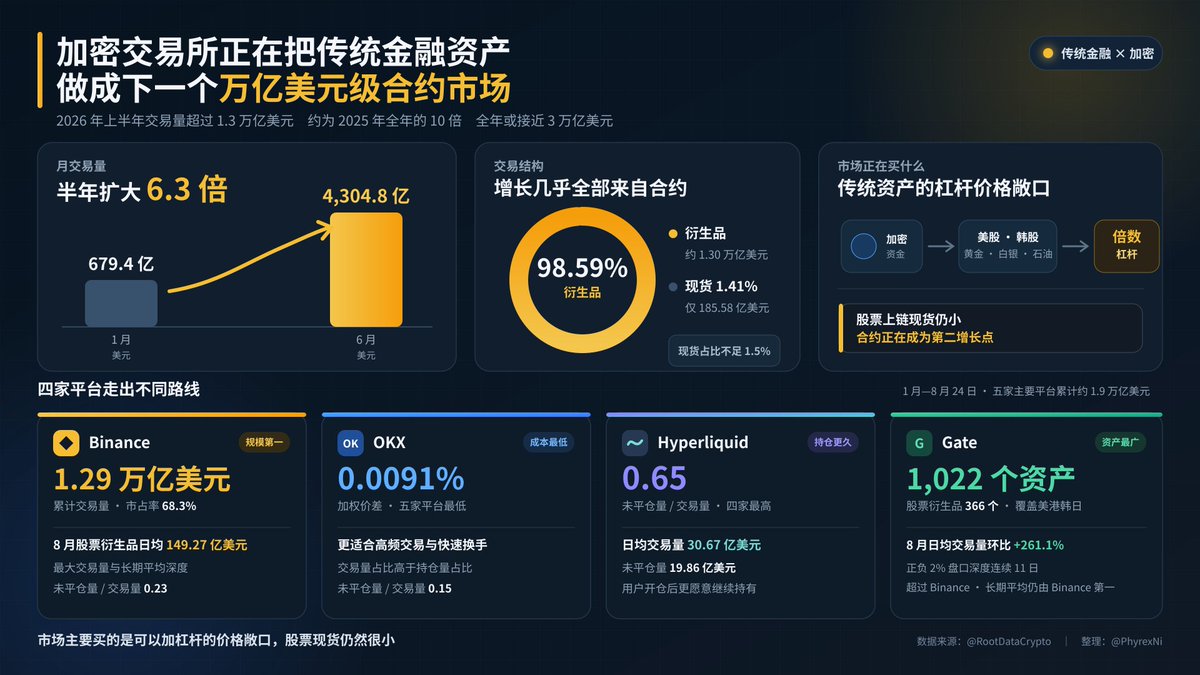
According to data from @RootDataCrypto, in the first half of 2026, the trading volume of traditional financial assets on top cryptocurrency exchanges has already exceeded $1.3 trillion, which is about 10 times that of the entire year of 2025.
The trading volume in January was only $67.94 billion, but by June it had grown to $430.48 billion, expanding 6.3 times in half a year. If this growth rate continues, the annual trading volume for 2026 could approach $3 trillion.
However, of this $1.3 trillion, 98.59% comes from derivatives, with the spot trading volume only at $18.558 billion, accounting for less than 1.5%.
Therefore, the main source of growth in the trading of U.S. stocks, Korean stocks, gold, and silver on cryptocurrency exchanges still comes from contracts. Users gain exposure to the prices of traditional financial assets, while the scale of actually holding tokenized stock in spot trading is still very small.
From January to August 24, the cumulative trading volume of traditional financial assets on five major exchanges was approximately $1.9 trillion, with @binance accounting for $1.29 trillion, representing 68.3%, making it still the largest trading platform.
Binance maintains its advantage based on the largest trading volume and open interest, with the average daily trading volume of stock derivatives reaching $14.927 billion in August.
Ranking second, @okx's advantage lies primarily in trading costs, with a weighted spread of only 0.0091%, the lowest among the five platforms, but its open interest percentage is significantly lower than its trading volume percentage, indicating that users prefer high-frequency trading and quick turnarounds.
Third-placed @HyperliquidX has an average daily trading volume of about $3.067 billion in stock derivatives, while its open interest reaches $1.986 billion, with the ratio of open interest to trading volume being approximately 0.65, much higher than Binance's 0.23 and OKX's 0.15. This indicates that users prefer to hold positions once opened, demonstrating a stronger capacity for capital retention.
The next @Gate has chosen to expand its asset coverage. It currently covers 1,022 traditional financial-related assets, among which stock derivatives have reached 366, ranking first in quantity, and the scope has extended to U.S. stocks, Hong Kong stocks, Korean stocks, and Japanese stocks.
From May to August, Gate's month-on-month growth rate for average daily trading volume reached 124.1%, 187.3%, 323.7%, and 261.1%, respectively. Starting from August 14, its weighted market depth within a ±2% range has exceeded Binance for 11 consecutive trading days; however, in a longer period, Binance's average depth still ranks first.
I'm not sure if my friends remember, I've always said that RWA of U.S. stocks or stocks on-chain is essentially a false demand, while stock contract futures could potentially become the second growth point. Now the data already shows that there are actually quite a few investors willing to buy the underlying stocks through cryptocurrencies.
More cryptocurrency investors still hope to leverage traditional stocks. I mentioned in my speech in Hong Kong that today's investors are increasingly uninterested in many altcoins controlled by 'whales,' but they are more interested in companies like Nvidia, Micron, Hynix, and even oil that can leverage several times, a dozen times, or even dozens of times.
The former's ups and downs are in the hands of 'whales,' while the latter's movements at least have earnings reports, data, and emotional support.
免责声明:本文章仅代表作者个人观点,不代表本平台的立场和观点。本文章仅供信息分享,不构成对任何人的任何投资建议。用户与作者之间的任何争议,与本平台无关。如网页中刊载的文章或图片涉及侵权,请提供相关的权利证明和身份证明发送邮件到support@aicoin.com,本平台相关工作人员将会进行核查。


