Author: Claude, Deep Tide TechFlow
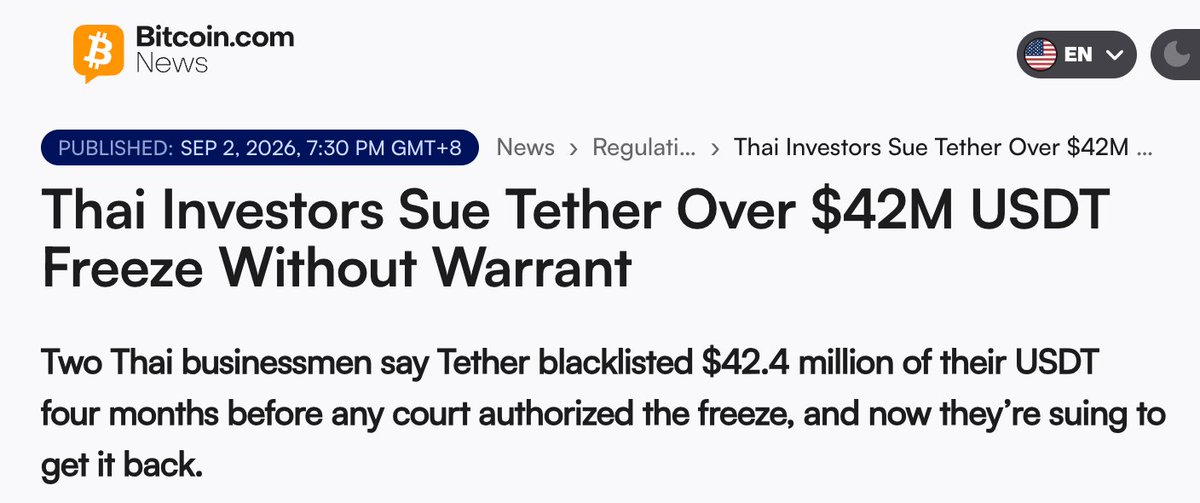
Many cryptocurrency users are accustomed to transferring assets into on-chain self-custody wallets, believing that holding private keys can protect them from third-party interference. However, a recent lawsuit disclosed in the Southern District of New York federal court showcases another side of centralized stablecoins in terms of judicial and risk control: Tether has been accused of unilaterally freezing over $42 million in USDT belonging to two investors nearly four months before the court officially issued a seizure warrant.
Case Restoration: Seizure Warrant Delayed by 4 Months, Even "Mixing Up" Names
According to Bitcoin.com revealed court documents, the timeline and background of the event are as follows:
On October 30, 2025, Tether blacklisted ten Ethereum addresses owned by two Thai investors without prior notification or any formal legal documents, instantly freezing a total of $42,417,785 in USDT.
The court seizure warrant used for the lawful seizure of assets was only formally approved nearly four months later on February 19, 2026.
What's more, the subsequent issuance of the seizure warrant stemmed from a $17 million "pig-butchering" investment fraud investigation in North Carolina, USA. The plaintiffs firmly state that they never participated in any fraudulent activities, and that the seizure of funds was purely a "collateral damage" and misidentification in law enforcement collaboration. The plaintiffs only learned the truth months after their assets were frozen.
Currently, the two investors have formally filed a civil lawsuit in the Southern District of New York federal court, requesting Tether to lift the blacklist restriction and compensate for related losses.
Tether's Technology and Freezing Authority
This case is not an isolated incident; it exposes the significant gap between the circulation of centralized stablecoins on public chains and actual control rights.
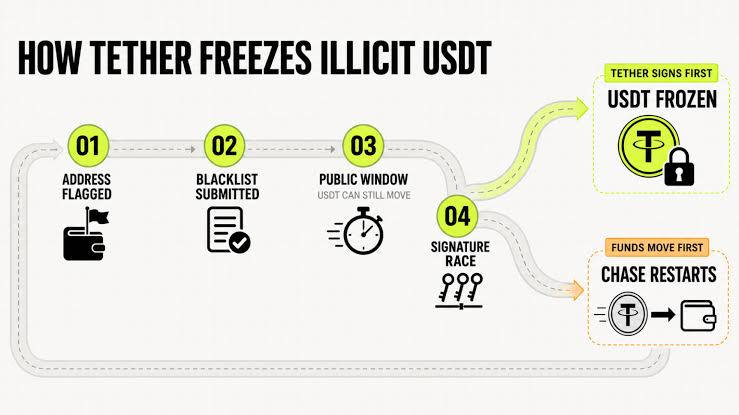
Although USDT operates on public chain networks like Ethereum and Tron, its underlying token contract has a hard-coded Blacklist mechanism. The multi-signature management private keys of Tether hold the highest authority and can unilaterally invoke functions to mark any address as non-transferable at any time. Once blacklisted, USDT in that address cannot be withdrawn or accessed by any DEX or lending protocol.
In traditional banking, freezing an account typically requires rigorous judicial procedures such as investigation, collection of evidence, and a judge signing a formal court order. However, on-chain, Tether maintains an extremely close collaborative network with law enforcement agencies such as the U.S. Department of Justice, FBI, and Secret Service.
Official data shows that Tether has frozen over $4.4 billion in USDT across more than 2,300 cases to date. In practice, to prevent suspicious funds from being quickly laundered on-chain, compliance teams often execute blacklisting on-chain as soon as they receive informal "assistance in investigation/seizure requests" from law enforcement, leading to significant delays in formal judicial authorization procedures.
Can Stablecoins in Self-Custody Wallets Really Serve as a "Safe Haven"?
First, it's important to understand the legal attributes of assets.
Native crypto assets (like BTC, ETH) stored in non-custodial wallets (such as MetaMask, Ledger) do indeed possess censorship resistance; however, centralized stablecoins like USDT are essentially just promissory notes of digital dollars mapped onto a public chain, with their underlying control maintained by the issuer.
In the context of joint law enforcement across departments and borders, "false reports" and "false freezes" are inevitable. Once an address is unfortunate enough to be flagged, ordinary users find it challenging to have the financial resources and time for cross-border litigation to reclaim frozen assets.
For large-scale long-term storage needs, careful assessment of the single exposure risk posed by centralized stablecoins is necessary, delineating the line between everyday transaction media and underlying censorship-resistant reserves.
Risk Warning and Disclaimer:
According to the "Notice on Further Preventing and Addressing Risks of Virtual Currency Trading and Speculation" jointly issued by ten departments including the People's Bank of China, the Cyberspace Administration of China, and the Supreme People's Court, virtual currencies do not possess the same legal status as fiat currencies and do not have legal enforceability, and should not and cannot circulate as currency in the market.
Activities related to virtual currencies qualify as illegal financial activities, and participating in virtual currency investment trading activities carries legal and policy risks. Any legal entity, non-legal entity, and individual investing in virtual currencies and related derivatives, in violation of public order and morals, shall have their relevant civil legal behaviors deemed invalid, and shall bear the losses arising therefrom.
This content is for the purpose of outlining overseas industry dynamics and objective events, and does not constitute any investment advice or asset endorsement.
免责声明:本文章仅代表作者个人观点,不代表本平台的立场和观点。本文章仅供信息分享,不构成对任何人的任何投资建议。用户与作者之间的任何争议,与本平台无关。如网页中刊载的文章或图片涉及侵权,请提供相关的权利证明和身份证明发送邮件到support@aicoin.com,本平台相关工作人员将会进行核查。


