CoinW Research Institute
Robinhood Chain has recently become a new hotspot in the on-chain market. According to The Block's report on August 31, Robinhood Chain experienced an explosion in on-chain activity in late August, with a single-day DEX trading volume reaching approximately $989 million on August 28, setting a new record; the on-chain DeFi protocol's TVL also rose to about $708 million, nearly doubling from the previous month. CoinDesk also reported that on August 30, the chain processed 5.52 million transactions, with DEX trading volume around $875 million, and 24-hour application revenue of approximately $2.66 million. For a new chain that only launched its mainnet on July 1, such rapid growth is quite remarkable. Interestingly, Robinhood Chain did not initially appear as a "memecoin chain." The official positioning by Robinhood is that it is a Layer 2 aimed at financial services and real-world assets, built on the Arbitrum technology stack, focusing on stock tokens, on-chain lending, collateral, 24/7 trading, and AI trading agents. What Robinhood initially wanted to do was to move traditional assets like US stocks and ETFs onto the chain, allowing them to be traded, lent, pooled, and circulated like DeFi assets. However, while Robinhood intended to bring US stocks onto the chain, the first substantial participants who came rushing in were memecoin traders.
RWA, or real-world assets on-chain, sounds grand, but cold starting is not easy. Stock tokens expose real assets and are easier for traditional investors to understand, but they naturally have lower volatility and slower story propagation, making it difficult to create trading heat quickly in the early stages of a new chain. memecoins are the opposite. They lack complex fundamentals, and often have no practical use, but they possess a very strong ability to spread attention. A good name, an image, or a hot concept can attract a large number of users, funds, and trading bots in a short time. For a new chain, the value of memecoins is not just speculation, but the ability to quickly bring users, trading frequency, and on-chain fees. Thus, in the early days of Robinhood Chain, there was a noticeable contrast: the official built RWA financial infrastructure, but the first to achieve scale effects was the memecoin trenches.
The so-called "trenches" is not the official product name of Robinhood but a term used in the memecoin trading community, often written in English as "Trenches." It originated from the interface context of trading tools like GMGN, referring to the first site where new coins have just launched, opened for trading, are about to graduate and migrate, and where funds are rapidly rotating. To put it simply, trenches are the "frontline trading desks" where memecoin traders lie in wait for new coins. Here, users do not wait for a project to release a white paper, conduct roadshows, or list on major exchanges, but rather make judgments seconds or minutes after the token is created: Who is the launching platform? How deep is the pool? Do buy and sell orders hold? Are the first few wallets internal addresses? Is Smart Money entering? Is there any risk with the contract? Is the heat spreading? The analysis by GMGN concerning the rotation of meme trades on Robinhood Chain mentions that early signal recognition mainly looks at three structural categories: the activity of the launching platform, the transaction holding after opening, and Smart Money's positioning. In other words, trench trading is not purely about observing price fluctuations, but rather watching whether the three lines of “supply, transaction, wallet” change simultaneously. This is why the trenches are worth attention. They represent the most sensitive layer of attention on-chain and the fastest reaction of funds. In traditional finance, for an asset to gain liquidity, it often requires market makers, research coverage, and exchange channels; in the memecoin world, liquidity may first emerge from the trenches. Whoever can hold the trenches has a better chance of capturing the early users' mindset in a new chain.
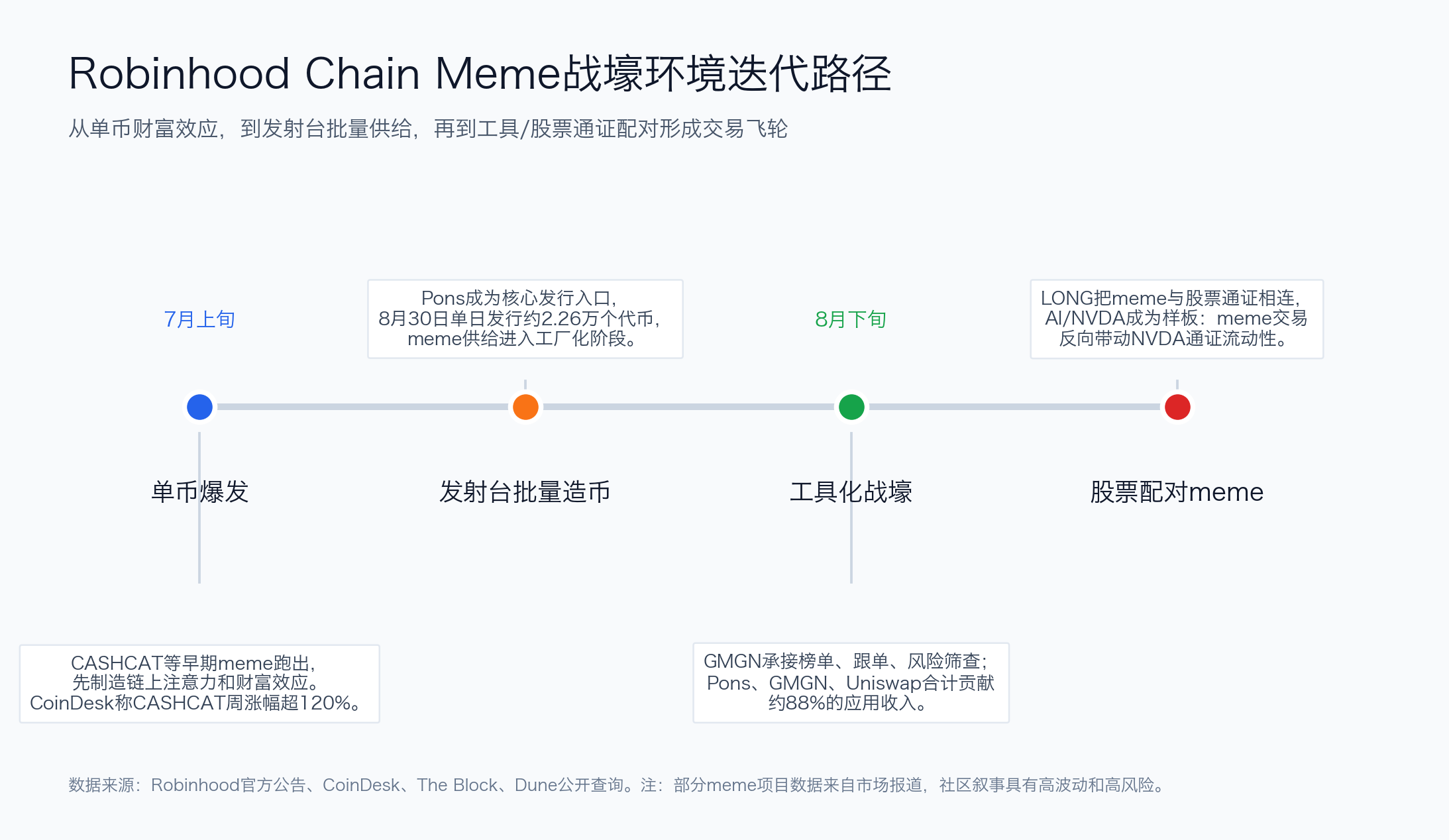
Looking along the timeline, the memecoin trend of Robinhood Chain did not form overnight, but went through an iterative process from "single-coin explosion" to "launch platform mass supply," and then to "trading tools, liquidity protocols, and stock token pairs operating together." This process fundamentally answers why a new chain focusing on RWA and stock tokens would be ignited first by memecoin traders. The earliest stage involved single-point memecoins generating attention. After Robinhood Chain's mainnet went live in early July, there was still no mature DeFi ecosystem on the chain, nor adequate trading scenarios for stock tokens. At this point, early memecoins like CASHCAT emerged first. Utilising Robinhood's early internal codename and the "Cash Cat" narrative, CASHCAT became one of the most representative memecoins on the chain in July. The logic of this stage is straightforward: rather than rushing to prove how complex the financial infrastructure is, the new chain first attracts the first batch of on-chain users with a memecoin that can spread, trade, and rise.
Source: CoinW Research Institute
The second stage involved scaling the supply of memecoins from the launch platform. Early on, with only the sporadic hits like CASHCAT, the market resembled a random event; however, after platforms like Pons became active, the supply of memecoins on Robinhood Chain entered a factory-style phase. CoinDesk data shows that on August 30, Pons issued approximately 22,600 tokens in a single day, continuing to grow from the previous day. The production of memecoins on the chain no longer relies on a few project parties but has transformed into a high-frequency, batch, low-barrier issuance market. For traders, opportunity density increased as many new coins could be filtered, rushed, and rotated daily; on the downside, the risk also amplifies simultaneously, with apparent increases in copycat projects, low-quality projects, short-term liquidity pulls, and contract risks.
The third stage involves the formation of tool-based trenches. Having just a launching platform is not enough, because when the number of new coins surges, what users lack the most is not the courage to "buy which coin," but filtering tools. The value of trading tools like GMGN lies in aggregating new coin discovery, leaderboards, candlestick charts, holding addresses, Smart Money, risk alerts, and trading entry points into a single interface. GMGN is not merely a trading front end but the operating system for trench traders. Users discover new coins, assess fund flows, track popular wallets, and then jump to trade through it. At this time, Uniswap serves as the main liquidity provider, Pons offers issuance entry, and GMGN provides trading and discovery entry, the three of which together form the infrastructure for memecoin trends on Robinhood Chain.
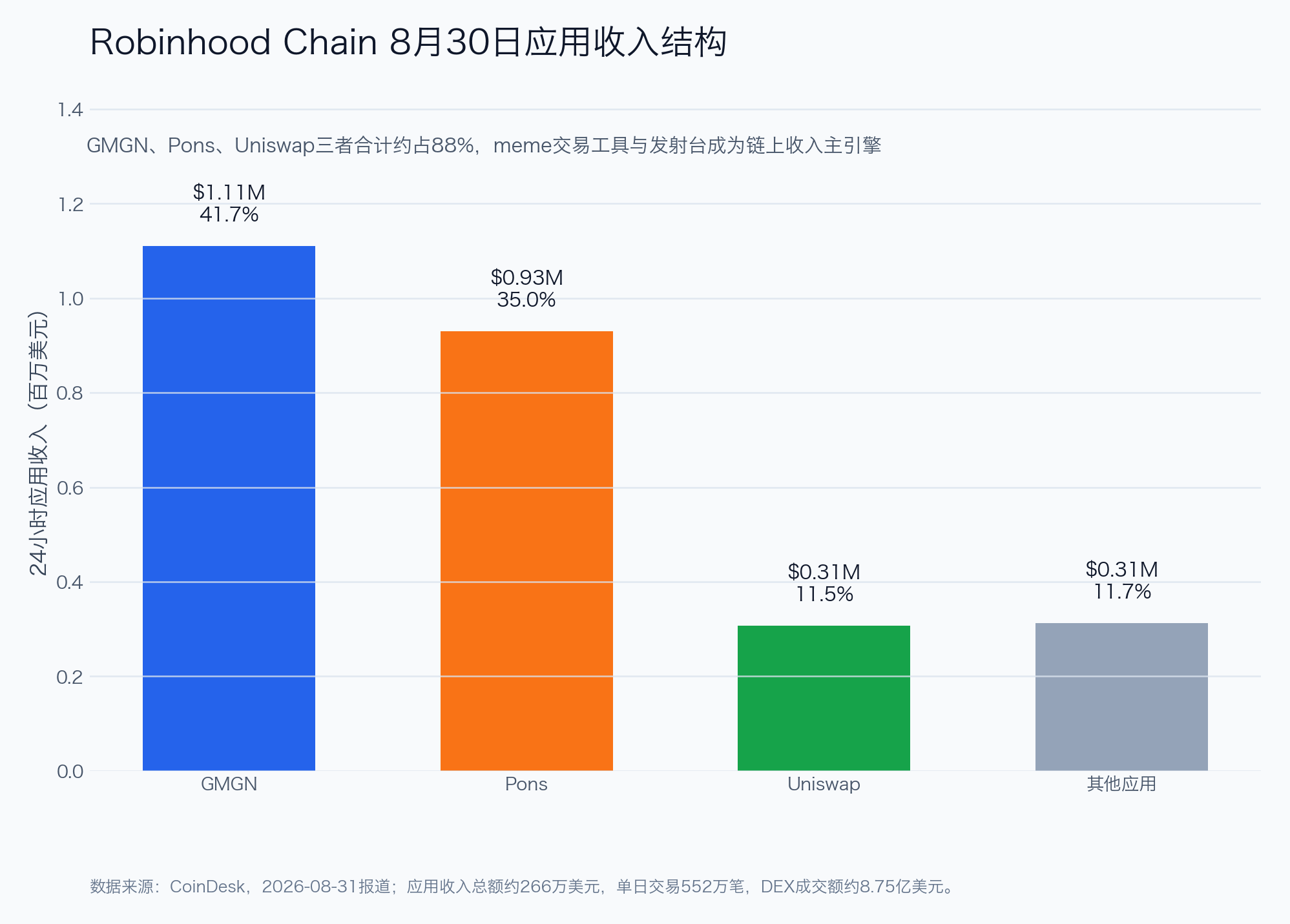
The data also reflects this change. Data platforms report that on August 30, Robinhood Chain processed approximately 5.52 million transactions, with a DEX trading volume of around $875 million and an application revenue of about $2.66 million in 24 hours. Among these, GMGN generated about $1.11 million, Pons about $931,000, and Uniswap about $307,000, collectively contributing approximately 88% of application revenue. From an evolutionary perspective, the trenches of Robinhood Chain have already transformed beyond just a "dirt dog arena." The early successes of CASHCAT proved that people were willing to come to the chain; Pons proved that token supply could be rapidly expanded; GMGN proved that traders have a demand for tools; and Uniswap proved liquidity could be sustained. At this stage, Robinhood Chain has formed a memecoin operating system that operates on “issuing coins, discovery, trading, and liquidity” in concert. The next point worth paying attention to is how this memecoin operating system connects with stock tokens/RWA.
Source: CoinW Research Institute
If the earlier CASHCAT, Pons, and GMGN addressed “how to bring people into the trenches,” LONG and AI/NVDA tackle whether these trading volumes can relate to the RWA assets that Robinhood Chain truly aims to utilize. What truly distinguishes Robinhood Chain from other memecoin chains is its stock tokens. Traditional memecoins typically pair with ETH, SOL, or stablecoins, with the underlying liquidity still being crypto-native assets. However, on Robinhood Chain, memecoins can form trading pairs with tokenized stocks. Stock tokens can become the base assets in the pool, while memecoins attract attention and create volatility. The key to this mechanism is not just fitting a stock concept onto a memecoin, but allowing memecoin transactions to truly consume and amplify the liquidity of stock tokens on-chain.
Specifically, the first step is for stock tokens to serve as the base of the pool. For instance, a certain memecoin is not paired with USDC, but with tokenized NVDA. When users buy and sell the memecoin, the counterpart in the trading pair is the NVDA tokenized token. The second step is locking stock tokens in liquidity pools or Vaults. To ensure smooth trading, the pool must have enough NVDA tokenized tokens to provide depth, essentially settling part of the stock tokens on-chain. The third step is for memecoin trading to subsequently drive the usage of stock tokens. The hotter the memecoin, the more frequent the trading, which in turn raises the transaction volume, pool depth, and visibility corresponding to the stock tokens. This forms a feedback loop where memecoins bring in traffic, traffic brings in transactions, transactions create usage scenarios for stock tokens, and the active use of stock tokens reinforces Robinhood Chain's RWA narrative.
Source: CoinW Research Institute
AI/NVDA is currently the most typical example. AI, short for Artificial Inu, is a memecoin launched by LONG on Robinhood Chain, with the core narrative being “AI, computing power, Nvidia.” It is not an ordinary AI concept coin but is directly paired with tokenized NVDA. Data from The Block shows that AI’s market capitalization increased from approximately $1.5 million on August 1 to a peak of about $13.5 million on August 30; its NVDA pool liquidity is about $3.3 million, more than three times the depth of the WETH pool. The official site of Artificial Inu also emphasizes that the AI paired with tokenized NVDA will have transaction fees entering the Vault, with some fees being burned or permanently locked. The cleverness of this approach lies in connecting one of the strongest investment narratives in the real world to the memecoin trades. NVDA represents the mainline of AI computing power, and this memecoin is responsible for gathering community sentiment and short-term capital. Purchasing AI also involves trading the mixed narrative of “AI computing power + Nvidia + memecoin wealth effect.” However, it is essential to clarify that AI does not represent ownership of Nvidia stock, and holders cannot automatically redeem assets from the Vault. It remains a high-risk memecoin asset; it simply uses stock tokens as the liquidity and narrative foundation.
At this point, Robinhood Chain's story has evolved from purely "memecoin speculative frenzy" into a more complex flow experiment. For Robinhood, memecoins are not the endpoint but may serve as the entry point. What Robinhood has excelled at in the past is converting complex financial products into trading experiences that ordinary users can engage with. From zero-commission US stocks and options to crypto trading, it has consistently been about "lowering barriers and amplifying participation." What Robinhood Chain aims to do now is to further digitize traditional assets on-chain. However, relying solely on the “compliance RWA” narrative makes it difficult to attract the most active early users; in contrast, memecoins can educate users on operations concerning wallets, DEXs, slippage, LPs, launch platforms, on-chain leaderboards, and trading bots at the lowest cost.
However, this is merely the "grand narrative" presented. A more concealed layer is that a common expectation is forming among memecoin project parties, trading groups, and early players. Robinhood has a vast user base for US stocks and retail trading, and if Robinhood Chain eventually brings a significant number of non-Crypto novices onto the chain, then the players who initially entered the trenches can leverage their asymmetric advantages in information, tools, wallet monitoring, and trading speed to secure an early advantage and gain excess returns when new users come in later. Therefore, the prosperity of memecoins in Robinhood Chain is not merely a "natural spillover from the official RWA strategy," but also a competitive game around the anticipated future influx of users. Early capital in the circle constructs leading tokens, leaderboards, trading volumes, and wealth effects; subsequent players observe the on-chain heat and price performance before joining this narrative. As long as the story "Robinhood can bring traditional stock users to the chain" is not immediately disproved, the game can continue to operate. Here, memecoins are both a cold-start tool for Robinhood Chain and a high-risk chip for early players betting on future traffic entrances.
Looking ahead along this trajectory, the new breakthrough points of Robinhood Chain will likely still revolve around "how memecoins continue to leverage traditional asset narratives." More hot-stock paired memecoins may arise. Stocks like TSLATSLA, AAPL, MSTR, COIN, HOOD, GME, which naturally carry retail sentiment and community foundations, are particularly suited for memecoinification. Especially GME, MSTR, and HOOD, which are inherently tied to retail sentiment, Bitcoin, or trading platform narratives, may yield more viral potential. The theme of AI stocks may also continue to spread. NVDA is just the first stop, followed by potential stock-paired memecoins surrounding GOOG, MSFT, TSLA, AMD, electricity, data centers, and robots. As long as the AI capital expenditure narrative remains alive in US stocks, there are opportunities to repackage it as a memecoin version on-chain.
GPU assetization could potentially become the new narrative interface. Nvidia has recently stated clearly that AI Factory Compute is becoming an investable asset class and is collaborating with institutions such as Apollo, BlackRock, and Blackstone, aiming to mobilize over $500 billion in third-party capital to support AI infrastructure development. The CFTC also issued a request for comments on August 19, starting to study the computing derivatives market, with Chairman Michael S. Selig even referring to compute as "the commodity of the smart economy." The market is beginning to reinterpret GPU, data centers, and computing revenue from simply being technology company capital expenditures to being basic assets that can be financed, traded, and derived. As of now, Robinhood has not explicitly launched GPU assetization products, nor has it publicly announced directly following CFTC computing derivatives directions. However, Robinhood Chain already possesses two potential interfaces: first, its stock token system already covers core assets like NVDA; second, similar on-chain experiments like $GPU have emerged in its ecosystem, using tokenized NVDA to purchase "graphics cards," pay for electricity, burn tokens, and settle NVDA into liquidity wallets. It is not yet an official product, but it indicates that the market has begun to piece together "NVDA stock token + GPU computing narrative + memecoin game mechanism." If in the future Robinhood’s ecosystem features more standardized computing yields, GPU leasing, AI infrastructure indices, or mappings for computing derivatives, it may become the next breakthrough point after the integration of RWA and memecoins.
In a more financialized direction, RWA yields may also continue to extend. In the future, stock tokens may not only serve as trading pairs but may also enter lending pools, act as collateral, and participate in structured yields, forming a composite path of “memecoin traffic, RWA sediment, DeFi amplification.” What can truly expand this path, however, is still the official entry and ecological incentives. If Robinhood Wallet, Robinhood App, or ecological projects further lower the entry barriers for users to join the chain, memecoin trading and stock token trading may see a second wave of growth.
Of course, this path is not guaranteed. Memecoin trading is highly dependent on sentiment; liquidity can swiftly come and go; stock tokens do not equate to full stock rights, and specific rights, tradable regions, redemption mechanisms, and regulatory attributes must be examined according to product terms; regulatory bodies may also focus on the grey areas between stock tokens, memecoin speculation, and secondary market manipulation. More realistically, short-term risks arise from the macro environment. After Warsh in Jackson Hole, the market's pricing for the Fed's rate hike in September has clearly heated up, with the latest reports from CoinDesk indicating that the market has priced in about a 66% chance of a rate hike in September. For memecoins on Robinhood Chain, this is not a background that can be overlooked: memecoins are essentially the assets most sensitive to risk appetite, with leverage and sentiment concentrated; once oil prices, US Treasury yields, the dollar, or rate hike expectations rise simultaneously, funds typically withdraw first from such high-volatility assets. Around September 2, this pressure has reemerged. The US-Iran situation escalated, driving up oil prices, with Brent crude nearing $95 per barrel and WTI breaking $90 per barrel; US stocks faced pressure, with the Nasdaq down about 1%, the S&P 500 down about 0.7%, and Bitcoin slightly retreating to around $77,500 amid cooling risk assets. The market merely "dipped a little," but due to its significant prior gains, thin liquidity, and concentrated chips, the memecoins on Robinhood Chain could see a pronounced retraction. Previously, GMGN on-chain data indicated that Robinhood Chain's hot coins had experienced sharp declines, with AI, NET, and MicroDuck falling around 20.82%, 37.21%, and 18.2%, respectively. This is a typical case of “macro risk appetite slightly cooling, leading to major deleveraging in on-chain memecoins.”
Therefore, Robinhood Chain's first attempt to place memecoin trenches and stock tokens/RWA in the same trading arena does not imply that it can operate independently of market cycles. In the short term, this is a high-risk, high-volatility investment field on-chain; in the medium term, it may serve as an important experiment for RWA cold-starting. The real question is not whether memecoins can thrive, but whether Robinhood can convert the attention brought by memecoins into long-term liquidity for stock tokens and real-world assets.
References
1.Robinhood Official: Stock Tokens and Layer 2 Blockchain
2.Robinhood Chain Official Website
3.Announcement of Robinhood Chain Mainnet Launch
4.The Block: Robinhood Chain DEX Trading Volume Hits New High
5.CoinDesk: Memecoin Trading Takes Over Robinhood Chain Activity
免责声明:本文章仅代表作者个人观点,不代表本平台的立场和观点。本文章仅供信息分享,不构成对任何人的任何投资建议。用户与作者之间的任何争议,与本平台无关。如网页中刊载的文章或图片涉及侵权,请提供相关的权利证明和身份证明发送邮件到support@aicoin.com,本平台相关工作人员将会进行核查。