On September 2, the three major U.S. stock indices closed up together, with the Dow Jones up 0.56%, the S&P 500 up 0.47%, and the Nasdaq up 0.45%. In August, ADP private employment only increased by 38,000, lower than the expected 47,000, cooling interest rate hike bets, which drove precious metals and utilities to rally. The star of the day is Hecla Mining (HL), which rose 8.69% to close at $20.77 — while on the same day, the silver price changed by less than 1%. Today's U.S. stock classroom poses a question: After more than a year of mining companies transitioning to AI, have they really decoupled from cryptocurrency prices? Tonight at 12:30 UTC, pre-market, is when optical communication equipment vendor Ciena (CIEN) releases its results. This article's data is based on the U.S. stock market closing on September 2.
1. Today's Market: Indices Rise Together, But Broadcom Falls Despite Meeting Three Targets
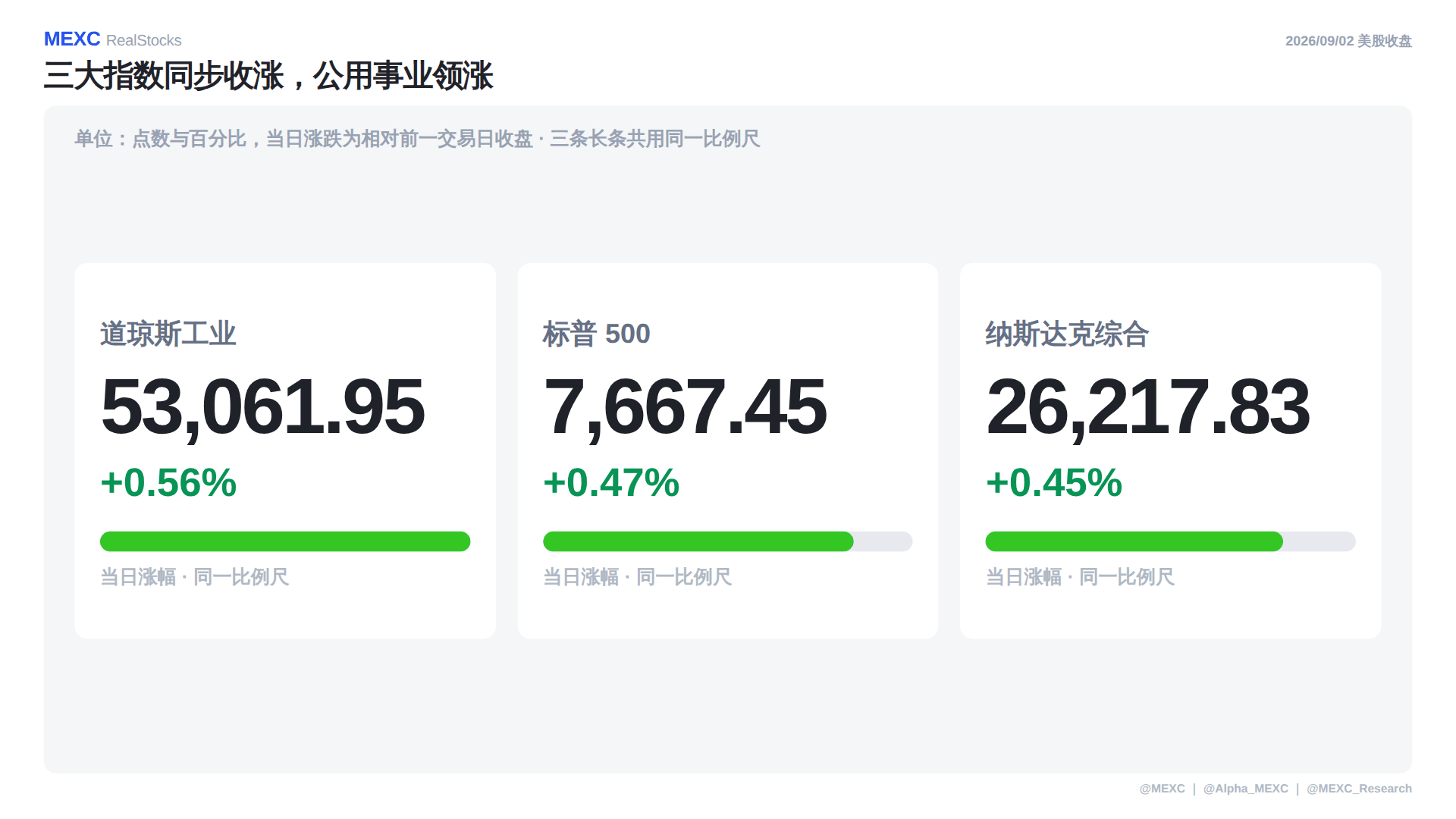
The unit is points and percentages, with daily changes relative to the previous trading day's close. The three major indices rose together, with similar magnitudes: the Dow Jones up 0.56% to 53,061.95, the S&P 500 up 0.47% to 7,667.45, and the Nasdaq up 0.45% to 26,217.83. The differentiation at the sector level is much more pronounced than the indices: utilities in the Nasdaq category rose 2.26% to lead, followed by communication services up 1.47%, while industrials fell by 1.03%. Capital-heavy and highly indebted industries are the first to react when interest rate hike bets cool down, which is the same reason for the rise in precious metals on that day.
What is truly noteworthy is last night's Broadcom (AVGO). Last season's revenue was $29.6 billion, an 86% year-on-year increase; AI semiconductors accounted for $16.7 billion, a 221% increase year-on-year; next season's guidance is $34.8 billion (of which $21.7 billion is from AI) — all three figures exceeded expectations, yet the stock closed down 0.66% to $367.24, and at one point down about 6% after hours, later narrowing to about 3.5%.
The difference lies not in revenue but in profit margin: The adjusted operating profit margin for this season is about 68%, and the company pointed next season to 66%. Revenue tells you how much was sold, while profit margin informs you whether the business is becoming more profitable or thinner — when high growth is already priced in, a guidance of "slightly worse than the previous season" for profit margin is enough to drive the stock price down.
2. Today's Star: Silver Price Below 1%, Hecla Mining Up 8.69%
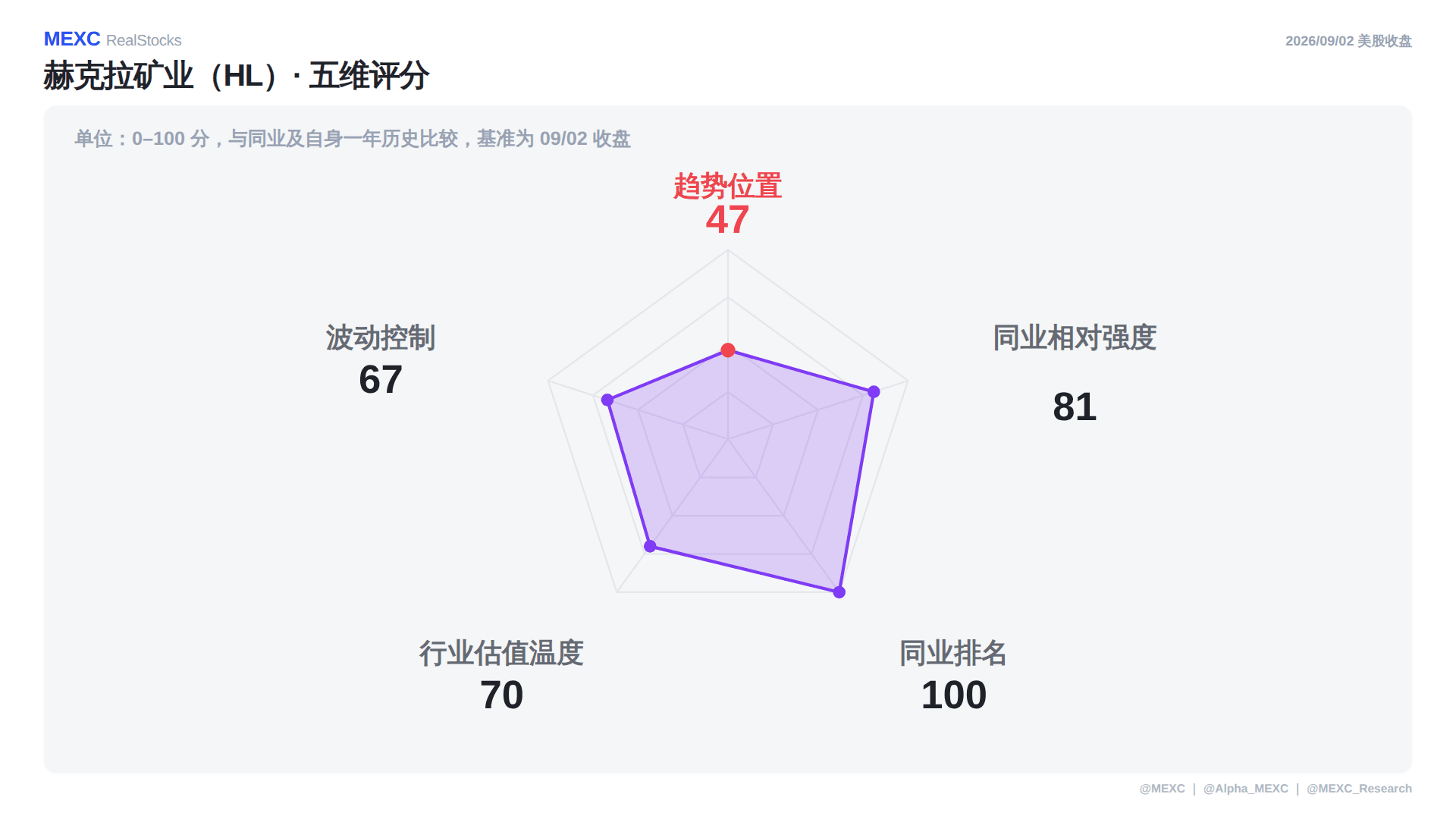
The unit is a score from 0 to 100, comparing with peers and its own year-long history, with a benchmark of the September 2 close. Hecla Mining (HL) is a precious metals miner with a market value of $13.9 billion, closing at $20.77, up 8.69%, and increasing its market value by about $1.1 billion in one day, with trading volume on par with the daily average — the price increase came from pricing, not volume.
In the five corners, peer ranking is 100, and peer relative strength is 81; there was no stronger stock in this category that day; however, the weakest trend position is only 47, and the stock price still stands in the middle of its 52-week range. This combination seems contradictory but is actually two different things — ranking speaks to "who increased more today," which is a horizontal single-day comparison; trend position speaks to "how far it is from its own high," which is a vertical cross-time comparison. Reading the two dimensions separately prevents misjudging the event-driven single-day strength as a trend.
The reason is straightforward: In August, ADP private employment only increased by 38,000, lower than the expected 47,000, cooling interest rate hike bets, which caused the silver price to turn from a decline to an increase. Miners’ extraction costs are largely fixed over the year, while selling prices fluctuate with metal quotes; thus, a 1% rise in metal can translate to several percentage points in gross profit, magnifying the stock price again — this is operational leverage, and today’s set of numbers illustrates it most intuitively: silver price below 1%, Hecla up 8.69%.
One qualification must be remembered: This round of increases results from cooling interest rate hike bets, and there are non-farm payrolls and CPI data to be released before the Federal Reserve meeting on September 15–16; bets can change direction with the next data release.
3. Today's Star - Extension: The Same Data, Different Reactions for Silver and Gold
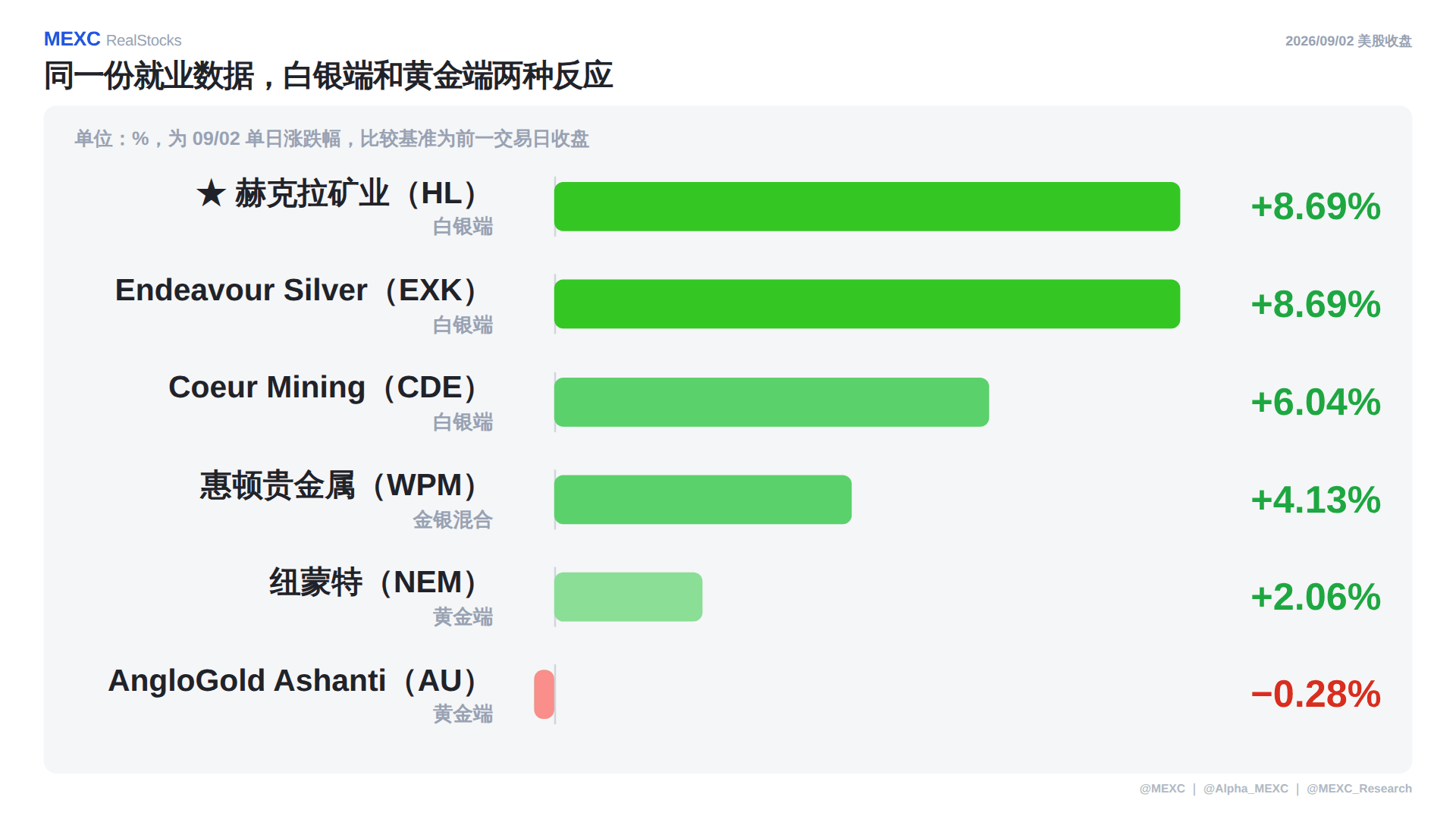
The unit is %, representing the single-day increase or decrease on September 2, with a benchmark of the previous trading day's close. All six companies are under the precious metals sector; the same employment data elicited completely different reactions at either end: Hecla on the silver side +8.69%, Endeavour Silver also +8.69%, Coeur Mining +6.04%; precious metals mixed Wheaton +4.13%; on the gold side, Newmont only +2.06%, and AngloGold Ashanti even closed down 0.28%.
The difference comes from silver's dual identity: it is both a precious metal and an industrial metal; photovoltaics, electronics, and solder all require silver. Therefore, a piece of data reflecting "economic slowdown, cooling interest rate hike bets" primarily benefits gold from the interest rate perspective, while for silver, it has the dual effect of interest rates plus industrial demand expectations, making its elasticity naturally greater.
That day, the sector averaged a rise of 2.42%, but this average masks internal differences — looking at it alone, one might think the entire sector rose by more than two points. When noticing an overall sector movement, breaking it down to see which side rose helps determine which specific stock to watch; this is a strategy to use every day.
4. U.S. Stock Classroom: Mining Companies Have Shifted to AI for Over a Year, Have They Really Decoupled?
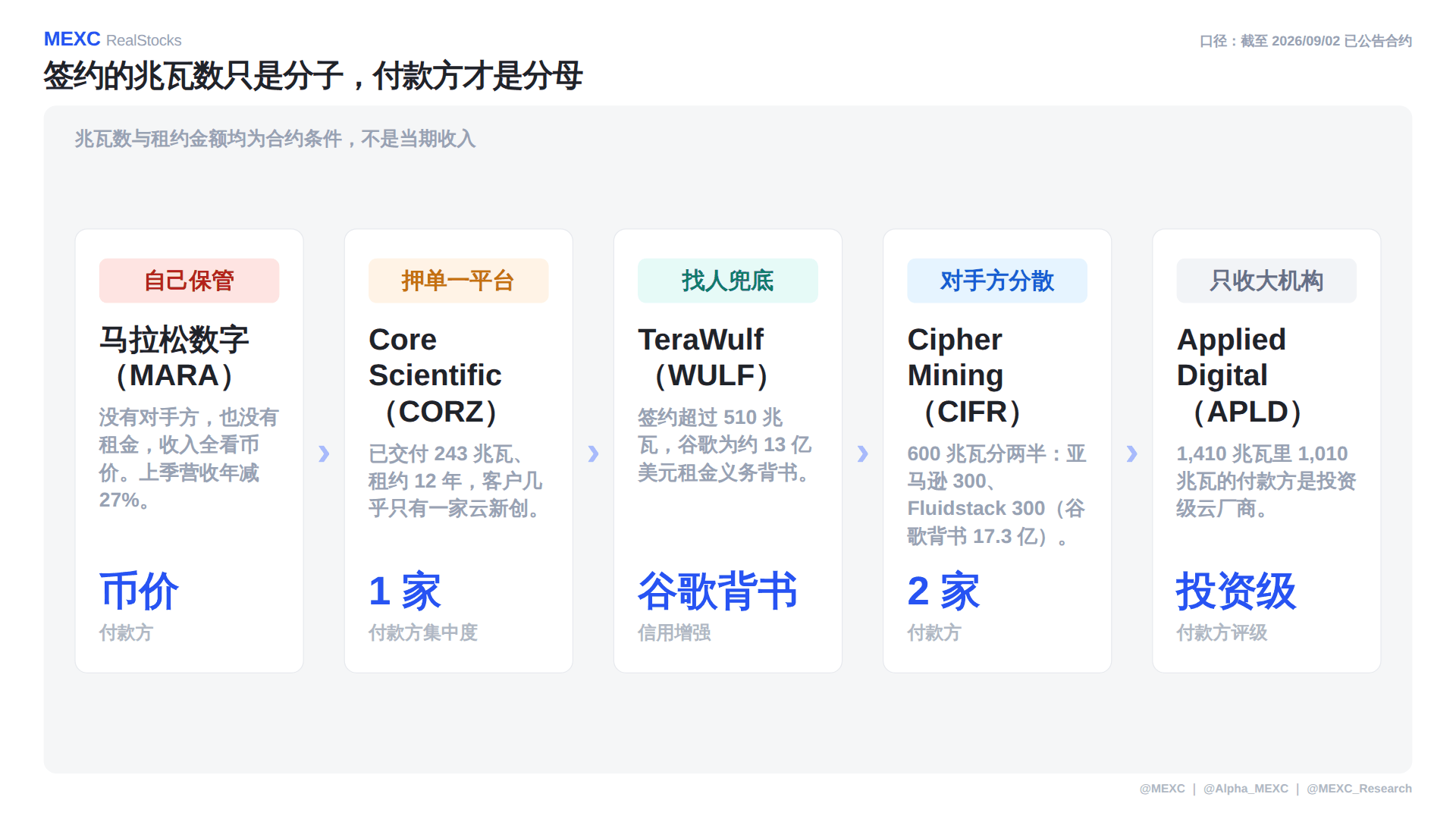
The image shows production capacity already contracted or delivered by five mining companies, with megawatts and lease amounts as contract conditions, not current income. All five are transforming their mines into AI data centers, but the contracted megawatts are just the numerator; the payer is the denominator — for the same long-term contract, who pays determines how much it is worth.
Marathon Digital (MARA) has not shifted at all; its revenue solely relies on cryptocurrency prices: in the second quarter, computing power increased by 22% year-over-year, but revenue fell by 27% year-over-year to $17.49 million, while selling 2,213 bitcoins to supplement cash. Core Scientific (CORZ) was the first to shift, delivering 243 megawatts with a 12-year lease, but has almost only one cloud startup as a customer, for which it issued $3.3 billion in project debt with a 7.75% coupon rate. TeraWulf (WULF) signed over 510 megawatts, with Google backing approximately $1.3 billion in rental obligations. Cipher Mining (CIFR) allocated 600 megawatts to two payers: Amazon directly signed for 300 megawatts for 15 years, and Fluidstack took 300 megawatts for 10 years, with Google's backing of $1.73 billion. Applied Digital (APLD) has 1,410 megawatts in hand, of which 1,010 megawatts are allocated to investment-grade cloud vendors.
Falling Together, Diversifying When Bouncing Back
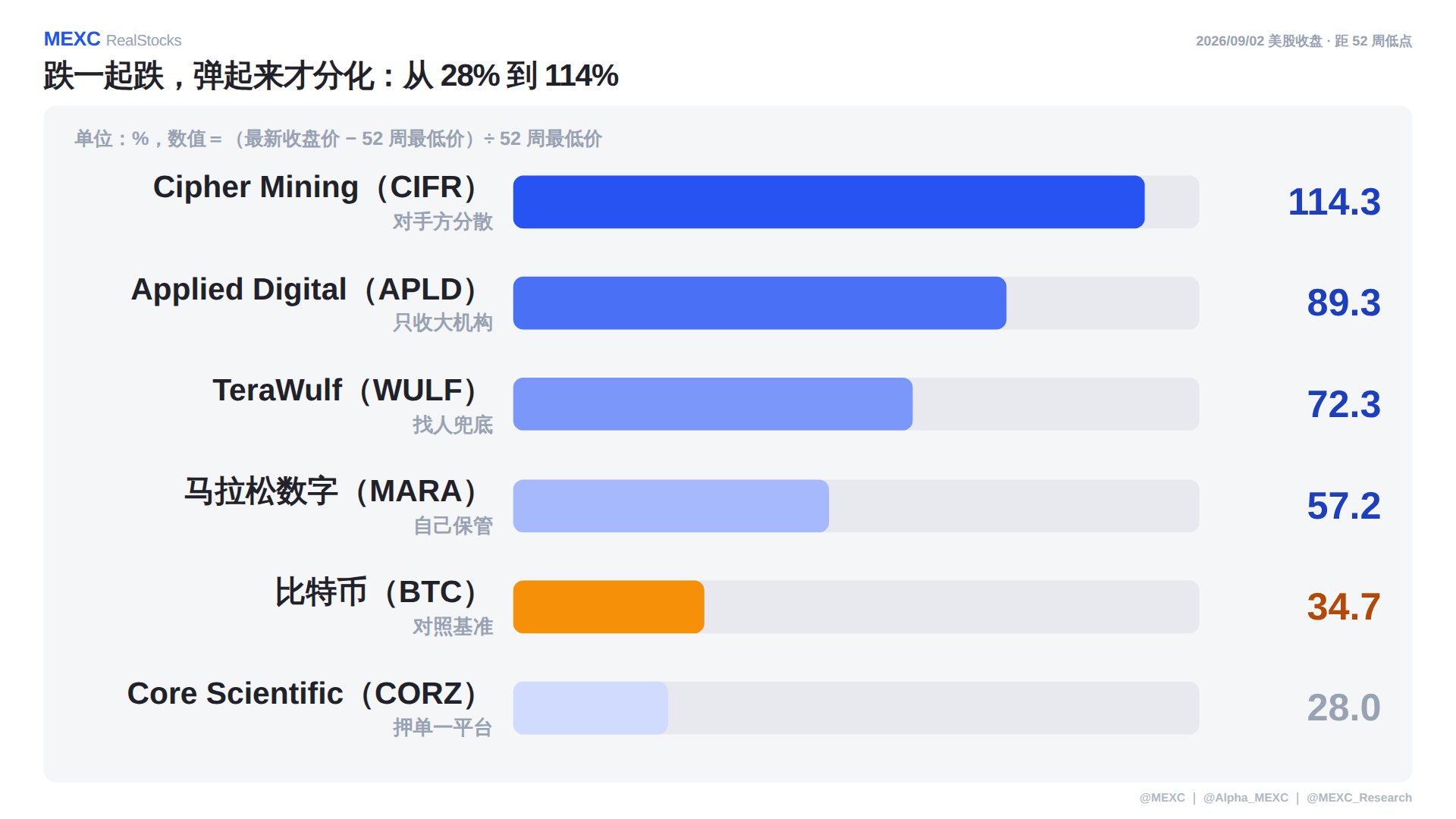
The unit is %, with the value equal to (latest closing price - 52-week lowest price) ÷ 52-week lowest price, measuring how much has returned from each low point. Cipher Mining bounced back 114.3%, Applied Digital 89.3%, TeraWulf 72.3%, Marathon Digital 57.2%, while Bitcoin during the same period was up 34.7%, and Core Scientific only 28.0%.
The key is that looking from a different perspective gives a contrasting impression: When viewed as a retracement, the six stocks are clustered between 38% and 55% from their highs, with little difference; whereas viewed as a rebound, moving from 28% to 114% reflects a fourfold difference. They fall together, but diversify when bouncing back — volatility has never shrunk, and the so-called decoupling has not occurred in the price but in the contract. The market does not provide a title for the transformation, but rather the quality of the contracts.
5. Understanding a Company: Cipher Mining is in the Power Plant Business, Not the Cloud Business
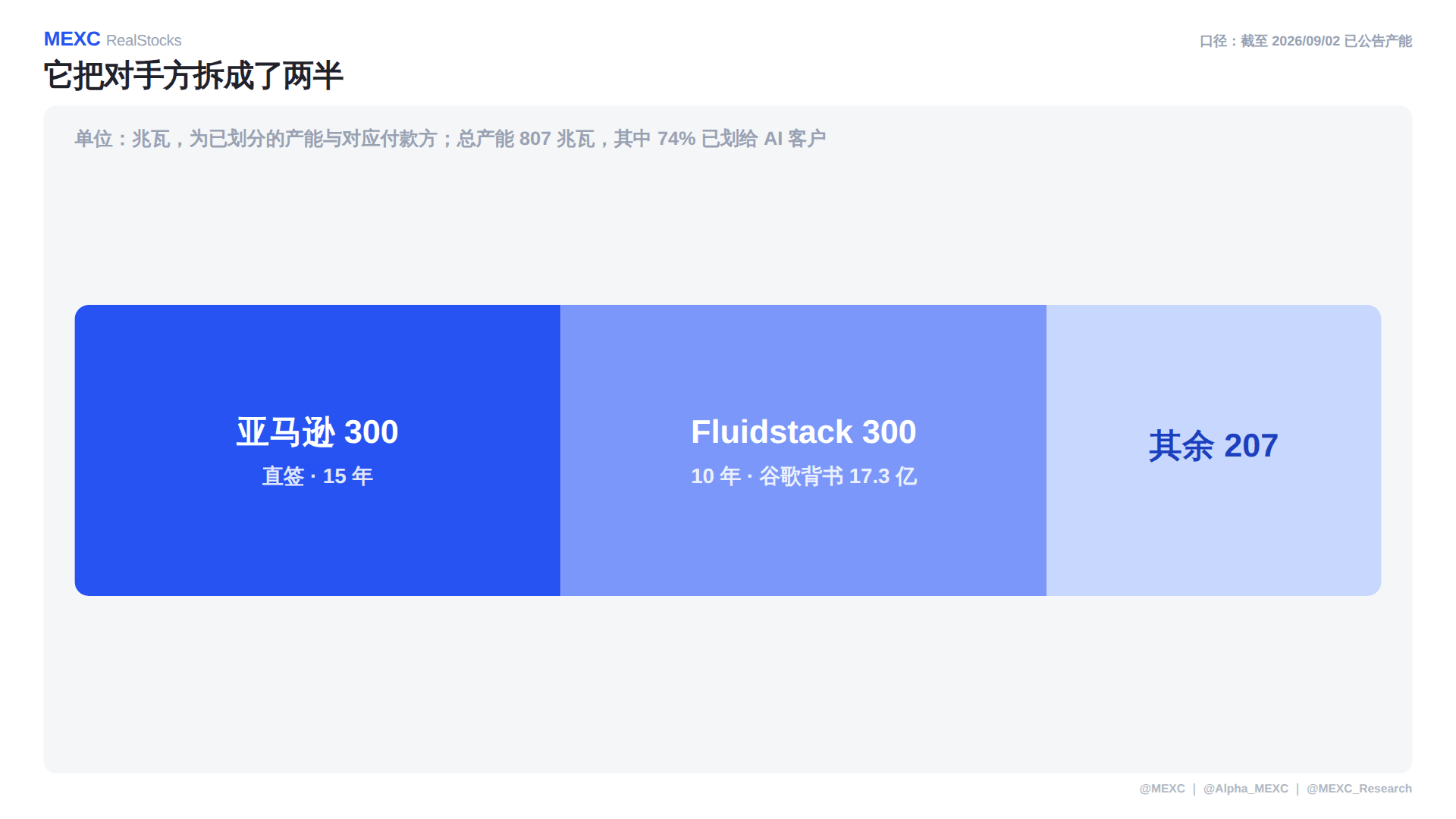
The unit is megawatts, representing the capacity allocated by CIFR and the corresponding payers; the total capacity is 807 megawatts, of which 74% has been allocated to AI customers. It does not buy GPUs or sell computing power, only provides electricity, space, and grid connection permits — the entire company has only 66 employees. This statement is key to understanding it: It does not earn money from computing power, but from the power plant.
It has divided its counterpart into two halves: one half directly signed with Amazon for 300 megawatts for 15 years, and the other half has 300 megawatts leased by Fluidstack for 10 years, with Google additionally backing $1.73 billion in rental obligations. The benefit of diversification is that a single default will not devastate the entire table; the cost is that revenue is locked in by rent, and how much customers earn from this power is unrelated to it — a business with certainty exchanged for a cap.
When considering all five companies together, we derive today's most worthwhile takeaways: Look at the quality of an AI contract, start with who pays — whether the payer is Amazon, a startup backed by Google, or a startup relying on financing to expand makes a significant difference. Then examine the concentration (whether it is dependent on one or spread among several), and finally, when the money starts flowing in — the contract amount is a summation for the upcoming several years, while this year's cash flow is a different matter.
6. What to Watch Tonight: Will CIEN’s Full-Year Guidance Be Revised Upward Again?
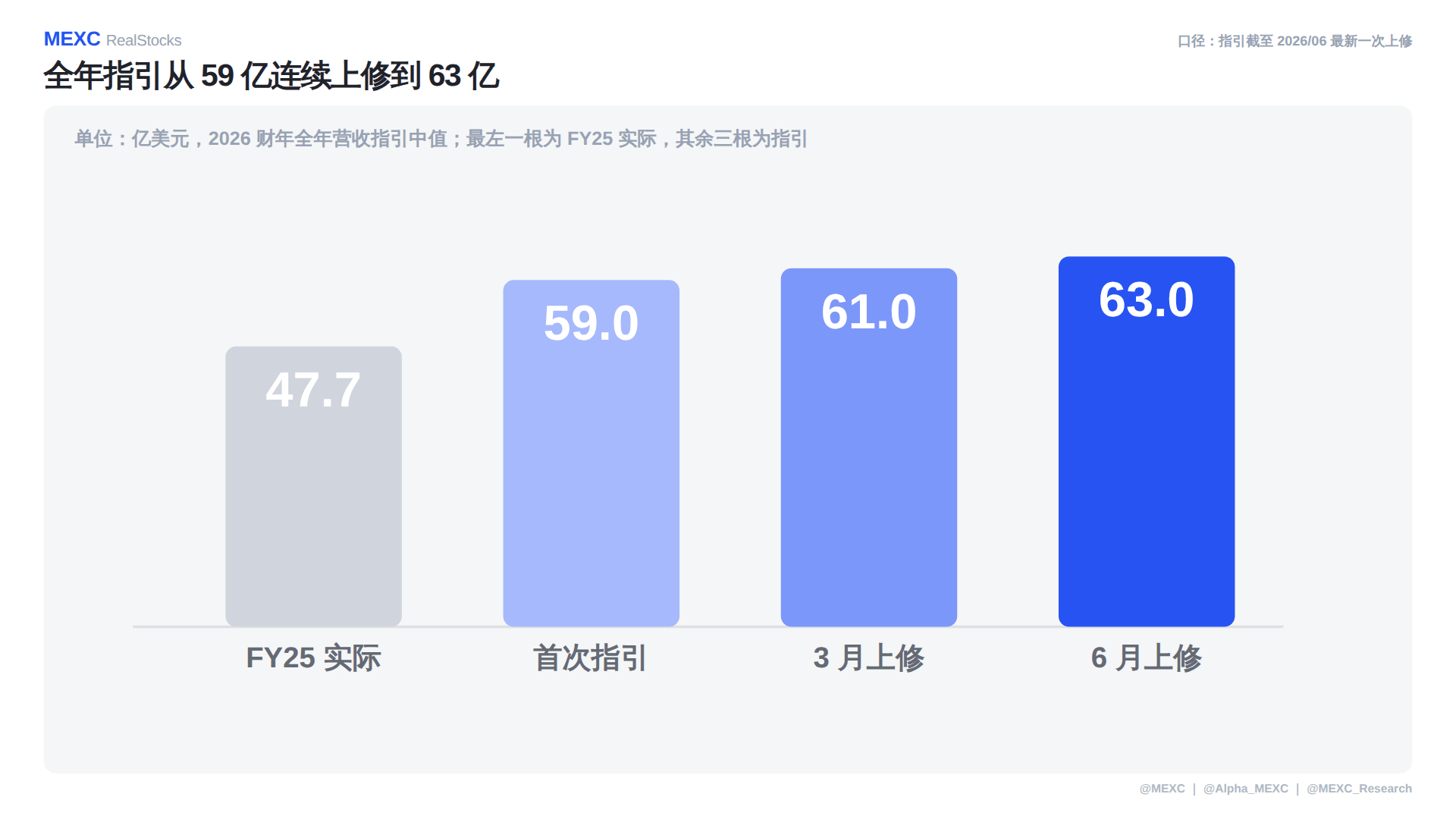
The unit is in hundred million dollars, representing the median guidance for the company’s full revenue in fiscal year 2026 (ending in October); the left-most bar shows the actual value for fiscal year 2025 at $4.77 billion, and the other three bars are guidance, not realized performance. The first guidance of $5.90 billion came from December 2025, revised to $6.10 billion in March, and further revised to $6.30 billion in June; the median year-on-year growth rate rose from 28% to 32%.
This evening at 12:30 UTC, Ciena (CIEN) will release its financial report, along with initial jobless claims and comments from a Federal Reserve governor; at 14:00 UTC is the August ISM services PMI; this week’s true watershed is tomorrow’s August non-farm employment report. The company's median guidance for this season’s revenue is approximately $1.625 billion, which is about +33% year-on-year.
Its position is the second baton of AI capital expenditure: Money first flows to chips, then to the optical channels that connect computing power, and Ciena specializes in coherent optical transmission and routing equipment between data centers, cities, and long-haul backbones. Focusing on full-year guidance rather than quarterly performance is important because quarterly figures can be disturbed by delivery rhythms and confirmation timings; the median full-year guidance represents the company's recognized outlook on demand for the entire year — whether it will be revised or not speaks more to the visibility of orders than simply meeting single-quarter targets.
Diving Deep: What Line Stood Firm in This Financial Report?
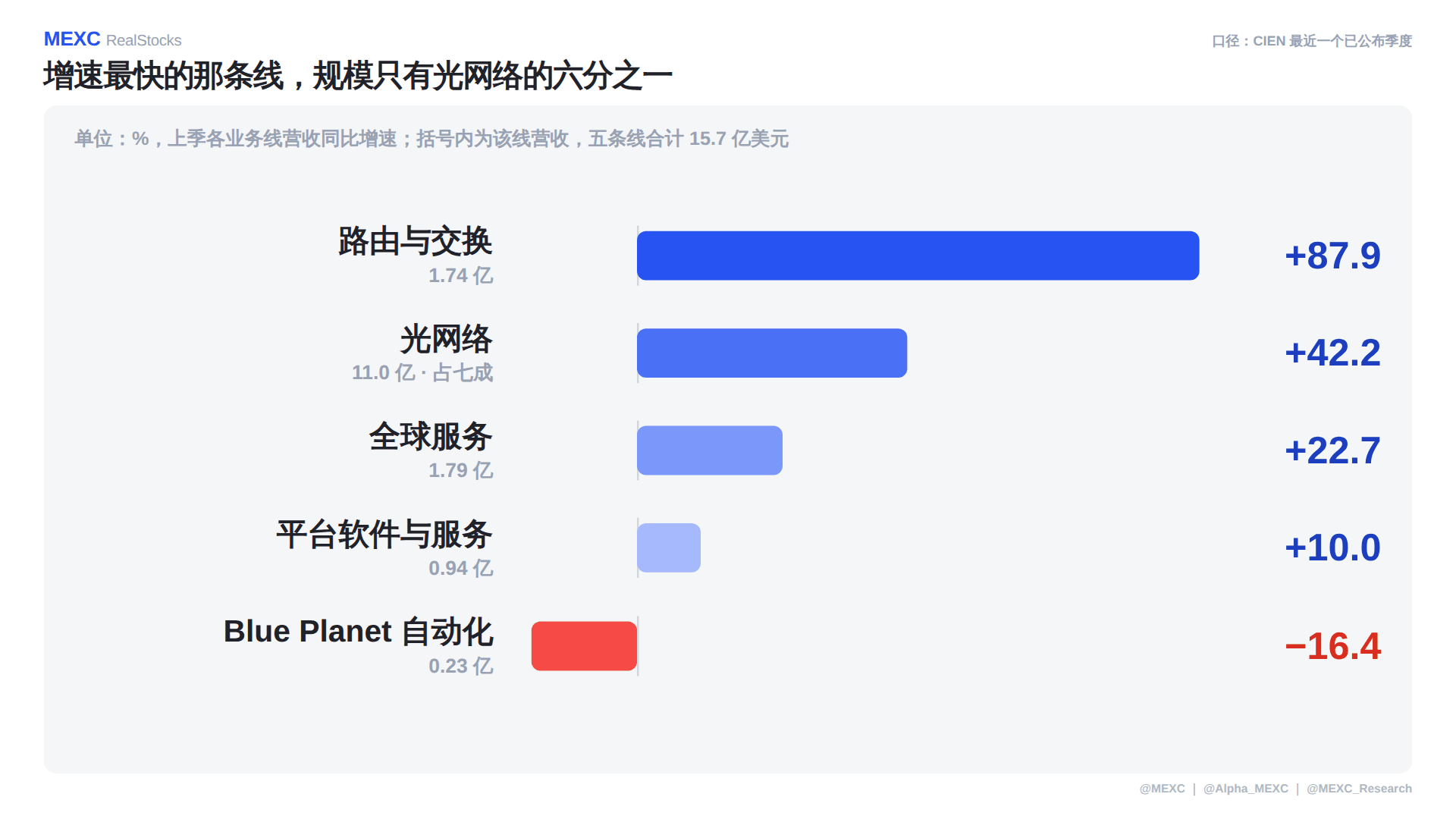
The unit is %, representing the year-on-year growth rate of each business line's revenue from the last season; total revenue for the last season was $1.57 billion, composed of $1.10 billion from optical networks, $179 million from global services, $174 million from routing and switching, $94 million from platform software and services, and $23 million from Blue Planet automation.
The strength behind this financial report is the optical network, at $1.10 billion, with a year-on-year growth of +42.2%, accounting for 70% of total revenue; the fastest growth, however, is in routing and switching, which increased by +87.9%, though its scale is only $174 million, roughly one-sixth of the optical network. The two lines sell different products: optical networks connect data centers, while routing and switching handle data entering and exiting the campus, following AI cluster traffic with a small base and great elasticity.
The reading method is to consider both growth rate and scale: Doubling from a small base will not significantly impact the entire financial report, but it indicates where demand is expanding; the +42% on a large base is what determines this quarter’s numbers. Besides the total figures tonight, it's also worth watching if routing and switching can continue to approach doubling and if Blue Planet's -16.4% has stopped. Additionally, the adjusted gross margin last season was 44.9%, and the company points this season to 45% — when revenue increases from major customer direct sourcing, the gross margin is a measure of quality.
Frequently Asked Questions (FAQ)
Q1: Why did Hecla Mining (HL) rise 8.69% when the silver price changed less than 1% that day?
Because miners' extraction costs remain roughly fixed over the year, while selling prices fluctuate with metal prices; thus, even a slight change in metal can almost completely translate into gross profit, further magnifying the stock price — this is operational leverage. Comparing "metal price changes" and "individual stock changes," the ratio of the two reflects the degree of leverage.
Q2: Why did silver prices rise by 6% to 9%, while gold prices remained around 0% despite both being precious metals?
Because silver is both a precious metal and an industrial metal and is used in photovoltaics, electronics, and solder. A piece of data indicating "economic slowdown, cooling interest rate hike bets" primarily benefits gold from an interest rate perspective, while for silver, it has the dual effects of interest rates and industrial demand expectations, making its elasticity inherently greater. The sector averaged a rise of 2.42% that day, which masks the differences between the two ends.
Q3: Why do "peer ranking 100" and "trend position 47" appear simultaneously in the five-dimensional score?
Because the two measure different things. Peer ranking compares who increased the most among peers today and is a horizontal single-day comparison; trend position measures how far the price is from its own 52-week high and is a vertical time comparison. A stock can be the highest gainer in a day while its price is only at the midpoint of its range.
Q4: Why do mining companies transitioning to AI still follow cryptocurrency price movements?
Because the decoupling has not occurred in price. Looking at the rebound magnitude from the 52-week low, Cipher Mining bounced back 114.3%, while Core Scientific only 28.0%, a fourfold difference; when viewed as a retracement from highs, the six stocks cluster between 38% to 55%. They fall together, but only diversify when bouncing back — volatility remains the same, and the differentiation is in contract quality, not price correlation.
Q5: When looking at an AI long-term contract, which number should be prioritized?
It is not the megawatt number but the payer. The contracted megawatts are just the numerator; the payer is the denominator: for the same 10-year lease, whether the payer is Amazon, a startup backed by Google, or a financing-dependent startup makes a huge difference. Next, examine the concentration (whether it’s concentrated in one or distributed among several), and finally, when the money begins to flow — the contract amount is the total for the upcoming years; this year's cash flow is a separate matter.
免责声明:本文章仅代表作者个人观点,不代表本平台的立场和观点。本文章仅供信息分享,不构成对任何人的任何投资建议。用户与作者之间的任何争议,与本平台无关。如网页中刊载的文章或图片涉及侵权,请提供相关的权利证明和身份证明发送邮件到support@aicoin.com,本平台相关工作人员将会进行核查。


