The blockade of Hormuz by Iran affects not only oil but also food.
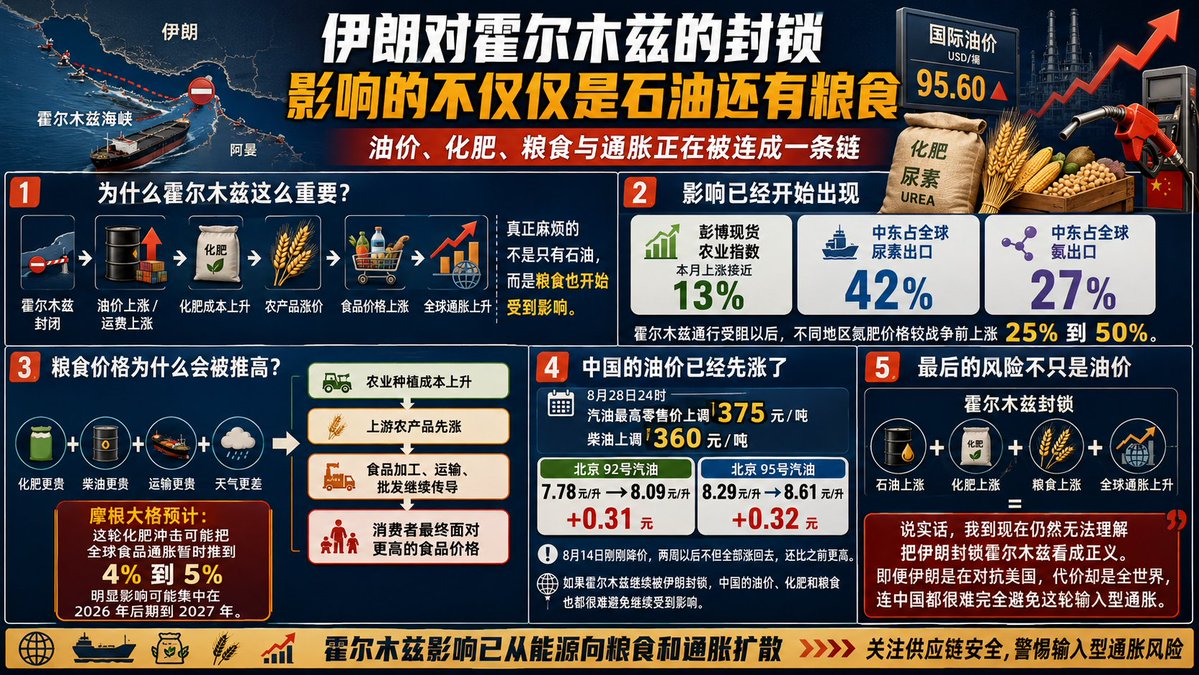
I have previously written that the blockade of Hormuz leads to impacts beyond oil prices, including fertilizers and food. This influence has now begun to appear in agricultural product prices.
The Bloomberg spot agriculture index has risen nearly 13% this month, a very rare single-month increase in many years. The main reasons are the war and severe weather working together, especially the increase in fertilizer, energy, and transportation costs brought by the closure of Hormuz, which has started to affect food prices.
Not just food, the Middle East also accounts for 42% of global urea exports and 27% of ammonia exports, which are all raw materials for nitrogen fertilizers widely used in agriculture. After the blockage of Hormuz, nitrogen fertilizer prices in different regions have risen by 25% to 50% compared to before the war.
Currently, upstream agricultural products have already risen, and later it will be the turn of food processing, transportation, and wholesale, ultimately affecting the prices of food that consumers buy. JPMorgan previously predicted that this round of fertilizer shock could temporarily push global food inflation to 4% to 5%, with a noticeable impact likely concentrated in late 2026 to 2027.
Oil prices and transportation costs remain high, fertilizer supply has not fully recovered, and global weather is starting to face more problems. All these combined result in not just rising oil and food prices, but also a global increase in inflation and a decrease in purchasing power, with the most significant factor being the blockade of Hormuz by Iran.
To be honest, I still cannot understand the belief that Iran's blockade of Hormuz represents justice. Even if Iran is fighting against the United States, the cost is borne by the entire world, and such widespread inflation is something even China cannot avoid.
China's last adjustment of refined oil prices was at 24:00 on August 28, when the National Development and Reform Commission raised the maximum retail price of gasoline by 375 yuan per ton and diesel by 360 yuan. For example, in Beijing, the price of 92 gasoline rose from 7.78 yuan/liter to 8.09 yuan/liter, an increase of 0.31 yuan. 95 gasoline rose from 8.29 to 8.61, an increase of 0.32 yuan.
Moreover, on August 14, China had just lowered oil prices, with 92 gasoline in Beijing dropping from 7.97 to 7.78 yuan. As a result, two weeks later, it jumped directly to 8.09 yuan, completely reversing the previous reduction and adding more. If Hormuz continues to be blocked by Iran, China’s oil prices will continue to rise, and even the prices of fertilizers and food will not be spared.
@Gate Crypto, US stocks, Hong Kong stocks, South Korean stocks, gold, CFD, one-stop trading for prediction markets
免责声明:本文章仅代表作者个人观点,不代表本平台的立场和观点。本文章仅供信息分享,不构成对任何人的任何投资建议。用户与作者之间的任何争议,与本平台无关。如网页中刊载的文章或图片涉及侵权,请提供相关的权利证明和身份证明发送邮件到support@aicoin.com,本平台相关工作人员将会进行核查。


