Author: Nicky, Foresight News
In the early morning of September 7, a newly launched platform on BNB Chain, Brew, achieved a market capitalization of 30 million dollars within 4 hours, with its platform coin BREW rising over 1100%, according to GMGN market data. That afternoon, another nearly simultaneous launch, Sock Market, also made waves, with its platform token SOCK surging over 1200% in one hour, reaching a market cap of 2.78 million dollars at one point.
Within a single day, two new platforms created by anonymous teams gained market traction on BNB Chain, pointing to a recent narrative emerging in both the BNB Chain and crypto markets: allowing Meme coins to trade not only against mainstream tokens like BNB, but also directly against tokenized stocks on-chain.
To understand why this is happening now, we need to slightly extend the timeline. In June of this year, Binance officially launched bStocks, bringing over 7,000 stocks, options, and ETFs from the U.S. stock market on-chain in a tokenized form, with support for 1:1 redemption for real stocks. According to official data, as of September 7, bStocks' cumulative trading volume has exceeded 30 billion dollars.
For launchpads on BNB Chain, this infrastructure means a new pool option has emerged: before this, the liquidity of Meme coins was almost entirely valued in BNB or USDT; afterwards, a cat-dog themed token can trade directly against on-chain stocks of NVIDIA and SpaceX, participating in the price fluctuations of U.S. stock assets through buy and sell. The two previously unrelated arenas of Meme and RWA are now bound together.
The first to seize this opportunity was Flap. This project, founded by Cedric from the ETHGlobal hackathon with a team of fewer than 10 people, has an official Chinese name selected by community vote: "Butterfly," symbolizing taking off.
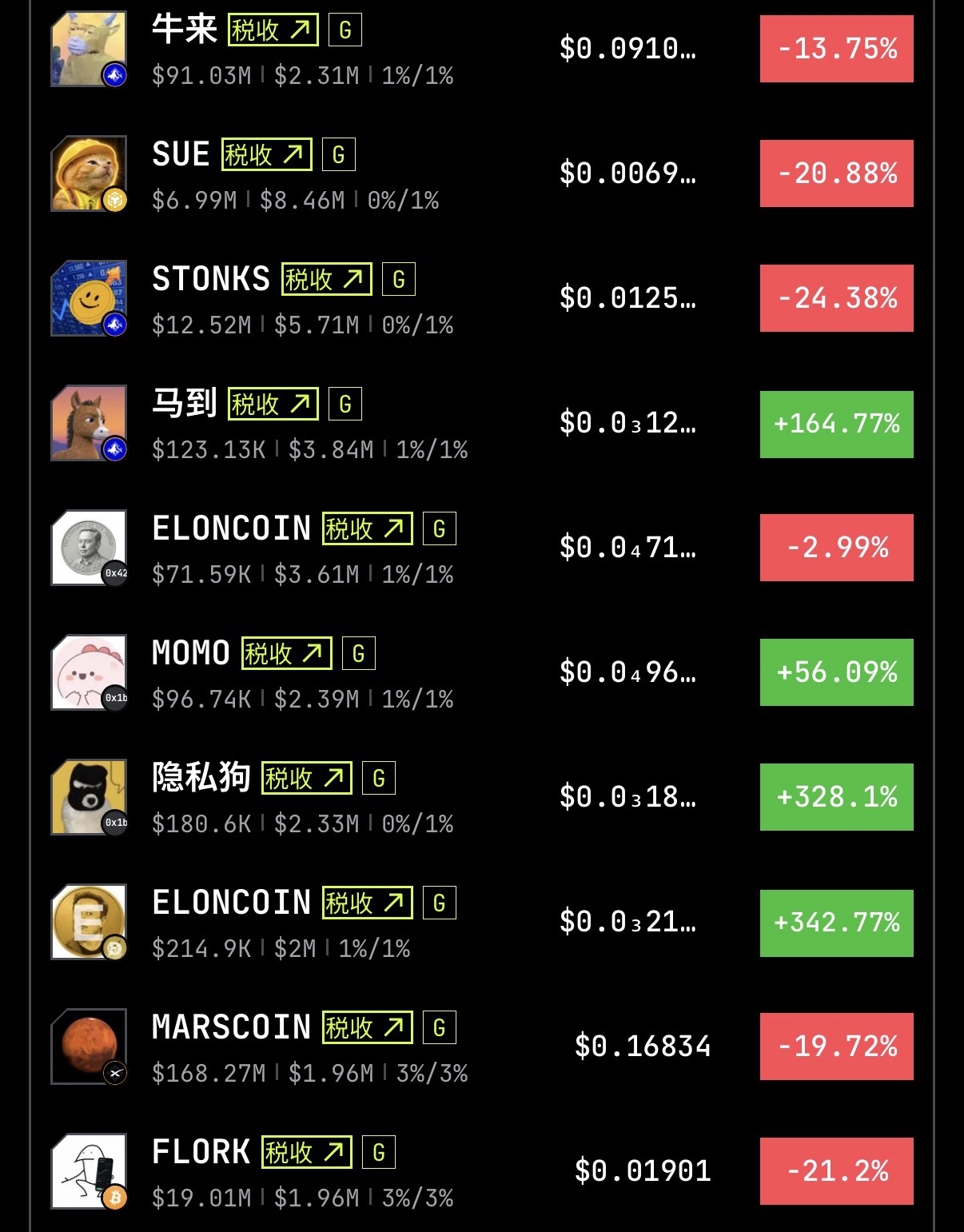
Flap made key modifications based on the joint curve launchpad: it allows tokens to use bStocks as a liquidity pool, while also designating stocks as dividend assets. Holders not only possess the Meme itself but will continuously receive on-chain stock tokens proportionate to their holdings, creating a dual revenue structure of "trading Meme while receiving stocks."
On September 4, Binance launched the MarsCoin spot trading pair, which soared to over 0.26 dollars on September 5, reaching a market cap of 260 million dollars, with a two-day increase exceeding 100%. According to data from Flap's official website, the Meme coin "Bull Come" that has been listed on Binance contracts has distributed 2,033 QQQB (approximately 1.465 million dollars) as dividends, while MarsCoin listed on Binance spot has distributed 29,703 SPCXB (approximately 4.473 million dollars). According to DefiLlama data, Flap currently has a 24-hour fee of about 2.88 million dollars and an income of about 575,000 dollars, ranking first among all launchpads on BNB Chain. After Bull Come and MarsCoin went live on Binance, the wealth effect of this model was thoroughly ignited.
Brew and Sock Market represent two different solutions and further forks to this narrative after Flap validated market demand on BNB Chain.
Brew's approach is more straightforward; it completely removes the joint curve and graduation migration. Tokens directly enter the PancakeSwap V3 pool upon creation, with liquidity permanently locked via Brew's locker function, preventing creators from withdrawing principal or transferring positions. The trading pairs are entirely chosen by the creators, which can be BNB, USDT, other Meme coins, or bStocks stock tokens. The launch pool charges a fixed 1% transaction fee, with all tokens on one side burned and the other side shared between the creators and the protocol, with the protocol taking up to 50%.
According to Brew's official website, the current top two tokens by market cap on the platform are the platform coin BREW and COLD, with market caps of approximately 16.4 million dollars and 79,800 dollars, respectively, where the COLD token pairs with BREW. The creator fees for platform coin BREW have accumulated to approximately 30.58 WBNB (about 22,700 dollars), with 39.61 million tokens burned, accounting for about 3.96% of the total supply. Regarding platform coin BREW itself, there are no ongoing buyback commitments mentioned in the official documentation, with the protocol fee direction stated simply as "distributed to the protocol."
Notably, according to Fomo Wallet, the renowned trader Bonk Guy holds approximately 2 million (valued around 28,000 dollars) BREW, with a market cap of about 626,000 dollars at the time of purchase; Fomo Wallet shows this position was transferred from an external wallet.
The key difference between Brew and Flap does not lie in the simplicity or complexity of the launch process, but in the openness of the pool assets. Although Flap was the first to introduce bStocks to the launchpad, its quoted assets have long depended on a preset list, limiting creators to choosing from stocks allowed by the platform. Brew, however, from day one, has fully entrusted the choice to the creators: any on-chain compatible BEP20 token can serve as a paired asset, including mainstream crypto assets like ZEC, which have recently seen a surge in market interest. This means tokens on Brew can use ZEC as a trading pair or any other sufficiently liquid Meme coin or ordinary token, without being restricted to the stock narrative. This difference was rapidly magnified in the market on September 7, as BREW attracted market attention, and Flap realized that its moat might be eroding against a more flexible competitor.
Flap's response came the same early morning. On September 7, Flap officially announced a "permissionless launch" feature on BNB Chain, supporting custom quote tokens, with pricing assets including RWA, mainstream crypto assets, and popular Meme tokens, no longer limited to a preset list, while allowing users to layer Flap's programmable mechanisms, including creator wallets, dividends, burns, and liquidity. The timing of this move indicates that Flap clearly saw Brew's threat: if they did not immediately open the freedom of pool assets, those desiring to utilize ZEC or other crypto assets as liquidity pools would migrate their liquidity and market attention to new platforms like Brew.
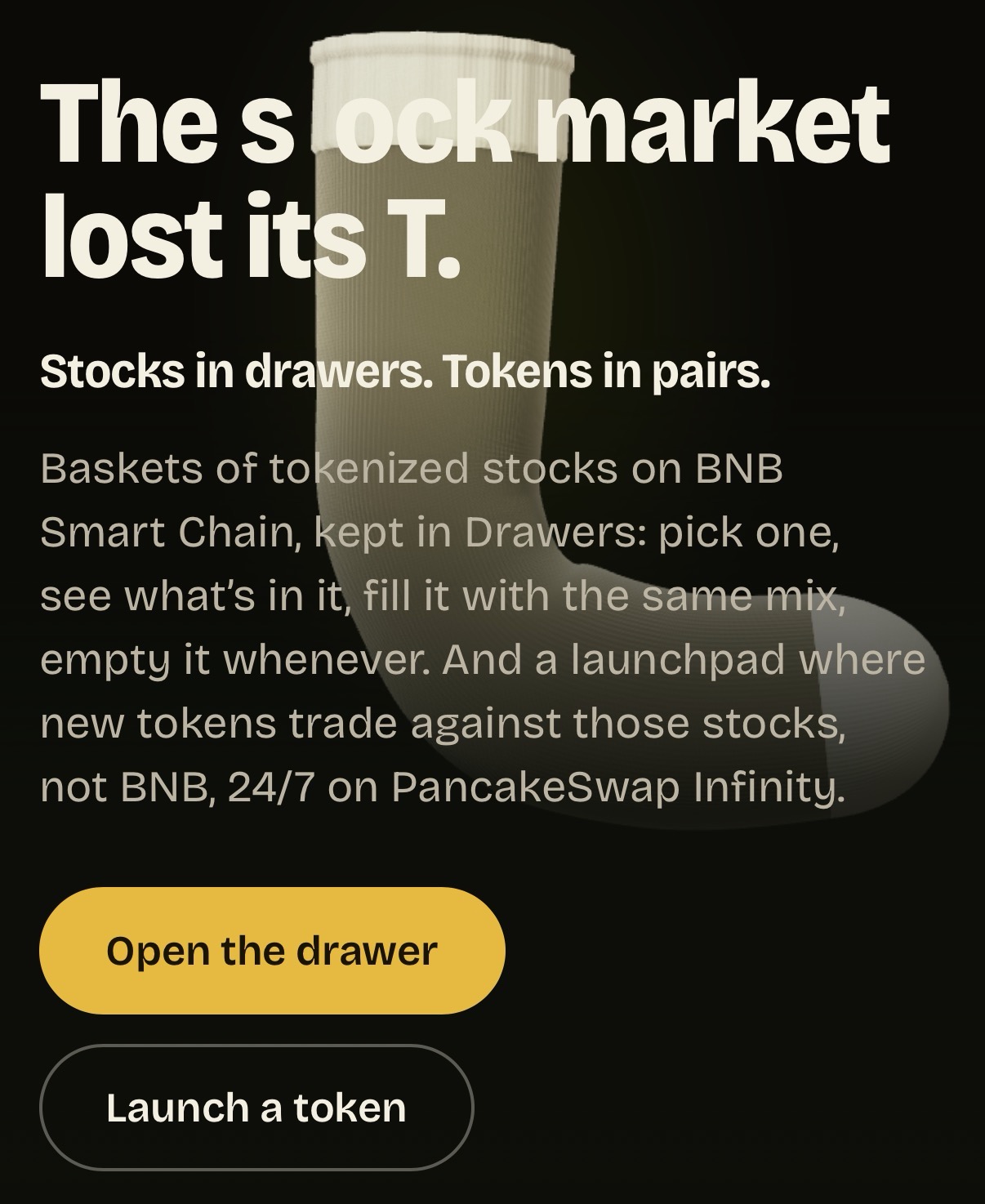
If Brew represents "a minimal version of arbitrary asset pairing launch," Sock pushes complexity to a new level. Its name itself is a hint embedded in the website: stock with the letter 't' removed becomes sock, along with the metaphor "stocks put in a drawer." The core mechanism of Sock allows users to create a Drawer consisting of 2 to 10 bStocks. Essentially, it's an on-chain stock basket, similar to a mini ETF. When the new token is launched, a PancakeSwap Infinity pool is opened for each stock in the basket, beginning liquidity trading against real stocks from the very first block. When buying, multiple stocks are purchased simultaneously based on weight; when selling, each pool settles independently.
This design embeds multi-asset exposure into the tokens, rather than the traditional single-coin pricing. In terms of rates, each transaction during the Infinity phase incurs a 1% base fee, with 70% going to the creator and 30% to the platform; creators can also set an additional tax of 0% to 10%, which cannot be changed after the launch. When the value of the stocks locked in the pool cumulatively reaches about 10,000 dollars, the tokens migrate to PancakeSwap V3, where the additional tax is canceled, leaving a 1% pool fee to continue to be shared at a 70/30 split. The platform coin SOCK also has no ongoing buyback plan, but on September 7, the officials stated they had burned 1% of the total SOCK supply with platform income. According to GMGN market data, SOCK currently has a market cap of about 970,000 dollars, with a 24-hour trading volume of about 3.9 million dollars; currently, only the SOCK token has completed the launch migration on this platform.
Both platforms share the trait of having yet to disclose team information publicly. Brew's official website and accounts have not revealed the identity of its founder, and the same goes for Sock. Considering that both platforms' core operations involve complex fee distribution and liquidity management, an anonymous team implies a higher operational risk. However, if we shift the focus back to the entire landscape, anonymity has never been a barrier to entry; the true filter is whether a platform can deliver enough breakout assets within a cycle.
Previously, a mainstream launchpad on BNB Chain, Four.Meme, which once occupied a top position, has now clearly fallen behind amidst this round of stock pool craze.
Four.Meme's history is almost a microcosm of the BNB Chain ecosystem's Meme cycle itself. In July 2024, the GameFi project BinaryX incubated and launched this platform, and its traditional joint curve mechanism is simple and direct: tokens trade on the internal curve, and upon completion, graduate to PancakeSwap. Creators can choose a trading tax of 1%, 3%, 5%, or 10%, which can be split for holders' dividends, burned, or added to the pool. This pathway was perfectly sufficient during the prosperous period of BNB Chain's Meme ecosystem from 2024 to 2025, and can even be said to be the industry standard.
However, as the market narrative shifted from "who can let the tokens graduate" to "who can let the tokens open against stocks," Four.Meme’s reaction was noticeably delayed. According to DefiLlama data, Four.Meme’s current 24-hour fee is only about 9,578 dollars, which is one three-hundred-twentieth of Flap platform's 2.88 million dollars.
Moreover, it is intriguing to see Binance's latest contract choices. On September 6, the Chinese token "Haqimi" was launched on Binance's contracts, according to GMGN market data, with a market cap reaching 90.56 million dollars on that day and a single-day increase of 251%. Haqimi comes from the Four.Meme platform, issued on October 7, 2025, and has virtually no relation to the current stock pool narrative. Similarly, "Binance Life," also from Four.Meme, has long been listed on Binance spot and contracts, and in June of this year, its market cap nearly approached 900 million dollars.
This time gap is not difficult to understand. Stock pool type Meme tokens involve liquidity structures linked to real stocks, which are inherently more complex than ordinary BNB-valued tokens in terms of compliance checks and market-making arrangements. "Bull Come" and MarsCoin are both already established top assets on Flap platform with sufficient liquidity and market consensus, not newly issued tokens on new platforms. In contrast, tokens like "Haqimi," from an older platform, have more predictable token structures, market-making history, and community scale, presenting lower listing risks. It also indirectly reflects that Flap platform has become the leading launchpad in the current BNB Chain ecosystem.
From Flap's "Butterfly" to Brew's "Coffee Aroma," to Sock's alphabetical riddle, this round of competition among launchpads on BNB Chain is rapidly rewriting the pattern previously dominated by Four.Meme. Flap opened up the stock pool narrative with a product innovation, Brew seized the first wave of attention with more open asset options, and Sock attempts to define the next stage with the heaviest design. But the true determinant of who can survive is not whether the name is catchy or the mechanism intricate, but in this round of the combination between bStocks and Meme, who can first produce assets with stable market caps and trading depths sufficient to support secondary market continuous pricing.
免责声明:本文章仅代表作者个人观点,不代表本平台的立场和观点。本文章仅供信息分享,不构成对任何人的任何投资建议。用户与作者之间的任何争议,与本平台无关。如网页中刊载的文章或图片涉及侵权,请提供相关的权利证明和身份证明发送邮件到support@aicoin.com,本平台相关工作人员将会进行核查。


