
Editor|Cold Cat
How to enable embodied intelligence to continuously evolve is the core problem that the entire industry has always focused on.
The most direct solution is to enhance individual capabilities. More agile hands, stronger generalization ability, more reliable execution performance — this is also the direction with the most intense competition in the industry for a long time.
However, tasks in the real world are never designed specifically for one person or one robot. A smarter robot cannot solve all problems.
Thus, another line of thought gradually becomes important: What if we add some robots for complex tasks?
Collaborative models are inherently suitable for those physical tasks that require multiple points of action, multiple workspaces, or parallel operations.
In factories, multiple general-purpose robots work individually, fully leveraging their individual intelligence; when faced with complex tasks, they can quickly combine their abilities. The physical capabilities required by the system can scale approximately linearly with the number of robots, without having to redesign the entire automation scheme every time.
But what happens when robots leave the assembly line, disengaged from the central scheduler's control, and enter more general scenarios? Will they work independently, just staring blankly at each other? Or worse—will two robots both think they should pick up this cup and end up "fighting" over it at the table?
How can we make them truly act like two reliable colleagues who can naturally break down, hand off, and cooperate to complete a complex task without human direction or a unified strategy, achieving the effect of 1+1 > 2?
This means multi-robot systems must achieve the effect of many hands making light work while also eliminating the problem of "three monks with no water to drink."
When robots enter scalable applications, collective collaboration must be one of the key capabilities, or even a necessity.
Zeno Robotics has released Zeno-1, a foundational model with 3 billion parameters, the first physical intelligence foundational model specifically designed for decentralized multi-robot collaboration, capable of closed-loop visual-motion reasoning locally at 30 Hz.
In simple terms, robots can now truly collaborate autonomously to complete tasks!
Let’s take a closer look at the details of these two robots collaborating.
First is the action of hanging pants. It fully demonstrates the precision of the collaboration between the two robots, accurately grasping the pants to pass through the drying rack, with the handoff of the drying rack being very natural, stable, and without any unnecessary shaking.
Packing a pillow into a vacuum bag, the collaboration level of the two robots is jaw-dropping. This is a relatively long-range complex task and also a very typical household application scenario. The robots robustly executed autonomous action decisions, loaded the elastic pillow into the transparent vacuum bag, held the bag steady while tightening the seal, and finally vacuumed in place. Any deviation in any link would prevent smooth execution.
Interestingly, each robot in the demo is actually running a copy of the same strategy model, making judgments based on the information they individually observe. Who grabs, who coordinates, when to wait, and when to take over — these collaborative behaviors emerge from the same model.
Technical report: https://zenobot.ai/research/zeno-1-collaborative-intelligence
This differs entirely from the traditional multi-robot systems that rely on a central controller for unified task division and synchronized clocks.
Technical breakdown: The four-phase training of Zeno-1
The core problem of Zeno-1 can be summarized in one sentence: How to enable a model to learn to cooperate with teammates without being told what the teammates are thinking?
This problem is difficult for three reasons.
First, dimensional explosion. Two robots have their own observation spaces and action spaces, leading to a rapidly expanding joint state space as the number of robots increases, and the cross-attention calculation load between various agents grows exponentially. The traditional multi-agent reinforcement learning approach is to train all agents simultaneously in a centralized simulator, but this method is almost infeasible on physical robots because the necessary multi-robot synchronized collaboration data and privileged data are extremely hard to obtain.
Second, time accumulation errors. Collaboration between two robots is not turn-based like chess; it is continuous and real-time. A 0.1-second timing deviation may be insignificant at the moment, but after 5 seconds it could lead to failure of the entire task. Errors accumulate over time and are irreversible.
Third, partner uncertainty. In real scenarios, your partner might hesitate, might slip, or might take unexpected actions due to observation noise. Any assumption that "the partner will perfectly execute the preset trajectory" is bound to be fragile. The model must maintain robustness against changes in partner behavior.
Four-phase progressive training
First phase: Learning the world (large-scale video pre-training).
The goal of the first phase is to allow the model to establish a broad prior knowledge of the physical world.
Zeno-1 undergoes pre-training on large-scale video data, learning the basic principles of the physical world: How do objects move under the influence of forces? What happens during contact? How do flexible objects deform when grasped? How do liquids flow when poured?
This step does not involve robot control at all; the model observes numerous real-world physical interaction videos like a "bystander," extracting generic physical priors such as motion, contact, deformation, and causality. These prior knowledge provide a foundation for subsequent phases: the model does not need to learn from scratch that "objects will fall" or "excessive force will overturn items," as these commonsensical insights have already been encoded during the pre-training phase.
Second phase: Learning oneself (individual embodied training).
The physical intuitions gained from video pre-training are generic and cannot directly drive specific robots to execute actions. The second phase grounds these generic priors onto specific robot bodies.
In this phase, a single robot is trained in a real environment, transforming the visually-physical priors obtained from pre-training into concrete perception-decision-execution abilities. The model learns to extract task-relevant features from its own visual observations and body state, and maps them into coherent whole-body action sequences.
After this phase, Zeno-1 as an individual has achieved basic capabilities such as dexterous manipulation, tool use, and interactive mobility.
"First, become a competent individual, then you qualify to talk about collaboration."
Third phase: Learning to collaborate (Closed-loop partner interaction, CPI). This is the core innovation of Zeno-1.
The traditional path is to collect a large amount of demonstration data of multi-robot collaboration and then use supervised learning to imitate. However, this route is nearly impossible: it is difficult to generate large-scale high-quality collaborative data with two real robots in real environments due to cost and efficiency constraints.
The idea of CPI is completely different. It allows two independently operating robots to be training partners. Each robot acts independently based on its own observations, and its actions change the shared physical environment, thereby affecting the next decision of the other robot.
It is worth mentioning that in CPI training, the partner itself is an autonomous entity in the learning process, and its behavior naturally comes with various imperfections: sometimes fast, sometimes slow, and sometimes making mistakes. The model has seen numerous cases of partner behavior deviations during training and has become robust to delays.
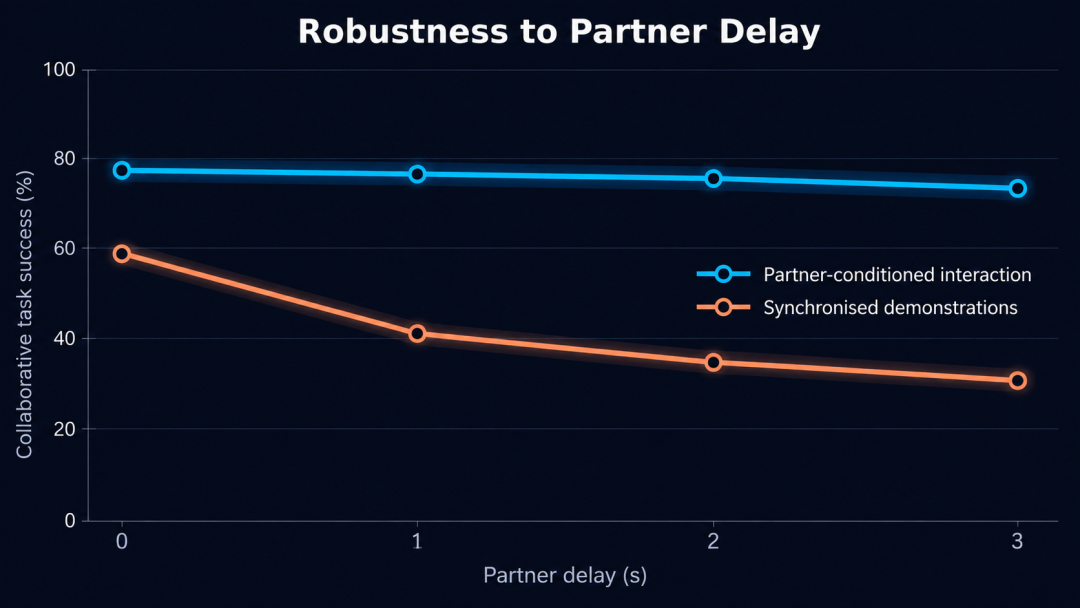
When we deliberately disturb the action timing of collaborative robots, Zeno-1's deployment robustness becomes particularly evident. Even when faced with delays that can quickly impair strategies based on synchronized demonstration training, Zeno-1 still manages to maintain coordinated collaboration.
Through CPI training, Zeno-1 has learned a series of specific collaborative adaptive behaviors: slowing down, waiting, yielding, maintaining contact, recalibrating timing, and then resuming normal rhythm when the interaction becomes compatible again. These behaviors spontaneously emerge entirely from closed-loop interactions.
Fourth phase: Targeted correction of collaboration failures
The specific approach is to observe the robots' collaboration process in real deployments, identify critical moments when collaboration goes wrong, and then have the operator provide corrective demonstrations around these key moments, which are supplemented back into the training data.
The key mechanism lies in the final step: the model does not uniformly learn from all experiences; it invests more learning resources where collaboration is most prone to errors.
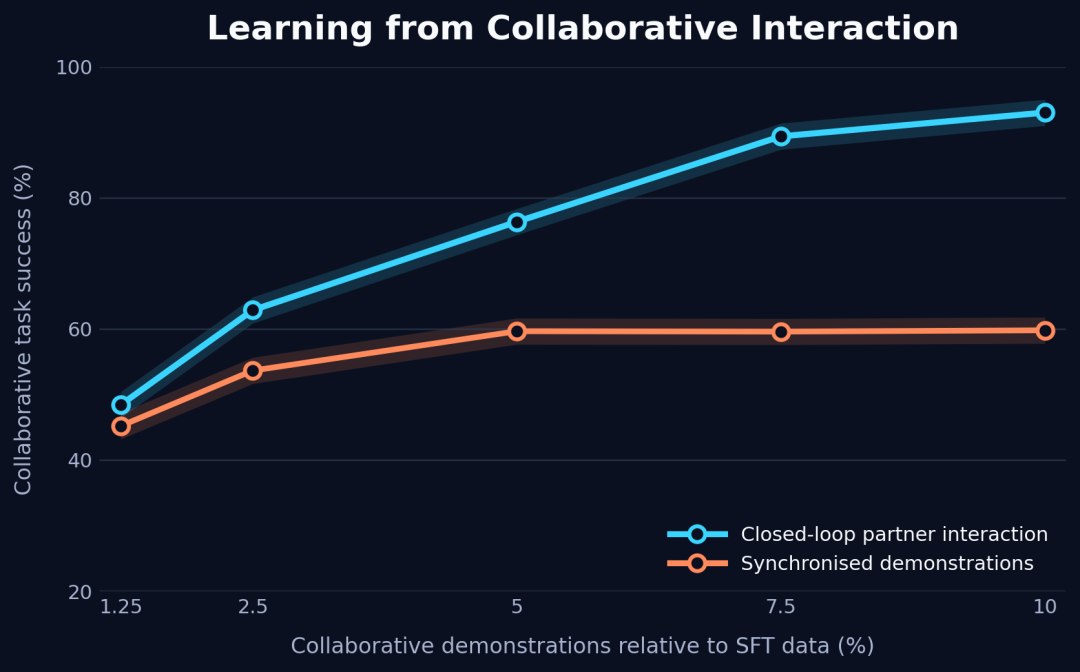
Increasing the proportion of closed-loop partner interaction during the collaboration adaptation process significantly enhances its collaborative performance compared to simply adding an equal amount of synchronous multi-robot demonstration data.
Specifically, the training process is as follows:
Step 1 : Two robots are placed in the same physical environment, each loading the strategies trained in the first two phases.
Step 2: The two robots act independently based on their observations. The action of Robot A changes the shared physical environment, and this environmental change enters Robot B's next frame of observations, thereby influencing B's decision, and vice versa.
Step 3: As the interaction progresses, the timing rhythm, motion trajectories, and contact forces of the two robots need to continuously adapt to each other. Collaborative capabilities naturally emerge from this closed loop.
Step 4: The system identifies moments of collaboration breakdown. When coordination fails, these failure segments are marked, and the model undergoes extra training at these critical moments.
The two robots "co-evolve" during continuous interaction, with robots learning collaboration through genuine cooperation, rather than "imitating" collaboration by watching human demonstrations.
Two key subsystems: Persistent Interaction Memory and Predictive Introspection
From the demonstration videos, we see that the robots are capable of successfully completing quite lengthy tasks. This means that on top of CPI, Zeno-1 has two subsystems that make long-duration collaboration feasible.
Zeno-1 robot long-range task demonstration
Persistent Interaction Memory.
Multi-robot collaborative tasks often span several minutes or even over ten minutes. At this time scale, purely reactive strategies would lose a lot of key context.
Zeno-1 addresses this issue through a learnable memory module. This module updates at each time step, maintaining a compressed representation of interaction history. It encodes three types of information:
Task progress: Which stage the current task is at, which sub-goals have been completed.
Partner behavior patterns: Recent action trends of the partner, whether they are slowing down, speeding up, or changing strategies.
Shared physical state evolution: How object configurations change, how contact points shift.
Ablation experiments indicate that persistent memory is crucial for collaborative tasks exceeding three minutes. Removing this module resulted in a significant degradation of model performance on long-timed tasks.
Robots without persistent interaction memory possess only "goldfish" memory, making judgments from scratch for every step, unable to retain accumulated interaction experience.
Predictive Introspection.
This mechanism enables Zeno-1 to "run through" an action in its mind before executing it. It specifically operates on two levels:
At the partner interaction level, an action might appear optimal locally, but if it puts a partner in an unfavorable position, it becomes suboptimal from the team's overall perspective.
Zeno-1 evaluates each candidate action's potential impact on the partner's subsequent behavior. According to evaluation data retained on the testing set in the technical report:
Zeno-1 has an 87% probability of choosing actions that improve the subsequent behaviors of its partners at collaborative decision points.
In contrast, when the partner behavior prediction module is removed (considering only the immediate effects of actions), this proportion drops to 61%.
"Thinking for the partner" is not just a bonus but a key determinant of collaboration quality.
At the physical contact level, Zeno-1 has a built-in Action-Conditioned Latent World Model that can predict how shared physical states will evolve after executing a certain action.
Its core function is to identify potential failures before executing actions: grasping errors, slipping, unstable grips, and object disturbances.
In tests with 200 real robot experiments, this world model achieves a contact failure prediction AUC of 0.94 within a 0.5-second warning window, compared to an AUC of 0.81 based solely on current observations.
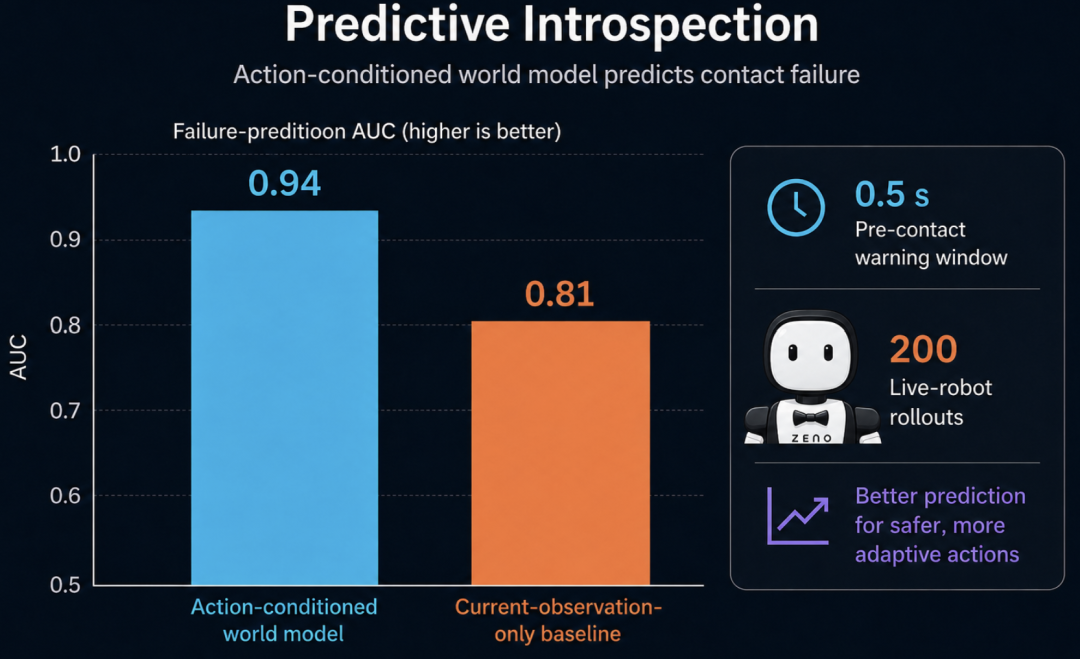
Zeno-1 can anticipate imminent failures 0.5 seconds before contact.
In simple terms, it can prevent collaborative errors. Zeno-1 can simultaneously consider "is this action good for the partner" and "will this action fail physically" before acting.
1+1 > 2, the starting point of multi-robot collaboration
Collaboration among robots seems to suggest unified control, but why does Zeno insist on decentralization? There are two reasons:
Scalability. The joint action space of a centralized controller expands exponentially with the number of robots. Assuming the action space dimension of each robot is d, the joint space of N robots is d^N. Under Zeno-1's decentralized architecture, adding one more robot only requires loading the same strategy copy without redesigning the controller or redistributing the joint action space, leading to linear growth in calculation.
Robustness. Centralized systems have single point failures. If the central controller experiences delays or faults, all robots fail simultaneously. In a decentralized system, each robot makes independent decisions, and the failure of a single node does not propagate to the entire team.
This feature is very practical. You don't need to deploy a complete robot team at once; instead, you can gradually add capacity as needed.
In the real world, a lot of work inherently requires cooperation to be completed. An industry analysis from the Tencent Cloud Developer Community points out that in the second half of 2026, embodied intelligence will enter the "restructuring of flexible workstations" stage: no matter how capable a single robot is, it still cannot handle production lines that require multi-station collaboration.
What do robots rely on for coordination? The answer is: the physical world itself.
In Zeno-1's technical path, "the shared physical world itself is the coordination interface." Each robot observes the environment and the actions of other robots to assess task progress, understand collaborative status, and adjust its next action accordingly. Coordination no longer relies entirely on explicit communication and unified scheduling but emerges naturally from ongoing interactions in the real world.
The academic world has also begun to advance in similar directions. In June of this year, Chelsea Finn and Jeannette Bohg's research groups at Stanford proposed a method called CHORUS, which introduced decentralized multi-robot collaboration based on a single VLA policy.
The industrial sector is also starting to view collaboration as a key capability for the next stage. Figure's Helix 02 and Google DeepMind's Gemini Robotics 2 have both explicitly demonstrated or emphasized multi-robot collaboration, indicating that collaboration is gradually entering the definition of core capabilities of robotic foundational models.
An increasingly clear trend is emerging: robot foundational models are progressing from individual capabilities toward collaborative intelligence.
Zeno-1 has at least validated one thing: collaborative physical intelligence can be realized within a single decentralized strategy.
The tasks a single robot can complete are ultimately limited. When robots truly learn to observe each other, understand each other, and work together like colleagues, 1+1 will truly start to exceed 2, and the upper limit of capabilities in the entire robotics industry will also open up.
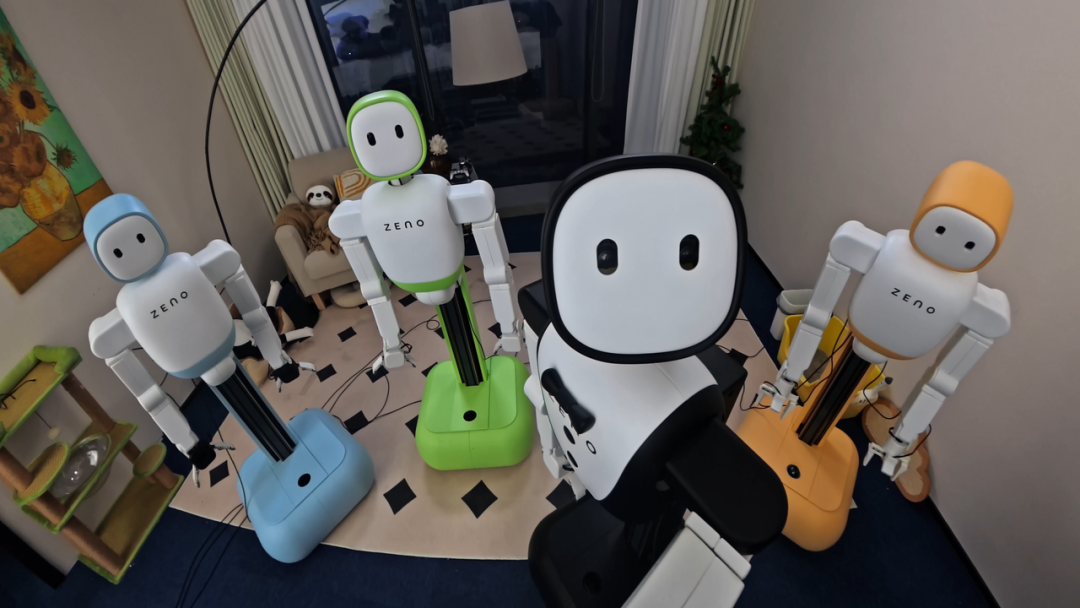
Looking further ahead, a world of civilization involving numerous robots is beckoning to us.
免责声明:本文章仅代表作者个人观点,不代表本平台的立场和观点。本文章仅供信息分享,不构成对任何人的任何投资建议。用户与作者之间的任何争议,与本平台无关。如网页中刊载的文章或图片涉及侵权,请提供相关的权利证明和身份证明发送邮件到support@aicoin.com,本平台相关工作人员将会进行核查。


