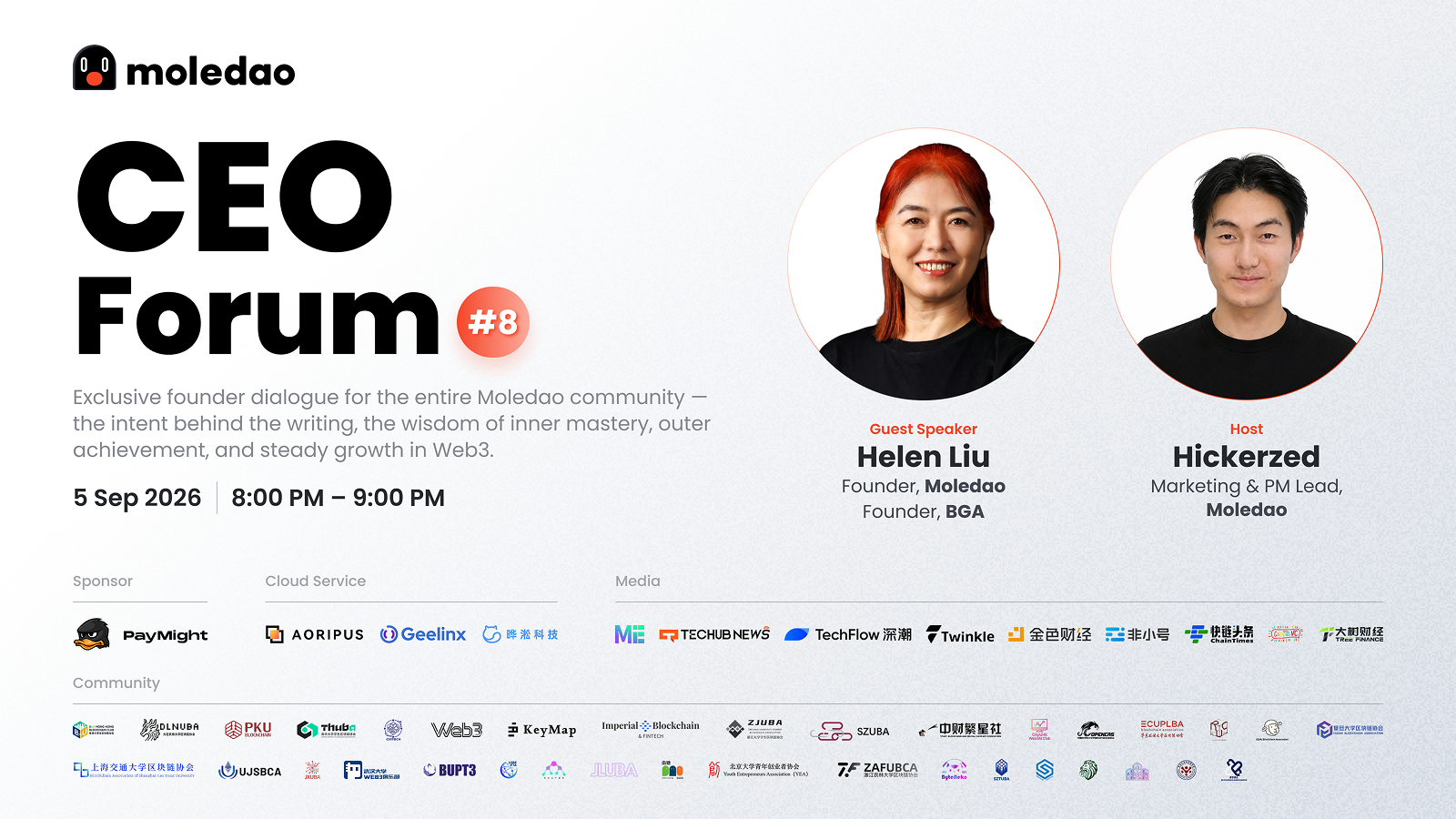
On the evening of September 5, 2026, we held the eighth session of the CEO Forum in Chinese online. Moledao founder Helen Liu, as a guest, engaged in discussions with host Hickerzed and community members. In over an hour, the discussion started from the beginning of the CEO Forum and Moledao, extending to Web3 job hunting, cross-functional transformations, data analysis, entrepreneurial judgments, risk control, business development, token issuance, and industry prospects.
Background of CEO Forum
The CEO Forum (Chief Executive Officer Forum) was initiated by Moledao founder Helen in 2025, and is a flagship high-end dialogue project aimed at global universities and industry leaders. The forum is committed to connecting experienced entrepreneurs, industry leaders, and the new generation of young talent through small-scale, high-density, and high-quality exchanges, promoting the transmission of business experience, cutting-edge cognition, and long-term value between generations.
Unlike traditional keynote speeches and large forums that primarily focus on one-way output, the CEO Forum emphasizes deep interaction, real practice, and thought inspiration. Participants are not only listeners to viewpoints but also co-creators of dialogue. They can engage in direct communication with Helen and invited entrepreneurs, gaining a deeper understanding of entrepreneurship, leadership, technology, finance, and innovation through real entrepreneurial journeys, business decisions, and organizational practices.
To date, the CEO Forum has successfully held seven sessions, visiting world-renowned universities such as Columbia University, Stanford University, Imperial College London, and the University of Hong Kong, gradually establishing a high-quality dialogue platform connecting young people from global universities, entrepreneurs, and industry practices.
Why Was Moledao Established, and What Problems Does It Aim to Solve?
Helen recalled that the idea of Moledao emerged when she joined Bybit early on. At that time, the company had around one to two hundred people, and the team was rapidly expanding while finding blockchain talent was very challenging. Five or six years ago, the industry was still young, with practitioners scattered across different cities and projects. Some wanted to participate in projects, some wanted to take on tasks, and others wished to turn their knowledge and experience into income; compared to mainstream industries, blockchain builders were quite lonely back then. So we needed to create a collective, a supportive community for builders.
This was also the starting point of Moledao. We hoped to gather those who believed in blockchain and were willing to contribute to its construction, allowing members to share experiences, participate in projects, take on tasks, and also access part-time and full-time positions. In the early days, the community gathered a group of members who had an understanding of blockchain, some of whom later joined Bybit and took on significant roles within the company.
Over the past five years, we have successively tried blockchain courses, task and reward platforms, job fairs, internship programs, and career services. Helen mentioned on site that early courses had entered teaching scenarios at universities like the University of Hong Kong and Nanyang Technological University. Hickerzed also introduced that the two Web3 internship programs received over 1,600 applications, and more than a thousand participants thereby entered the community. Currently, our Telegram community has about 2,400 members, with approximately 50,000 registered users on the platform.
These efforts have allowed the community to continue to grow and have clarified our direction. Next, we hope to build Moledao into LinkedIn for the blockchain industry, connecting talent with employers, and also helping those already in the field to continue learning and growing. Helen candidly stated on site that the team currently has only four to five full-time members, with more work being done by volunteers and part-time partners.
How to Enter Web3 and Achieve Career Transformation?
Helen mentioned that organizations that are truly willing to give someone an opportunity often do so not because the person is eager to leave their current position, but because they have proven that they can be responsible for an outcome. A position that is "well taken care of" means that problems can be identified, things can be advanced, results can be reviewed, and relevant individuals do not need to repeatedly ask questions. What a person accumulates is not just a skill, but a rarer professional credit: others believe that by handing over more complex tasks to them, things will not be out of control.
Helen answered based on her own experience. Most of her career was spent in Web2, and entering Web3 was somewhat accidental. However, the skills formed over years of work did not become invalid when switching industries; professional skills are transferable, so do not be afraid. Roles in product management, marketing, project management, operations, customer service, data, security, and development have transferable components between Web2 and Web3.
Helen shared that there is no need to first transform oneself into someone who "looks very Web3." Understanding assets, projects, and on-chain knowledge is certainly helpful when entering Web3, but the speed of learning and established professional skills are equally important. Banks do not require every new employee to master all financial products before starting, and Web3 companies will also provide newcomers the space to continue learning the business.
Helen also mentioned, first do well in what you are currently responsible for, so that others are willing to entrust you with greater responsibilities. The true differentiator in recruitment often lies in the results a candidate has achieved in their original position, how they solve problems, and their ability to continue learning in a new environment.
How to Transition from HR to Co-CEO?
Helen's transformation did not come from an exceptional promotion to a new position, but from the increasing complexity of the issues she handled. The true boundaries between functional departments and business departments are often not defined by professional backgrounds. While they are all very professional, sometimes due to being too specialized, they remain within their departmental scope and lack the willingness to understand the ultimate results. If a person only performs actions within their functional scope, they will be defined by the position. However, when they start to question why certain events happen, who is affected, and how to truly solve them, they gradually gain a perspective that transcends their position.
After joining Bybit, Helen first ensured that the HR department could operate independently and orderly. When founders come to communicate with issues, she handles both the immediate problems and possible overlooked areas, allowing managers to confirm that this department has been well taken care of and can be entrusted to her without worry.
The next step was Chief of Staff. Helen attended meetings with the founders, institutions, customer service, regional teams, and business departments, following up on each action item post-meeting, then bringing back plans and progress before the next meeting. Through this, she saw how different departments within the company operate, and through repeated execution, she learned the business. Later, when she was responsible for the marketing team, the insights she had accumulated from the company perspective helped her judge which businesses should be amplified by the market and what content the brand should use to establish its position.
This also addresses a common issue when transitioning roles. Customer service employees wanting to move into product or marketing roles have limited persuasive power by simply submitting resumes. Customer service interacts with users daily and can quickly spot issues like activity links not opening, unclear task guidance, or reward retrieval interruptions. If someone is willing to personally replicate the problem, push the relevant teams to make changes, and continuously provide useful suggestions for products and operations, they have already established the experience needed to enter adjacent functions while performing their current role, making their applications for product and operations positions much more secure.
Helen refers to this accumulation as the "depth" of work. A person should first understand issues, propose solutions, and influence others' work in their current position; new opportunities usually arise more naturally. Moving from HR to Chief of Staff, then to business management, it's the continuous transcendence of boundaries and accountability for results that lead to the ability to lead multiple teams, transitioning from “completing professional work” to “being accountable for organizational results.”
When AI Can Quickly Count, Compare, and Even Explain Data, What is the Value of Data Analysts?
Helen distinguishes between two levels of work.
The first level is presenting facts: consolidating trading volumes across spot, futures, stocks, and different regions, comparing changes from today to yesterday, this month to last month. This type of work once required analysts to invest substantial time, but is increasingly becoming automatically completed by AI.
However, what managers genuinely need is not just a report that proves "trading volume has declined," but further answers: Why did it decline? Is this a common fluctuation across the industry or a problem specific to the company? Have competitors experienced similar changes? Is it a failure of marketing activities, a hindrance in product experience, or is a specific group of core users being lost?
These questions cannot be solved solely with more data. Analysts need to understand the environment in which business occurs, discern correlation from causation, and judge which changes are just noise and which signals warrant immediate action by the company. More importantly, analysis cannot stop at explaining the past. A valuable conclusion should ultimately see the root cause behind the data, which can then produce actionable items: what is worth continuing to invest in, what needs to be halted promptly, and where the next opportunity may arise.
The value of data is never in the numbers themselves, but in what they tell us. AI can enhance the speed of generating data reports, yet cannot take on the consequences of choices made by an organization. The true value of a data analyst is not just asking "why" one more time than AI, but transforming numbers into judgments and then converting those judgments into actions.
Could A Diverse Work Experience Blur One's Career Direction?
Working in small projects, where job content covers various areas, can feel a bit scattered. There are concerns about not being recruited by larger companies. Helen believes that "being scattered" is neither a flaw nor does it naturally become an advantage. What truly matters is whether a person can build an understanding of the overall business from various jobs.
In small teams, one person might need to write project reports, plan token listing events, track data, manage communities, and communicate with project parties and other partners. These individuals possess a significant strength in their hands-on skills. At first glance, these responsibilities seem to lack clear functional boundaries; however, they can see how each link influences the others, which provides a systemic perspective that is hard to obtain from a single position.
If given the opportunity to be hired by a large platform and enter a major exchange, even if they only handle token listing operations, they will find it easier to explain to other departments where the project’s value comes from, why users are interested, what risks the security team is concerned about, and what information the market, community, and business development need. Their advantage is not “having done many things,” but being able to speak the language of different teams, enabling them to grasp the project demands quickly and translating the language of different teams for each other, thus understanding how a result is collaboratively created.
However, breadth can also become a trap. If a person merely accepts new tasks continuously but does not dive deep into any single task, "having done everything" might ultimately become "not having done anything deeply enough."
Transitioning from a small company to a large organization brings about another type of capability transformation. Small teams rely on individual initiative and quick responses since everything lies within their controllable scope, while large companies depend on processes, collaboration, and risk management. In small teams, finishing one's work typically signifies the end; in large organizations, genuine completion also includes obtaining approvals, driving collaboration, and confirming delivery. Therefore, individuals from small companies should be attentive to learning how to utilize processes in large companies, ensuring that tasks remain under their control; only then can they influence outcomes.
Thus, the value of career experience does not depend on whether the position is specialized enough, but on whether a person can distill breadth into a systematic understanding and refine complex experiences into a stable core competency.
What Does Issuing Tokens Mean?
Helen discussed that Moledao had seriously considered whether to issue tokens but ultimately chose to maintain a non-profit direction.
Issuing tokens can bring funding, liquidity, community participation, and a wider range of stakeholders, and may help projects expand their influence more quickly. However, tokens are never just a financing tool. When a project has publicly traded tokens, its responsibility structure also changes: in addition to users, products, and its original mission, the team must now face the profit expectations of token holders and the ongoing evaluation of market prices.
The price can amplify consensus but can also reshape behavior. The team may begin to prioritize what can stimulate trading, maintain excitement, and support token prices, rather than the original problems they truly hoped to solve. When short-term prices conflict with long-term constructions, what a project chooses to protect will ultimately decide what it becomes.
This does not mean that issuing tokens will definitely divert a project from its course. Helen still supports new projects trying tokens and on-chain products. The true question to answer is not "should we issue tokens" but rather: Do the tokens actually serve the product? Do the benefits acquired by token holders stem from the long-term value created by the project? When market sentiments conflict with the organization's mission, can the team still maintain its original judgments?
Where a project ultimately goes is decided not only by the vision it initially proclaimed but also by what it rewards over the long term, who evaluates it, and whom it chooses to be responsible to. This is also a key issue for Helen when assessing whether to acquire or merge small teams. It is not enough for both sides to have similar goals; they also need to confirm what each believes, how decisions are made, and in what manner they are prepared to reach their destination. Goals determine whether they can move together, while methods dictate how long they can stay on the same path.
Is There No Hope for Web3?
Confronted with the reduction of Web3 positions and industry contraction, Helen believes that the current downturn is still part of the industry's cycle. In the short term, companies will cut positions and tighten budgets, and opportunities that once relied on industry expansion will diminish; however, on a longer time scale, crypto continues to hold potential for sustained development in areas like payments, stablecoins, bank settlements, and value exchanges between AI agents. Traditional financial institutions will gradually absorb blockchain technology and capabilities. Crypto will be more deeply integrated, becoming part of future currency forms and the next generation of banking infrastructure.
However, believing in the long-term development of the industry does not mean that every single position, project, and company will be able to wait for the next cycle. Macro trends can help individuals select directions, but they cannot establish personal competitiveness. What can truly be carried forward is the professional abilities formed by an individual within the industry and the scarcity of these abilities when combined with new settings.
Helen cited the example of an internal audit position. Traditional auditing experience has always held value, but individuals who have done internal audits in large crypto companies have added layers of experience that are difficult to replicate quickly: they understand how on-chain assets flow, know what new risks are brought about by custody, wallets, permissions management, and transaction business, and understand how traditional control frameworks need to be adjusted to enter crypto business.
Even if they leave Web3 in the future, these experiences will not disappear along with the industry's popularity. When banks, payment institutions, and other traditional financial companies begin to establish digital asset-related businesses, what they bring back is not merely "having worked in crypto" but a composite skill set that is temporarily scarce in traditional finance and may be needed in the future.
This is also a way for individuals to cope with cycles: Do not completely bind yourself to a hot position, but instead allow industry experience to settle back into your expertise. Market, product, auditing, compliance, data, and technological capabilities will not lose value due to a downturn in the industry; what is truly important is whether you have added a layer of understanding that others temporarily lack in your original expertise within the unique environment of Web3.
The industry will cyclically create and reclaim positions. Only chasing positions can easily lead one to be swept away by cycles, while continuously accumulating competency combinations can enable one to transform an industry experience into long-term career assets.
Notable Quotes from the Event
"Whatever you are doing now, do it well, so that you stand out when being selected."
"When you want to enter the next position, first let others see that the current position you are responsible for has been well taken care of, and you can indeed take on more."
"A good data analyst must help others see where the opportunities are and what can be done next after reviewing the data."
"Doing everything in a small project might become your advantage. You know the selling points of every link and how to convey the essentials to different collaborative departments."
"After issuing tokens, a project takes on another responsibility towards token holders. The business cannot morph merely for the sake of token prices."
"We must both recruit and cultivate talent, allowing them to truly step into this industry."
"The application scenarios of blockchain technology have yet to be fully realized, and it will become part of mainstream finance in the future."
Returning Experience to Specific Issues
This exchange did not provide a single answer to all questions. Helen explained her past actions, judgments, and results in the context of job searching, role transitioning, entrepreneurship, and industry changes. For those dealing with similar issues, these experiences hold greater reference value.
Outside of the CEO Forum, we are about to launch a practical column on centralized cryptocurrency exchanges. Helen will share content related to project construction, the launch of exchanges, token listing compliance, market monitoring, and post-listing operations for project parties based on her own exchange experience. The course schedule and registration information will be announced on Moledao's official channels.
Thanks to Helen for her sharing, and also to all friends who participated and asked questions online. The replay of the eighth CEO Forum and subsequent activities will be released successively.
Check out the announcement for the eighth CEO Forum, and feel free to follow our official website and X account.
免责声明:本文章仅代表作者个人观点,不代表本平台的立场和观点。本文章仅供信息分享,不构成对任何人的任何投资建议。用户与作者之间的任何争议,与本平台无关。如网页中刊载的文章或图片涉及侵权,请提供相关的权利证明和身份证明发送邮件到support@aicoin.com,本平台相关工作人员将会进行核查。


