Original | Odaily Planet Daily(@OdailyChina)
Author|Azuma(@azuma_eth)
Zcash (ZEC) is experiencing an epic rally.
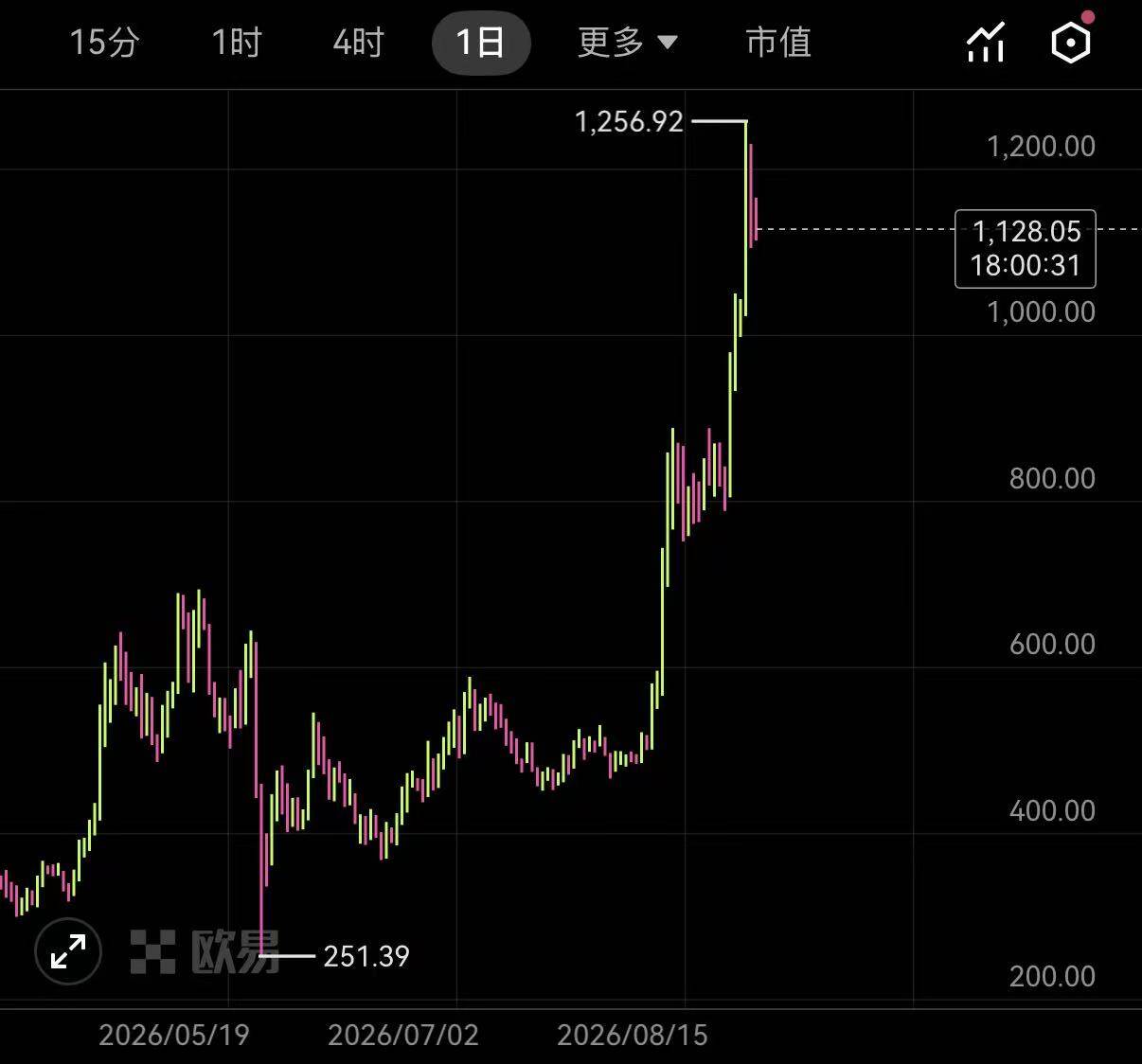
OKX market data shows that ZEC officially broke the $1000 mark on September 6, peaking at $1256.92; as of today at 2:00 PM, it has slightly retreated to $1128.05. If we calculate from the low of $251.39 during the Orchard vulnerability incident in early June of this year, ZEC has nearly 400% increase within just three months.
However, while ZEC is surging in the secondary market, not everyone in the opinion market is convinced.
Wang Chun Slams Zcash
Today at noon, Bitcoin super OG and co-founder of F2Pool, Wang Chun (@satofishi), tweeted multiple times, exposing the black history of Zcash and bluntly stating that “blocking this team was one of the best decisions I've made so far.”
- Odaily Note: Regarding Wang Chun, a more recognized identity now is “the first astronaut about to go to Mars.” In May this year, SpaceX officially announced that Wang Chun will board the Starship to carry out the first crewed interstellar Mars aviation mission, which is planned for a two-year deep space flight, passing Mars without landing, and finally returning to Earth. For details, please refer to the article “The 1980s born from Tianjin, soon to be the first person to go to Mars.”
First, at 12:52, Wang Chun retweeted his historical tweet from six years ago criticizing the Zcash team for misunderstanding daylight saving time, questioning the professionalism of the team.
Six years ago, a member of the Zcash team emailed me, continuously mixing up EST (Eastern Standard Time) and EDT (Eastern Daylight Time). Communication was completely stalled, and I directly blocked their entire company. Looking back six years later, this is still one of the best decisions I've made. Remember the BlockFi mishap back then? They were supposed to distribute $701.4 to users, but instead, they directly transferred 701.4 bitcoins. A person who can't even distinguish between EDT and EST is likely to confuse BTC with USD.
Then at 13:17, Wang Chun commented on ZEC again, this time with more aggressive language, supporting the idea that ZEC is “unworthy of its position.”
Zcash's recent surge is purely driven by narrative. A large market cap does not mean a token deserves its current position; being next to Solana and Hyperliquid in market cap rankings does not mean Zcash can achieve what those two can.
Its launch was inherently unfair. For the first four years, 20% of each block reward was deducted as “Founders’ Reward.” This money flowed to founders, employees, advisors, and early investors, totaling 2.1 million ZEC, which is 10% of the total supply cap of 21 million. Bitcoin rewards only miners, while Zcash also supports a company and its backers. When the first profit-sharing was supposed to end, another similar 20% deduction reemerged under the name of the “development fund.” A token that directly embeds self-serving provisions into its block rewards has no right to be packaged as a clean, neutral currency.
This deduction did not create a true economic ecosystem. Privacy is its marketing selling point, but using privacy features is optional. For exchanges and simple wallets, transparent addresses are always the most straightforward path. For most of Zcash's history, the vast majority of tokens have been exposed in plain sight. “Optional privacy” is merely a marketing gimmick; “default privacy” should be the underlying protocol. Meanwhile, team governance has been mired in board infighting: Electric Coin Company (ECC), foundation, Bootstrap, brand ownership, wallet ownership, and who gets to divide the cake. In January 2026, the entire ECC team left, claiming they were pushed out. This is not a trivial matter; this is the true operational ecology of the project. A foundational team that can't even collaborate under the same roof with its nonprofit board is definitely not “decentralized,” but rather, its upper structure has already collapsed.
Next, the market is now trying to gloss over a security mess. In May 2026, a serious vulnerability in the Orchard funding pool was made public. This vulnerability had been lurking for about four years. In theory, it could create fake ZEC out of thin air without leaving clear on-chain traces. Due to the privacy nature of the funding pool, no one could prove whether fake coins had ever been created. The “Ironwood” upgrade in July closed the old funding pool and forced tokens through a checkpoint for migration. This was cleaning up after the mess, not a justification for its position in the top ten by market cap. A currency that cannot verify its privacy supply like Bitcoin and even had to conduct an emergency fix after a four-year vulnerability outbreak can hardly be considered “hard currency.”
The conclusion is clear: an unfair launch, team deductions that do not match product strength, years of upper-level intrigue, and a massive hole lurking in the privacy pool for four years — these are definitely not what a top ten network should have as a track record, but rather a true portrayal of a token that survives on storytelling (story coin). You may have reasons to look down on Solana and Hyperliquid, but at least they bear authentic application demands; whereas Zcash only carries a listing on an exchange and a short squeeze frenzy. These two are entirely different. Mixing them up is as absurd as transferring 701.4 of assets incorrectly or mistaking EST for EDT.
Review of Black History
In simple terms, aside from the professional issues relating to time zones, Wang Chun mentioned four points of controversy regarding Zcash in his tweets.
20% "Internal Treatment"
The earliest question raised about Zcash was its entirely different launch mechanism from Bitcoin. After the mainnet launch in 2016, in the first four years of Zcash, 20% of each block reward did not go to miners, but was distributed as “Founders’ Reward” to founders, early employees, advisors, investors, and Electric Coin Company (ECC) and other related parties. This portion of the reward ultimately accumulated to about 2.1 million ZEC, accounting for 10% of the total supply cap.
More notably, after the Founders’ Reward expired in 2020, the 20% block reward deduction did not completely vanish. The Zcash community introduced a new Dev Fund through ZIP 1014, continuing to allocate 20% of block subsidies to Bootstrap, Zcash Foundation, and Major Grants from 2020 to 2024.
Although the uses of funds and governance method differ from the initial Founders’ Reward, critics still view this as meaning Zcash has long maintained a “developer deduction” mechanism distinct from Bitcoin.
“Privacy Coin,” Yet Allows You Not to Be Private
The second controversy about Zcash comes from its core product positioning — privacy.
Zcash does not force all transactions to be privacy-protected but simultaneously supports shielded (privacy) and transparent (clear) transactions. Users can choose whether to use privacy features based on the support from wallets and exchanges; even some wallets or exchanges currently only support transparent transactions. The Zcash official also clearly reminds that to keep transaction and financial history private, one needs to use a wallet or service with shielded transactions enabled by default.
This creates a rather controversial product positioning — Zcash does indeed have unique privacy technology, but privacy is not a mandatory attribute at the protocol level. For users, not using the privacy function is often more convenient; for exchanges and wallets, transparent addresses are easier to support and regulate.
The “optional privacy” issue raised by Wang Chun does not essentially deny Zcash's privacy technology; rather, it questions whether Zcash can support today’s valuation with the narrative of “privacy currency” when a large number of transactions in the network can still occur publicly.
Core Team Openly Squabbling, Ultimately Choosing to Part Ways
If the first two issues pertain to Zcash's historical design, then the ECC incident that erupted early this year directly exposed conflicts at the governance level of the project.
In January 2026, the entire team of Zcash's core development company Electric Coin Company (ECC) collectively left. ECC CEO Josh Swihart stated at the time that the team was forced to leave due to serious disagreements with the nonprofit organization Bootstrap, which governs ECC; the Bootstrap side attributed the conflict to governance arrangements and legal constraints of the nonprofit organization.
This incident did not ultimately stop Zcash — the former ECC team then established a new company to continue developing Zcash, and by the end of February, Bootstrap announced that both parties had reached a resolution, with ECC gradually concluding operations and related technical assets being transferred.
However, from an outsider's perspective, a project's core development team publicly clashing with its governance body, and even eventually “storming out,” is clearly difficult to completely align with the image of a highly decentralized and mature governance protocol. This also became one of Wang Chun's important evidences to question Zcash's “worthiness of position.”
Four-Year Orchard Vulnerability
What truly put Zcash's “hard currency” narrative to the test was the Orchard vulnerability exposed in May this year.
On May 29, security researcher Taylor Hornby discovered serious vulnerabilities in the zero-knowledge proof circuit of the Orchard privacy pool. According to Zcash's disclosure, this vulnerability theoretically could allow attackers to generate unlimited fake ZEC undetected. Moreover, due to the privacy attributes of Orchard, even if the vulnerability has been fixed, no one can prove through cryptographic means whether anyone exploited it to create fake coins during its existence.
Zcash quickly took emergency measures, temporarily shutting down Orchard-related operations and re-enabling the repaired circuit through the NU6.2 upgrade, completing the entire emergency fix process within days.
The issue is that for an asset emphasizing scarcity, privacy, and the “digital cash” narrative, “theoretically can infinitely increase issuance, and afterwards cannot prove if it ever occurred” is itself an extremely serious trust issue. This was the direct reason why ZEC was slammed down to around $250 on June 1 and also the project's most difficult black history to avoid.
More Heavyweights are Bearish
Aside from Wang Chun's comments, another heavyweight is also expressing their bearish sentiment towards ZEC with real money.
Garrett Jin, known as the “1011 Insider Whale Agent,” is now the largest ZEC short on-chain. This morning, Garrett Jin closed a long position in Bitcoin valued at nominal $106.18 million and chose to increase his short position in ZEC.
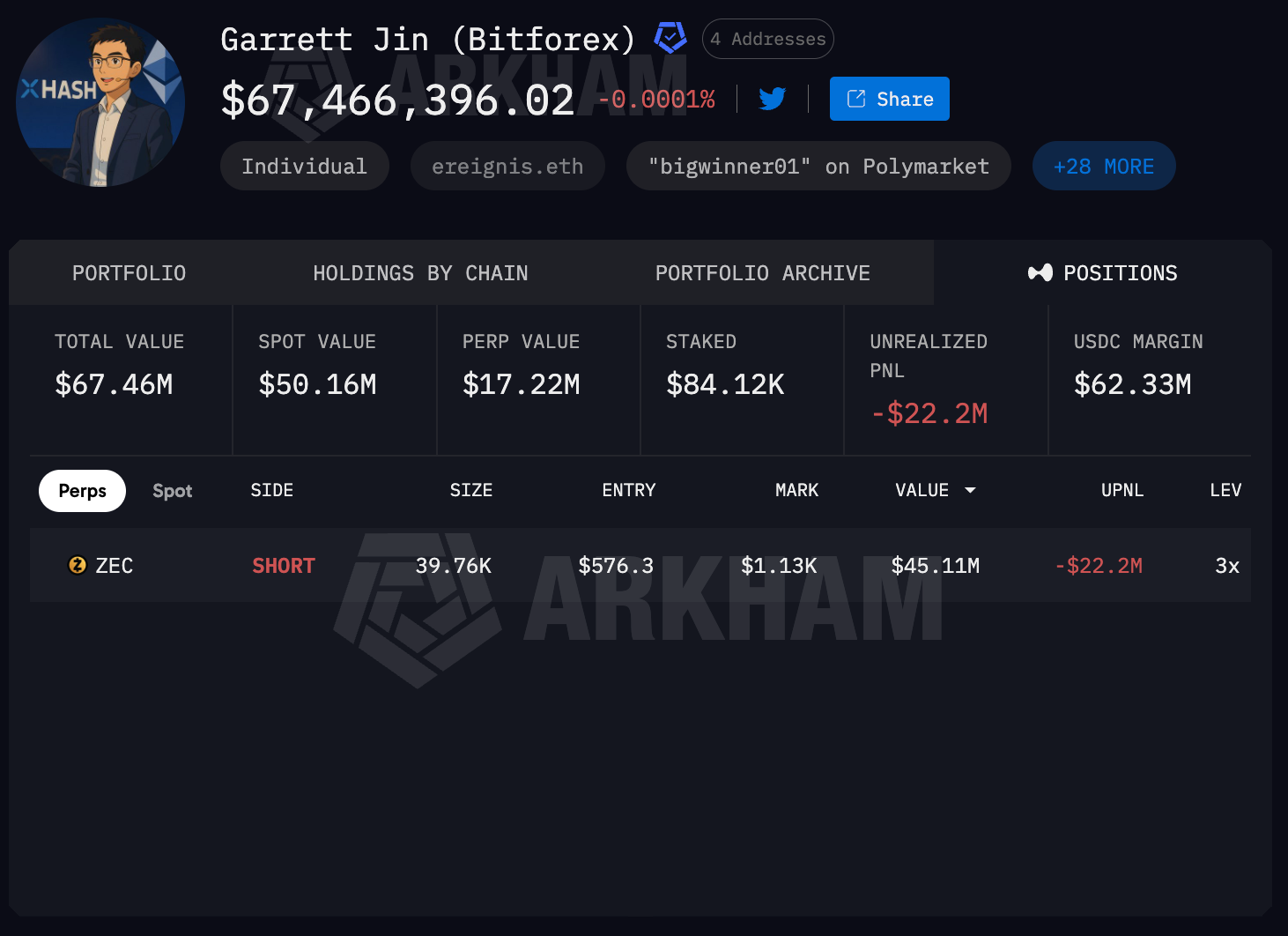
Currently, Garrett Jin is shorting ZEC worth $45.11 million with 3x leverage, with an average entry price of $576.3, currently still at a loss of $22.2 million — but Garrett Jin seems very resolute, having significantly increased his short position multiple times during ZEC’s price rise.
How Long Can ZEC Continue to Rise?
Of course, neither Wang Chun nor Garrett Jin can solely determine ZEC's price based on their bearish sentiment or positions. In fact, having risen from $250 to over $1200, ZEC has already proven that the return of the privacy narrative, capital chasing, and short squeezes are completely sufficient to overshadow the fundamentals in the short term. As long as market sentiment continues to warm, ZEC certainly does not rule out the possibility of further highs.
The issue is that after this round of nearly 5-fold increase, it has become difficult for ZEC to explain its current price with “undervaluation.” When the short squeeze gradually ends (might there be another hit on Garrett Jin?), profit-taking selling pressure will increase, and the market will inevitably return to fundamentals: aside from the privacy narrative, what exactly does Zcash have to support higher valuations? Especially the aforementioned launch mechanism, optional privacy, governance conflicts, and Orchard vulnerability; these issues have not automatically disappeared because of the price increase.
Therefore, rather than predicting whether ZEC's next stop is $1500 or $2000, it may be more worthwhile to observe how much premium the market is willing to leave ZEC when hot money recedes, and shorts are no longer forced to cut losses. This will also determine whether this round of sky-high prices is a re-evaluation of the values of old privacy coins or a super rally driven by storytelling and liquidity.
免责声明:本文章仅代表作者个人观点,不代表本平台的立场和观点。本文章仅供信息分享,不构成对任何人的任何投资建议。用户与作者之间的任何争议,与本平台无关。如网页中刊载的文章或图片涉及侵权,请提供相关的权利证明和身份证明发送邮件到support@aicoin.com,本平台相关工作人员将会进行核查。


