Author: AiPlot Research Institute
Focus: Deep analysis on RWA / Commodities / Financial Infrastructure
Copper is undergoing an important identity transformation.
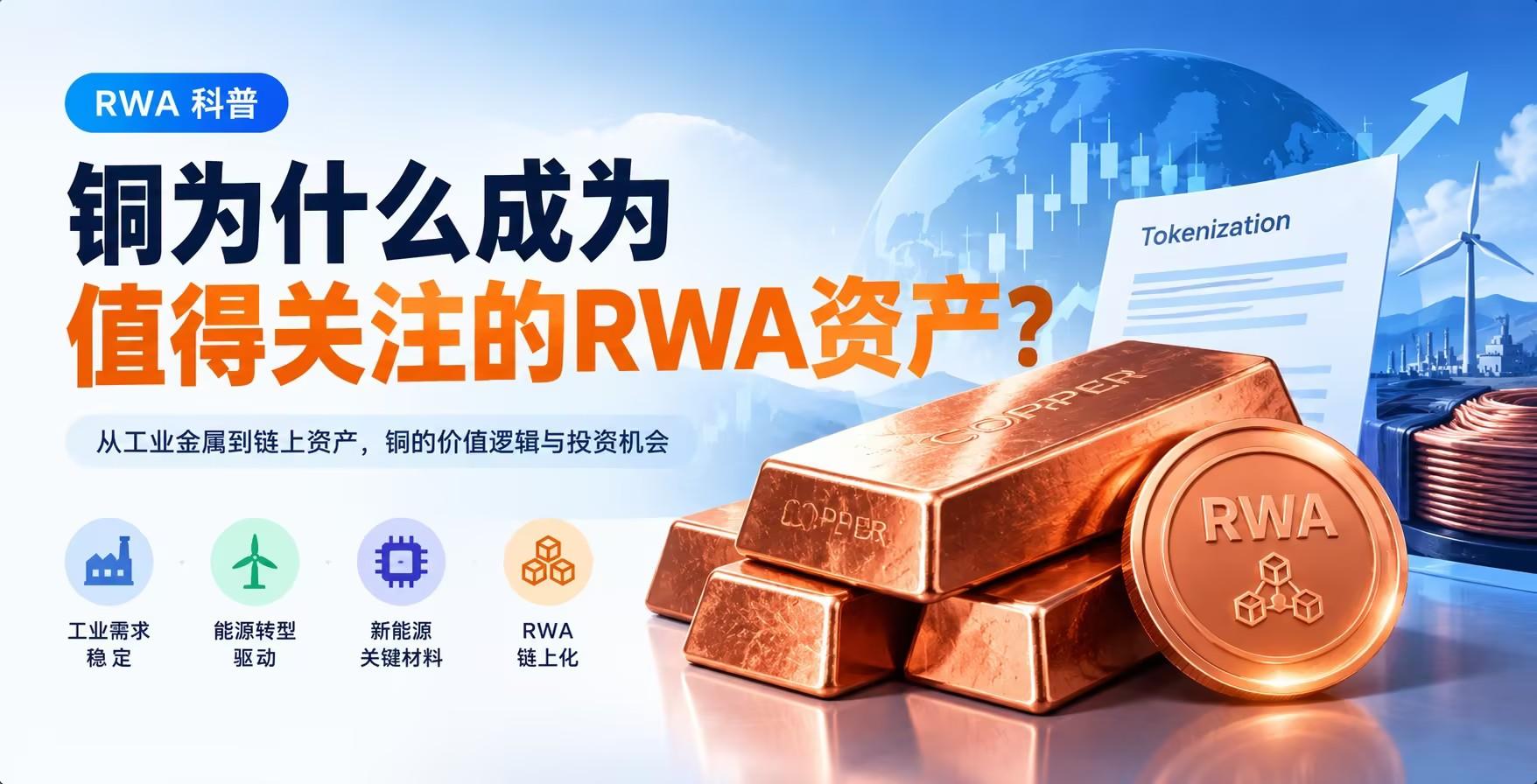
In the past, the market typically understood copper as a typical cyclical industrial metal: demand rises during economic growth, and prices are under pressure when manufacturing slows, making copper prices a "barometer" for assessing global economic performance. However, in today's context of simultaneous advancements in artificial intelligence, electrification, and energy transition, the demand logic for copper is shifting from traditional manufacturing cycles to a broader cycle of infrastructure investment.
Data centers require power and cooling systems, power grids need transmission and distribution equipment, new energy vehicles demand motors and cables, while wind and solar energy require a vast amount of electrical connections. Copper may not necessarily appear in the most conspicuous names of technology products, yet it runs through the complete chain from computing power to electrical power, from energy to infrastructure.
The recent rise in copper prices can be summarized as "the US is scrambling for copper": tariff expectations drive earlier purchases, while AI data centers, clean energy, and power grid upgrades bring about long-term demand, exacerbated by supply pressures from major supplying countries like Chile, tightening the market further.
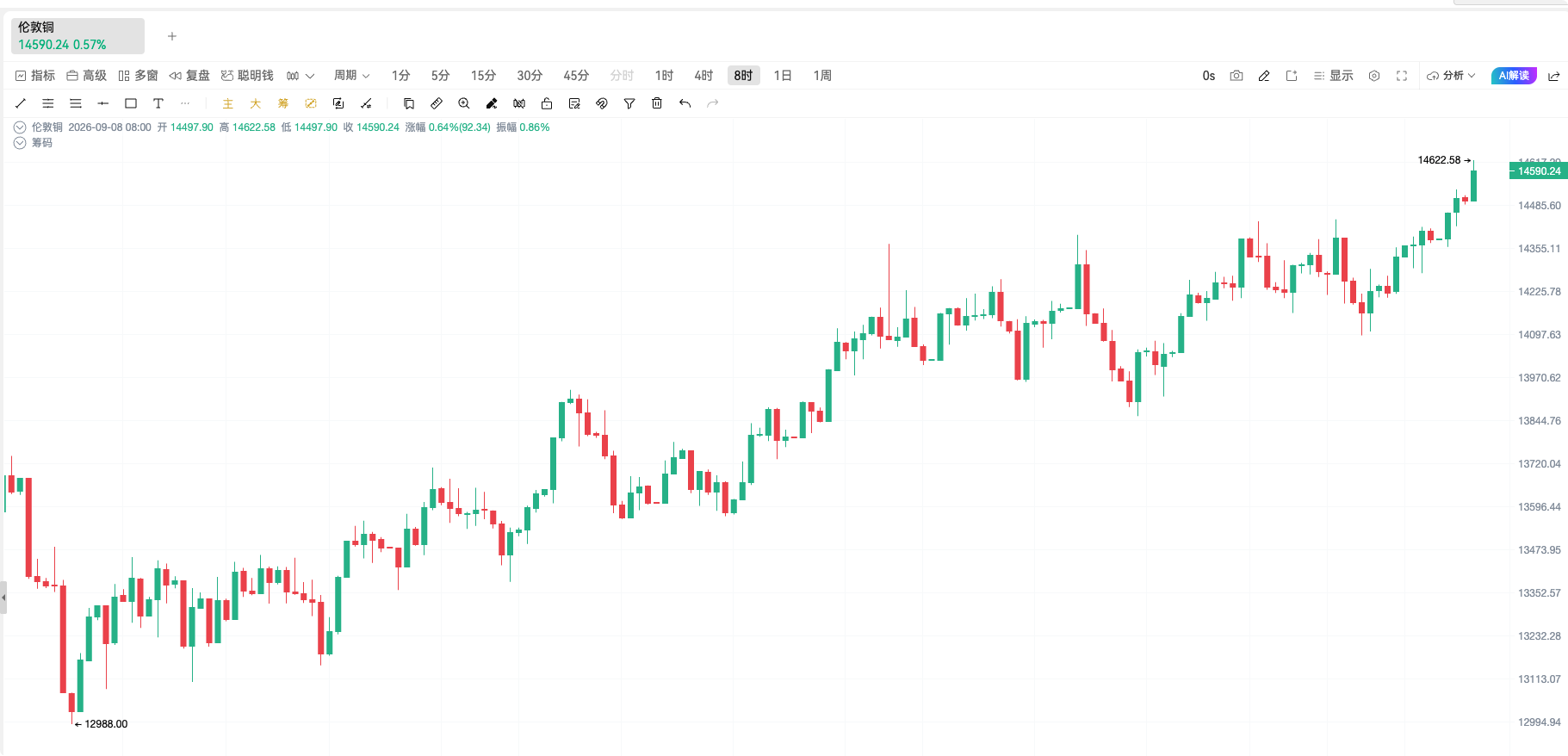
This assessment's short-term aspect explains why inventories are being reconfigured and spot premiums suddenly widen; its long-term aspect points to a more important question: If global electrification and computing power infrastructure continue to expand, can copper mine supplies keep pace fast enough?
This article will analyze structural demand for copper, mining supply constraints, and how copper mining company stocks enter the RWA market through pathways like Robinhood, Ondo, and xStocks, using Southern Copper (NYSE: SCCO) as a case study.
The core judgment is: Copper is an important "infrastructure asset" in the AI era, but tokenized SCCO does not equate to tokenized copper itself; rather, it brings the equity economic exposure of copper mining companies into the on-chain financial system.
1. The US "scrambling for copper" is just a price phenomenon; the real change is the rising strategic attribute of copper
LME three-month copper once touched a historic high of $14,533 per ton, with a cumulative increase of approximately 17% for the year; concurrently, Chile's copper exports in August decreased by 14% month-on-month and by 3.2% year-on-year. These data reflect the market situation at a specific point in time and cannot be directly extrapolated from the date, but they reveal three structural features of the copper market: regional inventory differences, supply chains easily affected by policy shocks, and low short-term elasticity of mine supplies.
US buyers are securing copper ahead of time under tariff expectations, potentially creating a self-reinforcing price cycle: buyers worry about higher future prices, so they buy early; early purchases reduce available spot in other regions; spot tightness drives prices higher; higher prices further reinforce expectations for hoarding and inventory migration.
However, attributing this round of行情 solely to tariffs would underestimate the changes in the copper market. While tariff expectations can alter the flow of goods, they cannot create long-term demand out of thin air. The underlying reason that makes the market willing to pay higher prices for copper is that copper is transitioning from an ordinary industrial raw material to a strategic resource closely related to national energy security, data center construction, and electrification investment.
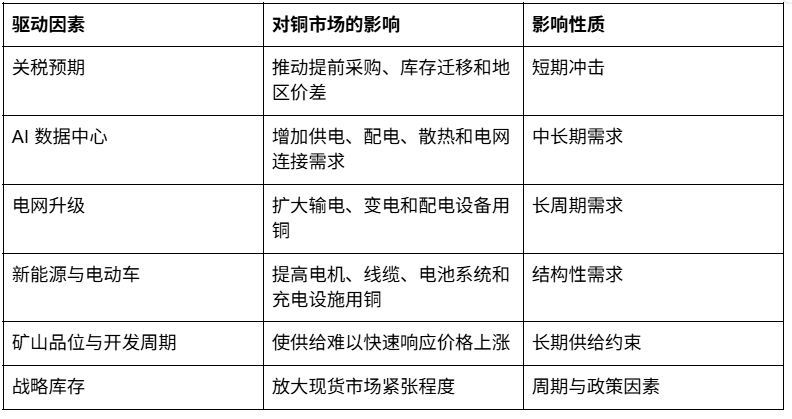
Therefore, the superficial logic of the US scrambling for copper is to guard against tariffs, but the deeper logic is that the global supply chain is reassessing the availability of copper.
2. Demand for copper from AI comes not just from servers, but from the "computing power – electricity – power grid" chain
When discussing AI and copper, the most common misconception is to only count the metal usage within the servers. In fact, the demand for copper from AI transmits mainly through three levels.
The first level is inside the data centers. Servers, racks, power supply modules, busbars, transformers, cooling systems, and backup power facilities all require conductive materials. The second level is the connection between the data center and the power system, including substations, transmission lines, and distribution networks. The third level is power generation, energy storage, and grid upgrades to match the new power demand.
In other words, AI doesn't merely increase the number of servers; it necessitates the construction of a new set of highly reliable, high-density, continuously powered energy infrastructure. Therefore, the demand for copper is not limited to the technology sector but will propagate along power capital expenditure into mining, smelting, equipment manufacturing, and grid systems.
S&P Global's research predicts that global copper demand may increase from approximately 28 million tons/year in 2025 to about 42 million tons/year by 2040, a growth of about 50%. This is a scenario forecast rather than a definitive outcome, but its importance lies in the fact that even if AI contributes only part of the increment, the copper market will need to face a long-term demand curve much larger than traditional economic cycles.
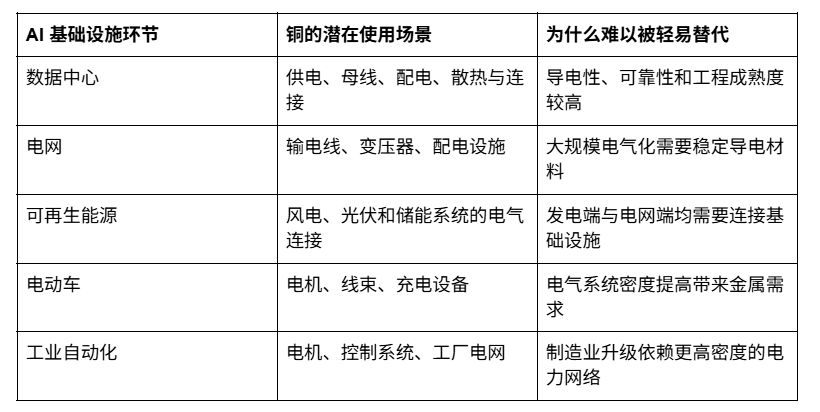
This explains why copper is referred to as the "blood of industry": it is not the exclusive material of any single end product but is the universal connective layer of the entire electrified economy.
3. The core contradiction on the supply side: prices rise quickly, but mine expansions are slow
The long-term contradiction in the copper market is not the absolute scarcity of resources, but rather that qualified supply cannot be released quickly when needed.
A large copper mine typically takes years from exploration, feasibility studies, permitting, and financing to construction and production. Mines are also affected by declining ore grades, equipment maintenance, energy costs, community relations, environmental approvals, tax policies, and infrastructure conditions. Even when copper prices rise, mining companies cannot rapidly increase output as factories do by adding shifts.
This creates an important asymmetry: demand can rapidly rise in a few years due to AI, power grids, or policy investments, but it may take over a decade for supply to effectively create new capacity.
As a result, rising copper prices may lead to two outcomes. First, in the short term, they drive sharp volatility in inventories, trade flows, and spot premiums; second, in the long term, they increase capital expenditures, exploration, and merger value for mining companies. However, there exists a long time lag between mine investment and the actual release of production.
This is also the fundamental distinction between copper mining companies and copper spot. Copper prices are commodity price variables, while copper mining companies are production assets with operational leverage. When copper prices rise, it improves mining company revenues and profits, but companies must also grapple with costs, output, project timelines, political risks, and capital expenditure pressures.
4. Why is Southern Copper a representative case for observing copper assets?
Southern Copper is a comprehensive copper producer, primarily producing copper, molybdenum, zinc, and silver, with mining, smelting, and refining facilities mainly located in Peru and Mexico, while conducting exploration in Argentina and Chile.
Unlike merely holding copper futures, Southern Copper's value derives from a complete mining asset system. The company owns mines such as Toquepala, Cuajone, La Caridad, and Buenavista, along with supporting smelting, refining, and SX-EW facilities. The company emphasizes in its annual report that its high degree of vertical integration allows it to manage production processes from mining and beneficiation all the way to refined copper rods.
This vertical integration has two implications. On one hand, the company can better control production processes, logistics, and some processing stages; on the other hand, by-products like molybdenum, zinc, silver, and gold can also reduce the unit cash cost of copper through income offsets.
Southern Copper's 2025 performance shows that the company achieved net sales of $13.42 billion, an increase of 17.4% year-on-year; net profit reached $4.3349 billion, an increase of 28.4%; adjusted EBITDA was $7.8224 billion, an increase of 22.1%, with an adjusted EBITDA margin of 58.3%; and operating cash flow was $4.7521 billion, an increase of 7.5%. In 2025, copper production was 954,270 tons, and the copper cash cost after deducting by-product revenue was $0.58 per pound, down from $0.89 in 2024.
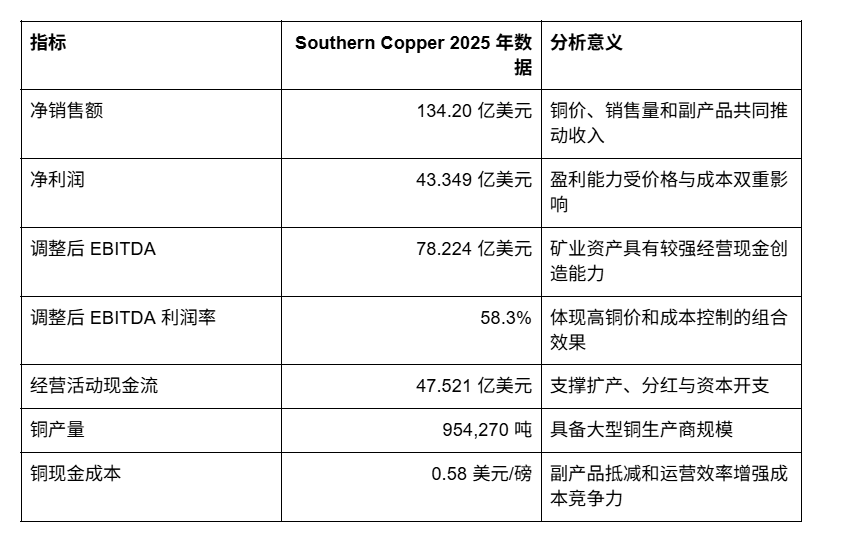
It should be emphasized that low cash costs are not an unchanging "moat." They can be affected by ore grades, energy, labor, transportation, by-product prices, and production structures; high profit margins also partially benefit from the current copper price environment. Therefore, when studying Southern Copper, it is essential not to look at just one year’s net profit, but to continuously observe production levels, cash costs, capital expenditures, and project timelines.
5. Southern Copper's growth options: it's not just about selling today's copper
Another important feature of Southern Copper is its extensive project pipeline.
The company has disclosed a capital investment plan exceeding $20.5 billion over the next decade, with a long-term goal of reaching annual copper production of 1.6 million tons by 2033.
Among these projects, the Tía María project is expected to produce 120,000 tons of copper annually, with project progress at 24% by the end of 2025, and is anticipated to commence operations in 2027; the Los Chancas project is expected to yield 130,000 tons of copper and 7,500 tons of molybdenum annually, with production expected by 2031, but is currently stalled due to illegal mining; the Michiquillay project is expected to produce 225,000 tons of copper annually, with the target production time set for 2032.
The significance of these projects lies in the fact that they provide Southern Copper with future production growth options, offering investors corporate exposure to long-term copper demand. However, project options also come with risks related to approvals, communities, land, capital expenditures, and execution.
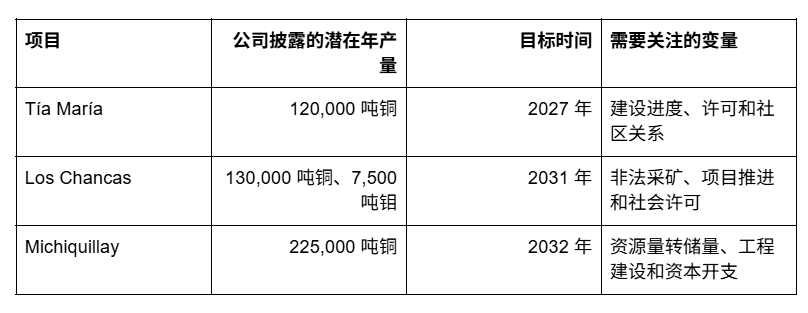
Thus, Southern Copper is not only a passive beneficiary of current copper prices but also part of future copper supply expansion. For RWA investors, such corporate assets are more complex than copper spot: they benefit from rising copper prices while also bearing risks associated with mine operations and project development.
6. AiPlot data reveals: RWA mapping of copper mining stocks is still in its early stages
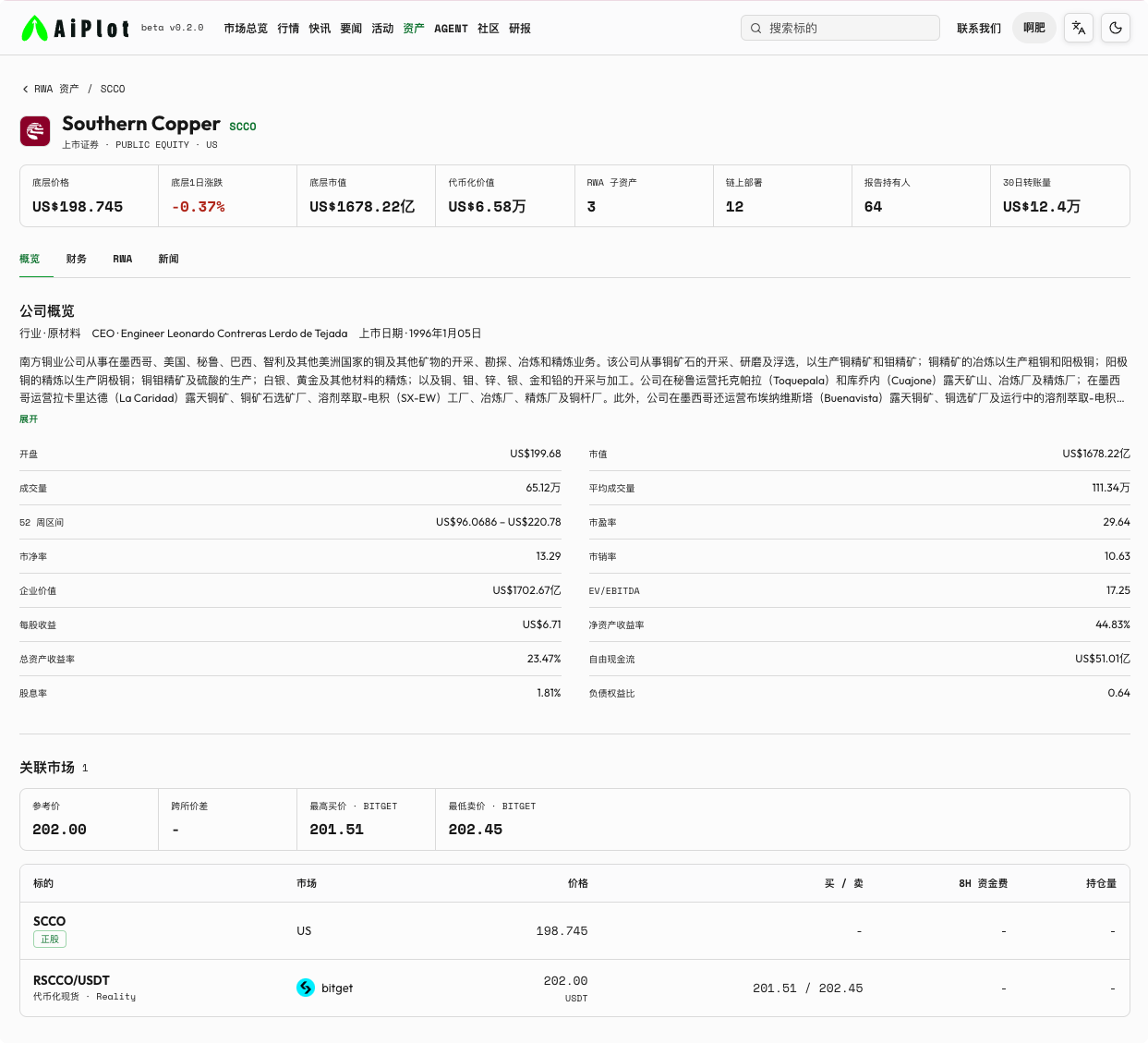
AiPlot's Southern Copper page provides a valuable window of observation.
The underlying price of SCCO is about $198.745, with an underlying market capitalization of approximately $167.822 billion; the corresponding tokenized value is roughly $65,800, with 3 RWA sub-assets, 12 on-chain deployments, and 64 report holders, with a 30-day transfer volume of approximately $124,000.
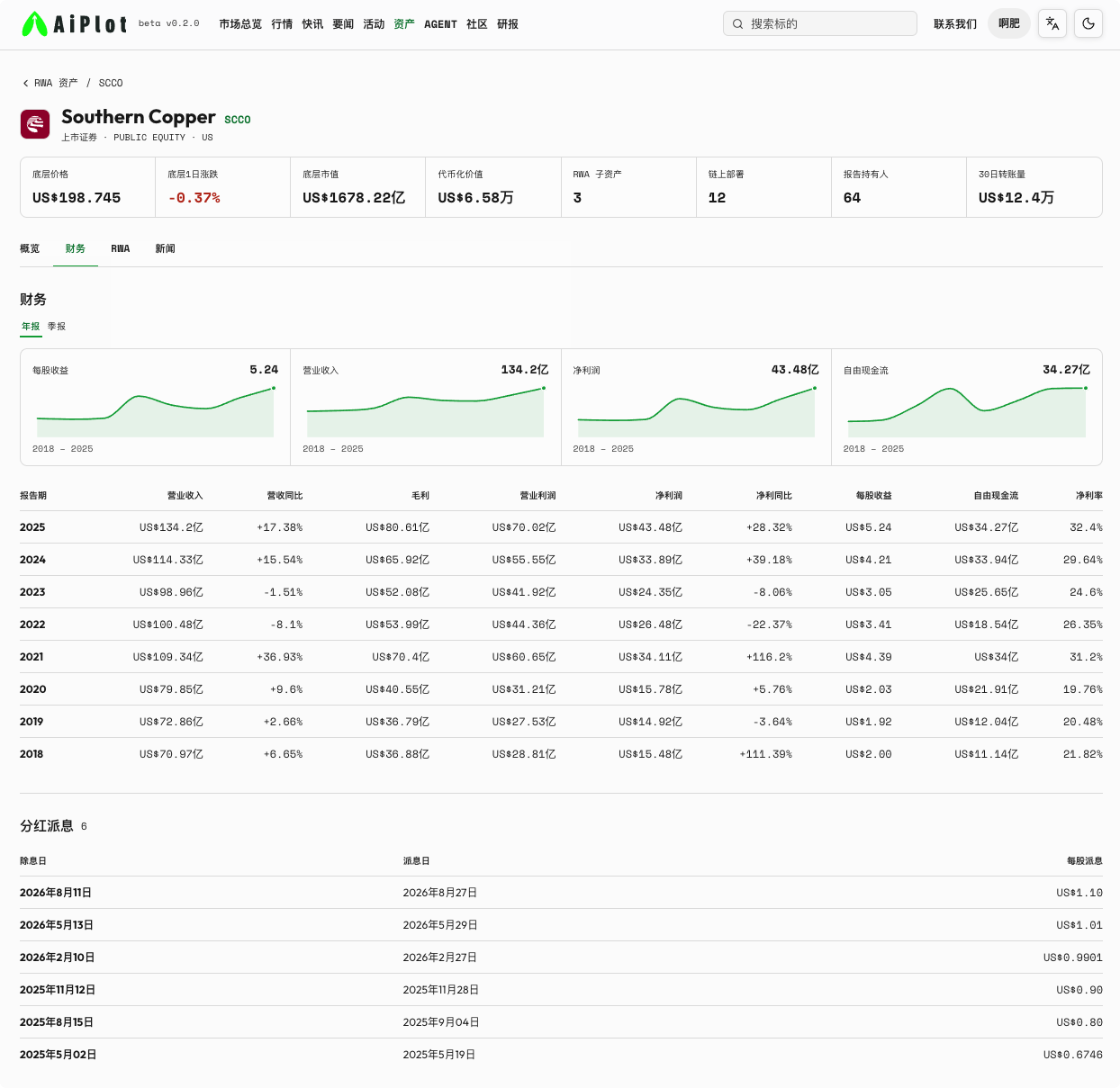
The importance of these numbers lies not in their absolute scale, but in their showcasing a typical early state of RWA: the scale of underlying listed assets is large, yet the scale of on-chain tokenization is still small; assets already exist with multiple issuers and multiple network deployments, but liquidity and holder distribution are still uneven.
The three directly mapped assets shown on the AiPlot page come from Robinhood Europe, Ondo Global Markets, and Backed Assets / xStocks.
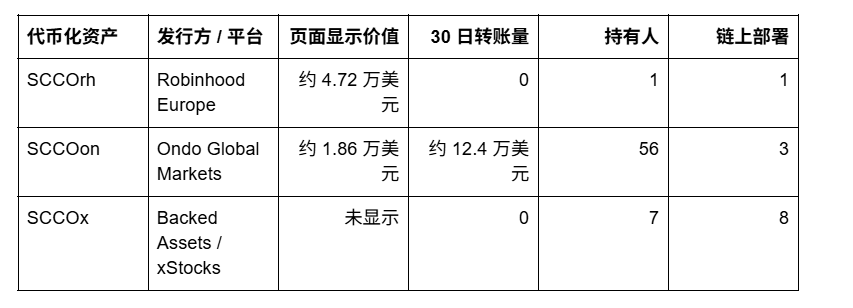
From the data, Ondo's mapping is currently the most active on-chain asset: it has a higher number of holders, and the 30-day transfer volume is significantly higher than the other two mappings.
This indicates that "multi-chain deployment" does not equate to "multi-market liquidity." An asset can be deployed across multiple networks but still only have actual trading activity on a specific chain or with a particular issuer. RWA research must not only count the number of contracts but also observe holders, transfer volumes, trading markets, and cross-chain liquidity.
7. Tokenized SCCO does not equate to tokenized copper
This is the most crucial distinction for understanding copper-related RWAs.
The tokenization of SCCO's shares represents the economic exposure of Southern Copper's stock; it is not copper spot, copper futures, copper warehouse receipts, nor direct ownership of a specific batch of physical copper inventory.
Holders of tokenized SCCO may face the following types of risks: copper price risk, company output risk, cash cost risk, policy and social risks in Peru and Mexico, capital expenditure and project delay risks, dividend policy risks, and issuer and custody structure risks.
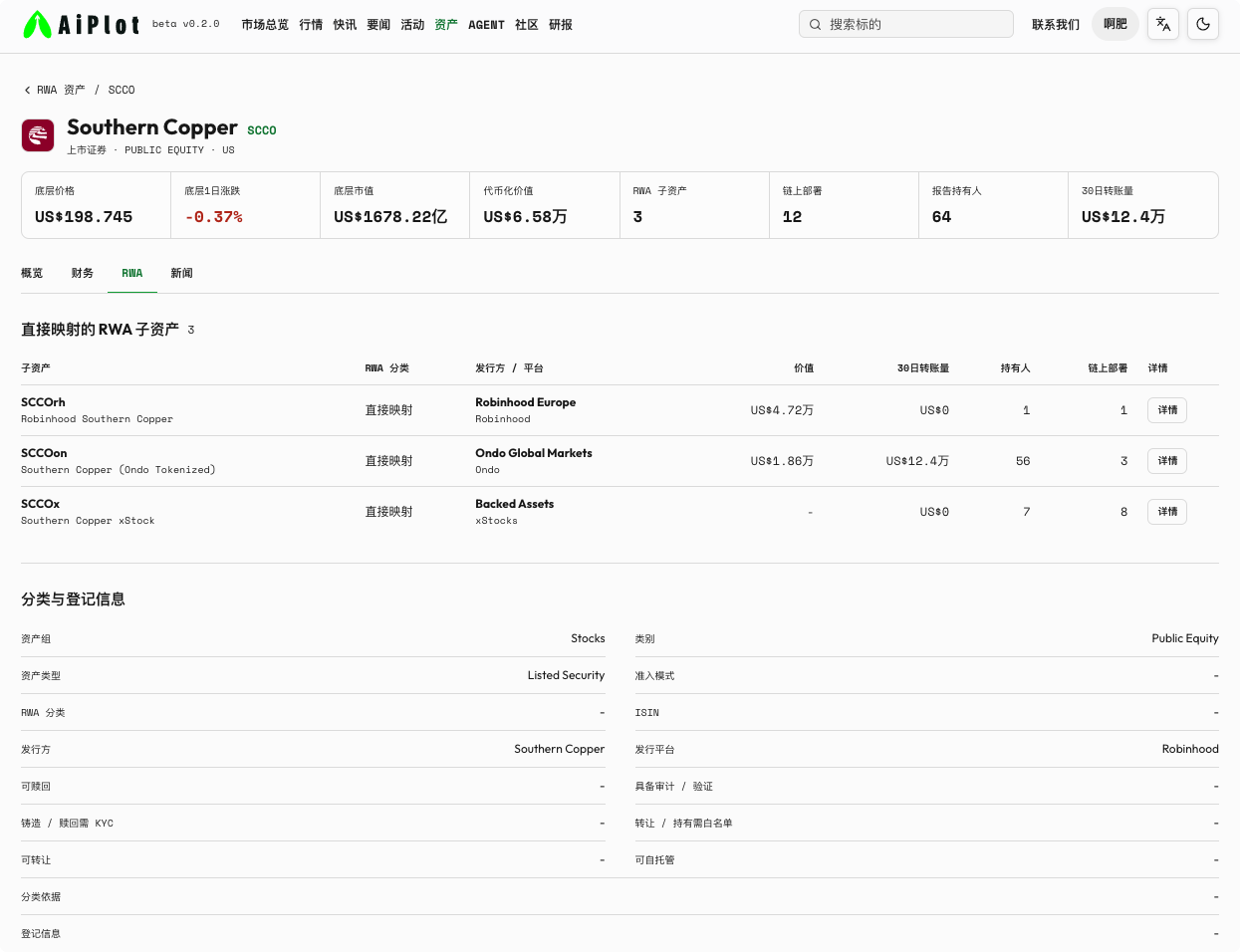
In contrast, should future RWA products such as copper warehouse receipts, copper inventory yield rights, or copper mine project yield rights emerge, their risk structures would differ. Copper warehouse receipts are closer to inventory and storage risks; copper mine yield rights are more aligned with project financing and credit risks; while mining company stocks carry corporate equity risks.
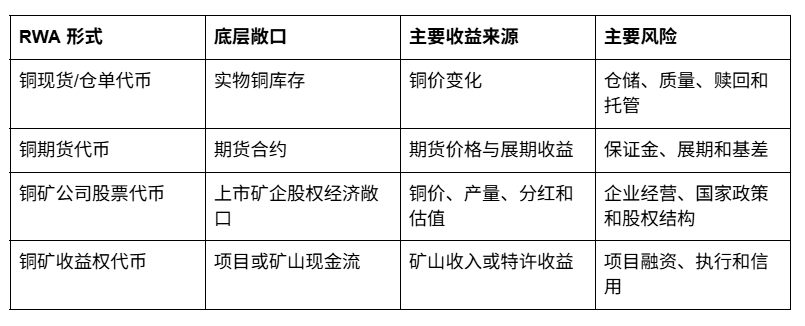
Therefore, AiPlot's observation of SCCO and its multiple tokenized sub-assets is valuable. It allows researchers to break down the "copper price theme" into three layers: corporate assets, issuers, and on-chain markets, rather than simplifying all copper-related RWAs into one type of product.
8. Why do copper-related RWAs have financial innovation value?
Copper itself is a globally priced asset that circulates across regions and is closely related to industrial production. Its entry into the RWA market holds the potential for innovation, not by making copper more scarce, but by altering how investors access and utilize copper-related exposures.
First, tokenization can lower cross-border access barriers. Qualified users wouldn't need to frequently switch between traditional brokers, banks, and different clearing systems to possibly obtain on-chain economic exposure to mining stocks or other copper-related assets.
Second, tokenization can enhance asset composability. Equity-based RWAs have the opportunity in the future to connect with stablecoins, lending protocols, automated strategies, and collateral markets, becoming part of on-chain investment portfolios.
Third, tokenization can improve data transparency. Through tools like AiPlot, researchers can observe issuers, underlying assets, holders, transfer volumes, on-chain deployments, and DeFi usage, forming more detailed asset profiles than merely looking at stock prices.
Fourth, tokenization might expand the distribution channels for copper assets. Traditional copper investments often concentrate on futures, mining stocks, ETFs, and spot supply chains; on-chain products have the opportunity to connect more crypto-native users with copper mining companies and industrial metal themes.
However, the on-chain form does not automatically eliminate risks associated with underlying assets. It enhances accessibility, transferability, and composability, but does not guarantee returns.
9. How should investors study copper and SCCO's on-chain assets?
Researching copper-related RWAs requires at least three tables simultaneously: the copper market table, the corporate fundamentals table, and the on-chain assets table.
The copper market table should observe spot prices, futures curves, inventories, regional price differences, smelting and processing fees, mine supplies, and downstream demand; the corporate fundamentals table should observe mine output, cash costs, by-product revenues, capital expenditures, project timelines, debt, and dividends; while the on-chain assets table should focus on token issuers, legal structures, on-chain deployments, holders, transfer volumes, redemption paths, and DeFi usage.
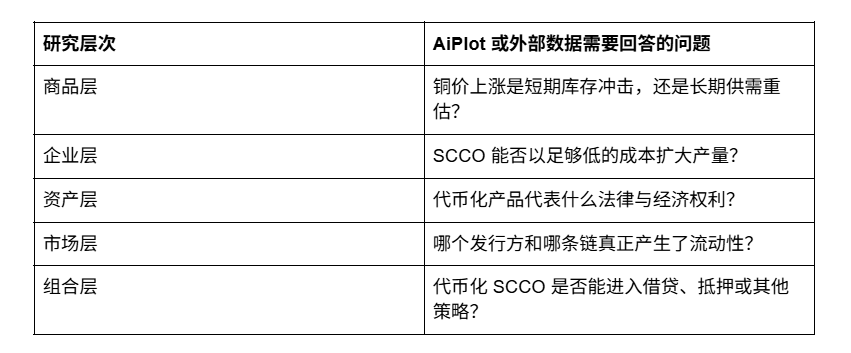
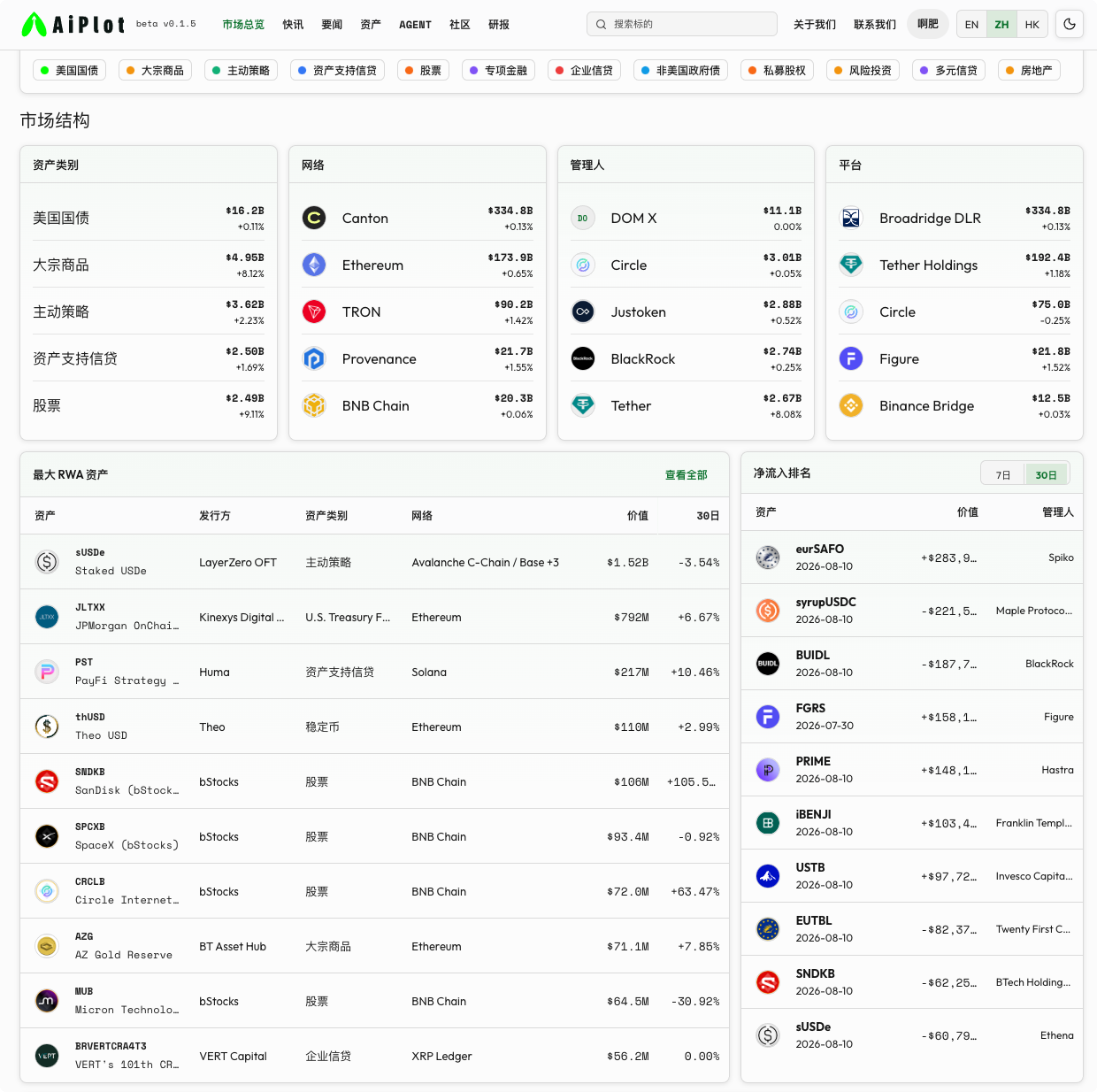
This is precisely the value of AiPlot in the study of copper-related RWAs: it not only displays the price of a particular token but also integrates the underlying listed companies, financial performance, issuers, on-chain deployments, and trading activities into the same research map.
10. Conclusion: Copper is an infrastructure asset, SCCO is corporate exposure, and RWA is a new distribution layer
The long-term logic of copper is changing. AI data centers, clean energy, electric vehicles, and power grid upgrades collectively drive electrification investments, while mining development cycles, declining grades, permitting, and capital constraints limit the supply side's rapid response.
In the short term, tariff expectations and early US purchases may continue to cause inventory migrations and regional price differences, and speculative capital may amplify price volatility. But looking at a longer cycle, the core that determines copper's value remains: is the world willing to pay capital expenditures for more electricity, more computing power, and stronger energy infrastructure?
Southern Copper is a representative corporate case of this theme. It owns large copper mine assets, a comprehensive smelting and refining system, strong cash generation capability, low disclosed cash costs, and ongoing project pipelines. AiPlot's data indicates that SCCO has already seen multiple tokenized mappings from Robinhood, Ondo, and xStocks, but the on-chain scale remains in its early stages compared to the underlying listed companies.
This is precisely the most noteworthy aspect: copper is already a key infrastructure asset in the real world, while copper mining stocks are becoming an early entry point for on-chain finance to engage with this asset theme.
In the future, copper-related RWAs may further expand from single stock mappings to ETFs, mine yield rights, inventory warehouse receipts, supply chain financing, and copper yield strategies. At that time, the market focus of competition will not only be "who issues tokens first" but rather who can simultaneously address underlying asset transparency, compliance custody, on-chain liquidity, and financial composability.
The story of copper will ultimately not just happen on futures exchanges or mine sites; it may also unfold in the on-chain asset market.
For more data and analysis, please follow AiPlot:
https://aiplot.com/
📖 Community communication:
-Telegram:
https://t.me/+IIYMcJigBAo4Mjg1
The content of this article represents the author's personal views and does not represent the stance of this platform. The views, conclusions, and suggestions in the article are for investors' reference only and do not constitute any investment advice related to this platform. The market is risky; investment requires caution.
免责声明:本文章仅代表作者个人观点,不代表本平台的立场和观点。本文章仅供信息分享,不构成对任何人的任何投资建议。用户与作者之间的任何争议,与本平台无关。如网页中刊载的文章或图片涉及侵权,请提供相关的权利证明和身份证明发送邮件到support@aicoin.com,本平台相关工作人员将会进行核查。