Author: Bitget
Computing power is becoming the "new oil" of the AI era. In the industrial age, whoever controlled oil held the pulse of economic growth. In the AI era, the true driver of everything is computing power. Large model training, real-time inference, generative applications… behind every second of intelligence are hundreds and thousands of high-end GPUs operating continuously. As computing power becomes increasingly scarce and price fluctuations become more pronounced, a completely new financial instrument has emerged - computing power futures.
It is quietly transforming the most essential production factor of AI into a tradable, hedgeable, and investable asset.
What are computing power futures?
Computing power futures are simply derivatives based on GPU rental prices. They do not involve the delivery of physical machines but allow the market to price and trade the question of "will future computing power be expensive" through a standardized index.
Just as crude oil futures enable global price discovery for oil supply and demand, computing power futures allow the market to begin pricing the true costs of AI infrastructure.
When training a large model incurs computing power costs in the tens of millions or even over a hundred million dollars, such price fluctuations are no longer mere "technical details" but real commercial risks and investment opportunities. Computing power is the new oil of the AI era. And computing power futures are a crucial step in turning this "new oil" into a tradable asset.
Bitget takes the "new oil" into the hands of ordinary people
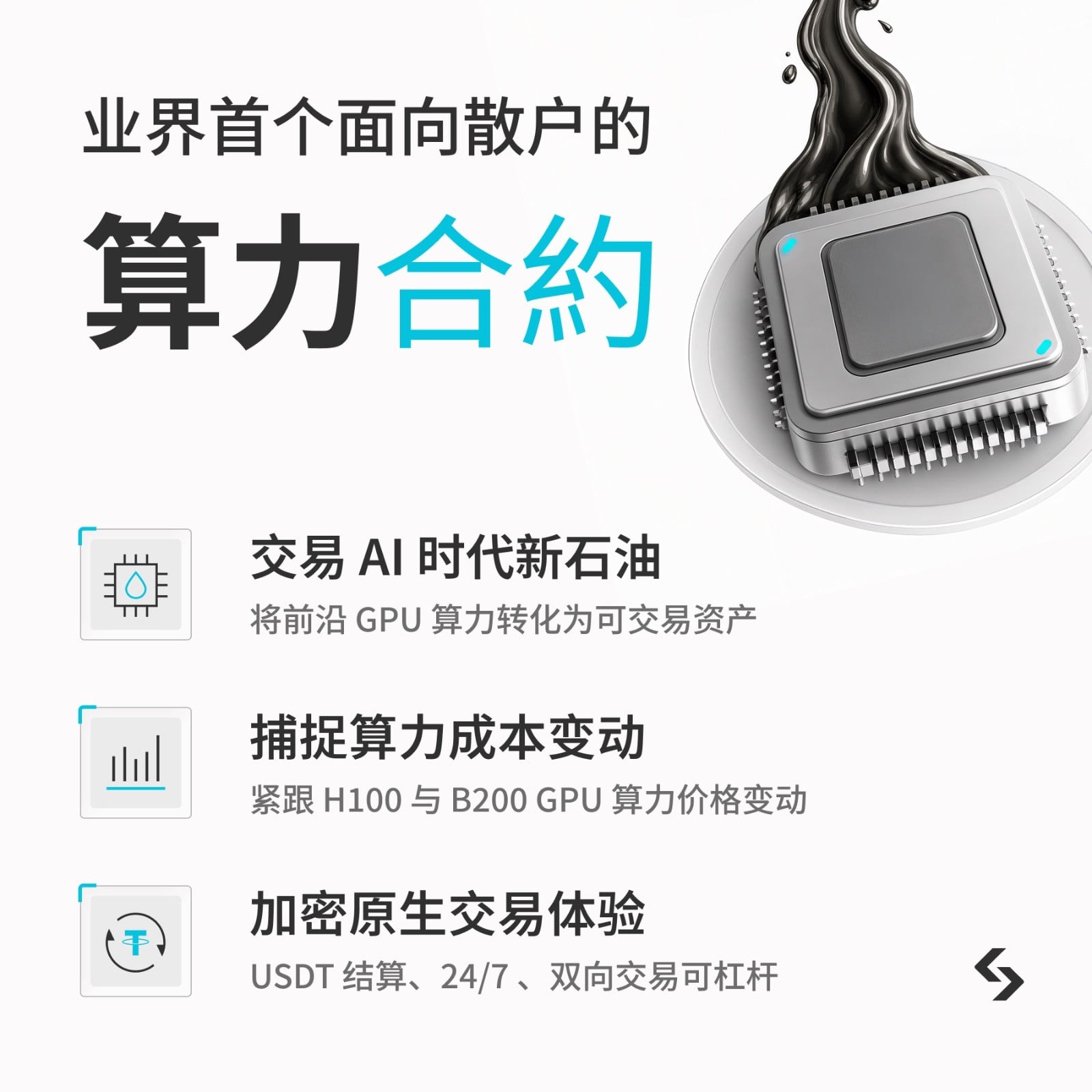
On September 8, 2026, Bitget officially launched the industry's first pre-market perpetual contract for computing power aimed at retail users - H100USDT and B200USDT.
These two contracts respectively anchor the GPU rental price indices of NVIDIA H100 and the next generation Blackwell B200, priced in "USD per GPU hour." You do not need to purchase any graphics cards or rent any servers; you can directly trade the rise and fall of global AI computing power rental fees with up to 10x leverage, settled in USDT, and traded 7x24 hours.
What was previously a game of computing power pricing only possible for cloud vendors, supercomputing centers, and large AI companies can now be easily joined by ordinary traders. This is not just another contract being launched; it is the first genuine financialization of the core production materials in the AI era.
What are the H100/B200 indices tracking?
These two indices are published by the professional data organization Silicon Data and are currently the most recognized benchmarks for GPU rental prices in the market:
- H100 Index: Reflects the standardized average hourly rental cost of the mainstream training and inference card H100.
- B200 Index: Reflects the standardized average hourly rental cost of NVIDIA's latest generation Blackwell B200.
The data comes from real quotes from multiple cloud service providers and computing power suppliers, standardized for specifications, rental periods, regions, and other factors. It aims to reflect the true supply and demand relationship in the market rather than the internal prices of a single platform.
Trading these two contracts essentially means trading the question of "is global high-end computing power expensive or not."
What does cash settlement mean?
Unlike many traditional commodity futures, computing power futures use pure cash settlement. Upon expiration or closure, nobody will deliver a pile of graphics cards to your home, nor will you be required to take over servers in a data center. The system will simply complete profit and loss settlement using USDT based on the difference between the contract price and the index price. This means:
Lower entry barriers, simpler operations, better liquidity, and more suitability for a native 7x24 hour trading environment for cryptocurrencies. What you are truly trading is a "price viewpoint," not a "physical asset."
How is it different from crude oil and crypto futures?
| Comparison Dimension | Crude Oil Futures | Crypto Perpetual Futures | Computing Power Futures (H100/B200) |
| Nature of the underlying | Energy of the industrial age | Digital asset prices | Core production materials of the AI era |
| Price drivers | Supply, demand, geopolitics, inventory | Sentiment, funds, macro | AI demand, chip supply, electricity costs |
| Settlement method | Physical or cash | Cash settlement | Pure cash settlement (USDT) |
| Trading time | Fixed time periods | 7x24 hours | 7x24 hours |
| Participation threshold | Relatively high | Retail friendly | Retail friendly, up to 10x leverage |
| Era significance | Blood of industry | Volatility tool | "New oil" of the AI era |
It has both the "infrastructure properties" of crude oil futures and the flexibility and efficiency of crypto perpetuals. In short: it allows ordinary traders to directly participate in the pricing of the fundamental costs of AI for the first time.
What are you actually trading in computing power futures?
You are trading:
- Expectations of rising and falling global high-end GPU rental prices
- Changes in AI computing power supply and demand
- Profits and losses settled in USDT
- Judgments on "whether future computing power will be expensive"
You are not trading:
- Real H100 or B200 graphics cards
- Data center cabinets or electricity
- Any physical assets that require operations and delivery
- The delivery pressure of traditional futures
You are buying a viewpoint, not machines.
Frequently Asked Questions
Q: Why should ordinary people pay attention to computing power futures?
Because AI has permeated almost all industries. The increase in computing power costs will ultimately be passed on to AI service prices, technology company profits, and even related conceptual assets. Directly trading the price of computing power is more accurate than indirectly speculating on concepts.
Q: How is it different from directly buying Nvidia stocks?
Stocks are influenced by valuation, performance, and sentiment; computing power futures more purely track GPU rental supply and demand. The two are related but not entirely synchronized.
Q: Is there a lot of risk?
Where there is leverage, there is risk. It is advised to reasonably control your position and treat computing power futures as a tool for expressing viewpoints, not as gambling.
Q: Will there be more related products in the future?
It is highly probable. As the AI computing power market further matures, more GPU models and longer-term contracts may emerge. This is just the beginning.
Conclusion
From oil to computing power, humanity has always transformed the most critical production factors into tradable assets. When computing power becomes the "new oil" of the AI era, those who can participate in its price discovery early often see the direction of trends sooner.
The H100 and B200 perpetual contracts launched by Bitget truly put this opportunity in the hands of retail traders for the first time.
免责声明:本文章仅代表作者个人观点,不代表本平台的立场和观点。本文章仅供信息分享,不构成对任何人的任何投资建议。用户与作者之间的任何争议,与本平台无关。如网页中刊载的文章或图片涉及侵权,请提供相关的权利证明和身份证明发送邮件到support@aicoin.com,本平台相关工作人员将会进行核查。


