Written by: Rita
Global semiconductor sales increased by 131% year-on-year in July, decreasing by 9.5% month-on-month, slightly above the historical average decline of 8.5%. On September 8, Bernstein released the WSTS tracking report, noting that memory remains the core engine of growth, with a year-on-year increase of 452%, contributing about $355 billion in new revenue this year, driving the industry's 111% growth since the beginning of the year. Excluding memory, sales still recorded a year-on-year growth of 35%.
The rise in memory prices explains nearly 70% of the industry's 111% increase this year. In the month-on-month data for July, most product categories performed better than seasonal patterns, but there was a clear regional disparity, with China experiencing a month-on-month decline of 28%, while the Americas only declined by 0.4%.
Memory contributes nearly 70% of the increase, non-memory still grows by 35%
The total semiconductor sales in July increased by 131% year-on-year, remaining high after June's 144%. Memory continues to dominate growth with a year-on-year increase of 452%, contributing about $355 billion in new industry revenue as of July, accounting for nearly 70% of the industry's 111% increase. The price factor of memory alone has supported most of the industry's increase.
Excluding memory, industry sales grew by 35% year-on-year, and demand for non-memory products also remained healthy. Looking at the three-month rolling data, industry sales grew by 30.4%, far exceeding the historical average of 5.5%. Among them, memory grew by 48.3%, and non-memory reached 10.8%.
Performance of each product category better than seasonal norms
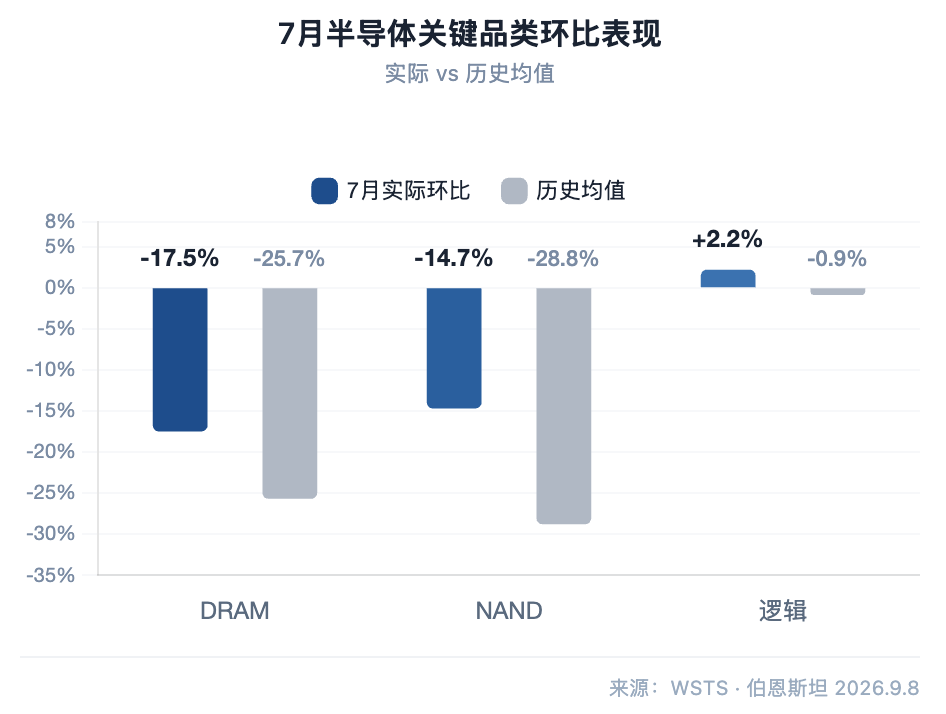
The overall sales in July saw a month-on-month decline of 9.5%, slightly lower than the historical average of 8.5%. However, the performance of each product category generally exceeded seasonal patterns.
Discrete devices decreased by 5.9% month-on-month, better than the seasonal average of 10.2%. Standard analog linear increased by 8.6% month-on-month, better than 2.7%. Logic devices increased by 2.2% month-on-month, better than a decline of 0.9%. MCUs decreased by 1.5%, better than a decline of 9.1%. DSP grew by 6.8%, better than a decline of 5.1%. DRAM decreased by 17.5%, better than a decline of 25.7%. NAND decreased by 14.7%, better than a decline of 28.8%.
MPUs decreased by 8.2% month-on-month, lower than the seasonal average of 5.7%, making them one of the few categories that underperformed historical trends. Optoelectronics, sensors, and analog application-specific products were roughly in line with historical averages.
Regional performance diverged, with China down 28%
Year-on-year, total sales in all regions achieved growth. The Americas grew by 172.6%, Europe by 89.8%, Japan by 58.4%, China by 97.5%, and other Asia-Pacific regions by 140.3%.
From a month-on-month perspective, regional performances diverged significantly. The Americas only declined by 0.4%, Japan grew by 1.6%, Europe declined by 4.4%, other Asia-Pacific regions declined by 4.7%, and China declined by 28.0%. Excluding memory, the month-on-month changes per region were +13.3% for the Americas, -5.9% for Europe, +0.2% for Japan, -5.9% for China, and -0.9% for other Asia-Pacific regions. The significant decline in China was mainly influenced by fluctuations in memory prices.
Shipment volume remained stable, ASP supported by memory prices
Overall shipment volume in July was basically flat month-on-month (-0.3%), with an average selling price declining by 9.3%. Year-on-year, shipment volume grew by 16.3%, and the average selling price increased by 98.8%, with memory prices still being the main driver of the significant year-on-year rise in ASP.
Performance in shipment volume varied by category. Discrete devices, optoelectronics, and DSP shipments increased month-on-month, while sensors, standard analog linear, logic, MPUs, MCUs, DRAM, and NAND shipments declined. Calculating based on a three-month rolling average, overall shipment volume grew by 10.2%, with growth in all categories.
Memory ASP rose significantly month-on-month, with DRAM prices per bit increasing by 6.5% and NAND by 9.5%. This contrasts with the data showing that memory shipments declined by over 20% month-on-month, indicating that memory price factors are still dominating industry growth.
Automotive and computer terminals outperform seasonal norms
ASIC sales grew by 0.5% month-on-month, better than the historical average decline of 2.5%. In the terminal market, computers and peripherals grew by 2.8% month-on-month, outperforming the seasonal decline of 3.0%; the automotive sector declined by 0.5%, better than the seasonal decline of 5.3%; multi-functional and others declined by 3.6%, better than the seasonal decline of 5.6%.
Consumer electronics declined by 8.2%, worse than the seasonal decline of 6.0%; wireless communication declined by 6.1%, worse than the seasonal decline of 0.1%; wired communication grew by 1.2%, worse than the seasonal growth of 3.9%. The resilience of the automotive and industrial sectors, along with the better-than-expected performance in the computer field, reflects the structural support of AI-related demand for the semiconductor terminal market.
Bernstein's data indicates that the semiconductor industry showed characteristics of price-driven and structural differentiation in July. The rise in memory prices is the core driving force behind overall growth, and the healthy growth in non-memory areas indicates that the industry's fundamentals have not overly concentrated on a single category. In the midst of regional divergence, the significant month-on-month decline in the Chinese market, when considering the specific fluctuations in memory prices, is not sufficient to alter the overall positive outlook for the industry.
Disclaimer
This article is an interpretation and summary by潮向研究 of a third-party brokerage research report (Bernstein, September 8, 2026), compiled with publicly available market information. The ratings, target prices, profit forecasts, and related judgments quoted herein reflect the opinions of the respective broker's analysts and represent the stance of their institution, not that of潮向研究, and do not constitute any investment advice.
Markets carry risks, and decisions must be made independently. This article should not be considered a basis for buying or selling any securities.
免责声明:本文章仅代表作者个人观点,不代表本平台的立场和观点。本文章仅供信息分享,不构成对任何人的任何投资建议。用户与作者之间的任何争议,与本平台无关。如网页中刊载的文章或图片涉及侵权,请提供相关的权利证明和身份证明发送邮件到support@aicoin.com,本平台相关工作人员将会进行核查。


