Author: Artemis Analytics
Translated by: Deep Tide TechFlow
Deep Tide Introduction: While the market is still debating whether open-source models will drive state-of-the-art AI down to a bargain price, Artemis offers an intuitive judgment: Anthropic's true moat is not the model itself, but its enterprise-grade lock-in capabilities, similar to AWS. This analysis dissects how to read Anthropic's S-1 from three dimensions: computing power, gross margins, and channel structure, providing valuable references for investors concerned about how AI narratives map to the valuations of crypto and technology stocks.
Core Argument: Anthropic is the AWS of AI
In 2015, skeptics viewed AWS as an extremely unprofitable cost center within Amazon that provided a commoditized product analogous to electricity, with no clear understanding of the cloud market's scale. Worse, the market worried that competitors like Google and Microsoft would crush AWS’s pricing.
Fast forward to 2026, Amazon has become the undisputed winner in the cloud computing field, creating a powerful business far beyond the original S3 product through a one-stop product matrix, scale effects, and a developer ecosystem.
By 2026, Anthropic also faces similar doubts: despite raising and burning billions of dollars, their cutting-edge models could still be commoditized by open-source players.
We believe that with an exceptionally talented team, Anthropic will not only continue to push the boundaries of cutting-edge models but will also create a highly sticky one-stop AI product matrix that allows enterprises to easily build, scale, and maintain AI systems for every vertical industry worldwide. These products include but are not limited to cutting-edge models in specific fields (such as drug discovery models), as well as tools to ensure AI safety, compliance, performance optimization, and more.
Anthropic will create enterprise-grade lock-in, with long-term gross margins expected to exceed 60% or even higher, and build an extremely profitable business similar to AWS, with ARR projected to surpass AWS by 2027.
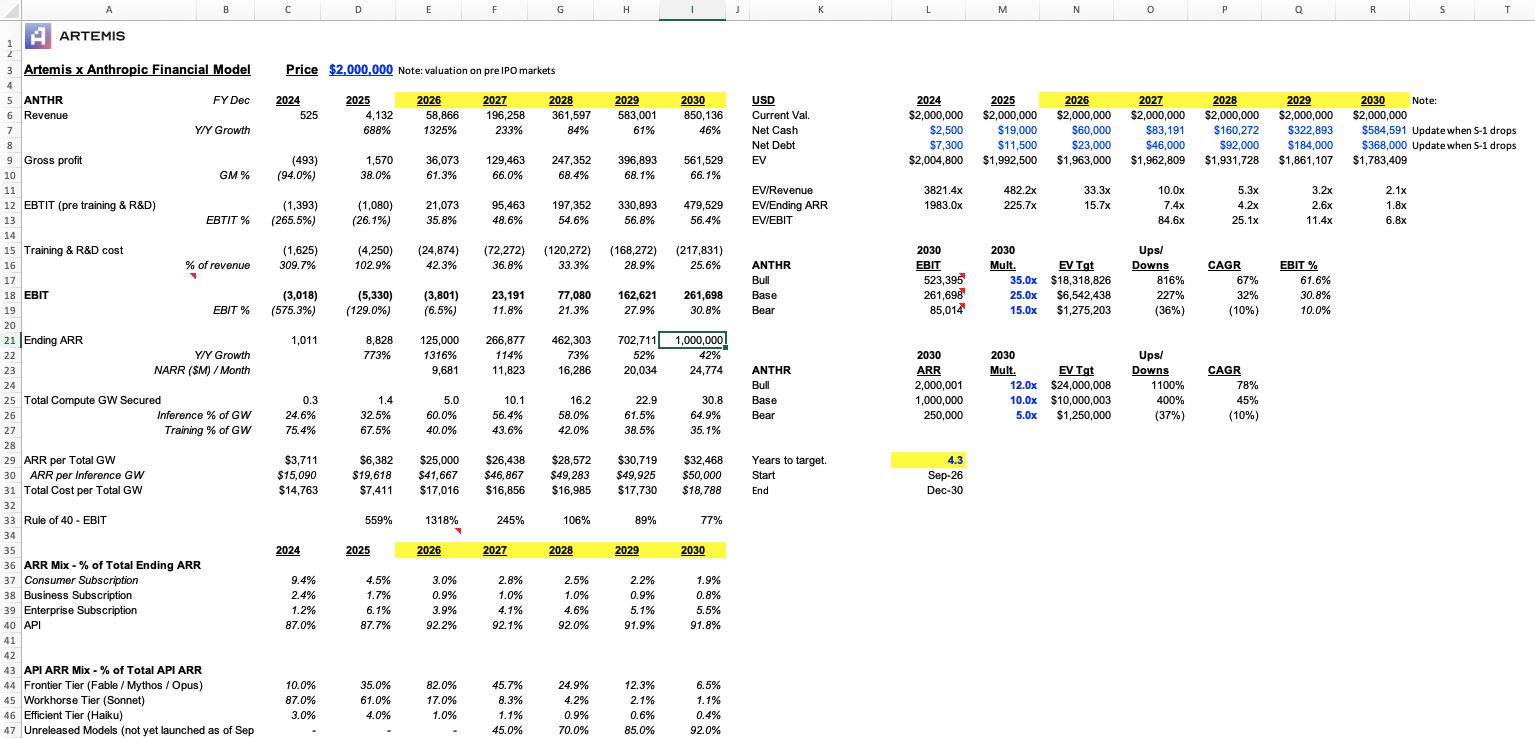
Complete financial model at: https://www.artemis.ai/anthropic-thesis
The Essence of Anthropic (What to Look for in the S-1)
Anthropic's core boils down to three points: 1) Can it attract top researchers to develop cutting-edge models? 2) Can it secure and lock in computing power at a low cost (about $10 to $15 million per megawatt)? 3) Can it charge premiums for tokens via APIs (e.g., $50 million in ARR per megawatt)?
From the key metrics perspective:
- Demand-side: We estimate the monthly net new ARR to be between $10 billion and $15 billion. Even if token prices are falling, token usage is still increasing, and enterprises have significantly de-risked their demand for cutting-edge models and deployment agents.
- Supply-side: Total locked computing power (GW). Reports indicate that Anthropic has locked in 15 to 16 GW of computing power by 2030, while at least 20 GW of training power is needed to support $1 trillion in ARR, which we believe is achievable by 2030 (reportedly, OpenAI will lock in at least 30 GW of total computing power by 2030).
- Gross margins: The difference between the ARR (in millions of dollars) that Anthropic can charge per megawatt and its per-megawatt computing power cost (in millions of dollars) is key to determine Anthropic's long-term profitability and whether it is a good business.
Additionally:
- Anthropic is an enterprise API business. 90% of ARR comes from APIs. The $100 trillion endpoint depends on whether Anthropic can sell models directly and also sell through AWS Bedrock, Gemini Enterprise Agent Platform, and Microsoft Foundry. The consumer business is insignificant.
- Look at net ARR, not gross ARR. Investors need to deduct the 15-20% share paid to AWS, Gemini, Microsoft, and exclude Meta revenue as well as income from Chinese AI labs distilling Anthropic models.
What Could Go Right
Many things could go right.
In our base case, by 2030, Anthropic can secure a total of over 30.8 GW of computing power to support $1 trillion in ARR, with total costs per megawatt at $18 million and per-megawatt inference ARR at $50 million.
This implies a steady-state gross margin of 66% and an EBIT margin of 30%, with total training and R&D expenses dropping to about 25% of revenue.
In this scenario, Anthropic is extremely profitable and experiences rapid growth as agents continue to penetrate over 300 million enterprises worldwide.
What Could Go Wrong
Sorted by probability:
- High risk: Codex and OpenAI Astra capturing Anthropic's market share. We have observed from engineers around us that they are beginning to switch from Claude Code to Codex. Last weekend, after trying Astra and Fable, we found that the gap has significantly narrowed, and customers may turn to OpenAI. Here are some customer quotes. Artemis blockchain data lead: "From personal experience, I have been using Codex, and I prefer its communication style. I think some people see them as complementary, using Claude Code for planning and Codex for execution. But I prefer to treat them as substitutes and only use Codex. I used to be a heavy user of Claude Code in the terminal, but now I prefer Codex in the ChatGPT app."
- Artemis fintech analyst: "OpenAI's Codex application is too powerful, capable of visualizing what the agent is doing, clearly designed for programming. Claude Code has a good first-phase experience in the CLI, but now Codex's GUI is so much better for observing agent behavior. Claude Code created the first generation programming experience in the CLI, but I believe the second generation will appear in applications with a GUI."
- A PM from a $3 billion company: One of our friends is a staunch supporter of Claude Code and Claude Harness and shared this over the weekend: "Wow, brother, I have to say, Astra is too strong."
- High risk: Low switching costs between models. 25% of the gross income in Q2 2026 flowed in through third-party channels like AWS Bedrock and Gemini Enterprise Agent Platform. Through AWS Bedrock, Anthropic's provided APIs can be easily replaced by OpenAI's Astra and other open-source weight models. If Anthropic does not have the most advanced model, enterprises can easily switch and revenue may significantly shift.
- Medium risk: Harnesses like Grokbot and Instinct don’t need Anthropic. Grokbot builds on x.ai's cutting-edge model and directly challenges Claude Cowork and Claude's harness. If Instinct and new AI applications are built on open-source or other cutting-edge models, it will force Anthropic to move up the stack to acquire harnesses or applications, or to innovate similarly to Claude Code, Claude Design, Claude Cowork.
- Lower risk: Computing power cannot be locked. Anthropic has already locked in close to 15 GW of computing power and needs another 15 GW to support $1 trillion in ARR. An IPO above $100 billion would be sufficient for Anthropic to lock in computing power. That said, Amazon, Nvidia, Google, and SpaceX are all suppliers, shareholders, and competitors (Amazon has Titan, SpaceX has Grokbot, and Nvidia is moving up the stack through partnerships with HuggingFace). We believe the likelihood of this scenario is extremely low.
- Lower risk: Anthropic stops releasing cutting-edge models. Either researchers become rich through the IPO and no longer want to continue, or they encounter technical bottlenecks. Currently, the incentive mechanism is perfectly aligned, but what if the equity value in their hands reaches $150 million to $300 million? A $5 to $10 million equity stake at a $100 to $200 billion valuation would be worth nine digits at a $3 trillion valuation. We believe the likelihood of Anthropic stopping the release of state-of-the-art models is extremely low.
Valuation and Final Thoughts
Even among high-growth software and AI comparable companies, at a $2 trillion valuation, Anthropic appears inexpensive based on EV/ARR and EV/NTM revenue (it’s still not outrageous even at a $3 trillion valuation).
We believe Anthropic will go public with a $2 trillion valuation in mid to late October, with retail and institutional demand pushing it to $3 to $4 trillion.
To be honest, Anthropic is likely worth buying regardless.
- Anthropic’s reported $65 billion net ARR in July 2026 implies a year-over-year growth of 15 times, while our estimated $90 billion ARR by the end of September 2026 also achieves a 15 times year-over-year growth, which is generational-level growth.
- Furthermore, our forecasts (which are more conservative than SemiAnalysis's $300 billion ARR for 2027) project a $125 billion ARR by the end of 2026 and a $275 billion ARR by the end of 2027, corresponding to a 20 times expected ARR for 2026 and a 7.2 times expected ARR for 2027.
- For a company that is truly one of the fastest growing public companies ever and a clear winner in enterprise-level AI, it’s hard not to be bullish on $ANTHR.
A company that may develop AGI and sell it to over 300 million enterprises that would be eager to replace or enhance white-collar employees with intelligence; how should such a company be valued? We roughly calculate: 300 million enterprises × one white-collar employee replaced per enterprise, with an ACV of $120, the global potential AI spending is $36 trillion. What if Anthropic captures 20% of that (i.e., $7.2 trillion ARR)? What if it captures 30% (i.e., $10.8 trillion ARR)?
Ramp estimates that 56% of U.S. enterprises have AI expenditures, but the median is just $12 per month. We believe this is businesses paying for ChatGPT or Claude individual subscriptions.
Our long-term view is that agents (rather than chatting with agents through Claude or ChatGPT) are the key to accelerating global and broader AI spending, and currently, agent penetration in enterprises is still below 1%.
In short, our base case of $1 trillion in ARR by 2030 may actually still be too conservative.
If superintelligence arrives, and Anthropic can use its own models to build models, drastically reducing research costs and expanding margins? What if superintelligence can only be obtained through Anthropic, willingness to pay skyrockets, and $50 million ARR per megawatt might even be too conservative?
Time will tell, as these cutting-edge models are getting closer to superintelligence.
Finally, I recall this statement from Anthropic's Chief Financial Officer: “Humans mostly think in linear and incremental ways. I’ve been at [Anthropic] for two years. This is the paradigm I need to break for myself. Stop linear thinking, and start thinking exponentially.”
Congratulations to Anthropic, looking forward to the S-1 and exponential growth on the path to superintelligence.
Disclosure:
This article represents Jon Ma's personal opinions, published for informational and educational purposes. It does not constitute investment, financial, legal, or tax advice, nor does it constitute a solicitation or recommendation to buy, sell, or hold any securities (including any interests in Anthropic).
Artemis Analytics is not a registered investment advisor or brokerage. The author may hold a position in Anthropic through SPVs. Please conduct your own research and consult licensed professionals before making any investment decisions.
Anthropic is a private company. Its shares are not registered and are not publicly traded, and secondary market rights lack liquidity and can only be sold through restricted channels. The third-party “markers” or secondary market prices referenced in this article (including any implied valuations) may not reflect the actual prices at which any transactions may occur. Any mention of future IPOs, their timing, or pricing is speculative; there is no guarantee that an IPO will occur or under what terms it may occur.
Conflicts of Interest. The author and Artemis Analytics have direct and/or economic interests in Anthropic through collective investment vehicles, benefiting if Anthropic’s valuation rises. We may buy and sell these interests at any time without updating this page. Artemis Analytics is also a customer of Anthropic, and our products are partly built on Anthropic’s models, with Artemis employees cited in this article as users of Anthropic products. Readers should assume that the author is not a neutral observer.
Forward-looking statements and estimates. This page contains estimates, forecasts, scenarios, and price targets (including ARR, gross margins, computing power capacity, and 2030 valuation data), which are the author's own views or obtained from third-party sources, including Artemis's internal estimates and published research from agencies like SemiAnalysis. These figures do not represent Anthropic's reported financial results, have not been verified or endorsed by Anthropic, and are inherently uncertain. Actual results may differ materially. Bullish, baseline, and bearish scenarios are illustrative scenarios and do not constitute predictions or guarantees.
Information from third-party sources is considered reliable, but has not been independently verified, and we make no representations about its accuracy or completeness. All investments involve risk, including the risk of losing the entire investment amount; past performance does not guarantee future results. Please conduct your own research and consult licensed financial advisors, lawyers, or tax professionals before making any investment decisions. Anthropic has no affiliation with Artemis Analytics and has not reviewed or approved this content.
免责声明:本文章仅代表作者个人观点,不代表本平台的立场和观点。本文章仅供信息分享,不构成对任何人的任何投资建议。用户与作者之间的任何争议,与本平台无关。如网页中刊载的文章或图片涉及侵权,请提供相关的权利证明和身份证明发送邮件到support@aicoin.com,本平台相关工作人员将会进行核查。


