A rigorous screening process left only Jupiter and Orca.
Written by: Edgy
Translated by: Chopper, Foresight News
I am looking for cryptocurrencies with valuation advantages. I set three screening criteria for the top 300 tokens by market capitalization: revenue growth, valuation lower than industry peers, and token price not yet reflecting the improvement in fundamentals.
Ultimately, only two projects met all the criteria, both of which share common features; those that were filtered out may deserve further investigation. Below are the conclusions from this research.
Screening Rules Explanation
The goal of this screening is to identify projects that meet all three conditions:
- Lower valuation compared to competitors in the same sector
- Revenue growth rate surpassing the market average
- Token price has not yet realized the benefits of fundamentals
I used CoinGecko's prices and DeFiLlama's revenue as benchmarks, comparing data from the past 30 days with the previous 60 days. Then I asked Claude to help me analyze.
This analysis made a key adjustment: rankings are based on the protocol's actual retained revenue, not total fees. Fees are all costs paid by users, while revenue is the actual profit retained by the protocol.
For example, Jito: for every $100 in fees generated, the protocol actually retains about $6, with the majority of the remainder distributed as MEV rewards to validators.
If valuation is calculated based on total fees, Jito's price-to-earnings ratio is only 4.5 times, which seems extremely cost-effective; however, when calculating based on retained revenue, the valuation soars to 73 times.
Lido also retains only about 6% of fees, while Uniswap's retention rate is 8%.
If fees are solely used as a judgment standard, the "undervalued opportunities" you find might not be real.
How 300 Tokens Were Reduced to Just 2
In the first round of screening, 38 candidates with valid statistical data were selected:
- Initial sample: 300 tokens
- Of which DeFiLlama has queryable revenue data: 117
- After removing public chain projects and very small candidates, 38 projects with retained revenue were remaining
Projects like Morpho, Ondo, Celestia, The Graph, and EigenCloud were all excluded. Although these projects generate fees, the revenue does not flow back to the tokens themselves.
Next, three screening thresholds were applied sequentially, comparing each project to the fully diluted valuation (FDV) median of the annualized revenue within their sector (trading, lending, staking, and other sectors):
- Valuation below peers → 18 remaining
- Revenue growth rate above sector median → 9 remaining
- Token price rise lagging behind sector median → 3 remaining
After adding stress tests to filter out projects with anomalous revenue spikes in a single day, only 2 remained.
The industry median growth level is an average revenue increase of 18%, and the average token price increase is 25%. Candidates must exceed an 18% revenue growth rate while the token price increase is less than 25% to qualify.
Bias from Fully Diluted Valuation (FDV)
Using FDV instead of circulating market cap valuation directly eliminated many fundamentally strong projects. Hyperliquid is the most typical example: calculated based on circulating market cap, the revenue multiple is 28 times; but when calculated using FDV, the valuation reaches 120 times, because the token circulation is only a quarter of the total supply.
This judgment standard may not be fair to HYPE, but this screening uniformly adopted this set of rules.
Results
Cheap valuation, business growth, but prices fully reflect value.
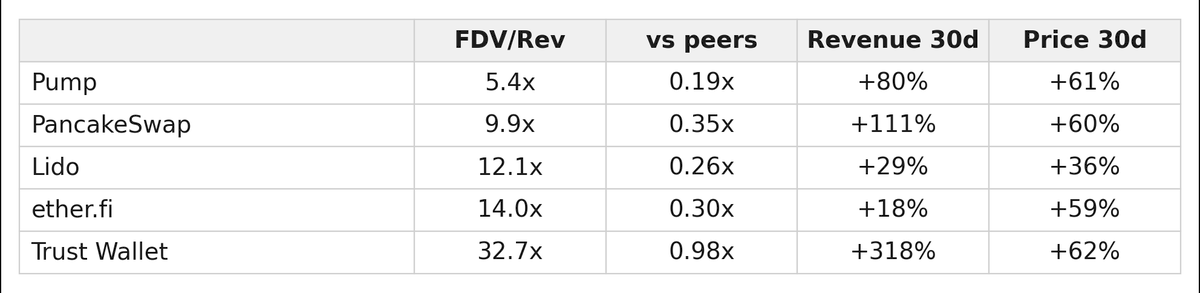
Pump remains the strongest candidate in this screening in terms of business model. $57 million in revenue over 30 days, with a valuation of less than 6 times; revenue increased by 80%, and token price by 61%. The market has fully priced this in, and there are no undervalued opportunities. The market pricing of these tokens is efficient and reasonable.
Low valuation, but not favored by the market, and the business itself is not growing anymore.
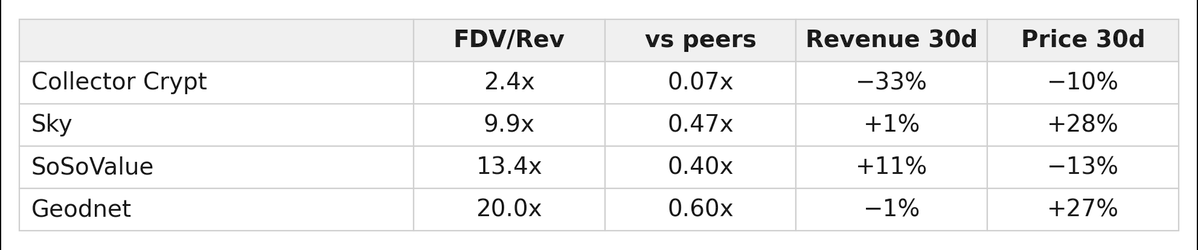
A value trap range, where low prices do not equal being undervalued. Collector Crypt has a revenue multiple of only 2.4 times, the lowest valuation among the top 300 tokens, but its revenue has declined by one-third.
Business growth, low market attention, but valuation is not cheap.

Revenue continues to rise, token prices are stagnant or even falling, which on the surface appears to be an excellent buying opportunity. But in comparison with competitors, their valuations are actually high.
If only fee data is considered, Jito can easily mislead investors: revenue increased by 44%, token price dropped by 13%, with a fee-related valuation of only 4.5 times. It seems like an excellent opportunity, but when converted to true retained revenue, the valuation reaches 73 times.
Bonk has another problem. After excluding the recent three days of explosive data, 57% revenue growth turned into a negative growth of 17%, and this growth is likely just a short-term pulse effect from the Solana market.
Simultaneously meeting all three conditions.

Aethir did not pass the revenue stability stress test, with 65% of its revenue concentrated in a single day's burst. The underlying causes have yet to be thoroughly investigated, and from preliminary data, the risk seems high.
Ultimately, only Orca and Jupiter remain, both of which belong to decentralized exchanges in the Solana ecosystem.
Objective Variables from the Solana Market
It must be objectively stated here that during the month, the SOL price surged by 42%, and part of the exchange revenue growth comes from the lagging effect of the Solana bull market, but there are also independent fundamental drivers. The revenue growth rates of the two projects both surpassed that of SOL itself, while token price increases lagged considerably behind the public chain.
Jupiter's business model is more mature:
- 30 days revenue of $6.4 million, revenue growth rate of 44%
- Fee retention ratio of 34%, outstanding performance in the quality of profit among the screening sample
- Token price increase of 22%, with the sector median at 25%, meeting the "price lag" screening condition by a narrow margin
Orca has a lower valuation and is a smaller project:
- Monthly revenue of $700,000, ranked 293rd by market cap
- Revenue has doubled, and it is spread throughout the month rather than concentrated in one night, indicating genuine growth; the downside is that the project's scale is smaller.
Meteora is worth mentioning. It failed to reach the growth target by 0.04 percentage points. Revenue grew by 18.33%, with a target value of 18.37%, and a price-to-earnings ratio of 7.9 times.
The Positioning and Limitations of this Screening List
The content of this article does not constitute any buying advice. I will use another complete evaluation system to deeply explore truly undervalued candidates, and further comprehensive research across multiple dimensions will be needed.
This screening selected projects with at least 60 days of revenue records, so the newly launched Robinhood Chain token is not included in the statistics.
The core significance of this list is to filter out crypto projects that have achieved business growth, but whose token prices have not simultaneously realized the potential for price increases.
免责声明:本文章仅代表作者个人观点,不代表本平台的立场和观点。本文章仅供信息分享,不构成对任何人的任何投资建议。用户与作者之间的任何争议,与本平台无关。如网页中刊载的文章或图片涉及侵权,请提供相关的权利证明和身份证明发送邮件到support@aicoin.com,本平台相关工作人员将会进行核查。


