
“The more turbulent the times, the clearer we must distinguish what must change and what absolutely cannot change.”
Author|Hu Runfeng
Editor|Liu Yangxue
He is one of the pioneers of value investing in China, having co-founded Oriental Harbor with Dan Bin many years ago and serving as chairman. He studied under international futures master Stanley Kroll and was the first investor from China to attend the Berkshire Hathaway shareholder meeting, as well as one of the first Chinese investors to meet Elon Musk.
He is also one of the earlier Chinese investors researching the development of the artificial intelligence industry. In July 2021, he was invited as the first professional from the investment community to attend the Microsoft Research Asia “Master Forum,” where he delivered a thematic presentation on “AI and Investment,” more than a year ahead of ChatGPT's emergence.
He is Zhong Zhaomin, the founder of Oriental Marathon Investment Management. Recently, amid the adjustments in the AI bull market, Zhong Zhaomin had an exclusive conversation with Barron's Chinese website, discussing how value investing is evolving in the AI era. AI is changing businesses and transforming investment. Information acquisition is becoming easier, and technology iteration is accelerating, while previously stable business models and moats can be redefined at any moment. However, Zhong Zhaomin believes that AI has not rendered value investing obsolete; it has truly changed the methods of value investing, not the essence of value investing.
AI is rewriting investment; what must change, and what absolutely cannot change?
Hu Runfeng: What is the most important factor for value investing in the AI era? Compared to the pre-AI era, what things have not changed, and what have changed the most?
Zhong Zhaomin: I summarize it as “three changes, three constants.” First, the three constants:
First, the essence of investment remains unchanged. Buying stocks is still about buying companies; long-term value ultimately depends on the company's real ability to generate cash flow and create value.
Second, valuation and margin of safety remain unchanged. The greater the technology, the easier the market can discount future dreams, so it is more important to respect prices. A good company does not mean it is worth buying at any price.
Third, the circle of competence remains unchanged. AI can enable a person to quickly acquire vast knowledge, but just because the boundaries of knowledge expand doesn’t mean the boundaries of understanding expand simultaneously. One of the biggest risks in investment is always “dying” in areas we don’t know we don’t know.
There are also three changes:
First, research tools have changed. The “information gap” will become smaller, while the “understanding gap” will become larger. In the past, a lot of time was spent finding data, reading financial reports, and organizing information; in the future, AI will perform these tasks increasingly well. Human value will shift more towards asking questions, identifying causality, and judgment. It can be said that AI makes information and information processing easier, but deep understanding and judgment are becoming increasingly valuable.
Second, the moats have changed. In the past, we sought relatively static brands, channels, technologies, and switching costs; today, many moats are being rapidly reconstructed by AI. In the future, when researching companies, we cannot just ask “how deep is the moat,” but also, in the context of the AI era, can the speed of a company building new moats outpace the rate at which the old moats are diminishing?
Third, the logic of valuation must also evolve. In the past, we were more accustomed to static calculations; in the AI era, we need dynamic probabilistic judgments. With the continuous change in technological paths and competitive landscapes, investors must continuously correct their judgments based on new facts, using Bayesian methods to update their assessments.
Therefore in the AI era, the soul of value investing has not changed, but the methods of value investing must evolve.
Why can value investing transcend several eras from Coca-Cola, Moutai to AI technology?
Hu Runfeng: Traditional value investing often uses Coca-Cola, Moutai, and Hermès as classic cases, but tech companies often exhibit nonlinear growth. How can the principles of value investing be combined with investments in the tech industry?
Zhong Zhaomin: Many people understand value investing as buying companies with low PE, low volatility, and stable growth, but I think this is a narrow understanding of value investing. Value investing truly researches the relationship between value and price. Coca-Cola may offer stable compound interest over two or three decades, while a great tech company may create value that has not been seen in the past decade due to technological breakthroughs within just a few years. One is linear compounding, and the other is nonlinear growth, but the underlying logic is not different.
The real challenge of tech investment lies in: how to use the bottom line of value investing to embrace the upper limit of technological innovation. What is the bottom line? It is not to pay an infinite price for unverifiable stories. Tech companies can temporarily lack profits and make large-scale investments, but ultimately they must produce commercial validation: customers, revenue, cash flow, and return on investment must gradually prove they can create useful products or services, creating value, not just concepts.
At the same time, tech investment must not be constrained by static valuation. We talk about the different realms of value investing, essentially different temporal dimensions of value understanding. Short-term investments can be very demanding on valuations, while long-term investments should be particularly harsh concerning company quality; in extremely rare cases of opportunities that genuinely have great long-term certainty, the so-called “highest realm of valuation is not valuing,” does not mean avoiding valuation but instead not allowing a static valuation table to obscure a bright, rapidly expanding future and truly achievable goals, such as the newly listed SPACEX company.
True value investing has never been about conservatively rejecting change, but rather studying change, confronting change, and investing in change..
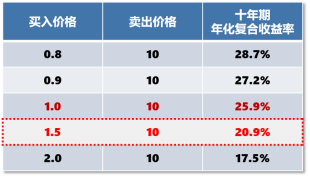
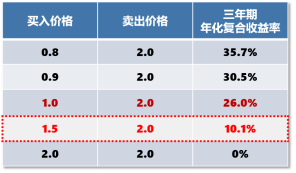
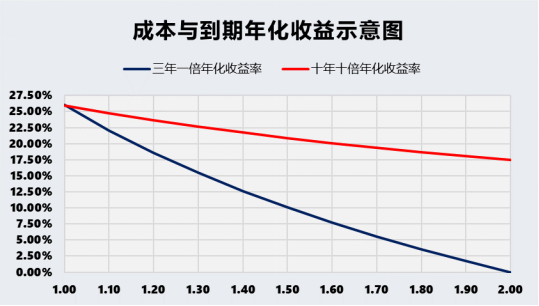
Image 1: The long-term rate of return varies significantly under different purchase costs, indicating that “good companies” also need to respect prices.
Why is technology an indispensable investment sector? What is the true barrier to research?
Hu Runfeng: Why do you believe the tech industry is one of the most important investment sectors? How can investors overcome the high professional barriers in the tech industry?
Zhong Zhaomin: One important source of long-term wealth growth is productivity improvement, and technology is one of the most significant forces driving productivity advancement. This is especially true of AI. It is not an isolated industry but a general intelligence technology that can penetrate manufacturing, software, healthcare, automotive, finance, and almost every industry. Ultimately, a true industrial revolution will change not just one product but the entire way society creates value, and may even alter the entire social structure of peak productivity and production relations.
However, tech investment is also the easiest to make mistakes, as investors must simultaneously answer three questions: Is the technology real? Is the business model feasible? Will an optimistic or even frenzied market preemptively consume the future? This is also the real threshold of tech investment. Simply understanding technology is not enough, understanding finance is also insufficient, and merely observing the market is even less adequate.
The barriers to tech investment are indeed high, and we rely on forming specialized high-quality tech research teams to delve into various scientific sub-sectors, such as large AI models, semiconductors, innovative drugs, and intelligent manufacturing, allowing those who truly understand the industry to conduct in-depth research. We then connect the knowledge using a unified investment principle and decision-making system. One individual cannot truly master “thirty-six trades,” but a team can excel in “eighteen skills.” Additionally, AI has further lowered the barriers to interdisciplinary learning, and in the future, excellent tech investment teams should be composed of complementary tech talents, empowered by AI, combined with a rigorous decision-making system to make better investment decisions.
The most challenging aspect of tech investment is not understanding technical jargon but translating technical language into business language and then into investment language and investment returns.
In the AI era, what should global investments buy?
Hu Runfeng: You have always emphasized a global perspective, searching for “national treasure assets” in different countries. In the AI era, what new characteristics have emerged in major stock markets?
Zhong Zhaomin: True global investment is not simply buying into a few more countries but looking for the most irreplaceable scarce assets and capabilities from different countries. The core strengths of the United States still lie in original technology, capital markets, and a global innovation ecosystem. Therefore, in the AI era, the most important chips, cloud infrastructure, and leading models are heavily concentrated in the U.S. China’s more prominent advantage lies in its engineer bonus, manufacturing capabilities, supply chain, and a vast unified application market, excelling at rapidly scaling technology from 1 to N. Japan, South Korea, and other Asian markets possess their global competitiveness in storage, equipment, and precision manufacturing.
Thus, when we talk about “national treasure assets,” we are not simply looking for the largest companies in a country but the enterprises that best represent its core competitiveness. Furthermore, global allocation is not about betting on which country will always win. There is almost no country, industry, or company that can eternally hold all advantages. A genuinely rational “national fortune mix” is to organically combine the most competitive industries and companies from different countries.
AI has also connected the global industrial chain more deeply. An American AI company's backend may link to Asia for storage, equipment, and manufacturing and also connect to global energy and raw materials. Therefore, the most crucial question for global investments in the future may not be “which index or company will rise tomorrow,” but: In the context of complex geopolitical and international division of labor, which leading enterprise in the global AI industrial chain is driving the redistribution of global resources and value?
In the long run, “keeping wealth” may even be harder than “creating wealth.”
Hu Runfeng: You have recently proposed “the way of creating wealth” and “the way of keeping wealth,” and if the two are perfectly combined, it is called “a method of offense and defense.” Why do you believe finding a way to make money is not enough?
Zhong Zhaomin: In the investment field, most research focuses on “how to make money,” but a complete investment system must also answer another question: How to protect the money made? I refer to the former as “the way of creating wealth” and the latter as “the way of keeping wealth.” Without the means to protect wealth, the investment system lacks a closed loop.
Within this, we have made an original and interesting discovery about human nature, which I call “two nearly 100%”: “stop-loss” nearly 100% “will” lock in losses; while “take-profit” nearly 100% “will not” sell at the highest point. Although both actions seem to be selling, they correspond to completely different human tendencies. Stop-loss faces loss aversion; having already lost, people are naturally unwilling to admit mistakes; take-profit confronts greed and regret; while stocks continue to rise, people always feel, “Is there still a bit more to earn?” Hence, while stop-loss is difficult, take-profit is even more challenging.
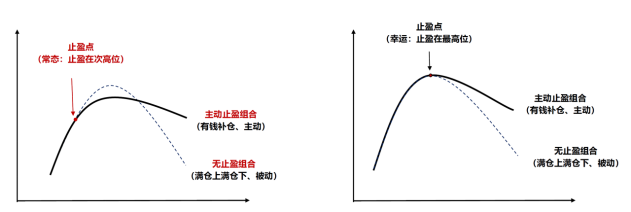 Image 2: While stop-loss and take-profit both appear as “selling,” they are fundamentally different human constraints and operational challenges.
Stop-loss can at least relatively easily establish rules, while take-profit requires investors to proactively make choices while profits remain. Selling too early can lead to regret, and selling too late may give profits back to the market. The true test lies not only in financial knowledge but also in understanding human nature and building operational systems.
This is why I increasingly emphasize a complete “investment iron triangle”: theoretical learning, world cognition, and operational systems. Investment theory learning is not difficult to understand; world cognition encompasses knowledge of political, economic, technological, company management, and valuation analysis, among others, but more importantly, understanding and responding to market panic and irrational human behavior; the operational system ultimately addresses “what to do after making a judgment.” Merely understanding theory without knowledge of operational systems and lacking disciplinary constraints makes it difficult for investments to form a closed loop. It may be that one can create wealth but lacks the means to protect it, making it hard to achieve compounding effect.
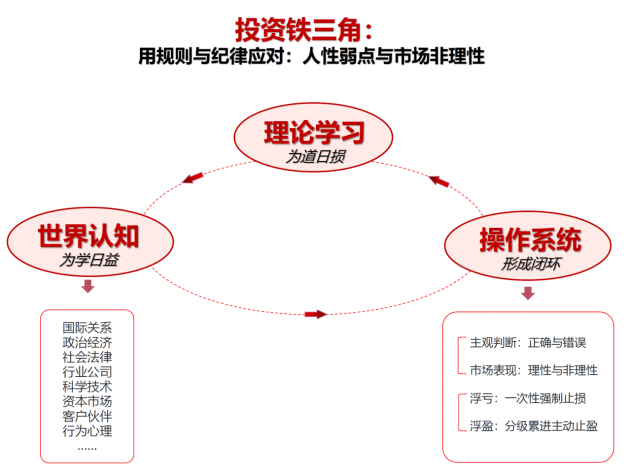 Image 3: The investment iron triangle. A complete investment system not only requires stock selection ability but also includes world cognition and operational systems.
Therefore, a truly mature investment system cannot solely focus on stock selection but must also have an execution system; it cannot only research how to create wealth but must also study how to preserve wealth. The longer one invests, the more one realizes that ultimately it is not about who is the smartest or hardest working, but who can organically unify theory, knowledge, and action discipline, with the ability to think systematically and execute systematically.
Finally, I want to share three phrases with investment friends, especially younger ones: 1. Knowledge comes from learning, skills come from practice, wisdom comes from understanding; 2. Borrowing the thoughts of management master Peter Drucker, both investment and management are practical studies, challenging in practice. Start practical operations as early as possible; 3. Value investing can be a means of livelihood, a means of self-cultivation, and a means of helping others.
免责声明:本文章仅代表作者个人观点,不代表本平台的立场和观点。本文章仅供信息分享,不构成对任何人的任何投资建议。用户与作者之间的任何争议,与本平台无关。如网页中刊载的文章或图片涉及侵权,请提供相关的权利证明和身份证明发送邮件到support@aicoin.com,本平台相关工作人员将会进行核查。


