CoinW Research Institute
Suiyuan Technology will start subscriptions on September 2, 2026, and plans to list on the Sci-Tech Innovation Board, with stock code 688801 and online subscription code 787801. According to the current issuance schedule, the preliminary inquiry will be on August 28, the issuance announcement will be disclosed on September 1, online and offline subscriptions will be on September 2, and the winning results will be announced and payments collected on September 4. As of the end of August 2026, Suiyuan Technology’s issue price, market capitalization, and formal listing date have not yet been announced. Therefore, this article will not directly discuss whether the current price is expensive, but will first answer three more critical questions: How much is the upcoming issuance pricing paying for the story of "domestic AI computing power secondary supply"? How big is the gap between this story and the company's current reality? What numbers should be used to verify whether it stands firm before and after the listing? The upcoming key points are very concentrated: on September 1, we will look at the issuance price, market capitalization, and corresponding price-to-sales ratio; on September 2, we will look at subscription enthusiasm; on the first day of listing, we will observe the opening premium, transaction volume, and turnover rate; after the listing, we will continue to monitor whether the revenue guidance of 2.3 billion to 3 billion yuan for the first three quarters of 2026 can be fulfilled, whether clients other than Tencent can expand, and whether losses and gross margins show improvement. These numbers are the core to judge whether Suiyuan Technology's IPO narrative can continue to stand.
1. The Market Isn’t Really Buying a "Chip Company," But Rather "Domestic AI Computing Power Secondary Supply"
Suiyuan Technology is not an ordinary chip company. Its core products are cloud AI chips and related computing power products, mainly serving scenarios like large model training, inference, intelligent computing centers, and cloud computing. For customers, Suiyuan Technology's value lies in providing a usable, deployable, and sustainably iterated domestic computing power option amidst uncertainties in the supply of high-end chips from NVIDIA. However, this narrative should not be understood as Suiyuan having already replaced NVIDIA as the first choice, nor should it be interpreted as having achieved an equal level of verification on both training and inference ends. More accurately, Suiyuan's current strongest support comes from Tencent’s validation as a major customer: it has proven that the company's products have entered real cloud AI scenarios, but it remains to be seen if this validation can be replicated in more clients, more tasks, and larger-scale clusters. For cloud vendors and intelligent computing centers, the value of backup suppliers lies not only in their "cheap" options, but also in whether they can reduce external supply risks.
This statement contains three layers of meaning. The first layer is domestic substitution. In recent years, the United States has continuously tightened high-end AI chip exports, and NVIDIA products like A100, H100, A800, H800, and H20 have all faced restrictions or uncertainties in their supply to China. For domestic cloud vendors and intelligent computing centers, domestic AI chips are no longer just alternatives, but essential solutions to be tested and deployed. The second layer is Tencent's validation. Suiyuan Technology is not just a technical roadmap and R&D story; it has already generated revenue. Public information shows that the company's revenue was approximately 990 million yuan in 2025 and approximately 1.12 billion yuan in the first half of 2026. Tencent is both an important shareholder and the largest customer: according to media citing the prospectus, Tencent Technology and its concerted actors Suzhou Paiyi hold about 20.26% of Suiyuan Technology's shares; in 2025, the company achieved sales revenue of about 830 million yuan from Tencent through direct sales and AVAP models, accounting for approximately 83.79% of its revenue that year. This indicates that Tencent's validation is indeed the firmest support in Suiyuan's current commercialization narrative. The Tencent order proves that Suiyuan’s products have entered real cloud AI scenarios, but it remains to be seen if it can sustain volume in training, inference, integrated training and inference, and large-scale clusters.
The third layer is future iteration. Suiyuan plans to raise 6 billion yuan, all directed towards projects related to its main business, with approximately 1.503 billion yuan allocated for the R&D and industrialization of its fifth-generation AI chip series, approximately 1.197 billion yuan for the R&D and industrialization of its sixth-generation AI chip series, and approximately 3.3 billion yuan for advanced artificial intelligence software and hardware collaborative innovation projects. The first two relate to the performance, energy efficiency, interconnectivity, and mass production of the new generation of chips, while the third is more about building full-stack software platforms, AI acceleration modules, intelligent computing clusters, and hardware-software collaborative ecosystems. When the market prices it in the future, it won't just be looking at products already sold, but also betting in advance on three things: whether the next generation of products can meet the higher demands of AI computing power; whether Tencent's AI capital expenditure still has room for continued expansion and can convert into sustained purchases from Suiyuan; and whether Suiyuan can replicate Tencent's validation with more cloud vendors, intelligent computing centers, and industry clients. Tencent's capital expenditure reached 84.72 billion yuan in the first half of 2026, an increase of 82% year-on-year, with a single quarterly capital expenditure in the second quarter of 52.784 billion yuan, a year-on-year increase of 176%, mainly directed towards data centers and server AI infrastructure. For Suiyuan, the more sustained the AI investment from Tencent, the greater the imagination space for order continuity.
2. If Valuation Is Backward-Calculated by Fundraising Goals, What Does It Imply?
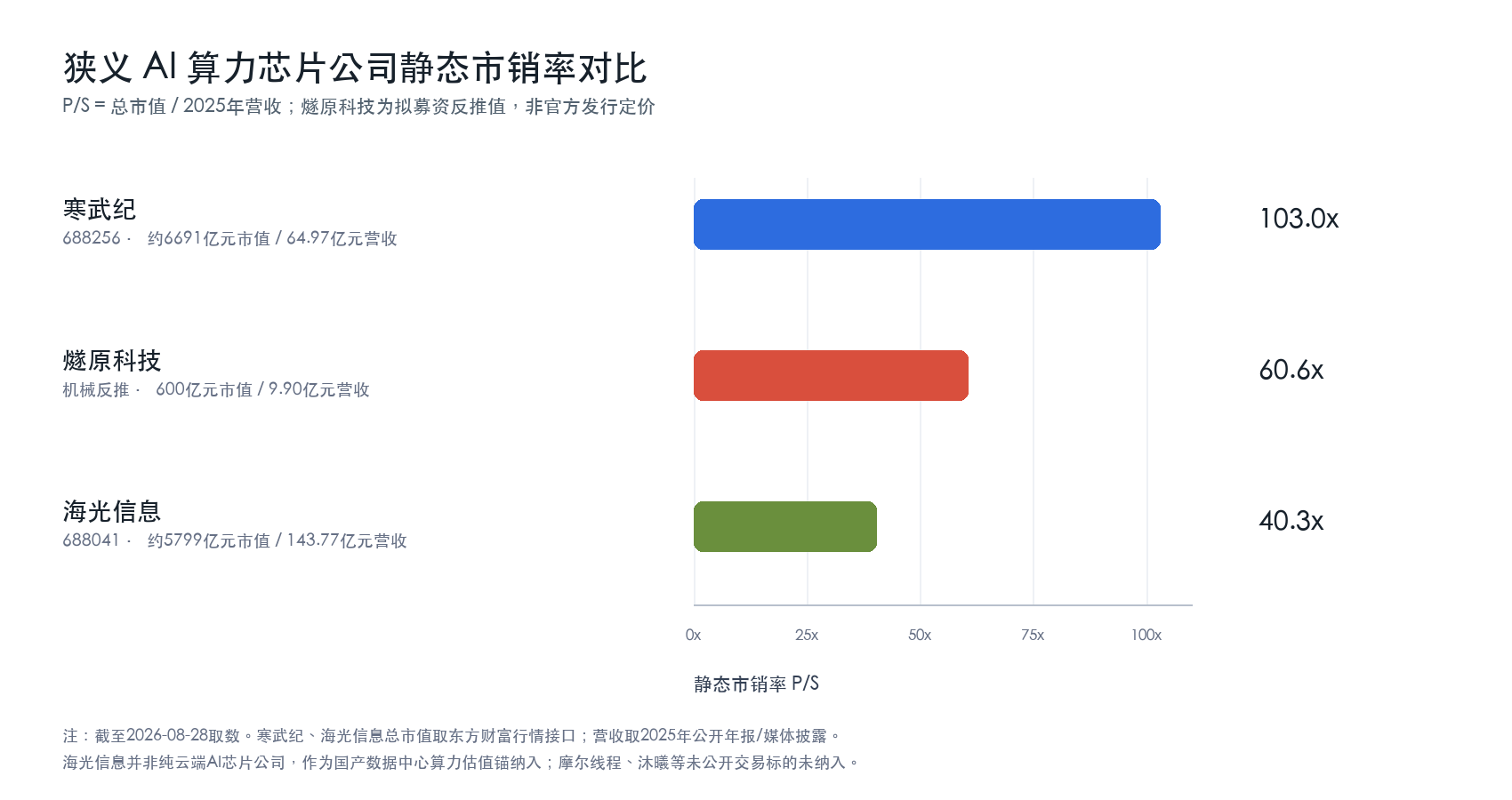
Suiyuan Technology intends to issue 43,035,173 shares, accounting for 10% of the total shares after issuance, corresponding to an approximate total share capital of about 430.35 million shares, aiming to raise 6 billion yuan. It’s important to note that as of now, the company has not announced the final issue price and formal market value. However, if we just consider a mechanical calculation assuming the company raises 6 billion yuan by issuing exactly 10% of its shares, then the corresponding post-issue valuation would be about 60 billion yuan, with an issue price of about 139.42 yuan per share. This number is not an official price but serves to help understand the potential valuation level the market may face in the future. If we further calculate based on the company’s expected revenue of approximately 990 million yuan in 2025, the static price-to-sales ratio corresponding to a 60 billion yuan market value is about 60.6 times. The price-to-sales ratio can be understood as "how much market value the market is willing to pay for 1 yuan of the company’s revenue." For technology companies that have not yet stabilized their profits, the market often uses the price-to-sales ratio as a reference instead of the price-to-earnings ratio, as the company does not yet have sustainable profits.
Source: CoinW Research Institute
If the final issuance valuation approaches 60 billion yuan, the market has already factored in high growth expectations; however, given the current trading heat of the domestic computing power sector in A-shares, the inquiry valuation will likely rise further. Recently, domestic AI chip and computing power targets like Cambricon and Haiguang Information have continued to attract capital attention, and the secondary market's risk preference for "domestic AI computing power substitution" remains high. In this context, Suiyuan Technology's issuance pricing may not only revolve around its historical revenue and loss levels, but could also be revalued within the entire domestic AI chip valuation system. The most direct support comes from revenue growth. Public records indicate that the company expects to achieve revenue of 2.3 billion to 3 billion yuan in the first three quarters of 2026, a year-on-year growth of 325.78% to 455.36%. However, rapid growth alone is not enough. The market also needs to confirm that this growth is sustainable: Tencent's demand cannot only be a phase of concentrated procurement but needs to translate into continued deployment; clients other than Tencent also need to transition from testing and small-scale orders to bulk purchasing, thereby reducing reliance on a single large client. At the same time, product iteration and profitability must keep pace with the valuation. Whether the fifth and sixth-generation AI chips can be successfully developed and industrialized will determine whether Suiyuan can maintain product competitiveness in the domestic AI computing power competition; and the company's earlier projection to achieve consolidated profit in 2026 or 2027 will determine whether rapid revenue growth can truly convert into profits.
Therefore, if Suiyuan Technology ultimately issues at a high valuation, the market is not actually purchasing a Suiyuan Technology that has revenue of about 990 million yuan in 2025 and is still in the investment phase, but is pricing in advance a domestic AI chip company that will experience rapid revenue growth in 2026, gradually expanding its client structure, continuously launching new generation chips, and approaching a profit inflection point. The higher the valuation, the smaller the "expectation gap" left for the company after listing.
3. The Biggest Expectation Gap: It's Not About Quickly Getting Rid of Tencent, but Whether Tencent's Investment Can Continue to Expand
NVIDIA being constrained does not equate to an automatic victory for domestic AI chips. Export restrictions have indeed opened a window for domestic substitution, but whether clients truly migrate depends on performance, software ecosystem, cluster stability, supply capability, and migration costs. AI chips cannot simply be bought and used; customers must also consider model adaptation, development tools, training efficiency, and operational costs. To put it bluntly, substituting AI chips is not as simple as just swapping out hardware. Existing models, training frameworks, engineering teams, and operations systems are often built around existing ecosystems. The higher the migration costs, the slower the substitution speed. NVIDIA's advantages come not just from chip performance but also from CUDA, development tools, and the developer ecosystem.
For Suiyuan, the most important variable in the short term is not whether it can quickly get rid of its dependence on Tencent. Given the current business structure, the binding relationship between Tencent and Suiyuan is unlikely to change significantly in the short term. The real expectation gap lies in whether Tencent's AI capital expenditure can continue to expand and whether this input can consistently convert into Suiyuan’s orders, revenue, and profits. On the positive side, Tencent is still increasing its investment in AI infrastructure. If Tencent continues to expand large models, cloud services, and AI applications, the demand for domestic computing power procurement still has room to grow. Suiyuan has already entered Tencent’s system; compared to suppliers still in the testing phase, it is more likely to benefit from subsequent procurement continuity. The risks are also clear. The growth in Tencent's capital expenditure does not mean Suiyuan will necessarily benefit in the same proportion; Suiyuan's revenue growth does not guarantee an improvement in profits. We need to observe whether Tencent's AI investments are sustained and not just concentrated procurements; how much of the new computing power demand is actually allocated to Suiyuan; and whether Suiyuan can maintain its gross margin while delivering more products, continuing to drive the narrowing of losses.
Therefore, the expectation gap here is not solely about "how high customer concentration is," but about whether capital expenditure, order conversion, and profit conversion can connect. If Tencent's investment continues to exceed expectations, Suiyuan's revenue elasticity may be amplified; if Tencent's investment slows down, or if new procurements flow more towards other suppliers, reliance on a single large client will quickly become a pressure on valuation. In the short term, Tencent remains the most important prop in Suiyuan's valuation narrative. The market will not only look at whether Tencent is a client but will also examine whether Tencent's money can continue to be invested in AI, whether the AI spending can continue to translate into Suiyuan's orders, and whether those orders can ultimately become healthier profits and cash flows.
4. Where the Real Disagreement Lies for Bulls and Bears
Regarding Suiyuan Technology, both sides recognize there is a window for domestic AI computing power and agree that Tencent’s validation has value. The real disagreement lies in whether this window can convert into a sustainable performance curve. The bullish side is more focused on "certainty." Amidst uncertainty in NVIDIA's supply, leading cloud vendors need domestic alternatives; Suiyuan’s entrance into Tencent's ecosystem indicates the product is no longer stuck in the laboratory; if subsequent revenue guidance is fulfilled, the market will view the company as moving out of the research and development investment phase into a period of significant revenue. For bulls, Tencent is not the entirety of the single customer risk but is the most important commercial entry point at this stage. The bearish side is more concerned about "extrapolation risks." Tencent's validation can prove the product is usable but cannot directly demonstrate that procurement intensity will persist over the years, nor can it prove that other clients will quickly follow suit. For AI chip companies, transitioning from revenue growth to profit improvement involves overcoming obstacles in research and development, wafer fabrication, software ecosystems, and delivery costs. Even if industry opportunities genuinely exist, Suiyuan still needs to prove it can convert those opportunities into healthier financial results. Therefore, bulls bet that Tencent's validation will bring greater elasticity in domestic computing power procurement, gradually supporting revenues and valuations. Bears worry that Tencent's validation merely represents a peak in projects, and after revenue growth, it still struggles to escape losses and customer concentration pressures. This disagreement will ultimately not be settled based on opinion, but rather on data. In the short term, we look at the continuity of Tencent's procurement, in the mid-term we review gross margins and narrowing losses, and in the long term, we assess whether the company can replicate the same customer validation beyond Tencent.
5. What the Market Needs to Validate in the Next Month
The focus of observation before and after Suiyuan Technology's listing can be summarized into four groups of data, with the upcoming issuance and listing nodes providing a continuous validation window. The first group is the issuance price and market value. On August 28, the preliminary inquiry will begin, and the market can first observe institutional bidding situations; it is expected that after the issuance announcement is disclosed on September 1, the issuance price, market value, and corresponding price-to-sales ratio will become clearer. This set of data determines how much "scarcity premium of domestic AI computing power" the market is willing to give Suiyuan. The second group is revenue growth. The company currently expects its revenue in the first three quarters of 2026 to reach 2.3 billion to 3 billion yuan, which is the most direct hard indicator to validate the "Tencent deployment + domestic substitution" logic. If the issuance valuation is already high, the importance of revenue realization will further increase. The third group is order continuity. In the short term, Tencent remains the core observation point for Suiyuan's performance elasticity. The market needs to look not only at whether the customer structure can immediately diversify but whether related procurements from Tencent can continue, new AI capital expenditures can continue to convert into Suiyuan orders, and whether these orders possess sustained delivery and repurchase characteristics. The fourth group is gross margin and narrowing losses. Early losses in AI chip companies are not unexpected, but the market needs to see a clear path to profit improvement. If rapid revenue growth coincides with stable gross margins and continuously narrowing losses, it indicates that scale effects are beginning to manifest; conversely, if growth is accompanied by declining gross margins and increasing cash pressure, the valuation may need to be recalibrated.
In terms of timing, subscriptions are expected to occur on September 2, followed by the phases of payment collection on September 4, and the market will then await formal listing announcements. If the company lists in mid-September, focus on the opening premium, transaction volume, and turnover rate on the first day of listing; for the next three trading days post-listing, further observe whether the price center stabilizes, whether transaction heat quickly cools down, and whether there is a correlation or divergence with domestic computing power targets like Cambricon and Haiguang Information. The overseas market is also an important reference. NVIDIA remains the core pricing anchor of the global AI chip industry, and changes in its product supply, export policy to China, and AI capital expenditure trends from cloud vendors can all impact the risk appetite of the domestic AI chip sector. It is worth noting that the A-share market currently lacks historical samples that completely correspond to “unprofitable cloud AI chip company + Sci-Tech Innovation Board IPO + high customer concentration,” and therefore it is inadvisable to simply apply the first-day rise and fall patterns of other new stocks. Rather than predicting how much shares will rise post-listing, what is truly worth tracking are four issues: what valuation the market assigns, whether revenue can be realized, whether clients can diversify, and whether growth can ultimately translate into profit.
6. Where the Most Likely Misjudgments in This Bet Might Occur
The core issue of Suiyuan Technology's IPO is not whether domestic AI computing power has opportunities, but whether the market is too smoothly mapping the "large factory AI expenditure expansion" onto Suiyuan. Alibaba's recent placement financing of 80 billion Hong Kong dollars provides a good reference. Alibaba has explicitly stated that the net proceeds from the placement will be used for full-stack AI capability and AI infrastructure construction, and previously proposed an investment of 380 billion yuan over three years to build cloud and AI infrastructure. This indicates that the leading Internet companies in China have not yet finished their investment in AI computing power, and the industry remains in a phase of heavy capital competition. However, such investments will not be evenly distributed among all domestic AI chip companies, nor will they automatically translate into Suiyuan's orders. The paths of AI capital expenditures for Alibaba and Tencent are not entirely the same. Alibaba emphasizes "full-stack AI," with layouts from cloud, models, applications to self-developed chips and infrastructure, and its funding investment seems more focused on reinforcing its own cloud and AI ecosystem depth. Tencent's AI investment is more closely aligned with the computational consumption of models, advertising, games, WeChat ecosystem, cloud services, and other application scenarios; whether external suppliers can benefit depends on whether they have entered Tencent's procurement system and whether they can continuously satisfy real business loads.
This is also where Suiyuan's narrative is most likely to be misread. Alibaba's financing will enhance the market's overall risk preference for the domestic computing power sector, but it is not a direct source of Suiyuan's orders; the continuity of Tencent's capital expenditure is closer to being the core variable for Suiyuan's short-term performance elasticity. In other words, the market can reprice the domestic AI computing power sector due to Alibaba's large financing, but does not mean it can simply deduce that Suiyuan's revenue must continue to grow significantly. Therefore, what Suiyuan needs to be most cautious of before its listing is not the lack of attractiveness of the story itself, but rather that the story is told too smoothly. Large enterprises increasing their investment in AI does not equate to all domestic chip companies benefiting; Tencent's continued investment does not guarantee an increase in Suiyuan's market share; and the higher the issuance valuation, the more the market will demand this transmission chain to provide more specific evidence. Suiyuan's listing is not a stamp of approval for the domestic AI chip story but rather a test of that story in the public market. The issuance pricing purchases the imagination of domestic computing power substitution, while post-listing, validation occurs regarding whether large factories' capital expenditure can truly translate into Suiyuan's orders and performance.
This article is for market research and information analysis only and does not constitute any investment or trading advice.
References
1.Stock Star: Suiyuan Technology Issuance Arrangement and Preliminary Inquiry Announcement
2.Securities Times IPO Project Page: Suiyuan Technology
4.Eastmoney: Report on Tencent Related Sales Proportion and Customer Concentration
5.NVIDIA SEC Filing: Disclosure of Export Control Risks
6.Tencent's Capital Expenditure Grew 82% in the First Half of the Year
7.Alibaba's 80 Billion Hong Kong Dollar Placement Aimed at AI Infrastructure
8.Alibaba's Q2 2026 Performance
免责声明:本文章仅代表作者个人观点,不代表本平台的立场和观点。本文章仅供信息分享,不构成对任何人的任何投资建议。用户与作者之间的任何争议,与本平台无关。如网页中刊载的文章或图片涉及侵权,请提供相关的权利证明和身份证明发送邮件到support@aicoin.com,本平台相关工作人员将会进行核查。