Original Author: Zhao Ying
Original Source: Wall Street Insights
The yield on Japanese government bonds has surpassed 3% for the first time in 30 years. Nomura Research Institute warns that this surge in global long-term interest rates originates from Japan, rather than being an external input. The combination of Japan's fiscal risk and expectations for normalization of monetary policy is spreading through the bond market globally, posing a systemic threat to tech stocks, AI investments, and even the real economy.
The yield on 10-year Japanese government bonds (JGB) briefly exceeded 3.0% in the Tokyo market, marking the first time since September 1996. According to wind trading platforms, Takahide Kiuchi, an executive economist at Nomura Research Institute, noted in a recent report that over the past year, the cumulative increase in the yield of 10-year Japanese bonds is approximately 1.4 percentage points, while the increase in the yield of U.S. 10-year government bonds during the same period is only about half of Japan's. This indicates that the rise in Japanese bond yields is mainly driven by domestic factors rather than being transmitted from overseas markets.
Takahide Kiuchi believes that in terms of absolute yield levels, Japanese bonds have reached a 30-year high, while U.S. bonds have only returned to levels last seen in January 2025. Additionally, the yield on German 10-year government bonds is at its highest since 2011, and the yield on British 10-year government bonds is at its highest since 2008. In comprehensive comparison, Japan is more likely to be the source driving the global long-term interest rate increase, rather than a passive follower. Meanwhile, the Trump administration has begun to unusually intervene in Japanese economic policy, pressuring the Bank of Japan to raise interest rates and urging the government of Saito to reduce fiscal expansion.
Three Factors Driving Japanese Bond Yields Above 3%
According to Nomura Research Institute's report, the yield on 10-year Japanese government bonds had approached the 3% mark in August and eventually broke this whole number during trading on September 1, backed by three driving forces.
First, expectations for an increase in U.S. interest rates have heightened. Federal Reserve Chairman Kevin Warsh's statements at the recent Jackson Hole annual meeting reinforced market expectations for a rate hike at the U.S. Federal Open Market Committee (FOMC) meeting in September, putting pressure on global bond markets.
Second, expectations for an increase in Japan's interest rates have intensified. The market widely expects the Bank of Japan to raise the policy interest rate at the monetary policy meeting in September, further pushing up Japanese bond yields.
Third, risks of fiscal expansion in Japan have increased. As of the end of August, the total amount of general accounting budget requests submitted by Japan's provincial departments for fiscal year 2027 was approximately 20 trillion yen higher than the fiscal year 2026 budget, significantly intensifying market concerns over the worsening fiscal situation in Japan.
Fiscal Risk is the Primary Cause of Yield Increase
Nomura Research Institute conducted a breakdown analysis of the factors behind the 1.4 percentage point increase in the 10-year Japanese government bond yield over the past year. The results reveal that rising inflation expectations contributed approximately 0.49 percentage points, changes in the Bank of Japan's bond holdings contributed about 0.08 percentage points, increases in U.S. 10-year government bond yields contributed around 0.08 percentage points, and changes in expectations for actual policy interest rates contributed about 0.15 percentage points, while "other" factors contributed as much as 0.60 percentage points—this component is believed to mainly reflect the risk premium associated with the deteriorating fiscal situation in Japan.
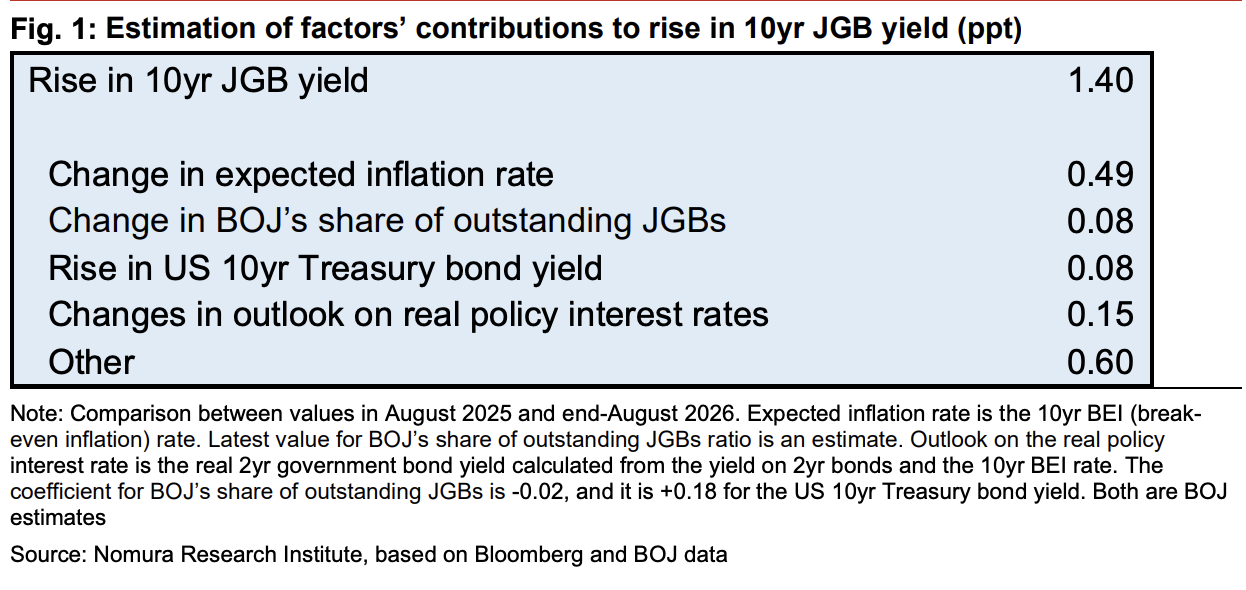
This means that among all the factors pushing up Japanese bond yields, the fiscal risk premium is the largest single contributor, far exceeding the influences of inflation expectations and monetary policy expectations.
Takahide Kiuchi pointed out that a rise in long-term interest rates is not always a "bad thing"—if it arises from improved economic growth potential or rising inflation expectations, actual interest rates may not necessarily increase alongside, resulting in limited negative impacts on the economy. However, if the rise primarily stems from fiscal risks, it often has a substantive negative impact on economic activity, and this shock is typically more delayed and harder to detect than an increase in short-term interest rates.
Trump Administration Rarely Intervenes in Japanese Economic Policy
The Trump administration has begun to intervene in Japanese economic policy in an unusual manner. U.S. Treasury Secretary Mnuchin recently stated at the G20 finance ministers and central bank governors meeting, clearly expressing to Japan's Finance Minister Kiyoshi Katayama and Bank of Japan Governor Kazuo Ueda that Japan needs to clearly communicate its path to fiscal sustainability and plans for interest rate hikes.
Previously, Mnuchin publicly expressed his expectations for the Bank of Japan to raise interest rates after the conclusion of a joint U.S.-Japan foreign exchange intervention at the end of July. Nomura Research Institute believes the underlying logic of this move by the Trump administration is: the continuous depreciation of the yen and the decline in Japanese bond prices (increase in yield) may negatively impact the U.S. and even global markets, thus Washington is seeking to more actively intervene in Japan's economic policy direction, pushing the Bank of Japan to raise interest rates and urging the government of Saito to retract its fiscal expansion stance.
The report notes that if the government of Saito gradually adjusts its active fiscal policy stance, the risk of fiscal deterioration in Japan will decrease, and the upward pressure on the 10-year Japanese government bond yield will also lessen.
Rising Japanese Bond Yields May Trigger Turbulence in Global Financial Markets and Cool Down AI Boom
Nomura Research Institute warns that the rise in global long-term interest rates, centered around Japan, poses potential shocks to the economy and financial system that should not be underestimated.
From a macro perspective, the rise in long-term interest rates will increase interest expenditures for governments worldwide, potentially triggering a negative spiral of "fiscal deterioration—yield increase," while lowering the market value of bonds in financial institutions' asset portfolios, undermining their balance sheet stability. Additionally, the increase in interest rates will also suppress the prices of risk assets such as real estate and stocks.
Of particular concern are technology and AI-related stocks. These types of assets are especially sensitive to rising interest rates. Takahide Kiuchi noted in the report that if the rise in long-term interest rates centered around Japan continues, it may trigger a cooling off of the AI boom in the stock market. A decline in AI-related stock prices will further weaken the ability of relevant companies to raise large amounts of investment funds through equity or debt financing, thereby putting the brakes on the physical asset investment expansion in AI infrastructure.
"This may not only lead to a gradual cooling of global economic activity but could also potentially trigger a sudden economic slowdown," the report stated. Nomura Research Institute believes that this partly explains why the Trump administration chose to take rare direct intervention actions, urging Japan to steer away from policy paths that might further depreciate the yen and increase long-term yields.
免责声明:本文章仅代表作者个人观点,不代表本平台的立场和观点。本文章仅供信息分享,不构成对任何人的任何投资建议。用户与作者之间的任何争议,与本平台无关。如网页中刊载的文章或图片涉及侵权,请提供相关的权利证明和身份证明发送邮件到support@aicoin.com,本平台相关工作人员将会进行核查。


