CoinW Research Institute
Stock tokens are changing the way Memes are issued. In the past, new coins were usually traded using native tokens of public chains or stablecoins; now, stock tokens such as Nvidia can directly become assets for fundraising, with transaction fees convertible into stock tokens, entering community treasuries or distributed to holders. Various platforms including Robinhood Long.xyz on Chain, Pons, StonkFun on Solana, and BNB Flap.sh on Chain, Four.Meme have begun competing in different ways around these stock meme coins.
CoinW Research Institute believes that the current stock meme coins are closer to a cyclical market driven by expectations, wealth effects, and attention. Long.xyz, Pons, StonkFun, Flap.sh and Four.Meme are expanding trading scenarios from stock pairing, multi-asset issuance, stock rewards, and new stock supply, which indeed helps increase the frequency and liquidity of stock token usage in the short term. However, these innovations are currently focused mainly on trading and issuance processes; whether RWA can further form a long-term business ultimately depends on the improvement of stock custody, subscription and redemption, market making, reserve verification, and regulatory frameworks.
1. Robinhood Chain: Two Core Stock Meme Launch Platforms
At present, the leading stock meme launch platforms on the Robinhood Chain are Long.xyz and Pons. Long.xyz relies on AI/NVDA and other representative projects to form a strong stock pairing cognition and further integrates transaction fees, stock tokens, and community treasury; Pons, on the other hand, extends the pairing of stock tokens to more projects based on a more standardized launch process and a larger platform traffic.
Long.xyz: AI's Market Value is About 40 Times the Main Pool Liquidity
Long.xyz allows creators to choose a stock token to establish a trading pool with the newly launched Meme. For example, the AI token can be paired with the Nvidia stock token NVDA, and the BONER token with the Hims & Hers stock token HIMS. Users can still place orders using ETH or stablecoins through trading tools; when the final quotes provided by the stock trading pool are more favorable, the tools will first convert the funds into the corresponding stock tokens before buying the Meme, without users manually completing the intermediate conversion.
In these transactions, when users buy Memes, stock tokens enter the pool; when users sell, the pool pays them with stock tokens. Thus, stock tokens not only participate in pricing but also become pool assets for trading. Even if liquidity positions are locked, normal trading will still change the number of stock tokens in the pool, with the locking mainly limiting the project parties' withdrawal of corresponding liquidity. In addition to trading pools, some projects also accumulate community assets through fee mechanisms. According to the treasury rules published by AI, a portion of the trading fees will be deposited into the community treasury, while the related fees collected in AI tokens will be destroyed or permanently locked according to the rules. In this way, Meme trading can both accumulate reserves for the community and reduce the circulating supply of some AI tokens.
From the actual scale, according to official data from Long.xyz, the platform has accumulated over 1 billion dollars in stock token transactions within about two months of launch, accounting for approximately 15% of the stock token transactions on the Robinhood Chain, with stock assets in the platform accounting for about 10% of the total stock token locked in the entire chain.
The most representative stock pairing project of Long.xyz is AI/NVDA, which is also a core sample for observing whether this model holds. Taking AI/NVDA as an example, a simplified model can be established using the constant product AMM formula (x×y=k) to observe how trading scale affects the price. Ignoring fees and assuming the dollar price of NVDA remains unchanged, if one invests an amount equivalent to 10% of the pool's NVDA reserves to buy AI, the quote of AI after the transaction would rise approximately 21%; selling an amount equivalent to 10% of the pool's AI reserves would decrease the quote by about 17.4%. If the initial reserves on both sides are simultaneously doubled while keeping the initial price unchanged, the price impact from the same quantity of buys and sells would shrink to about 10.3% and 9.3%, respectively. This indicates that the larger the order relative to the pool reserves, the more significant the impact on price: concentrated buying will continuously raise subsequent buying costs, while concentrated selling will depress subsequent selling prices. Therefore, stock tokens participating in Meme trading still require adequate liquidity to accommodate large orders.
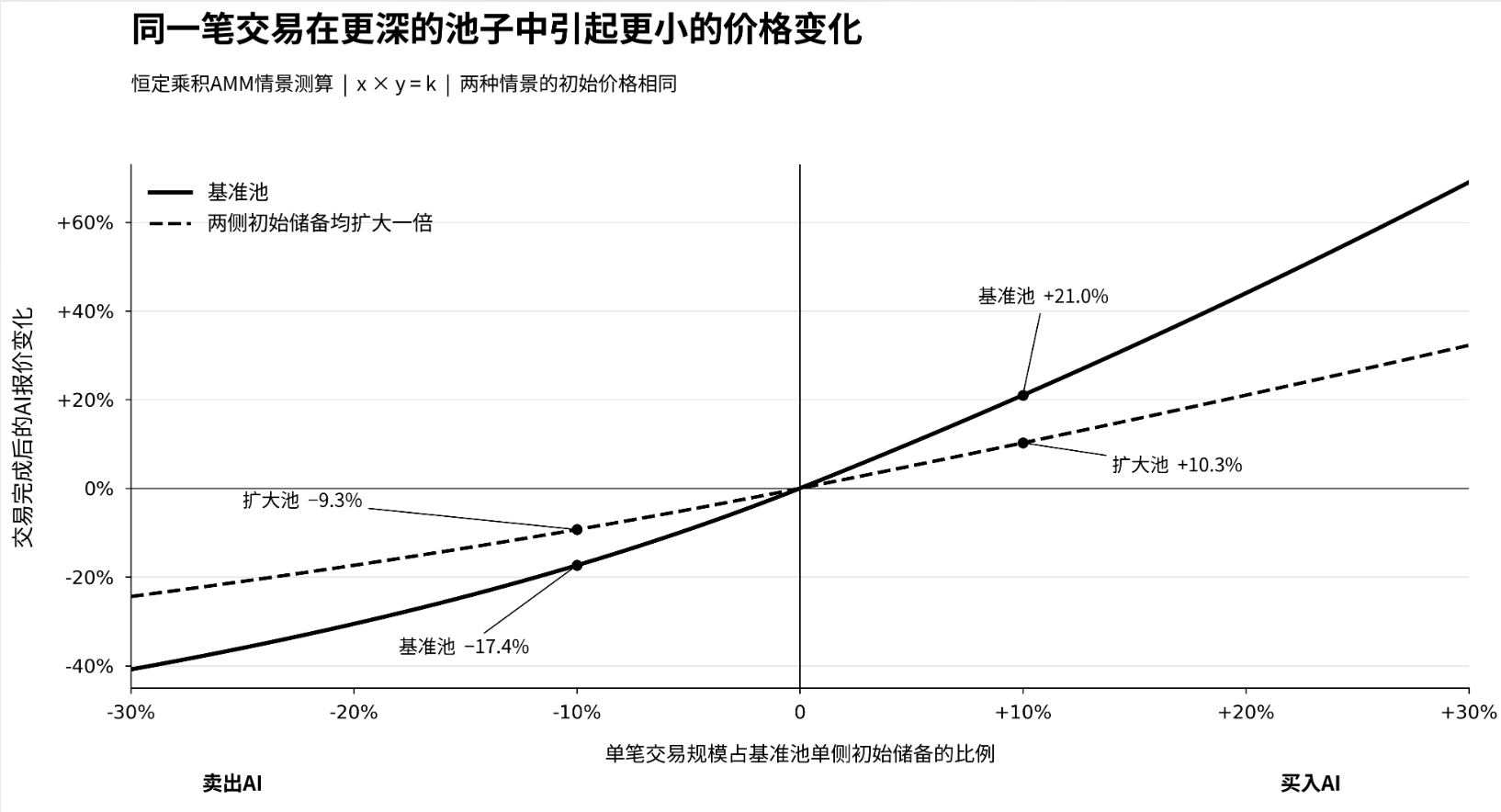
Source: CoinW Research Institute
Meanwhile, the AI community treasury currently holds about 1,258 NVDA tokens, valued at approximately $291,000. Compared to AI's market value exceeding $200 million, the stock reserve in the treasury remains relatively small, primarily reflecting fee sedimentation and asset reserves, providing limited support for AI's overall valuation.
Thus, Long.xyz has validated the market acceptance of stock pairing through AI/NVDA. However, the Meme market itself has a significant Matthew effect, leading to trading and liquidity concentrating on a few prominent projects. If the platform actively disperses capital through subsidies and liquidity incentives, this will also increase additional costs and may not necessarily lead to sustained trading. Currently, Long.xyz faces a more immediate issue: the platform's transaction volume, LP inventory, and stock asset sedimentation are still largely dependent on a few prominent projects like AI/NVDA, and if the popularity of core projects decreases, the overall trading scale and revenue of the platform may significantly decline.
Pons: V2 Becomes the Main Revenue Source but with Weak Liquidity
Pons has integrated stock pairing into a unified issuance process with V2. According to Pons' official description, new Memes first trade in the issuance pool that automatically quotes according to rules, and once graduation conditions are met, the raised assets and reserved Memes enter Uniswap V4 together, with the corresponding liquidity positions permanently locked. For example, if the project chooses MU as the paired asset, the raised assets during the issuance phase are MU, and upon graduation, the trading pool is directly established with MU, with fees also settled in MU. Thus, stock tokens run through fundraising, trading, and fee distribution, allowing creators to avoid the need to change paired assets upon graduation.
V2 also allows creators to set additional taxes beyond the base trading fee, utilizing part of the fees for repurchasing project Memes. Tokens acquired through repurchase enter the treasury and are gradually released over five years. For stock pairing projects, creators can retain the received stock tokens or use repurchases to support Meme trading; the stock tokens used for repurchase will reenter the trading pool, so active trading does not necessarily lead to a continuous increase in stock reserves, ultimately depending on the allocation and use of the fees.
Currently, V2 has become Pons' main source of revenue. DeFiLlama data shows that Pons generated approximately $82.74 million in fees in the past 30 days, with protocol revenue around $15.62 million; among this, Pons V2 generated about $74.75 million in fees and approximately $13.84 million in protocol revenue, accounting for 88.6% of the protocol's revenue during the same period. By this calculation, the actual revenue entering the Pons V2 protocol is only about 18.5% of the transaction fees, with the rest mainly allocated to project creators, and some projects also use part of the creators' income for token repurchases. This distribution method encourages creators' willingness to participate but also means that the growth of Pons' protocol revenue will lag behind the expansion of trading scale, necessitating continued observation of whether V2 can maintain stable revenue conversion capabilities after scaling transactions.
Pons has successfully streamlined the V2 issuance, trading, and fee processes, but its subsequent potential largely depends on whether the trading logic of stock meme coins can continue to hold. Currently, the core support for these assets comes from self-reinforcing expectations: improvements in stock token liquidity drive more Memes to be issued and traded around stock assets, while wealth effects further attract funding and attention. As long as the liquidity of stock tokens on Robinhood Chain, Solana, and BNB Chain continues to improve marginally, and this trend is not refuted by data in the short term, there remain conditions for the stock meme market to continue expanding. For Pons, what truly needs to be observed is whether this external liquidity improvement can continuously convert into V2's issuing demand, transaction scale, and protocol revenue.
2. Solana: StonkFun Expands from Stock Pairing to Multi-Asset Issuance
Currently, the more representative stock meme launch platform on Solana is StonkFun. In its early days, it primarily used xStocks' stocks and ETF tokens as paired assets for Memes, allowing SPYx, NVDAx, AAPLx, etc., for new coin issuance; after integrating with Raydium LaunchLab on September 5, new projects uniformly undergo early trading in the issuance pool, and once they meet the conditions, they enter the Raydium public liquidity pool, where trading is continued by aggregators like Jupiter.
More interestingly, StonkFun has expanded its product positioning from stock pairing to any asset pairing. The official homepage lists categories like PreStocks, Sunrise, currencies, leveraged assets, SOL, and custom tokens in addition to xStocks. While stock Memes remain an important entry point, the platform is beginning to replicate the same issuance mechanism across more assets.
StonkFun Expands from Stock Pairing to Multi-Asset Issuance
StonkFun has now evolved from a simple stock pairing launch tool to a multi-asset Meme issuance platform covering stocks, ETFs, Pre-IPO assets, and some crypto assets. After September 5, new projects complete early issuance through Raydium LaunchLab uniformly: creators select paired assets like SPYx and NVDAx, and users buy the new Memes with corresponding assets during the issuance phase; after reaching graduation conditions, the remaining Memes migrate into the Raydium public trading pool, where Raydium and Jupiter, among other trading tools, continue to handle subsequent liquidity. This process connects issuance, fundraising, and secondary trading, allowing creators to avoid reconciling trading venues post-graduation.
StonkFun offers both standard issuance and reward issuance models in its fee design. According to official information, the standard mode defaults to a 1% fee, with the platform and creators each receiving 0.5%; creators can also choose a higher rate to increase their share. The reward mode converts part of the fees generated from trading into paired assets, distributed according to rules to Meme holders. If a project pairs with NVDAx, the rewards for users can be NVDAx; if paired with crypto assets like HYPE or TAO, rewards can also be distributed directly in those assets. Thus, paired assets begin to bear three uses: fundraising assets, trading liquidity, and user rewards, further extending the play of stock Memes to broader asset pairings.
At the same time, their trading growth has started to translate into platform revenue. According to stonkfun.xyz data, recently StonkFun's daily protocol revenue reached about $1.508 million, ranking high among DeFi protocol revenues that day. Notably, under the current platform mechanism, about 60% of platform revenue is used to buy and burn STONK in the open market, while the remainder stays in the protocol.
To date, StonkFun has accumulated around $4.9 million in platform revenue, of which about $2.91 million has been used to repurchase and burn STONK, accounting for around 60% of total revenue. However, StonkFun also needs to pay attention to the liquidity and transaction retention of general graduation projects to reduce the platform's dependence on price actions of a few prominent assets like STONK.
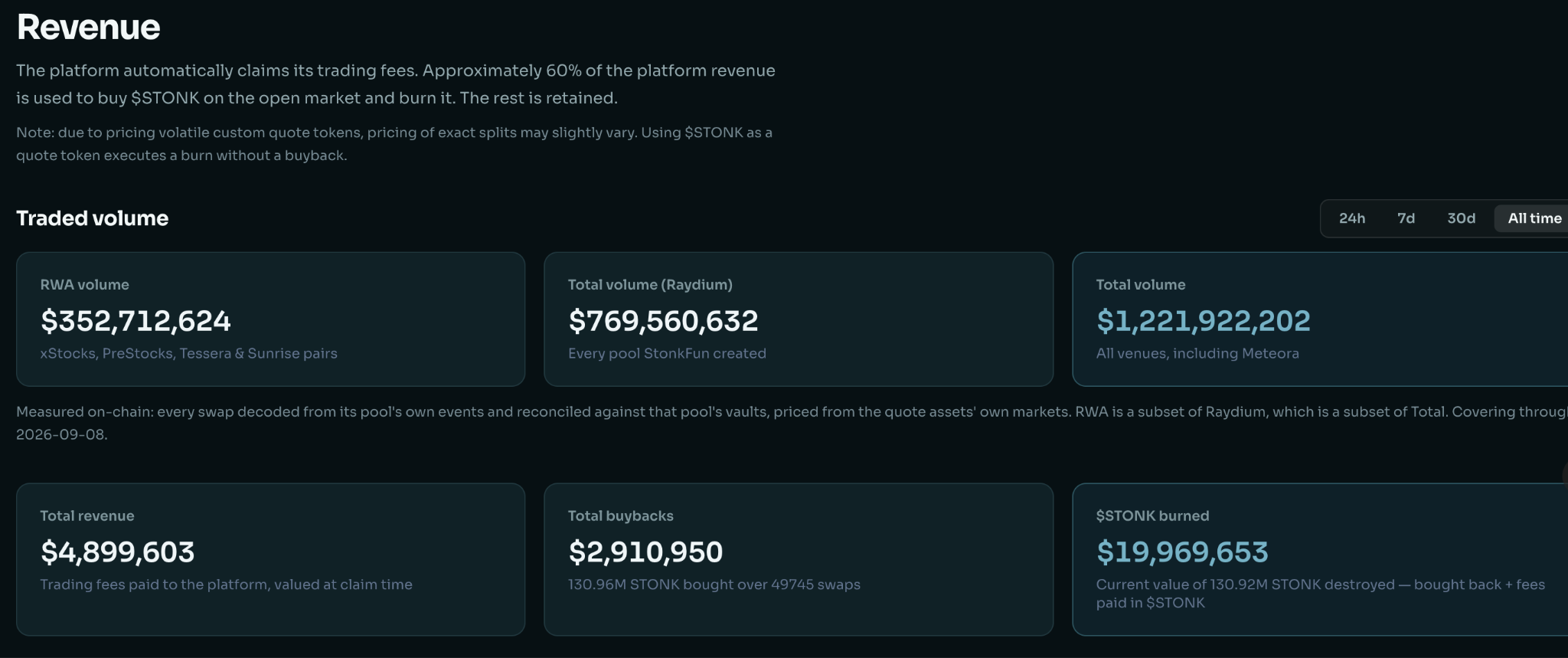
Source: https://www.stonkfun.xyz/revenue
3. BNB Chain Expands from Stock Rewards to New Stock Asset Issuance
Currently, the more representative stock meme launch platforms on the BNB Chain are Flap.sh and Four.Meme. Flap.sh focuses on designing pairs and rewards around existing stock assets, while Four.Meme introduces stocks not yet covered by bStocks onto the chain through 4Stock. The former focuses on how to use existing assets, while the latter begins to engage in asset supply.
Flap.sh Revenue Still Relies on Trading Taxes
Flap.sh features a mechanism for holding stock tokens that allows users to gain stock rewards beyond stock pairing. During project issuance, about 80% of Memes are sold in the issuance phase, with the remaining Memes entering the public trading pool alongside the raised assets. If the project chooses stock tokens as paired assets, the stock tokens invested by users when buying Memes will enter the trading pool; if the project simultaneously launches stock rewards, part of the transaction tax generated will also be converted into stock tokens and distributed to Meme holders.
MarsCoin is currently a typical case; according to the project official website, MarsCoin charges a 3% transaction tax for both buying and selling, and this fee goes into the SPCXB stock reward treasury, distributed according to rules to holders. To date, the official site shows that approximately 29,790 SPCXB tokens have been allocated, calculated at the page price to be around $4.44 million, with about 90 awaiting distribution. However, it is necessary to distinguish between rewards already issued in the past and how many can still support current transactions. MarsCoin currently has a market cap of approximately $141 million, with main pool liquidity around $1.9 million and 24-hour transactions of about $2.2 million, retaining about 6,444 SPCXB worth approximately $961,000. The 29,790 SPCXB tokens already given to users have exited the reward system and cannot continue to provide liquidity for current trading.
At the same time, the stock rewards themselves are not free. MarsCoin charges a 3% tax for both buying and selling. Assuming the Meme price remains completely stable and ignoring slippage, transaction fees, and stock rewards for a moment, if a user buys and then sells once, the transaction tax alone will reduce their principal by about 5.9%. Therefore, whether a user ultimately profits depends on whether the stock rewards they receive can cover transaction taxes, price fluctuations, and other trading costs. If the Meme price drops, even receiving stock rewards might not be enough to offset the loss of principal.
This also indicates that the stock rewards from Flap.sh heavily depend on sustained trading. The more active the trading, the more taxes generated, and the more funds available for purchasing and distributing stock tokens; once trading heats up decreases, new rewards will similarly decline. Flap.sh has now demonstrated that using Meme trading fees to give stock rewards to holders can function in practice, but whether this model can be sustainable in the long term will depend on whether sufficient trade can still be achieved after the project's popularity declines, as well as whether the stock rewards received by users can offset their involved costs.
Four.Meme Pushes Competition into Stock Supply Through 4Stock
After launching 4Stock on September 8, Four.Meme has further extended its business scope into stock asset issuance. Previously, the platform mainly used existing stock tokens in the market as paired assets for stock meme issuance; after the launch of 4Stock, Four.Meme began attempting to bring stocks not yet covered by bStocks onto the chain, providing new paired assets for subsequent Meme issuance. According to platform rules, each 4Stock token is supported by the corresponding stock at a 1:1 ratio, can be traded individually, or used as the pricing and pairing asset for stock memes, with the first launched asset being BNC4 corresponding to CEA Industries stock BNC.
Currently, 4Stock still adopts an application method to increase the supply of stock tokens. According to official rules, the minimum application amount is 10,000 USDC, with a 1% minting fee. Once the platform receives the funds, it buys the corresponding stocks through a managed account and issues the same number of on-chain stock tokens based on the actual trading quantity, typically processing time is within 24 hours. This process means that the on-chain supply of stock tokens has a certain lag. When a stock token suddenly experiences a large buy order, the new supply cannot match the trading demand immediately. The platform has plans to introduce automatic minting, and the redemption function is also mentioned to be coming soon, with future plans to support 4Stock conversion to the corresponding bStock.
When a new stock is first launched, it also requires initial participants to provide starting capital. According to platform rules, launching a new 4Stock asset requires an investment of 500,000 USDC, of which about half is used to purchase the corresponding stocks and mint stock tokens, while the other half is used to establish the initial trading pool. Initial participants can obtain 50% of the related coins’ early trading fees for the stock meme and 50% of the initial trading pool profits. This design is mainly to solve the initial funding and liquidity sources for new stock assets coming online. Initial participants bear the funds needed for stock purchases and market making and then receive returns through fees and liquidity earnings. For Four.Meme, this approach helps diversify the types of stock assets but also depends on the willingness of participants to invest the initial funding and the actual efficiency of stock purchases.
From the data since its launch, 4Stock has quickly attracted a batch of trading funds. The official page currently shows over 1,100 records of Meme creation. Currently, the 4Stock/BNC4 trading pool has a liquidity of about $1.43 million, with approximately 61,500 BNC4 in the pool, with trading volume around $426.2 million. Given that the product has only been online for a short time, this trading volume actually only covers a few hours, reaching nearly 30 times the liquidity, indicating relatively active short-term turnover. However, current data more reflects the concentrated trading after the launch of the new product. How much capital and BNC4 can be retained in the pool after a decline in popularity will better reflect the actual sustaining capability of this model.
At the same time, the deviation of stock token prices from underlying stocks is also an issue to focus on. On September 8, the price of the BNC4/USDT trading pool fluctuated between $3.71 and $35.58, sampling around $12.15. The platform's stated 1:1 support mainly corresponds to the issuance and reserve relationship of stock tokens, meaning each stock token issued corresponds to a specific underlying stock quantity. This indicates that this mechanism cannot guarantee that the on-chain transaction price remains consistent with the underlying stock at all times.
4Stock has expanded Four.Meme's participation scope in the stock meme industry chain. The platform previously mainly focused on Meme issuance and trading, and now begins extending upstream to stock asset supply. For stocks not yet included in the bStocks system, 4Stock can first establish on-chain stock assets and then issue new stock memes around these assets, which brings more ongoing trading topics for the platform. However, this model still remains in the early stage. Newly introduced stock tokens still need manual application, redemption functions are not officially open yet, and on-chain prices may experience significant fluctuations due to short-term supply and demand imbalances. Future observations can focus on three aspects: whether the issuance speed of new stock assets can be improved, whether redemption and conversion channels can be perfected, and how much trading volume and liquidity can be retained after new stocks have been online for a while.
4. Stock Meme's Market is Still Driven by Expectations
Currently, the market enthusiasm for RWA Memes shares a certain similarity with the previous AI Agent token hype. The market first forms expectations around the potential application space in the future; rising prices and wealth effects further attract funding and attention, subsequently leading to more projects, transactions, and products emerging around this narrative. In this process, expectations themselves will continually reinforce trading demand, making it easy for short-term market performance to outpace actual business progress.
At this stage, the relatively clear role of RWA Memes is to increase new trading scenarios for stock tokens while improving the on-chain liquidity of stock assets to a certain extent. Robinhood Long.xyz on Chain and Pons have increased the usage demand for stock tokens as paired assets for Memes, while Solana utilizes trading networks like Raydium and Jupiter to amplify related transactions, and BNB Chain further adds stock rewards and new stock asset issuance. These changes can increase the trading frequency and use cases for stock tokens, but still mainly occur at the asset trading level.
As long as stock tokens on Robinhood Chain, Solana, and BNB Chain continue to show marginal improvements in liquidity, and this trend is not significantly undermined by data in the short term, there remains space for RWA Memes to continue trading and expanding. Wealth effects will attract new funds, concentrated attention will drive more projects to be issued around stock assets, and the two can mutually reinforce each other for a period. However, the growth of TVL, expanded transactions, and increased Meme numbers all need further dissection. Rising stock prices directly push up TVL, and the same batch of stock tokens can repeatedly form transactions, these data alone cannot substantiate that the on-chain stock market has developed deeper, real liquidity.
For RWA to genuinely enter broader financial applications, it still requires the maturation of securities infrastructure and regulatory frameworks. Questions such as who holds and custodies the stocks, how on-chain tokens align with underlying securities, whether subscription and redemption can be completed in a timely manner, how to maintain quotes during traditional market closures, and what rights token holders possess will all determine whether stock tokens can transition from trading assets into broader financial scenarios.
Consequently, the pairing of stock tokens with Memes can be seen as a minor innovation in asset issuance and trading methods, which increases trading scenarios and may temporarily improve the liquidity of stock tokens, but its influence still has clear boundaries. What truly determines whether RWA can transition to the next stage remains the improvement of the underlying asset supply, custody and redemption systems, market-making mechanisms, and regulatory rules. Before these foundational conditions undergo significant changes, RWA Memes are more suitably understood as a round of trading trends emerging around future growth expectations.
5. Conclusion
The stock meme launch platforms have evolved from merely adding stock pricing and trading functions towards comprehensive competition across issuance, trading, rewards, and asset supply. Robinhood Long.xyz on Chain and Pons have validated the market demand for stock memes, while StonkFun on Solana has leveraged mature trading networks to expand this model to more assets and reward mechanisms; the BNB Chain's Flap.sh has already formed traceable stock rewards, and Four.Meme has further entered the stock asset supply segment through 4Stock. The different processes that each platform has successfully executed vary, hence judging who has established a long-term advantage based only on platform coin market cap, project quantity, or the transaction volume on a single day is still a challenge.
Based on existing data, the more evident problem with stock memes currently is that trading enthusiasm is quickly growing, yet liquidity and stable demand have not followed suit. Some leading Memes have market caps reaching tens of millions or even hundreds of millions, while the actual funds able to support trades in the pools are only a small fraction of that; stock rewards can enhance user participation willingness, but their funding still relies on transaction taxes and sustained trading; new stock assets like 4Stock introduce new issues of minting, redeeming, inventory supplementation, and price deviation. Thus, after stocks enter the meme issuance process, the original high volatility and liquidity risks still persist, but stock assets add new ways of trading and distribution for projects.
CoinW Research Institute believes that the current stock memes are closer to a cyclical market driven by expectations, wealth effects, and attention. The integration of stock tokens and Memes indeed increases new trading scenarios and may temporarily improve the liquidity of stock tokens on Robinhood Chain, Solana, and BNB Chain. As long as this marginal improvement continues and is not clearly refuted by transaction, inventory, and price data, there remains potential for related trends to spread further. However, in the longer term, the pairing of Memes with stock tokens, stock rewards, and new asset issuances are all innovations at the trading level that can amplify market attention, yet are unlikely to solve problems regarding stock token custody, subscription and redemption, market making, reserve verification, and regulation independently. This current wave of trading can proceed with expectations but whether it can solidify into a long-term business ultimately depends on the true maturity of on-chain stock infrastructure and regulatory frameworks.
免责声明:本文章仅代表作者个人观点,不代表本平台的立场和观点。本文章仅供信息分享,不构成对任何人的任何投资建议。用户与作者之间的任何争议,与本平台无关。如网页中刊载的文章或图片涉及侵权,请提供相关的权利证明和身份证明发送邮件到support@aicoin.com,本平台相关工作人员将会进行核查。