I previously rated Vistra Corp. (VST) as "Buy" in June 2026, because the stock price consolidation has provided a better margin of safety.
In this article, I will discuss why, despite the uncertainties surrounding the moratorium on data center construction policies, VST remains an attractive "Buy" target.
VST Faces Multiple Headwinds and Tailwinds
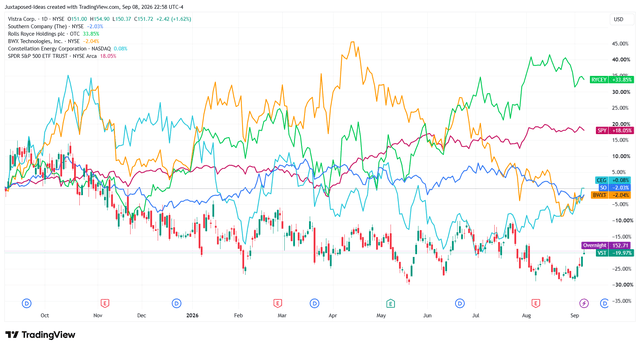
[Original image location: VST stock price movement over the past year (TradingView)]
1. Moratorium on Data Center Construction Policies
Since my last "Buy" rating, VST has experienced a single-digit percentage pullback, while the broader market has seen a single-digit percentage rise, primarily due to increasing community resistance to projects reminiscent of "Not In My Backyard (NIMBY)" sentiments.
Similar situations have been observed in Texas. Local regulators launched a new "Batch Zero" framework "to manage the surge in grid access applications from data centers and other high power users," which is expected to lead to delays in power-on times and/or adjustments to approved power capacity.
Similar concerns have arisen around VST's nuclear power projects, with local communities seemingly worried about the alleged eight data center projects surrounding the county's nuclear power plant planning.
Considering the increasing number of moratoriums on data center construction policies across the United States, I believe there may still be more uncertainty in the future. Until regulatory policies are further clarified, VST may continue to underperform the market.
2. Data Center Opportunities
On the other hand, beyond signing power purchase agreements (PPAs) with Meta (META) and Amazon (AMZN), VST has further proven its status as an AI beneficiary by establishing a new company, Helix Digital Infrastructure. Helix has several key partners, including Nvidia (NVDA).
This company "aims to deliver integrated infrastructure at the speed and scale required by hyperscale cloud providers to meet the accelerating demand for artificial intelligence," and VST will become the preferred power partner for Helix's future projects through existing assets and newly constructed dedicated assets.
While no further specifics about Helix have been disclosed, it is clear that data center projects are becoming increasingly large and complex, and the ongoing moratoriums on construction and delays in power access further highlight the importance of early power procurement planning.
Considering the significant disparities between the massive power demands of data centers, the actual available power, and the acceptance from local communities, I believe VST's forecasted "at least 4%-6%" annual load growth in the ERCOT region by 2030 is proving to be very prudent.
In contrast, the U.S. EIA has a more aggressive forecast for ERCOT, expecting load growth to reach 10% by 2027. Meanwhile, more and more customers are looking to co-locate data centers with existing generation resources, which further strengthens the rationale for VST as an AI beneficiary:
Because avoiding the new transmission infrastructure required for some frontend metering projects itself still holds a clear speed advantage.
Moreover, typically in these co-location discussions, customers themselves may bring backup generation capacity. Therefore, we actually believe this could further drive customers to co-locate with existing generation resources.
(Seeking Alpha)
It is also worth noting that VST has indicated that "to derive more value from existing assets, project pipelines are expanding," as more customers are seeking to "sign PPAs for our existing sites."
These developments highlight the company's years of AI-driven growth tailwinds, as VST can realize monetization at multiple levels through existing generation assets, a growing portfolio of PPA projects, and collaborations with Helix on new assets.
3. Healthy Power Generation and Retail Power Demand
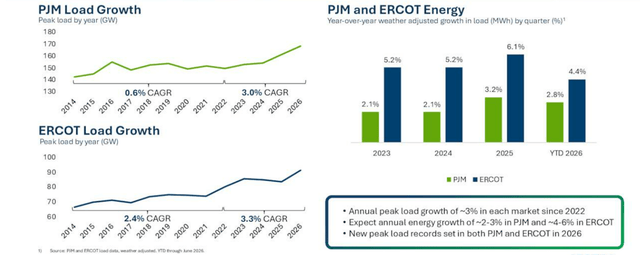
[Original image location: Strong Energy Demand (VST)]
On the other hand, data centers are expected to contribute only about +2% load growth per year, while non-data center sectors, including residential and small businesses, are expected to contribute about +3%. Therefore, it is almost certain that VST's diversified power generation and retail business monetization prospects remain resilient.
This trend is also supported by "industrial repatriation, increased electrification, population growth—especially in Texas—and broader economic expansion," based on the historical load CAGR of +3.3% for ERCOT and +3% for PJM.
Similar outperformance is also reflected in VST's robust adjusted EBITDA. In the first half of 2026, the company's adjusted EBITDA reached $3.26 billion, a 26.3% year-on-year increase, indicating that the management's previously reiterated FY2026 adjusted EBITDA median of $7.2 billion, a 21.8% year-on-year growth, has the potential for further outperformance and guidance upgrades.
These numbers clearly show that the recently completed acquisition of Lotus Infrastructure Partners and growth capital expenditure projects have played a significant role in boosting the company's monetization capability expansion. This is attributed to the FQ2'26 generation capacity rising to 44GW, a 7.3% year-on-year increase, as well as higher actual prices resulting from favorable hedging activities.
Additionally, readers should note that VST's preliminary FY2027 guidance does not yet account for the pending Cogentrix acquisition and META PPA, with these transactions expected to "add approximately $700 million to our median opportunity, all else being equal."
Without regulatory headwinds, investors could expect FY2027 adjusted EBITDA opportunities to rise to $8.3 billion, a 15.2% year-on-year increase, indicating that the company possesses a strong, sustained, and profitable growth outlook over the coming years.
Stock Price Consolidation Creates a Cheaper Entry Point
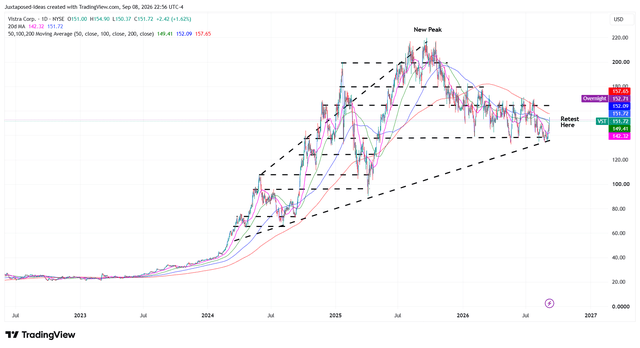
[Original image location: VST stock price movement over the past four years (TradingView)]
Currently, VST's price movements once again highlight its inherent volatility, as the stock price is re-testing the upward trend support line formed since early 2024.
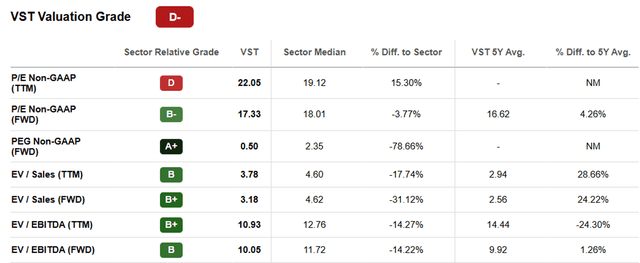
[Original image location: VST Valuations (Seeking Alpha)]
Thanks to sustained consolidation since the end of 2025, VST is gradually digesting the high valuations formed by the excessive rise seen in 2024/2025 through earnings growth. Its forward EV/EBITDA has decreased from a previous high of 15.09 times to 10.05 times, closer to the five-year average of 9.92 times, and lower than the industry median of 11.72 times.
Based on a current enterprise value of $73.48 billion and the management's reiterated FY2027 adjusted EBITDA median of $7.6 billion, a 5.5% year-on-year increase, I estimate VST's FY2027 EV/EBITDA to be approximately 9.66 times, making the current stock more attractive.
If we further consider that after the completion of the Cogentrix acquisition and META PPA, the FY2027 adjusted EBITDA opportunity could reach $8.3 billion, a 15.2% year-on-year increase, then the corresponding FY2027 EV/EBITDA would further drop to 8.85 times. It is clear that for investors looking to gradually increase their positions through dollar-cost averaging, the current continued consolidation is actually a positive.
It is particularly noteworthy that VST's balance sheet has become healthier. The FQ2'26 net debt/adjusted EBITDA ratio is 2.4 times (excluding cash margin deposits), down from 3 times a year ago and significantly lower than the diversified utility industry average of 5.12 times, and it is already close to the company's FY2027 target of 2.3 times.
Moreover, the company's capital allocation remains robust. Since November 2021, VST has repurchased and retired about 30% of its outstanding shares, and approximately $1.2 billion remains in the current stock buyback authorization.
Considering the relatively stable generation revenues brought by the company's favorable hedging activities through 2028, the tailwinds from the META/AMZN PPAs, the adequate funding coverage for growth capital expenditures/share buybacks/dividends, and the better margin of safety due to lower valuations, I reiterate my "Buy" rating on VST stock here.
Dividend Risk Affecting My "Buy" Rating
However, it is important to emphasize that VST's attractiveness as an income investment may be somewhat limited in the medium term since the company's forward dividend yield is only 0.61%, significantly lower than the industry median of 3.45%.
Meanwhile, the company's dividend payment growth has slowed to +1.7%, compared to the past five years' dividend growth rate of +9.81% and the industry TTM dividend growth rate of +4.14%, both of which are significantly lower.
It is evident that VST's stock price growth in 2024/2025 will far outpace the dividend growth rate, and the current 10.05 times forward EV/EBITDA valuation already reflects this low forward dividend yield of just 0.61%.
Considering that the Cogentrix acquisition is expected to complete by the end of 2026, and as multiple growth projects push FY2026 capital expenditure up to $1.5 billion, a 14.5% year-on-year increase, I believe that during the company's continued stock buyback phase, combined with increased M&A and capital expenditure intensity, dividend growth may temporarily take a back seat.
This can also be observed from VST's guidance, as the company expects annual dividend payments to remain at $300 million, while the FY2026 adjusted FCFbG guidance median reaches $4.32 billion, a 20.3% year-on-year increase.
Therefore, I recommend investors lower their expectations for VST's dividend growth.
免责声明:本文章仅代表作者个人观点,不代表本平台的立场和观点。本文章仅供信息分享,不构成对任何人的任何投资建议。用户与作者之间的任何争议,与本平台无关。如网页中刊载的文章或图片涉及侵权,请提供相关的权利证明和身份证明发送邮件到support@aicoin.com,本平台相关工作人员将会进行核查。


