
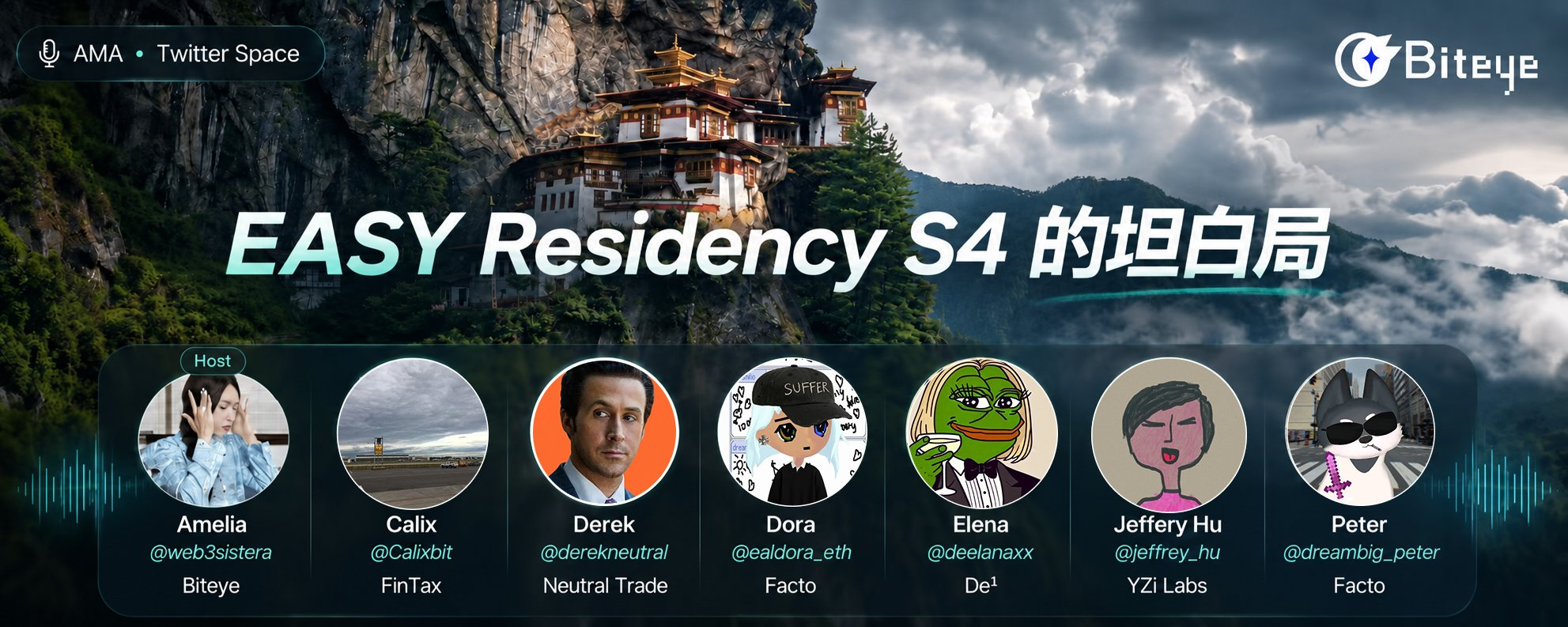
📅On the evening of September 2, Biteye held an online AMA, inviting the founders of S4 who had just returned from Bhutan to reminisce about their five weeks of life in Bhutan.
💡Participants included:
Calix (@calixbit), Founder and CEO of @FinTax_Official
Dora (@realdora_eth), Co-founder of @facto_to
Elena (@deelenaxx), Co-founder of @de1_ai
Jeffrey (@jeffrey_hu), Investment Director of @yzilabs
Peter (@dreambig_peter), Co-founder of @facto_to
Here are the sharing of these warm memories 👇😘
Question 1: What were you thinking when you first landed in Bhutan? Which moment was the most unforgettable?
Elena:
It took an hour and a half of mountain roads from the airport to the hotel. The mountains, buildings, and cultural landscape along the way immediately made me realize how different it was here compared to the noisy big cities, and I quieted down from the fast-paced rhythm I was used to.
I was thinking that living and building together with a group of excellent founders for five weeks should bring not only project progress but also deeper interpersonal communication and the opportunity to rethink "why we started."
What I found most unforgettable was on a rainy day. The four of us in the car couldn't find our destination, the driver didn't complain or show impatience, just kept smiling and asking for directions until he finally got us there. Similar details repeatedly appeared during those five weeks, making me feel the kindness and peace of the local people. After leaving the daily fast-paced rhythm, I started to question again: what are we really doing talking about AI, financial innovation, and building faster every day?
Dora:
I flew to Bhutan from Nepal on a small plane. When I landed, I saw Calix and Jeffrey; we weren’t familiar yet, just politely greeted each other. On the way to the hotel, we talked about our projects. It was the first time I became distinctly aware that what this cohort was doing was very different, but everyone was excellent.
The most unforgettable thing for me was the day before Demo Day. I returned to the office with Chris and Jon, cleaning up the keyboards and laptop stands that everyone had left behind. The space that had been filled with people just weeks ago was now empty; we walked the familiar paths and entered the office, but only had items to pack left. It was only at that moment that I truly realized this shared life was coming to an end, and I felt a strong sense of reluctance for the first time.
Peter:
Before I left, my knowledge of Bhutan came mostly from the internet; I only knew it was a small country and that landing at the airport was very challenging, so I was a bit skeptical when I first landed. After actually staying here, I found that it wasn’t as backward as I had imagined: the city is not large, the streets are clean, and there isn’t a constant honking and noise.
I usually need some time to make friends, but in Bhutan, working and eating together every day made it easy to become familiar quickly. The most special memory happened at the gym. I usually don’t work out, but after arriving in Bhutan, I often trained with other partners, which became an unanticipated part of my routine.
Calix:
When I just left the airport, I actually felt very familiar. During my early work in mining-related businesses, I had been to several areas in western Sichuan. Bhutan’s natural environment and some architectural styles reminded me of western Sichuan; the local use of hydropower to develop Bitcoin mining also increased this sense of similarity.
I left Bhutan and returned, and on the way back, I met the same local driver several times, and we gradually became friends. He initially proudly asked me what I thought of Thimphu, and later kept asking about mainland China, Hong Kong, and Singapore, hoping to have a chance to see them. Making a friend locally was an interesting gain from this trip.
I also admire the fellow founders from this session. The living conditions changed significantly, yet everyone’s projects continued to move forward, and the intensity of the work before Demo Day didn’t let the team relax.
Jeffrey:
Looking back, participants in every session tend to be relatively unfamiliar and reserved when they first meet offline. The difference in S4 is that everyone lived together in the same place for five weeks, gradually becoming willing to discuss deeper issues and facilitating collaboration between projects. This embodies the significance of offline residency and concentrated co-building.
Question 2: What was the biggest challenge while building in Bhutan? How is it different from New York and Silicon Valley?
Calix:
For FinTax, the most direct issue was infrastructure, as well as not being able to meet face-to-face for To B business advancement. The team usually needs to frequently visit clients and partners, but during the time in Bhutan, a lot of communication had to be done online. I was not responsible for the Demo Day pitch; I mainly provided logistical support and encouragement to the co-founders.
On the other hand, there weren’t many distracting activities locally. Arrangements such as hiking and meditation gave me time to quietly think about the strategic planning of the business.
Peter:
The "small" aspect of Bhutan was at the core of the experience. There are very few places to eat and socialize in Thimphu; founders would meet in the office on weekdays and often go out together on weekends. Those five weeks felt like going back to school.
If it were New York or other big cities, there would be more options, and people’s attention could be more scattered, making it hard to establish the same close relationships. The work itself did not exceed the daily pressures of entrepreneurship. The real tension was the high-intensity practices before Demo Day, and finally standing onstage, presenting to CZ and the King of Bhutan.
Dora:
The living conditions and circumstances in Bhutan differ greatly from those in New York and Silicon Valley, but that difference turned Bhutan into a small and pure “container.” Founders support each other and gain a deeper understanding of each other’s projects. Some of the friends’ projects even became potential partners later on.
I also experienced a failed payment once. The merchant did not have my contact information and could not confirm whether I would come back to pay later, yet very naturally agreed to let me pay later. This kind of trust between people also affected the way founders interacted and collaborated. If S4 had taken place in New York or Silicon Valley, we would not have formed entirely the same relationships.
Jeffrey:
The biggest practical difficulty was the internet. During weekly check-ins, the meeting room’s internet often disconnected; hotels and co-working spaces occasionally had similar problems, disrupting some teams’ work rhythms.
S4 ultimately took place in Bhutan, with the background of YZi Labs, Binance's ecosystem, and long-term local connections, as well as some coincidences. Looking back, the five weeks of offline interaction allowed different teams to establish deeper friendships and facilitated collaboration, which is quite different from the previous residency in San Francisco.
Elena:
New York and Silicon Valley have too many meetings, exhibitions, social activities, and external noise, making it easy for people to keep pushing forward. Bhutan allowed us to slow down, have time to focus and reflect, and provided more opportunities to communicate feelings and discuss projects and collaborations.
For me, the biggest challenge was not just the hardware conditions but also the extremely high information density every day. Founders continuously received feedback from mentors and other entrepreneurs and had to judge which conclusions to stick to and which to change. At the same time, the company was still operating at high speed. We needed to step back to rethink while immediately getting back to execution. The biggest challenge and the biggest value, in a sense, are the same thing.
Question 3: What was the biggest help that YZi Labs provided to your project?
Elena:
Every week’s catch-up meeting revolves around project progress, current blockers, and specific needs. The YZi Labs team not only gives advice but also helps us connect with clients, partners, and the resources of the BNB Chain ecosystem.
For De¹, the biggest direct help was finding the entry point to the BNB ecosystem. We began to think about how the financial world model could collaborate with the upstream and downstream scenarios such as Agent Studio and Agentic OS.
Dora:
Facto originally planned to start with smaller payment service providers, progressing one by one. YZi Labs reminded us that startup teams have limited time, technology, and credibility. If we concentrate resources to approach the most critical head clients, as long as one of the major clients adopts it first, subsequent expansion will be much simpler.
This isn’t just a sales strategy adjustment. YZi Labs also helped us connect with clients and provided important trust endorsement.
Calix:
I summarize the biggest help as “courage.” FinTax originally planned to enter the government and major financial institutions market, but it was unclear when to start and how to enter. The communication during those five weeks with CZ, Ella, Jeffrey, and others confirmed the real demand from government departments for compliance infrastructure, allowing the team to reduce ineffective hesitation and immediately adjust plans to push the business forward.
This choice also changed our fundraising rhythm. The team moved from the end of the Seed round to launch the Pre-A round, preparing funds for larger-scale To B and To G solutions; meanwhile, we also began to connect more directly with partners in the Binance ecosystem with clear demands.
Question 4: Why did you apply for EASY Residency initially?
Calix:
I knew about this program early on and was aware of the fierce competition. The team attempted to apply a few times but backed out for various reasons. By the time of S4, many friends persisted in encouraging me to give it a try, but I still felt that the business, valuation, and client scale might not be mature enough.
Getting accepted was a significant confirmation for a team that had persevered in the field of financial tax compliance infrastructure for many years and had also experienced downturns.
Peter:
Facto started paying attention to EASY Residency from S1. At that time, we were still working on lending agreements, and our product direction wasn’t fully thought out; our first application was unsuccessful. Later, we continued to follow each session and formed the idea of Facto two years ago. After waiting a long time, and still not seeing others addressing the same issue, the team fully committed at the end of last year.
When S4 opened, Ricky reminded us to apply again, and this time we finally entered the program. For a To B company, the credibility endorsement that YZi Labs later provided indeed helped advance sales.
Elena:
De¹ was relatively mature in terms of product when we applied. At first, I was uncertain how much value an accelerator could provide to a project at this stage. Later, a friend who participated in S3 strongly recommended it, and I asked participants from S1 and S2, finding out that the program could offer not only funding but also ecosystem resources and strategic collisions.
Before the deadline for S3, that friend reminded me again, leading me to submit my application.
Question 5: What should be noted when applying? What factors does YZi Labs value?
Elena:
The first piece of advice is to simplify. Don't cram product, technology, market, vision, milestones, and traction all into the application materials. Reviewers need to see a large number of projects in a limited time, and the most important thing is to allow them to finish reading and be able to summarize clearly in one sentence: what problem you are solving and why it should be solved by you.
Secondly, do not temporarily package a direction you do not believe in just to cater to a popular narrative in a certain session. Experienced investors can easily tell if the founder is discussing things they truly believe in or guessing what the reviewers want to hear.
Dora:
I also agree with simplifying and being clear about what makes the project different. YZi Labs reviews thousands of projects each session; applicants do not need to showcase all their achievements. More importantly, it’s about explaining what problem they are addressing and why the product is different.
Even if the product is only halfway done or is still a hypothesis, as long as the pain points faced are real and the direction is unique, it still deserves to be heard.
Calix:
I want to add the notion of “unique positioning.” The project or team needs to have clear uniqueness, including pioneering ideas, directions, and judgments. YZi Labs has seen a lot of projects and will examine these differences from a stricter perspective, and this uniqueness also reflects the team's taste.
Jeffrey:
From the perspective of investors, we divide the screening into two parts.
The first is the founder and the team, including the way of thinking about issues, execution ability, and how they act when faced with changes. Early investments often prioritize investing in people.
The second is the project itself: what problem is being solved, what approach is adopted, and whether there is initial revenue, user demand, or go-to-market capability. Incubators can connect resources and drive growth, but the team needs to provide some early evidence that can continue to scale.
Peter:
Do not take the direct feedback during the interview too personally. If you are not accepted this time, you can look back at what each piece of feedback revealed: is it that the project itself still has gaps, or is it that the team did not clearly present their existing abilities?
Question 6: How was Demo Day prepared? What was the most "heartbreaking" feedback?
Elena:
The biggest challenge was to articulate everything clearly and completely within three minutes while also making people want to listen further. The actual content we could speak about was less than expected, so we had to keep shortening and rewriting our expressions.
During the first rehearsal, Ella’s feedback to me was “the momentum needs to be stronger.” I later realized that Demo Day differs from regular introductions; the founder’s aura and conviction directly influence how the audience understands the project.
Peter:
For me, the preparation process was still about simplification. Founders always want to include all the advantages and proofs of their products in the speech, but the audience can process only a very limited amount of information in a short time.
In the end, we had to find the most unique aspects of the product and explain in the simplest way what the product does and what problem it solves. This training also helped the team clarify the core value versus auxiliary functions.
Amelia:
The three-minute presentation must first ensure a logical loop: who the core users are, what the most painful problem is, and how the solution resolves this; each link cannot be misaligned.
The most “heartbreaking” feedback I received was: “Your current numbers do not prove product-market fit.” This statement did not imply that the product had no market, but required us to find data that truly demonstrated the demand. We later reexamined the business and eventually satisfied the argument with the repurchase rate of existing users.
Jeffrey:
The most common issue in rehearsals is running over time. Everyone wants to fit in more information, but the structure of Demo Day is quite different from regular meetings or pitching to investors.
In those three minutes, it is necessary to clearly answer: what problem is being solved, why this team, what the advantages are, and whether investment or collaboration is being sought from the audience on-site. The repeated practice helps compress these contents to be sufficiently clear.
Question 7: If you could give your pre-application self one sentence, what would it be?
Calix:
Be more confident and actively seize every opportunity. The team does not have to wait until the business, valuation, and client scale reach the ideal state before taking action. Apply first; that’s when new collisions might happen.
Peter:
Put in all your effort when applying. If you are not accepted, do not interpret the feedback as a denial of your personal value. Understand the reasons behind the feedback, then decide what to supplement or adjust next.
Dora:
Believe in what you truly want to build. Sometimes the problem is not in the direction or product but in market maturity and timing. Founders need to persist in believing in things in the long term even when external conditions are not fully mature.
I connect this experience with two climbs to the Tiger's Nest Monastery. The first time, I didn't know how many slopes were ahead, facing the unknown at every step; the second time, even though the route hadn’t changed, I knew where the next turn was, and the fear was greatly reduced. Many entrepreneurial problems are similar; only by truly moving forward can the unknown become known.
Elena:
When coming, everyone might bring a product; when leaving, what they take away is a larger vision. The value of the residency is not only to accelerate the original plan but also pressures founders to rethink: how can existing technologies, products, and resources be amplified tenfold or even a hundredfold, and what do they truly want to build?
Question 8: Where to look for S5 information? If I was not accepted before, can I apply again?
Jeffrey:
Official information can be found on the YZi Labs official website and the X account of EASY Residency. According to the plans at the time, the application deadline for S5 is September 13, starting with several weeks of online phases, followed by a concentrated offline phase in Thailand. Demo Day is expected to coincide closely with the Binance Blockchain Week held at the end of November in Bangkok, with specifics subject to official announcements from the website and @EASYResidency.
Teams that have applied before but were not accepted can apply again. As the new session’s forms have changed, it is recommended to submit a complete application again to enter the review process following the new project criteria.
The final question, which is of greatest concern to the audience: What are the most substantial developments in your product and team after five weeks?
Amelia:
XHunt was uncertain about the real needs of some To B users when entering the project. Over the five weeks, the founders around us were potential customers, and we could continuously discuss and confirm our needs. By Demo Day, what we presented was already a product different from the original.
Elena:
The biggest change for De¹ was moving from a singular product mentality to an ecosystem mentality. We previously focused on how to improve the product but then began to think about how to leverage mature ecosystems to amplify product value.
The financial world model requires real markets, real capital flows, and significant user participation; therefore, upstream and downstream collaborations and ecological nodes have become an integral part of the product rather than merely external resources.
Dora:
The most significant practical progress for Facto was establishing deeper partnerships. Next, we will collaborate with Binance Pay to embed Facto's services into the payment scenarios of Binance Pay.
⭐Finally, this AMA did not provide a unified answer to entrepreneurship.
Some took away a larger vision, some found key customers, and others initiated new businesses that had been postponed. However, the five weeks of life and work allowed each team to see more concretely which judgments are worth insisting upon and which areas need immediate change.
免责声明:本文章仅代表作者个人观点,不代表本平台的立场和观点。本文章仅供信息分享,不构成对任何人的任何投资建议。用户与作者之间的任何争议,与本平台无关。如网页中刊载的文章或图片涉及侵权,请提供相关的权利证明和身份证明发送邮件到support@aicoin.com,本平台相关工作人员将会进行核查。


