
Editor | Panda
Recently, the well-known podcast program RoboPapers updated an interview episode with the focus on Dr. Xie Chen, the founder and CEO of Lightwheel Intelligence. The interviewers for this episode were Michael Cho, co-host of the RoboPapers podcast, and Jiafei Duan, an assistant professor at the National University of Singapore (NUS). The latter is the author of the MolmoAct series of robotic models, with research focused on robotic foundational models and scalable data collection.
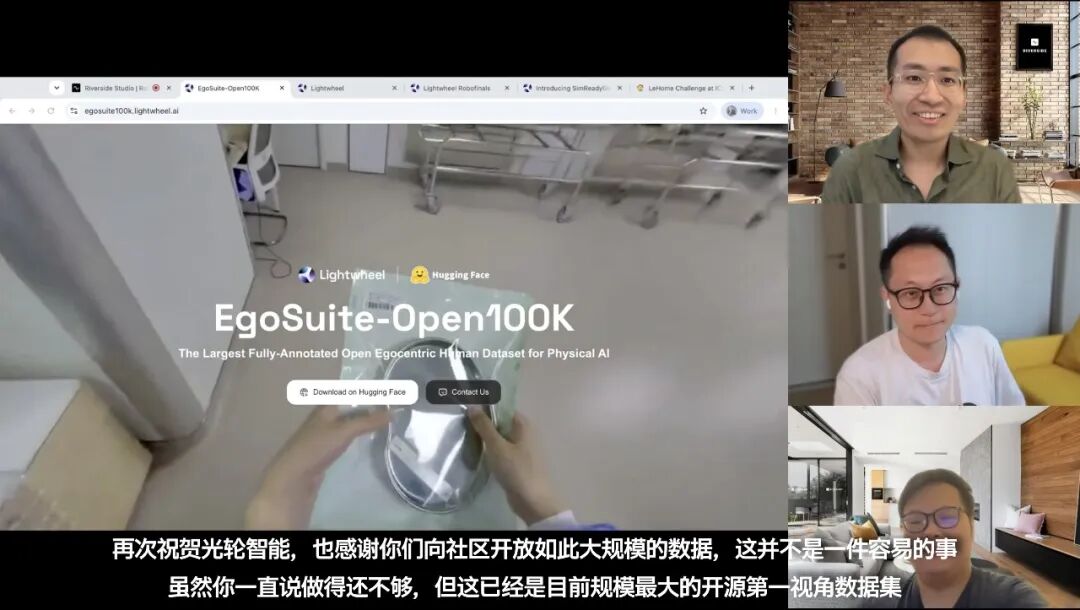
This in-depth technical interview program, hosted by robotic researchers and inviting paper authors to explain their work, has become a barometer of the global embodied industry. Most of the guests are researchers from cutting-edge laboratories such as Stanford, Berkeley, NVIDIA, and Dyna. In recent months, the program has discussed topics around the 1X World Model, NVIDIA DreamZero, the three stages of robot learning summarized by Ted Xiao, and the million-hour experiments of Dyna-2, corresponding to several outcomes at the forefront of the embodied industry: world models, human data, and scaling.
This in-depth interview primarily focused on three topics: how can a leading simulation company become the world's first embodied data unicorn? How does Lightwheel Intelligence build a data pipeline to scale the generation of high-quality data? By open-sourcing 100,000 hours of high-quality data, how does Lightwheel Intelligence achieve commercial value and maintain its leading position in the industry?
In this interview, Xie Chen also offered a new judgment: the Scaling Law of embodied intelligence requires training and evaluation two pyramids, with human data forming the base of the training pyramid and simulation the base of the evaluation pyramid.
1. Robots Begin to Seek Scaling Laws from Human Experience
On August 10, Dyna Robotics, based in Redwood City, California, released DYNA-2, a robots foundational model pre-trained entirely on first-person human perspective videos, with over 1 million hours of pre-training data.
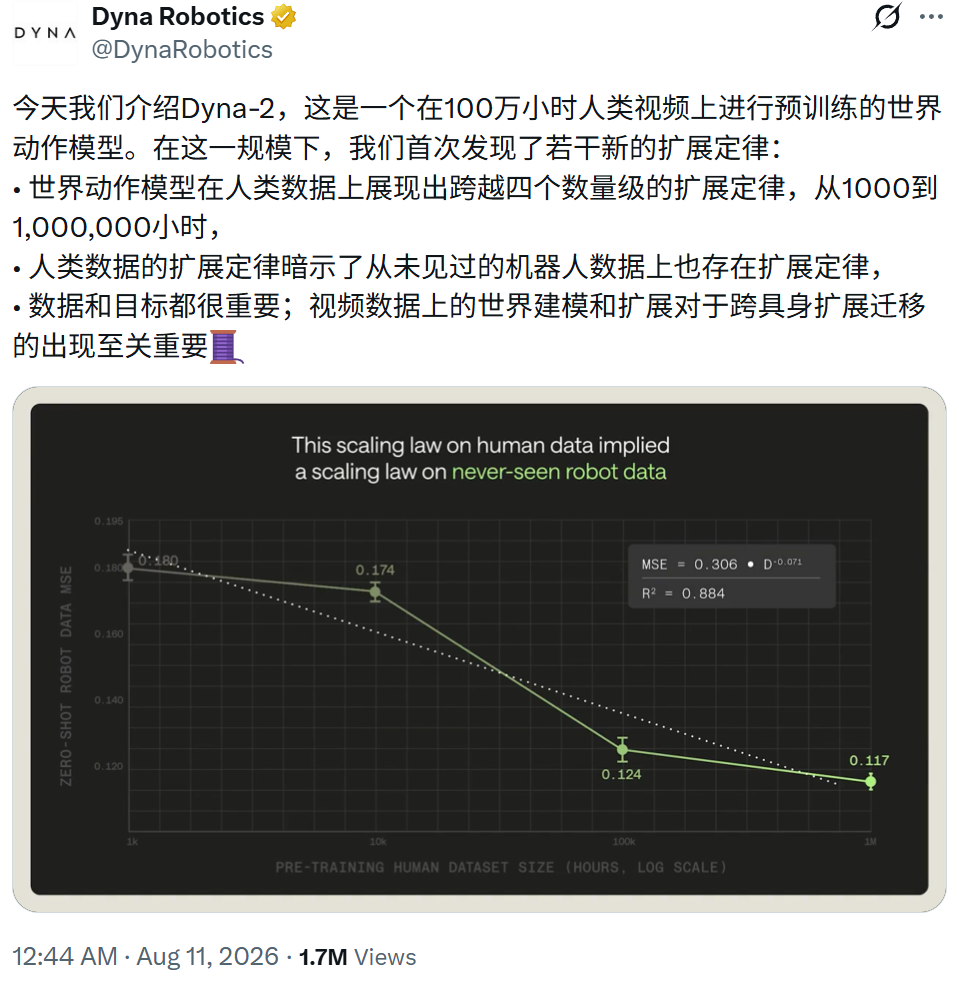
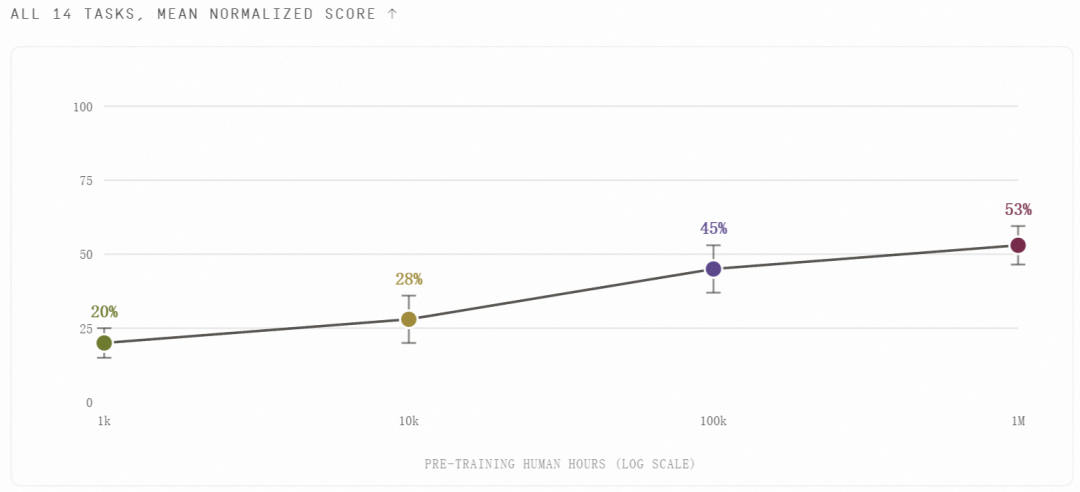
Dyna structured the pre-training data into steps of 1,000 hours, 10,000 hours, 100,000 hours, and 1 million hours, measuring with the same post-training recipe across 14 tasks. Their normalized scores rose from 20% to 53%; one unlocking task held a success rate of 0% below 100,000 hours, rising to 90% at 1 million hours.
However, Xie Chen believes that the Scaling Law for robots does not occur solely on the side of training data. As training data begins to scale, evaluative capabilities must also scale in tandem. Thus, robots require two pyramids: the core of the training pyramid is scalable human data, and the core of the evaluation pyramid is scalable simulation. The former addresses "where does the robot learn," while the latter addresses "how do we know what it has learned and what it lacks."
It is in this context that RoboPapers focused on Lightwheel Intelligence — leading globally in human data delivery and just having open-sourced the largest-scale high-quality multimodal human video dataset, EgoSuite-Open100K.
At the 2026 World Robotics Conference, Lightwheel Intelligence open-sourced EgoSuite-Open100K. This is a 100,000-hour multimodal human behavior dataset covering over 15,000 scenes, containing more than 15,000 tasks, with dual perspectives of the head and wrist, featuring hand and full-body poses, semantic annotations, and depth information. The first batch of data is available on Hugging Face and AtomGit, and the project is also donated to the Open Atom Open Source Foundation for incubation. This open-sourcing effort received rare support from Thomas Wolf, Chief Scientist of Hugging Face.
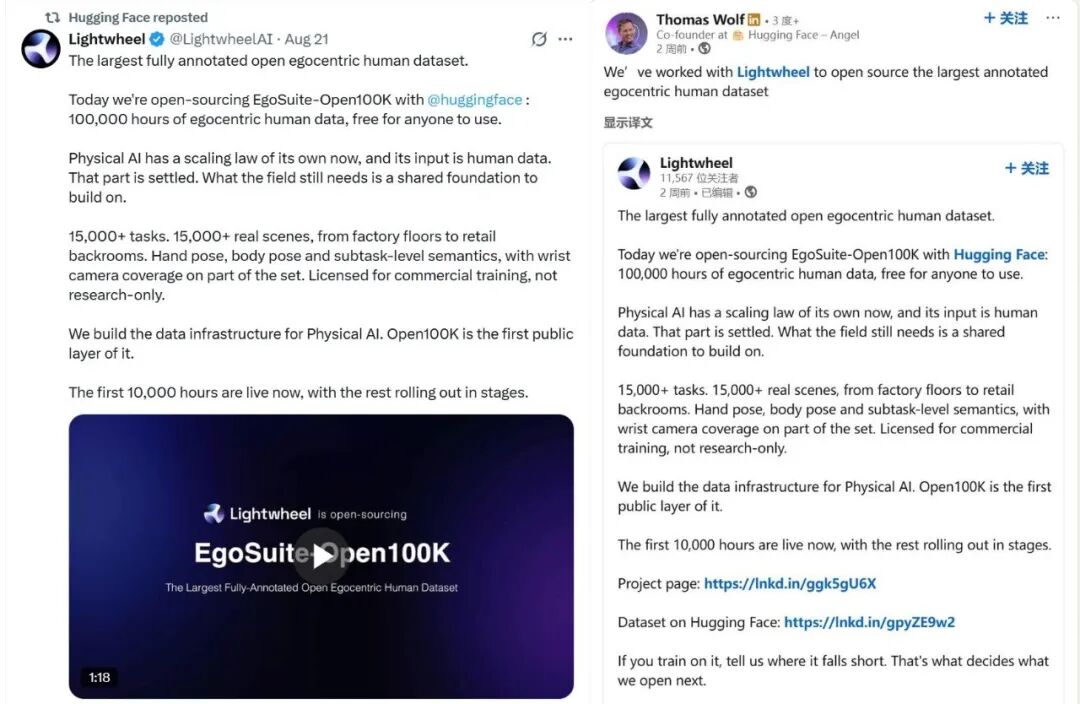
It can be said that Dyna-2 provides evidence from the model side, while Lightwheel Intelligence is solving this industry issue from the data supply side.
2. Training Pyramid: How Does Human Data Support Scalable Learning?
Jiafei Duan bluntly stated: "Many times, when I see high-quality robotic simulation demonstrations, I immediately think this could likely come from Lightwheel Intelligence." His first question was, why would a company that has achieved great success in simulation still need first-person human perspective data?
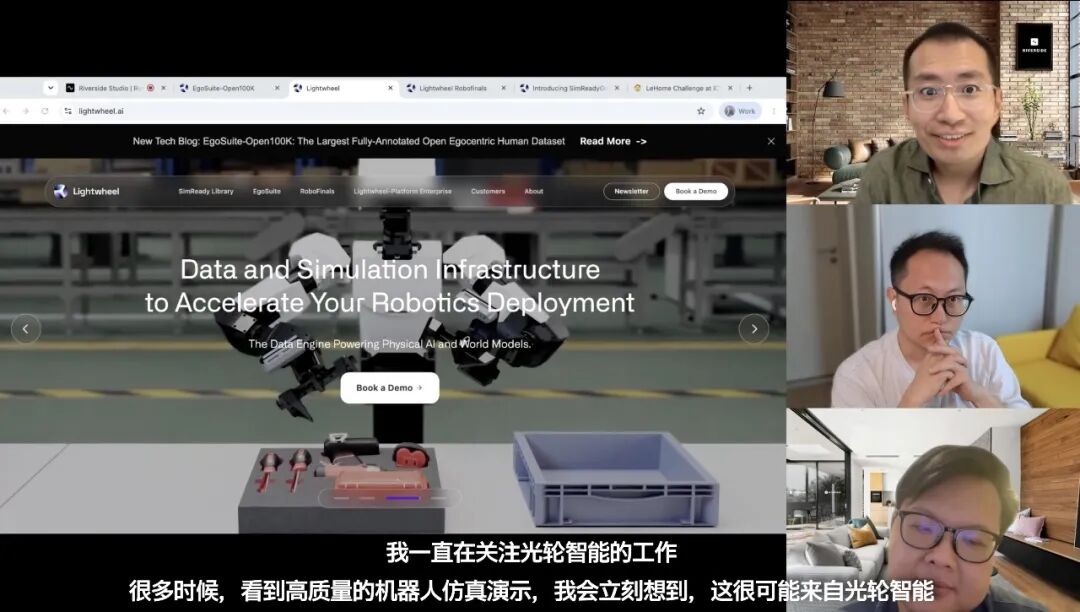
Xie Chen provided an answer from the supply side: there are millions of mass-produced cars operating on the roads, and every operation by the driver could become a supervisory signal; robots do not yet have such infrastructure. “There may only be tens of thousands of humanoid robots globally, and they don't constantly collect data. The way out for robot data is Robot-Agnostic Data (ontology-agnostic data).”
Real machine data remains important but cannot meet the needs for scaling: it is of high quality and physically real, also responsible for grounding the model prior in the specific robot's observation space, action space, and dynamic constraints; however, it is usually tied to a specific ontology, has high collection costs, and after changes in ontology and tasks, historical data is hard to repurpose directly.
Thus, the bottom of the data pyramid consists of first-person human data, used to tackle the scalability issue: providing the model with pre-training experience across tasks, environments, and ontologies. A small amount of high-quality robot data addresses Embodiment Grounding: aligning these experiences with specific ontologies. Simulations address Rollout and Verification: extending long-tail states, supporting reinforcement learning, and continuously evaluating the model at a lower cost.
Robot-agnostic does not mean robot-free. Human data, robot data, and simulations are not three interchangeable routes but different layers in a training and validation closed loop.
Compared to being tied to a specific robot ontology, human data has stronger potential for cross-ontology reuse but still requires action representation alignment and real machine grounding. Xie Chen has a clear judgment: "Human data may be the most scalable source for robotic foundational models."
3. The Real Barrier is How to Produce High-Quality Data
Xie Chen revealed in the interview that the confidence to open this batch of data comes from Lightwheel Intelligence's powerful data engine — which has made collection, automatic annotation, and quality inspection into a scalable pipeline, thus realizing the mass production of high-quality data.
High-quality data can be summarized into four key dimensions.
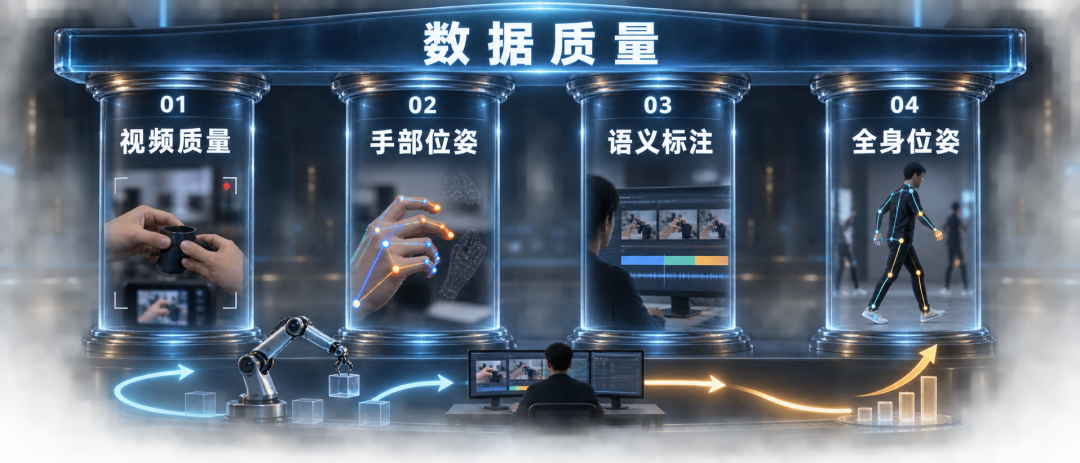
The first key dimension is video quality, which is the threshold for the entire production line: Are there any bad frames? Are both hands always within the frame? Are the movements natural? For example, the collector's actions need to ensure they represent a natural task state; they should not be too fast or too slow. Lightwheel Intelligence uses a real-time agentic quality inspection process at the collection end, where a segment is automatically checked as soon as it is captured, with feedback going directly back to the collector. Xie Chen believes the value of this step has yet to be recognized by the industry: "Allowing data collectors to learn on the job, receive real-time feedback, and continuously improve is itself a very important part of the data quality system."
After automatic quality inspection, there are two rounds of manual review. Why keep humans involved, even with AI? Xie Chen answered, “The precision and recall of the agentic workflow are already very high but have not reached 100%, so the final quality score must combine both automated and manual quality inspections.” More importantly, the failed samples caught during manual review will feed back into the automated process: "We are establishing a continuous feedback loop to improve the automated process using human feedback."
The second key dimension is hand pose, which is crucial for determining data quality; the precision of hand annotations directly affects data value. To this end, Lightwheel Intelligence has a dedicated team responsible for automatic hand annotation, having developed a complete algorithm for pose calculation.
The third key dimension, semantic annotation, is currently a real bottleneck. It has internally gone through seven versions, evolving from event-level to action-level annotations. The difficulty lies not in the descriptions themselves but in the timestamps — when does an action start and end at which frame? Currently, VLM cannot provide accurate enough answers. The present solution is a combination approach: using the accumulated action-level annotation data to fine-tune the foundational model and make VLM more accurate, thereby gradually reducing the proportion of human involvement in the loop.
Ranked fourth, full-body pose is considered a relatively early stage since foundational robotic models from leading laboratories generally start with hand data.
Additionally, there is a more critical dimension for clients: diversity. "The real challenge is to ensure the production of high-quality data while achieving task diversity, scene diversity, and collector diversity." To this end, Lightwheel Intelligence categorizes task scenes into seven major categories: home, hotel, retail, sports, logistics, office, and industrial, further breaking down specific tasks within each category. To manage this combinatorial space, an internal task agent has been assigned to generate tasks, maintain them, and match tasks with real scenes and actual collectors. For each scene and task, there are limits on the collection duration to ensure data diversity.
4. Evaluation Pyramid: The Larger the Data Scale, the More Scalable Simulation Evaluation is Needed
A core challenge of classic simulation is that even with a sufficiently refined simulation engine, it is challenging to answer “what exactly should be simulated.”
Lightwheel Intelligence extracts task and scene distributions from real-world first-person data and transforms them into simulation testing environments. This provides simulation a clear starting point from nearly infinite exploratory space and makes large-scale scene testing more feasible.

This judgment and practice received high recognition from both hosts.
Xie Chen has previously worked on self-driving simulation at Cruise and NVIDIA, and from long-term simulation practice, he has concluded a profound observation: to scale simulations, there must first be large-scale real data to align, calibrate, and validate. In this process, Lightwheel Intelligence has consistently communicated with external embodied research teams, and the most significant discovery explored is that effectively coordinating first-person data and simulation data is an excellent path to scale robot training.
In this process, Xie Chen redefined the "data pyramid." Currently, the embodied industry typically describes the data pyramid primarily based on the distribution of data for model training: at the top is teleoperation data, in the middle is simulation data, and at the bottom is human and internet data.
Xie Chen believes, "I think there are actually two data pyramids: one for training and one for evaluation."
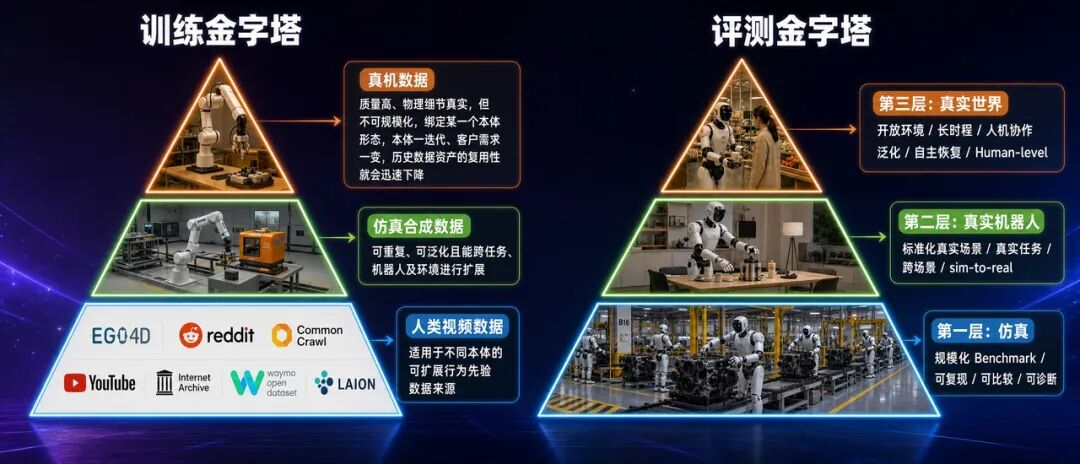
On the training side, first-person human data and simulation synthetic data primarily provide scalable pre-training and mid-stage training experience, while real machine data is responsible for final ontology grounding.
On the evaluation side, simulations provide environments for scalable evaluation that are reproducible, comparable, and diagnosable, suitable for initial capability assessment; above are real machine evaluations and assessments in real environments for final capability deployment evaluations.
In Lightwheel Intelligence’s product system, RoboFinals undertakes the task of simulation evaluation, and Xie Chen compares it to "the college entrance examination for robots." But "college entrance examination" is just the first layer of the metaphor; the key point is that evaluations cannot be based on a static question bank.
Currently in the industry, many simulation benchmark tasks and scenes come from artificial construction. Lightwheel Intelligence's approach is to extract representative tasks and scenes from real data, enter the simulation platform SimFoundry to complete task and scene generation, and then let RoboFinals observe whether data changes genuinely translate to robotic capability changes.
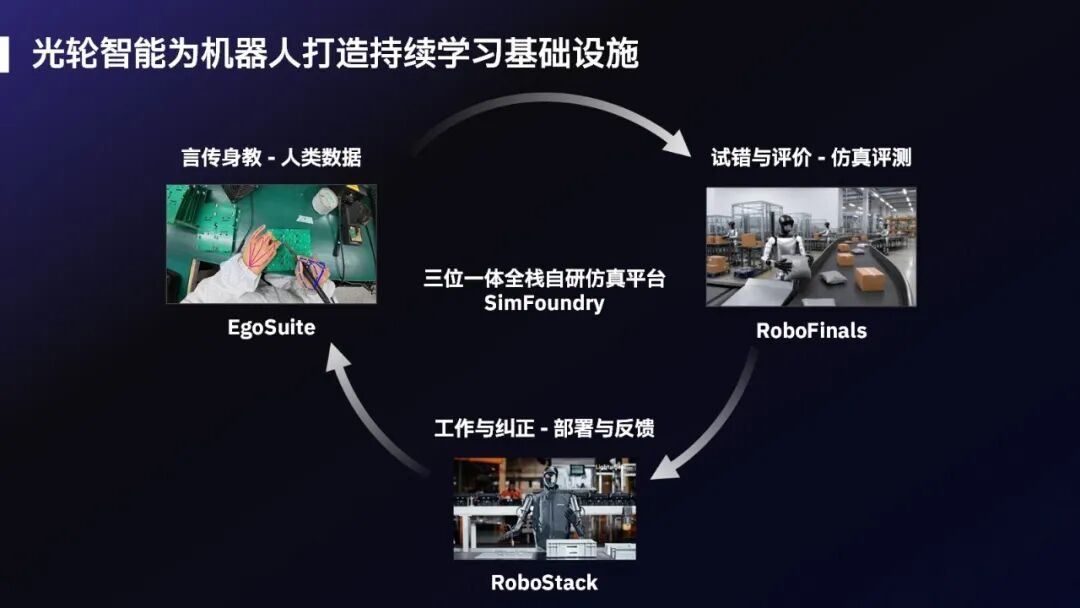
Based on Lightwheel Intelligence’s fully self-developed SimFoundry, this evaluation system is ensured to be physically real: the physical measurement factory built by Lightwheel Intelligence can use robotic arms, dexterous hands, and tactile sensors to measure real mechanical information such as door opening, movable component, and cable deformation; thus creating a physically real environment while simultaneously constructing real tasks for scaling evaluations. To minimize the gap between simulation and reality, real machine validation through sampling is also needed to gradually inspect the correlation between simulation results and real robot performance.
Every real failure can become a new examination question; each new question redefines the next batch of data. Therefore, evaluation in Lightwheel Intelligence's continuous learning system becomes a positive feedback loop, helping the model iterate efficiently.
5. "Three Uniques": The Only Chinese Company in Two Major International Embodied Standards and Five Global Embodied Infrastructure
The set of data cognition and engineering methods from Lightwheel Intelligence has already gained market recognition.
“You cannot create standard products without standards, and without standard products, you cannot achieve scaling.” According to reports, the resale multiple of Lightwheel Intelligence's standard product data has exceeded 10 times, high-quality data has been validated by leading model teams globally, clientele replenishment rates are nearing 100%, and the data purchase scale of leading clients has expanded 20-fold; in the last three months, over 30 leading model enterprises have been served, with each delivering over 200,000 hours of standard product data.
This standard product data directly tests the technological hypothesis of "robot-agnostic": the same batch of data can be sold to different ontologies and different model teams for repeated use, indicating it is indeed not bound to any specific hardware form. Conversely, if each client requires customization, this route becomes invalid. “If you only follow customer demand, you’ll turn into a highly customized company: the quality may be very high, but it lacks scalability and does not represent the distribution of the real world.”
Xie Chen disclosed in the RoboPapers interview that several clients have already pre-ordered more than 5 million hours of capacity for next year. The orders display the market’s demand for scalable supply, but the real barrier still depends on whether these demands can continually convert into high-quality, reusable, and reasonably unit-economical standard products. In the goals set for the team, “unit economics” and “scaling” are parallel: "The real goal is to continuously maintain and enhance data quality and unit economics while expanding scale."
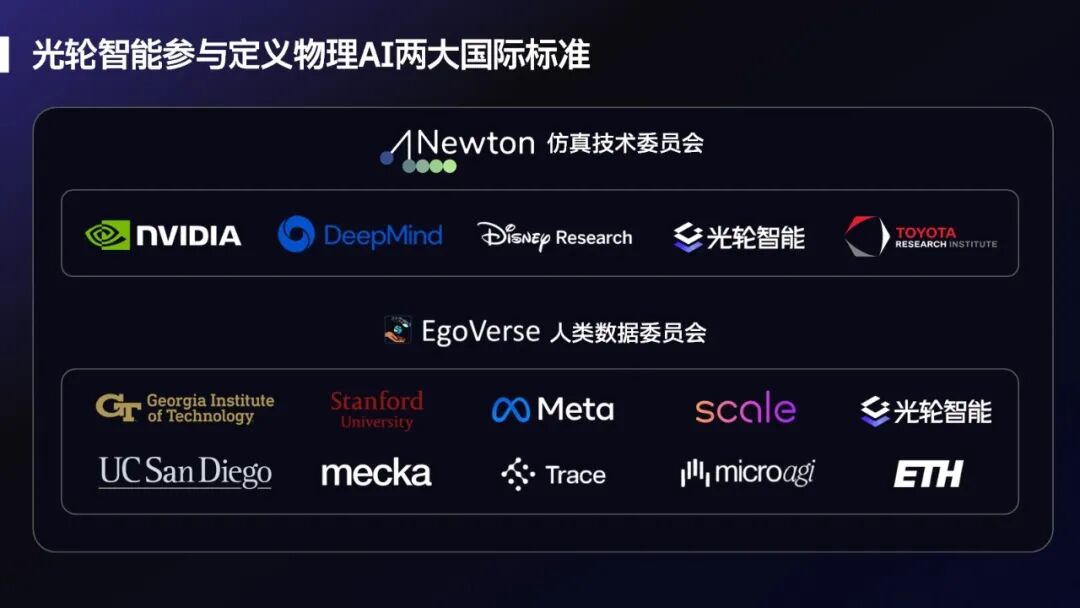
Within standard products lies the essence of standards. Lightwheel Intelligence is the only Chinese company in two international physical AI standard organizations:
In the simulation field, as the only Chinese enterprise in the Newton Simulation Technology Committee, Lightwheel Intelligence collaborates with top institutes like NVIDIA, Google DeepMind, Disney Research Institute, and Toyota Research Institute to lead the next generation of open-source physical AI simulation standards, participating in the co-construction of rules for the next-generation physical AI simulation infrastructure.
In the data field, as the only Chinese corporate member of the EgoVerse Human Data Committee, Lightwheel Intelligence collaborates with international teams such as Stanford, Meta, Scale AI, and Mecka AI to build the largest-scale human data training system, representing Chinese enterprise's voice in global standard co-construction on the embodied data side.
On July 30 of this year, The Robot Report selected the "Five Major Physical AI Infrastructure Platforms Shaping the Robotics Industry in 2026": NVIDIA provides computing power, simulation and development foundations, Applied Intuition handles verification and systems engineering, Scale AI focuses on industrial scale production of training data, Hugging Face takes charge of the open-source coordination layer, while Lightwheel Intelligence is responsible for "continuous learning infrastructure" — linking real-world experiences, simulations, evaluations, and deployments into a cohesive whole.
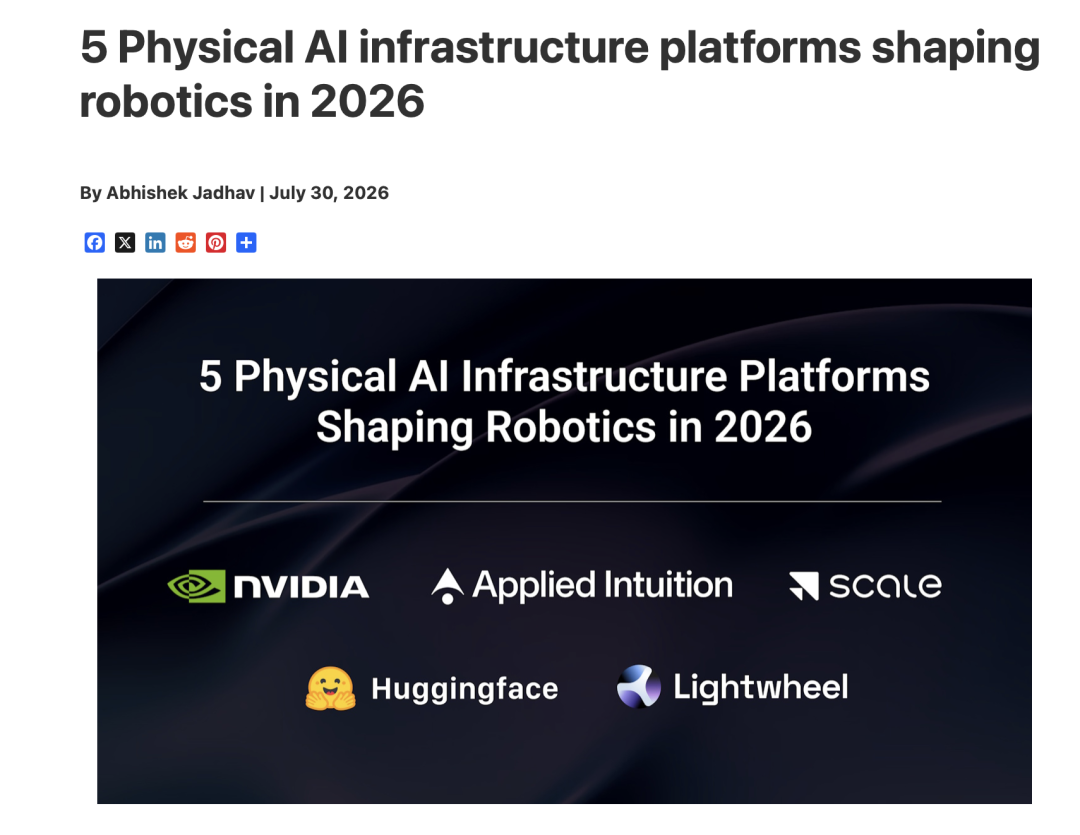
Thus, Lightwheel Intelligence becomes the only Chinese company among the international top organizations in the fields of physical AI infrastructure, simulation, and human data.
Standards also need to point toward a sufficiently large common goal. During WRC, Lightwheel Intelligence launched the "5-Year 10 Billion Embodied Intelligence Data Co-construction Plan" to collaborate with hardware manufacturers and scenario parties, promoting data moving from being fragmented to standardized circulation. Xie Chen also mentioned in the interview: “We plan to achieve 10 billion hours of data in five years. To achieve this goal, cooperation with everyone is vital, and the whole industry needs to use a common standard language.”
6. Creating the Tesla Model 3 of Embodied Data, Achieving 10 Billion Hours in 5 Years
In the latter half of the interview, Xie Chen frequently used Tesla as a metaphor.
Regarding the challenges of embodying intelligence, he provided a magnitude judgment: “The robotics problem may be over 1,000 times harder than FSD. In the future, we may need a billion people wearing different devices to collect data for robots.” And a billion people cannot wear the same device; “It is not feasible for one company to solve all problems with one device; the future should be an open ecosystem.” Lightwheel Intelligence's current collection end is already compatible with PICO, self-developed headsets, and iPhones, and they are co-designing the next-generation first-person collection device with hardware manufacturers.
In terms of data production efficiency and data value, he believes: “The true Model 3 is the entire pipeline, the entire data engine. The future should revolve around a failure-driven pipeline, learning from failures and only relaying the most valuable and interesting segments back.”
The value of Tesla's fleet lies in its implementation of real road data collection with continuous model supervision, allowing local comparisons of model outputs and human actions, relaying back only segments when discrepancies arise. Lightwheel Intelligence is adapting this logic to first-person collection: at the collection end, deploying computational power and models, conducting real-time inference and redirection, comparing model outcomes with human actions, and only relaying back segments where discrepancies occur.
This also explains an important detail in the 5-year 10 billion hours plan: these 10 billion hours cannot be repetitive 10 billion hours. Thus, shadow mode on the edge is essential.
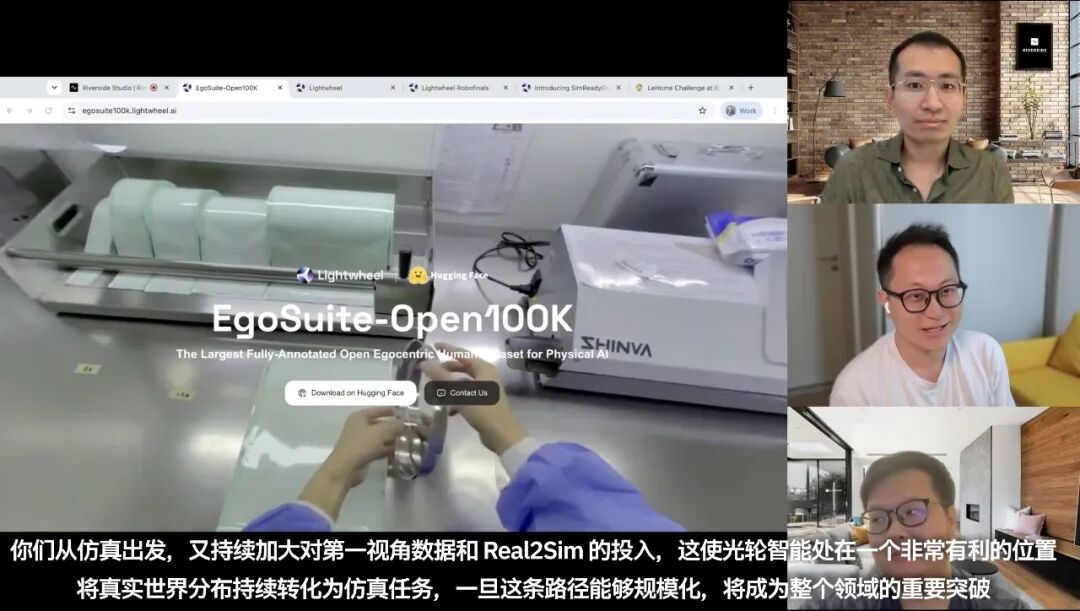
In Lightwheel Intelligence's continuous learning system, EgoSuite provides instructive human data, SimFoundry and RoboFinals offer scaled testing spaces and evaluation systems, while the RoboStack real machine deployment platform provides continuous feedback to inform the system what data needs supplementing.
This type of continuous closed-loop learning system is what led the two hosts to exclaim at the end of the interview:
Beginning with simulations and continuously increasing investments in first-person data and Real-to-Sim, this places Lightwheel Intelligence in a very favorable position to genuinely solve scalability issues. Continually translating the distribution of the real world into simulation tasks, this path will become a significant breakthrough in the entire field.
免责声明:本文章仅代表作者个人观点,不代表本平台的立场和观点。本文章仅供信息分享,不构成对任何人的任何投资建议。用户与作者之间的任何争议,与本平台无关。如网页中刊载的文章或图片涉及侵权,请提供相关的权利证明和身份证明发送邮件到support@aicoin.com,本平台相关工作人员将会进行核查。


