
Yesterday (September 11), the AI community and the mathematics community were both shaken.
Twenty-five Fields Medal winners, including Terence Tao, Yu Deng, and Peter Scholze, jointly released a statement - "A Severe Misalignment of AI in Mathematics." Terence Tao also published the full text of the statement on his personal blog (see the end of the text for the original), and as of the time of writing, there are already 2,415 supporters.
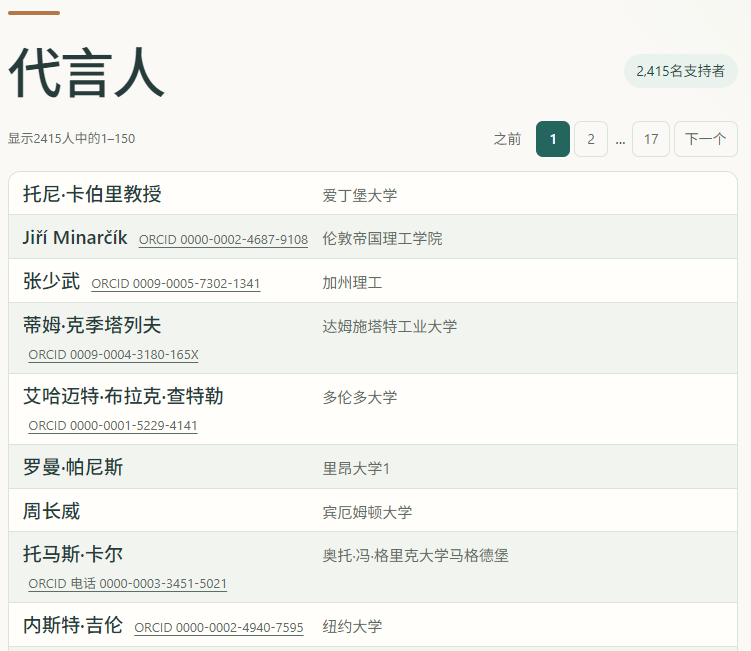
The entire text does not name OpenAI, but everyone understands.
The Trigger: 88 Hours to "Solve" a Millennium Problem
On September 8, OpenAI boldly announced: An internal unpublished model "solved" the smoothness problem of the Navier-Stokes equations in just 88 hours using about 10,000 concurrent agents—this is one of the seven Millennium Prize Problems listed by the Clay Mathematics Institute in 2000, with a prize of one million dollars.
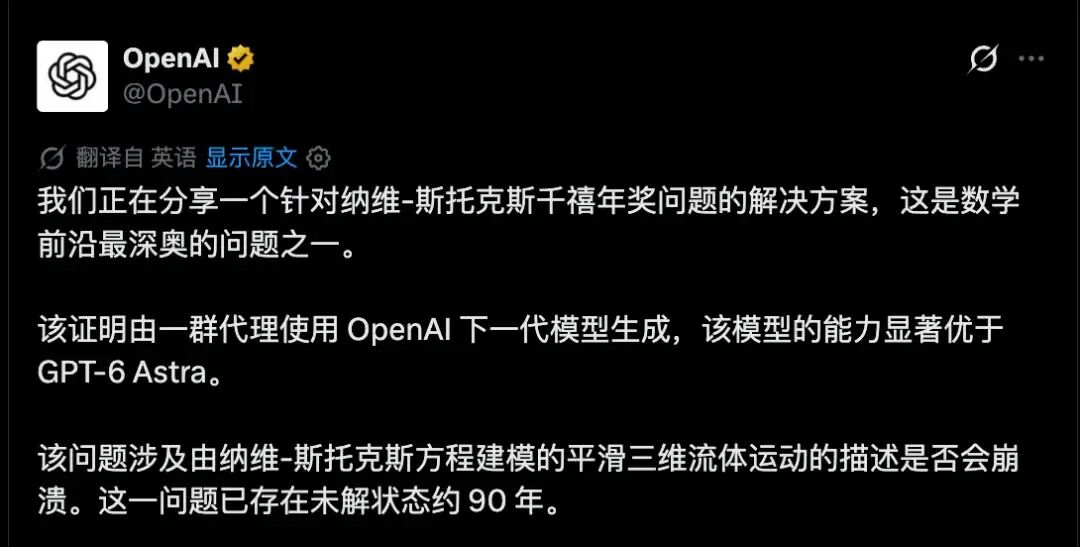
Just a few hours before the announcement was made, mathematicians Buckmaster from New York University and Alpöge from Anthropic had published breakthrough results on the same problem. Buckmaster later issued a statement, with very strong language: OpenAI's approach to solving the problem is almost identical to the route they are pursuing.
One took 88 hours, the other took several years; it is unclear who came first. But this incident ignited the long-standing dissatisfaction among mathematicians.
What the Statement Said
Among the 25 signatories, there are Pierre Deligne, who won in 1978, Shing-Tung Yau who won in 2010, and Yu Deng, who just received the award in July 2026—The Fields Medal is awarded every four years and only to mathematicians under 40, making it the Nobel Prize of mathematics.
The core of the statement is a single sentence: AI companies treat problem-solving as a scoring system, which is fundamentally different from the pursuits of the mathematics community.
Mathematicians explain: The importance of a famous problem lies in the process of overcoming it, which forces out new methods and new concepts. These results undergo a long process of reporting, discussion, and simplification before they may be included in textbooks and understood by graduate and even undergraduate students. Some ideas need to settle for decades or even centuries before becoming tools for all of humanity.
Solving problems is just a tool; understanding concepts and gaining insights is the objective.
However, AI currently treats tools as goals—producing "true/false" conclusions faster and faster in bulk, which "may destroy the fertile ground for nurturing ideas rather than injecting new life into them."
Three Deeper Concerns
The first is authorship and plagiarism. The mathematics results produced by AI are being released too hastily, unable to undergo proper academic paper writing and citation of previous works, and the issue of authorship has already begun to erupt. This competition for the Navier-Stokes breakthrough is a microcosm of that.
The second is the potential break in the chain of inheritance. Even if AI provides correct new ideas, no mathematician is willing to spend time digesting, integrating, and putting these ideas into the classical system, and such thoughts will never "come to life." The tradition of human inheritance passed down in the mathematics community may therefore break.
The third is how to train students. When mathematicians give students problems, the core purpose is not to get an answer but to train their intuition, judgment, and ability to pose questions during the research process. If answers can drop down directly from the sky, do people still need to climb this mountain?
Fields Medal winner Hugo Duminico made a very vivid analogy: Dropping a person by parachute to the top of Mount Everest and having them climb up themselves to stand in the same place leads to completely different experiences.
But the Statement is Not Against AI
This is noteworthy. The 25 mathematicians clearly acknowledge that AI has the potential to significantly enhance and accelerate real mathematical research, and the mathematics profession needs to adapt to this change. They are not against AI itself, but against the logic of treating problem-solving as a benchmark, speed as glory, and the human intelligence training process as a skip-able intermediate step.
The statement ends with a sentence: "Whether these changes ultimately benefit or cause destructive consequences in this field will largely depend on how humans in control of this new technology make decisions."
This Concerns Everyone
There is a passage in the statement that everyone involved in AI should read:
"We are witnessing a generalized threat to intellectual labor. In many fields, the purpose of years of rigorous training is not only to deliver final answers but also to develop the ability to understand, pose new questions, and generate new ideas. However, AI systems are becoming more capable of directly producing these results, resulting in a misalignment of objectives."
In short, mathematics is just the first field to be "solved quickly" by AI, but it will not be the last.
Writing code, writing papers, developing plans, conducting research, designing—almost all forms of intellectual labor that require long-term training to deliver are being redefined by AI in terms of answer delivery speed. When answers can be generated with a single click, do the abilities cultivated during the problem-solving process become a waste?
This is the real question the statement aims to ask.
免责声明:本文章仅代表作者个人观点,不代表本平台的立场和观点。本文章仅供信息分享,不构成对任何人的任何投资建议。用户与作者之间的任何争议,与本平台无关。如网页中刊载的文章或图片涉及侵权,请提供相关的权利证明和身份证明发送邮件到support@aicoin.com,本平台相关工作人员将会进行核查。


