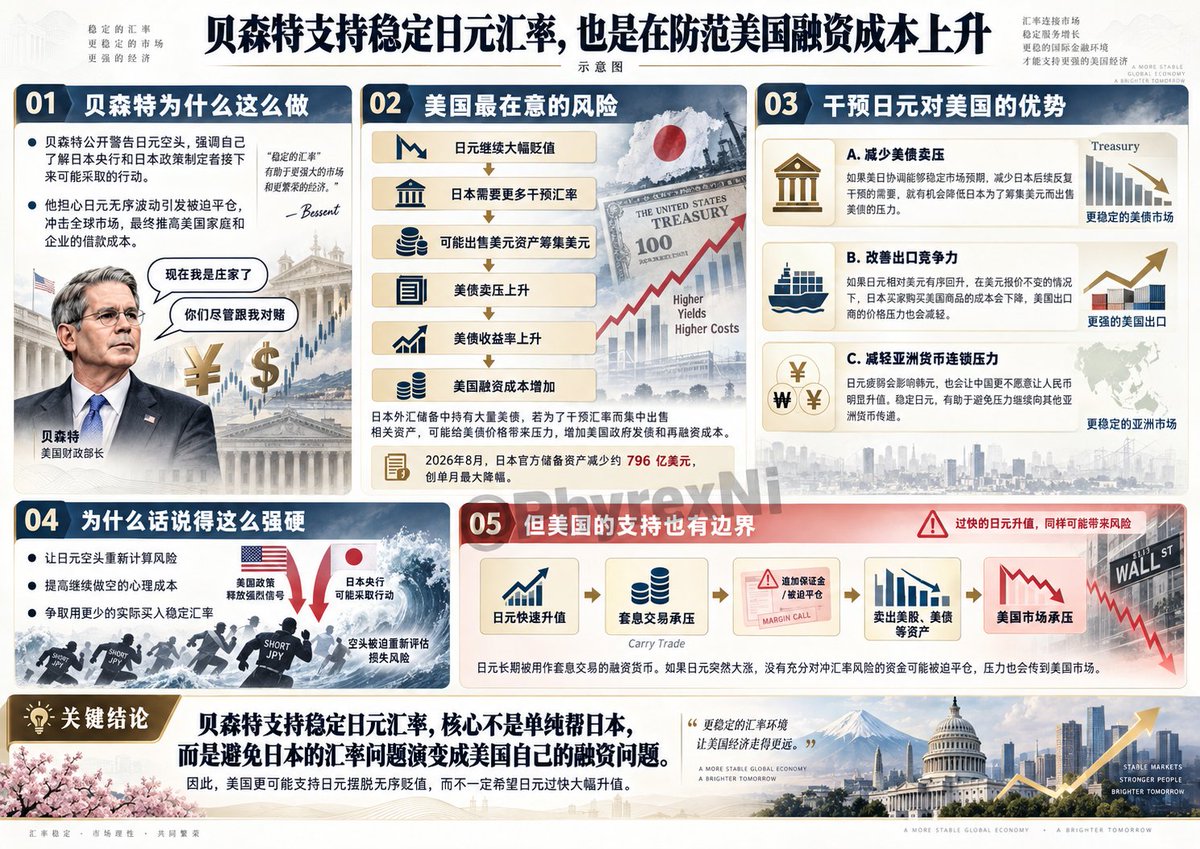
Besent supports a stable yen exchange rate, as well as preventing the rise in U.S. financing costs.
Besent recently publicly warned yen shorts, "Now I am the dealer," "You can bet against me." He emphasized that he understands the actions that the Bank of Japan and Japanese policymakers may take next, and traders need to consider the losses that could come from sudden policy changes if they continue to short the currency.
My personal understanding is that we must first consider America's own interests. Besent stated in his letter on August 27 that the disorderly fluctuations of the yen may trigger forced liquidations, impacting global markets and ultimately increasing borrowing costs for American households and businesses. The exchange rate issue in Japan could also become a financing issue for the United States.
One thing to watch is Japan selling U.S. bonds to intervene in the exchange rate.
To prevent the yen from continuing to depreciate significantly, Japan can sell dollars and buy yen in the market. Japan holds a significant amount of U.S. Treasuries in its foreign exchange reserves and can raise dollars by selling these assets if necessary. If the scale of selling is relatively large, it may apply pressure on U.S. bond prices, pushing yields up and increasing the cost for the U.S. government to issue new debt and refinance maturing debts.
This August, Japan's official reserves fell by about $79.6 billion, marking the largest monthly decline.
So I believe if U.S.-Japan coordination can stabilize market expectations and reduce the need for repeated interventions by Japan, there may be an opportunity to lessen the pressure on Japan to sell U.S. Treasuries to raise dollars. For the U.S., helping Japan obtain dollars while avoiding concentrated selling of U.S. bonds also has benefits for maintaining its own market stability.
If the yen can rise in an orderly manner against the dollar, it may also improve the price competitiveness of U.S. exporters.
The weaker the yen, the more yen a Japanese buyer must pay for an American product priced in dollars. After the yen rises, assuming the dollar price remains unchanged, the cost for Japanese buyers to purchase American goods would decrease, and the price advantage gained by Japanese companies from a weak yen may also diminish.
However, the costs of importing Japanese goods for the U.S. may also increase, so the impacts on exporters and importers are different.
Furthermore, the scope of Besent's considerations includes other Asian currencies. He previously stated that a weak yen would affect the won and would make China less willing to allow a significant appreciation of the renminbi.
Therefore, I think that by making such strong statements now, he hopes to make yen shorts reassess their risks. Traders previously needed to judge whether Japan would intervene; now they also have to consider whether the U.S. will continue to participate and whether Japan will have other policies to coordinate.
If these warnings can lead some shorts to reduce their positions, the government will have the opportunity to stabilize the exchange rate with less actual buying.
However, if the yen appreciates too quickly, it may also harm the U.S. market.
The yen has long been used as a financing currency for carry trades, that is, borrowing yen and then buying other currencies or overseas assets. For funds that do not fully hedge against exchange rate risks, a rapid appreciation of the yen will increase the costs of buying back yen to repay the borrows.
If losses grow, or if additional margin is required, some funds may be forced to sell assets to close positions. If positions involve U.S. stocks or Treasuries, the liquidation pressure could also transmit to the U.S. market.
Therefore, I tend to believe that Besent's and the U.S.'s support may be limited; as long as the yen can escape disordered depreciation, they may stop, aiming to reduce the potential selling pressure on U.S. Treasuries from repeated Japanese interventions while also avoiding a sudden surge in the yen that triggers concentrated liquidations.
@Gate Crypto, U.S. stocks, Hong Kong stocks, Korean stocks, gold, CFD, one-stop trading for prediction markets
免责声明:本文章仅代表作者个人观点,不代表本平台的立场和观点。本文章仅供信息分享,不构成对任何人的任何投资建议。用户与作者之间的任何争议,与本平台无关。如网页中刊载的文章或图片涉及侵权,请提供相关的权利证明和身份证明发送邮件到support@aicoin.com,本平台相关工作人员将会进行核查。


