
Transactions were once the endpoint of the brokerage business, but now they can also be the starting point for a longer business relationship.
Written by 丨 Gong Fangyi
Liu Yue's decision to work in Beijing was sudden, at the time he hadn't even found a place to stay. Upon arriving in Beijing, he first searched for individual landlords on social media and encountered intermediaries claiming to be landlords. One apartment was not yet finished with renovations, but the other party asked him to pay upfront. Another apartment had been renovated for three months, looked beautiful, but still had a strong smell, and he ultimately did not choose it.
Later, Liu Yue contacted an agent through the Beike app. That night, the agent was already on his way home, but after receiving the call, rushed back to show him apartments. After viewing four apartments in about an hour and a half, Liu Yue selected one that belonged to Beike's “Worry-Free Rental” service line.
“Initially, I did not come specifically for the 'Worry-Free Rental' name and had no idea what was special about it,” Liu Yue said.
The agent introduced him in detail on-site about the differences between Worry-Free Rental and traditional regular rentals, especially concerning costs and services; on the signing day, he also guided Liu Yue to read the contract page by page, reminded him of the content that needed careful reading, explained the general responsibilities for changing rentals mid-term and early termination, and clarified the responsibilities for damage to appliances and facilities during occupancy.
The apartment Liu Yue chose had a monthly rent of 3,400 yuan, plus a Worry-Free Rental service fee of 272 yuan, about 8% of the monthly rent; the two fees were calculated together and could be paid monthly. Whenever Liu Yue encounters routine repairs, coordination for agency work, or other issues, he can directly raise them in the service group, where the online housekeeper contacts the appropriate personnel to handle them. This was also what Liu Yue valued. “I don’t like adding many people on WeChat for different issues and trying to remember who to approach,” he said.
On the afternoon of the move-in day, around 2 p.m., Liu Yue noticed a bulge in the wall and some paint had peeled off. He was worried the damage would expand and would be unclear about responsibilities upon moving out, so he reported the repair in the service group. The online housekeeper responded in one to two minutes; about five minutes later, the repairman called to confirm he was at home and arrived within half an hour with wall repair tools; the repairman adjusted the putty on-site and smoothed the wall in under five minutes. This all happened within an hour of Liu Yue sending the message.
Worry-Free Rental charges both landlords and tenants separately; Beike uses income from both ends to cover costs related to leasing, management, as well as repairs, cleaning upon move-in, and safety guarantees as stipulated in the contract. Costs associated with vacancy, natural aging and updates of appliances, and damage caused by humans are borne according to the contract and responsibilities by the landlord, tenant, or platform.
This is not a lucrative business. In the second quarter of 2026, Worry-Free Rental managed over 790,000 units, with a year-on-year growth rate slowing to about 34%. A person close to the Worry-Free Rental project said that the team initially hoped that significant scale growth could clearly dilute management and supply chain costs, but it currently appears they have still underestimated the difficulty of controlling operational costs, and part of the costs continues to increase with the number of units.
These units are now spread across 13 cities, including Beijing, Shanghai, and Chengdu, and the same repair response and lease termination guarantees must adapt to varying building ages, distances, and tenant needs.
Worry-Free Rental is not a rental guarantee
The common rental market has various forms of regular rental, guaranteed rental, and management, with different methods of risk distribution. Regular rental provides one-time intermediary service; after signing and handing over, the landlord collects rent independently and handles repairs, early termination, and property damage with the tenant, with the biggest uncertainty for landlords being the rental cycle, as every day of vacancy is a loss; guaranteed rental involves the platform first leasing from the landlord and then subletting the property, which is considered capital-intensive and has high cash flow requirements for the platform.
Moreover, even if the property is vacant, the platform must continue paying rent to the landlord, and when market rents decrease, the price difference turns into a loss, which is one reason for many long-term rental apartment defaults in recent years. Worry-Free Rental also initially adopted an approach similar to guaranteed rental, but later shifted to a light asset management model, which does not profit from the rental price difference between landlords and tenants but rather charges a service fee based on the rental price ratio. Even though income from service fees may decline amid market fluctuations, it does not place pressure on cash flow.
Yu Jingqi, the head of strategy and quality for Beike Huiju's Worry-Free Rental, told us that although the terms regarding the vacancy period are already stipulated in the contract, some landlords still misunderstand Worry-Free Rental as a guaranteed rental, expecting that the platform should also pay the rent during the vacancy period when a tenant vacates, leading to customer complaints.
Currently, the rental prices for Worry-Free Rental products are determined by the landlords, and the lease term begins from three years. They are required to pay roughly the equivalent of about 36 days of rent (around 9% to 11% of the first year's rent) as a service management fee each year, with no other fees thereafter.
The speed of renting out is a crucial basis for landlords to determine whether this fee is worthwhile. According to the average for the first half of 2026, Worry-Free Rental had an average vacancy of 16.9 days, compared to 46.8 days for regular rentals. Although landlords do not earn rental income during the vacancy period, if the property remains unsold past the deadline, the platform compensates the landlord with half a month's rent as compensation and terminates the contract.
Zhao Jia, who regularly resides out of town, has a two-bedroom apartment in Chengdu that was listed for regular rental and had a maximum vacancy of two to three months. After leasing it, when tenants reported repairs, they first had to contact her, and then she would find a repairman, which involved several steps even for minor issues. In October 2025, through a friend's introduction, she handed the house over to Beike Worry-Free Rental.
During this time, several viewers found the walls and kitchen quite old, and the Worry-Free Rental housekeeper suggested repairing the walls, replacing the stove and gas oven. After she agreed, the housekeeper contacted the construction team, followed up on the repairs, and continued seeking new tenants. The house was ultimately rented out at 2,400 yuan per month, yielding Zhao Jia 2,160 yuan.
However, compared to the 4,800 yuan lost during the previous two months of vacancy, and the foundational repairs, renovations, cleaning, and changing the smart lock that Worry-Free Rental had initially covered, her management expenses still proved to be cost-effective. Moreover, she also had mortgage payments to cover, and the rental income helped subsidize the monthly mortgage.
The current average rent for Worry-Free Rental is approximately 80% of Beike's overall rental property average, and the units tend to be smaller in area and older in age — this will test the limits of service. Yu Jingqi explained that he roughly estimates, including flexible rentals, institutional management, and concentrated apartments, Worry-Free Rental units account for about 5%, servicing still a minority of landlords and tenants willing to pay continuously for management.
A Worry-Free Rental asset management manager mentioned that if the property is easy to rent and the landlord has time to manage it themselves, regular rentals might yield higher profits; conversely, if the landlord resides far away, lacks time to handle leasing matters, or has previously encountered issues such as unpaid rent or extensive vacancies, Worry-Free Rental management might be more suitable.
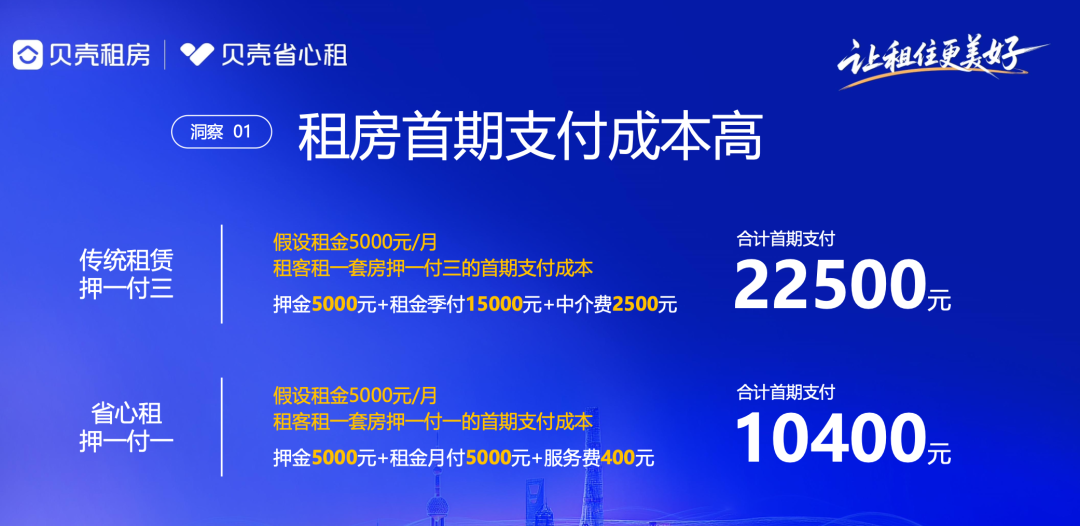
A cost comparison between Beike's Worry-Free Rental and traditional leasing. Source: Beike Worry-Free Rental Service Value Conference
Light assets but heavy service
Once landlords agree to hand over management, the platform needs to assess whether the property can be safely delivered, with asset managers visiting the site first to understand the condition and rental requirements while the platform verifies ownership documents, the identity of the signatory, and the payment accounts. Yu Jingqi noted that among the properties forwarded for review he managed, about 15% were returned due to non-compliance with the requirements regarding documentation or property condition.
Once approved, the property still cannot be listed immediately. Asset managers or rental housekeepers usually spend about one and a half hours checking gas lines, water heaters, electricity, doors, windows, and furniture, uploading photos and videos. If necessary, the platform must send people to clear debris, repair the walls, replace minor items, or furnish missing furniture.
Formaldehyde and other volatile toxic substances are general safety concerns for tenants, ranking higher in importance for many than the property's location, layout, or even rent. According to Xian's Worry-Free Rental asset management manager, Xiong Zongbao, they check if a house has just been renovated, had new furniture, or freshly painted walls when receiving it; if suspicious, they request professional detection for formaldehyde and explain related risks to the tenant.
If tenants suspect formaldehyde levels exceed standards after moving in, they can raise the matter in the service group. The platform arranges for a professional agency to conduct tests; once risks are confirmed, responsibility and costs are allocated accordingly; if initial assessments indicate the landlord is responsible, the landlord can either hire the agency independently or have the platform make contact. If toxic substances such as formaldehyde are found to exceed standards after a tenant moves in, it will severely impact the safety assessment metrics for the asset manager responsible for receiving the property.
Some risks cannot be eliminated by a single pre-move-in inspection. In January 2026, a tenant in Shenzhen suspected a gas leak; during the first inspection, staff did not find anything unusual using detection equipment but later confirmed the leak with foam water, discovering bubbles at the water heater connection. A retrospective analysis revealed that repair personnel had omitted rubber washers when installing the water heater.
The Shenzhen team subsequently requested gas inspections and face-to-face handovers, rechecking gas appliances with foam water, opening hot water when checking the heater, and conducting another check 24 hours after the new gas appliances were installed. The team used this method to inspect over 12,000 units, identifying 58 sources of gas leaks.
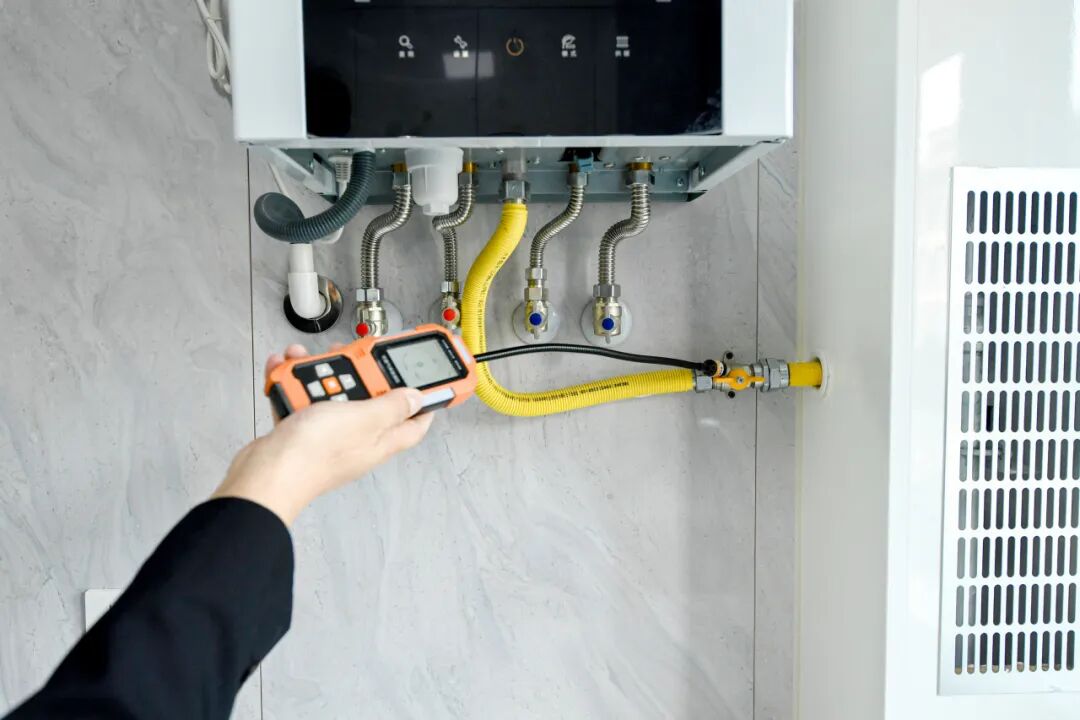
Worry-Free Rental gas inspections, with each interface held for eight seconds with detection equipment, and photos uploaded as evidence. Source: Beike Worry-Free Rental
Beike's safety data indicates that from the beginning of 2025 to June 2026, Worry-Free Rental inspected 567,000 newly accepted properties and carried out over 337,000 during the rental period, intercepting approximately 25,000 properties that did not meet safety entry requirements.
We learned that such safety assessments have been integrated into the daily management of Worry-Free Rental. For instance, if tenants post “gas leak”, “possible poisoning”, or similar keywords in the service group, the system automatically creates a group and escalates the issue; city leaders report monthly and begin with the incidence rate of gas leaks, ranked from highest to lowest. However, heavy service also has clear boundaries. For example, Liu Yue once wanted repair personnel to add barriers around the interior fire safety equipment, but they refused to do so due to fire safety regulations.
Lease termination assessments are more complex. A property managed by Xiong Zongbao in Xi'an originally did not allow pets; after receiving the landlord's consent, the tenant promised to only keep one small pet, yet upon vacating, there were signs of multiple pets and damage to the sofa. This triggered complications and disputes, leading the platform to eventually allow the tenant to vacate while covering deep cleaning and sofa repair costs.
For “difficult issues” in rental disputes, Worry-Free Rental will initially assume responsibility according to standards, then follow up with situational assessments. As of mid-April 2026, Worry-Free Rental had cumulatively compensated over 200 million yuan over four years. However, not all cities and properties can support such investments. Xiao Zhenyu, the regional head in charge of Worry-Free Rental for Jiangsu, Zhejiang, Shanghai, Tianjin, and Jinan, mentioned that the management model has many fixed costs, and as market conditions fluctuate, if rents and transaction volumes fall below a certain level, service fees become difficult to cover costs related to inspections, repairs, and safety corrections.
The costs behind the service
Liu Yue's first reporting of repairs and the resultant responses, dispatches, confirmations, and on-site visits represent a basic pathway for how Worry-Free Rental handles tenant needs. After renting, each property establishes separate service groups for landlords and tenants. Tenants submit photos, voice messages, and texts through the app or service group, and online service personnel first assess the issue before delegating any necessary on-site tasks to local craftsmen.
The platform requires that after submitting a work order, they contact tenants within half an hour, while emergency requests must be responded to on-site within two hours. Online coordination, consultation, and follow-ups involve issues that need assessment or repairs being handed to offline personnel.
Handling 790,000 units generates a large volume of trivial, repetitive, and dispersed tasks. Data provided by Beike indicates that in the first half of 2026, the top 20 types of completed repair projects totaled approximately 2.94 million. Among them, lighting projects accounted for about 326,000, with air conditioning and toilets at 252,000 and 224,000 respectively, mainly involving lighting, sanitation, home appliances, and hardware.
However, sporadic repair needs can peak during certain seasons. Between June and August 2026, Worry-Free Rental processed around 210,000 air conditioning service orders, incurring significant upfront costs to achieve a 94.9% timely response rate during customer appointments and an 89.8% completion rate within 24 hours following on-site check-ins.
Xiao Zhenyu indicated that starting in April, their team began preemptive measures for the upcoming hot season, including inspecting air conditioners, replacing remote control batteries for tenants, and deploying spare air conditioning stock. A service provider managing repairs for Worry-Free Rental in Beijing and Shanghai noted that during a typhoon in Shanghai, the daily number of repair orders for about 15,000 units they were responsible for increased from around 400 to 700, with about 20% of craftsmen unable to work due to their electric bicycles getting wet, forcing them to walk to job sites.
They are referred to as the “Star of David” within Beike, integrating frontline service teams involved in interviews and leasing processes, comprising asset managers, client managers, cloud housekeepers, rental housekeepers, service housekeepers, and supply chain service providers.
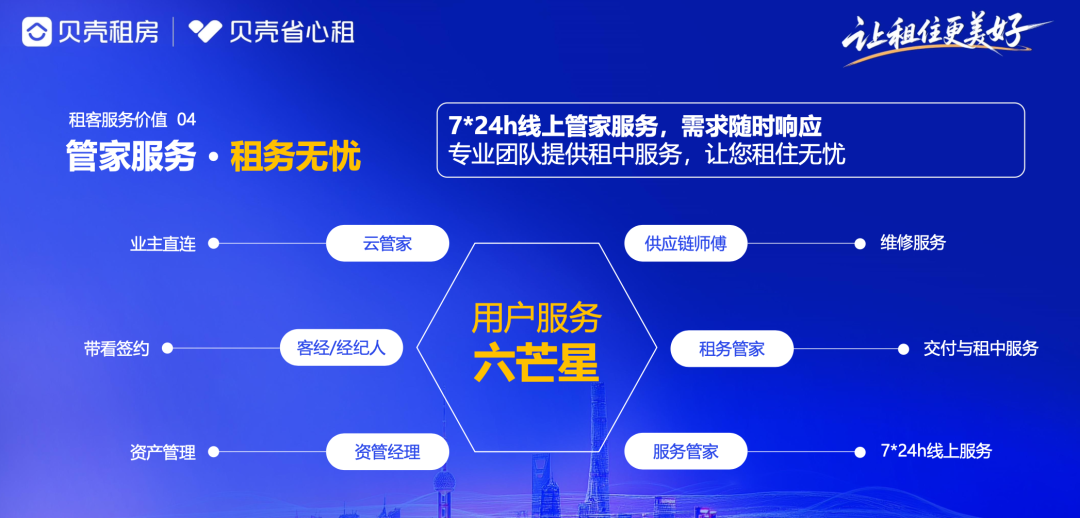
The Beike “Star of David” service system. Source: Beike Worry-Free Rental Service Value Conference
During the property receipt phase, the cloud housekeeper reaches out to landlords, and the asset manager signs the management agreement and takes full responsibility for the property; during the rental phase, the client manager finds tenants, conducts viewings, and handles signing; after tenants move in, the rental housekeeper manages repairs and ongoing services, while the service housekeeper is available online 24/7 to respond, with maintenance and cleaning assigned to supply chain craftsmen.
As of June this year, asset managers for Worry-Free Rental each manage about 170 units, a year-on-year growth of 40%, with many cities nearing or exceeding 200 units, and in many areas, properties are highly dispersed. For example, in Shanghai, 110,000 units are spread across 25,000 communities and over 6,000 square kilometers. Property management companies can cover a large community of over a thousand households with just two housekeepers; Worry-Free Rental's thousand units might be divided among twenty communities, significantly increasing labor costs.
As the number of entrusted properties increases, each rental termination generates new costs for pricing, promotion, viewings, preparation, and contracting, while searching for new tenant leads also reoccupies brokers' time. In the first half of 2026, of every three units successfully rented, about two were previously vacated units re-rented.
During the second quarter performance meeting, an analyst asked whether the improvement in profit margin could be sustained. Beike's CFO Xu Tao listed three main tasks, including reducing unit turnover and re-leasing frequency, increasing landlord and tenant renewal rates; piloting the separation of tasks related to rentals and renewals to lower per-unit labor costs; and controlling the quality of new units while adjusting products according to the city.
“Slow down, horse”
The demand for rental housing in China is significant, but the market is still in its infancy, with much room for iterative improvement in regulatory systems and appropriate business models. This market is highly fragmented and diverse. Many landlords and tenants are accustomed to one-time transactions, preferring to bear subsequent communication frictions and property wear-and-tear rather than continuously paying premiums for services.
Beike's past brokerage business, from Lianjia's property verification and standardized contracts to the ACN network's cross-store commissions, mostly concluded work at the signing stage, similar to others in the industry, considering a transaction the endpoint of the real estate brokerage business. Worry-Free Rental aims to prove that “transactions” can also be the starting point for a longer business relationship.
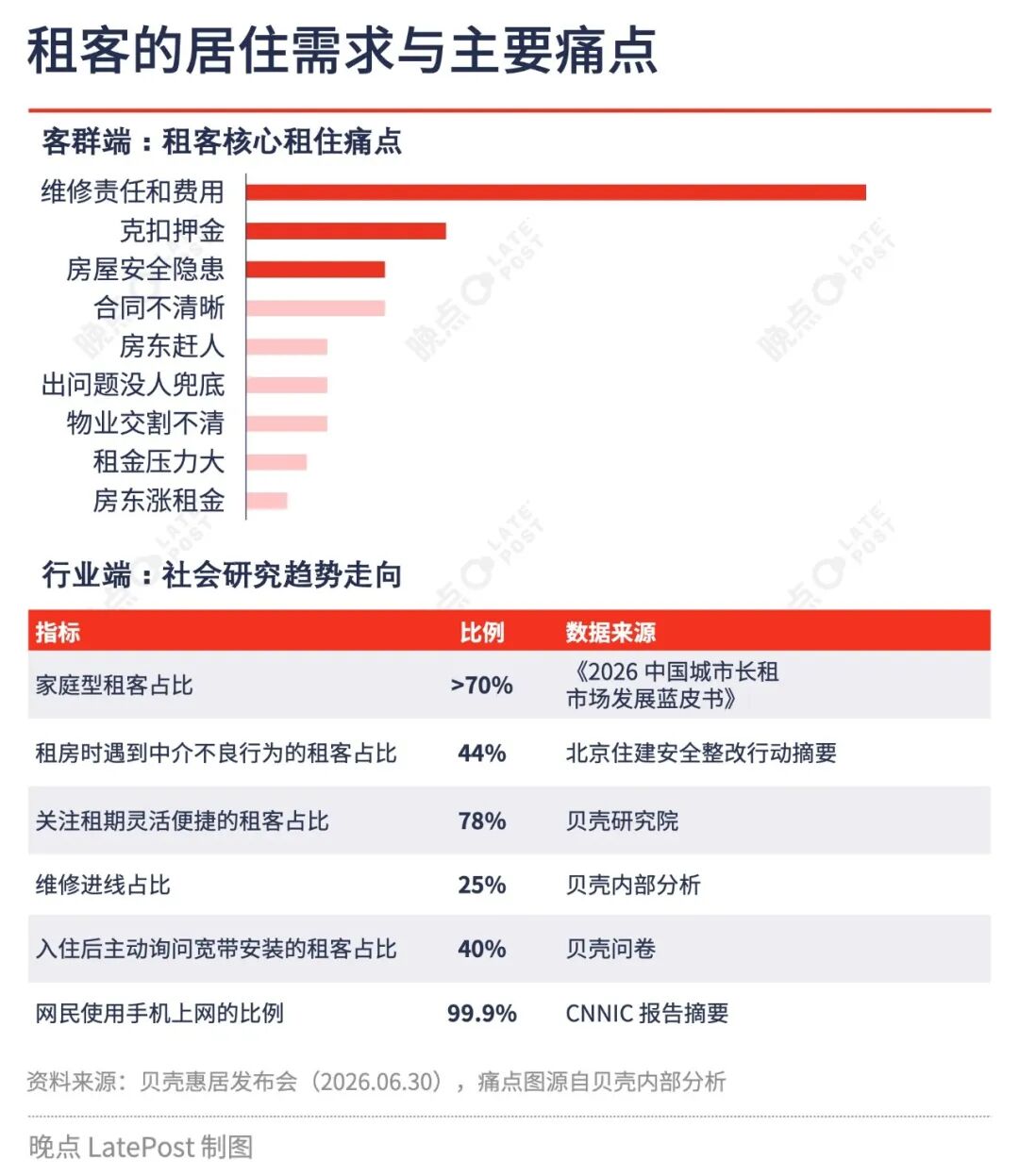
In February 2026, Huiju CEO Wang Yongqun shared internally about “Slow down, horse”, urging management to reassess property safety, customer satisfaction, the status of frontline service providers, and whether the existing model can support continued expansion, while proposing that new scale goals require a comprehensive evaluation alongside safety, service capabilities, and operational outcomes for each unit.
A longer service cycle is also altering the collaboration model of service providers. Worry-Free Rental is piloting enhancements to the division of roles and collaboration among online service housekeepers and cloud housekeepers to improve efficiency in problem-solving and service quality. The multi-housekeeper collaboration model aims to focus and segment services for better performance results after signing.
Because stores, brokers, and platform systems can continuously bring properties and tenants — this is the starting point for Beike's management — but the actual performance costs and customers' willingness to renew will emerge afterward. If management only looks at property receipts and initial rentals, the operational pressure brought by scaling up can be immense, comparable to guaranteed rentals: scattered repair and management demands across thousands of neighborhoods inevitably raise costs for labor scheduling and supply chain maintenance.
This time, Beike may no longer be able to view transforming the entire industry as a goal like in the past. They must accept that Worry-Free Rental cannot and need not replace regular rentals, guaranteed rentals, or direct rentals by individuals. But only by restraining the impulse for blind expansion and confronting the limitations of the industry can they find a long-lasting balance amidst the tension between scaling growth and service quality per unit: reducing management burdens for landlords, providing tenants with relatively stable services, and ensuring the platform receives relatively sustainable income.
Per the interviewee's request, Liu Yue and Zhao Jia are both pseudonyms.
Cover image source: Pexels
免责声明:本文章仅代表作者个人观点,不代表本平台的立场和观点。本文章仅供信息分享,不构成对任何人的任何投资建议。用户与作者之间的任何争议,与本平台无关。如网页中刊载的文章或图片涉及侵权,请提供相关的权利证明和身份证明发送邮件到support@aicoin.com,本平台相关工作人员将会进行核查。


