The article is reprinted from Alphabet AI
OpenAI played four big cards in one go yesterday.
Agents API, GPT-Live-1 API, Data agent, ChatGPT for Financial Services, spanning four product lines of Agent, voice, data, and finance in a single day, each one worthy of individual mention.
However, among these four cards, the most noteworthy might still be the Agents API.
Because this time, OpenAI has "unbundled" Codex.
The capabilities that were originally hidden behind Codex, responsible for keeping the Agent running, invoking tools, managing context, and coordinating multiple Agents have been extracted and packaged into a cloud API, made available for all developers to call.
1
Codex as a Service?
In fact, OpenAI had already started to unbundle Codex.
As early as April 2025, when OpenAI just released o3 and o4-mini, it open-sourced Codex CLI. It’s somewhat like an OpenAI version of Claude Code, directly installed in the local terminal. How the Agent runs, how it calls tools, is all clearly documented on GitHub; if you are willing to tinker, you can take it back, modify it, and run it yourself.
However, at that time, it was just a simple release of the product, and whether you would use it or how you would use it was still your own concern.
A month later, the cloud version of Codex, which we are familiar with today, was officially launched. Users can hand over their code repositories to it, with each task corresponding to an independent cloud sandbox, where Codex can modify code, run tests, fix bugs, and manage multiple tasks simultaneously.
After a few more months, in October 2025, OpenAI released Codex SDK.
Simply put, the SDK is a toolkit for developers, allowing Codex to be used not only as an independent product but also embedded in other applications. The SDK allows developers to start the same driver for Codex CLI with just a few lines of TypeScript code, retrieve structured output, and retain task status to continue running after a pause.
However, the SDK is mainly suited for invoking Codex within programs and has not yet opened up the full interactive capabilities of Codex. It is well-suited for backend workflows, automation scripts, and server-side programs. But if you want to create a complete client like Codex IDE, it still presents some challenges.
Thus, in February 2026, OpenAI officially unveiled Codex App Server, for the first time systematically clarifying the underlying Harness of Codex.
OpenAI clarified that Codex Web, CLI, IDE extensions, and Mac App appear to be different products, but they all operate on the same Codex Harness underneath, which is responsible for the Agent Loop, Thread, tool execution, authentication, and state management.
The App Server added a bidirectional JSON-RPC interface to this entire set of Harness. JetBrains, Xcode, or other clients do not need to reinvent an Agent Loop; they can simply start the App Server to drive the complete Codex.
With the App Server, other products can directly connect to the complete Codex Harness.
However, we still faced the last unresolved issue.
The SDK controls the local Codex Agent, and the App Server itself is also a persistent process that developers need to start and maintain. Although incorporating Codex into products is already resolved, running it stably as an online service is still somewhat challenging.
For a more concrete example, if you use the App Server to create your own Coding Agent website, and the frontend has already connected to Codex, when a user clicks "fix this repository," subsequent operations and infrastructure problems still need to be solved by you.
Then came August 19, when OpenAI consolidated the CLI, SDK, and App Server that it had gradually opened over the past year into a unified platform narrative of "open Codex Harness," officially elevating Codex from a product to a platform.
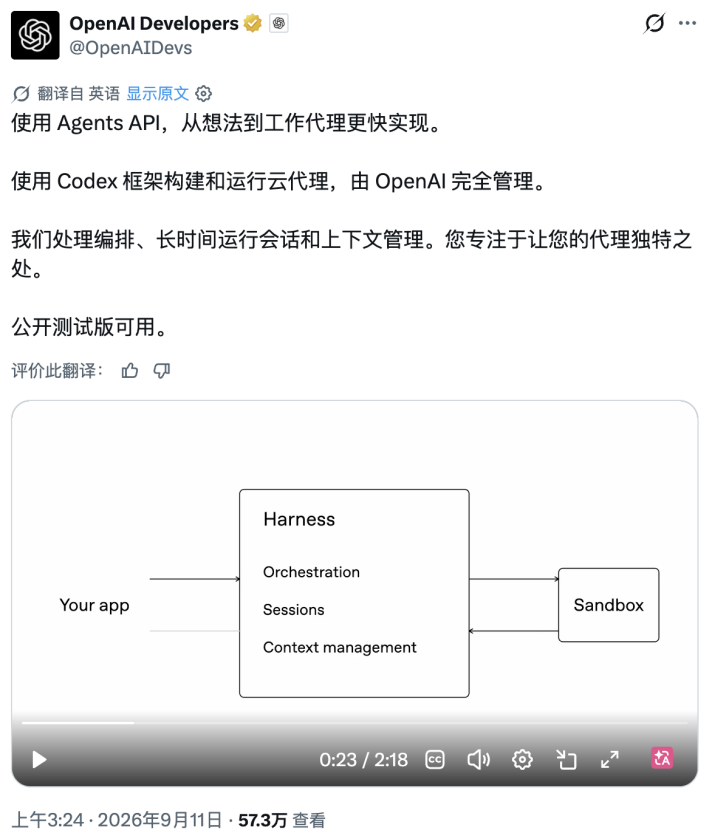
Then on (U.S. time) September 10, which was yesterday, the Agents API officially opened for public testing.
This time, developers only need to tell the API four things—task, model, tool, operating environment—to directly create an Agent. The Codex Harness, responsible for long conversation context compression, tool scheduling, and sub-agent collaboration, is hosted and maintained by OpenAI itself.
Even the machine that the Agent works on can be chosen by the developers, whether to use OpenAI's sandbox, their own infrastructure, or third-party environments like Cloudflare, E2B, Modal, etc. The Harness is provided by OpenAI, while the execution environment is decided by the developers.
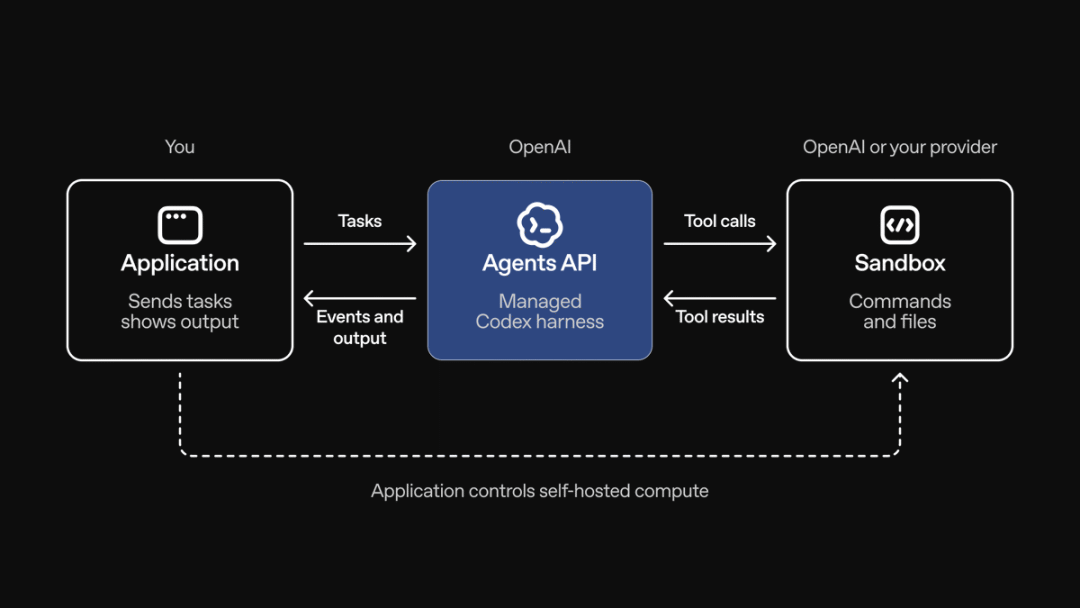
The official stance is quite clear: the Agents API itself does not charge extra fees. This means that the capabilities such as Harness hosting and long-session management do not incur an additional platform fee for the Agent.
Developers pay based on the actual model tokens and tools used; if using OpenAI's hosted sandbox, computing resources are charged separately.
Putting together this past year, OpenAI has been doing the same thing: dismantling Codex from a specific product, layer by layer, into reusable capabilities while increasingly relieving developers of concerns.
If we had to name this product line, it would resemble the former SaaS, except this time the service is not software but Codex.
Codex as a Service.
1
The Harness is also starting to fork
Of course, OpenAI is not the only one focused on Harness.
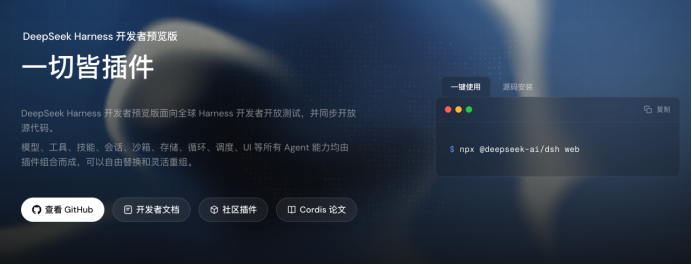
When DeepSeek Harness (hereinafter referred to as DSH) was released, it provided a very striking equation: Agent = Model + Harness.
In DeepSeek's view, the model is just half of the Agent; the other half is the Harness, responsible for helping it understand the environment, invoke tools, manage states, and continuously execute tasks. Both coordinate with each other, allowing the Agent to perform tasks effectively.
DSH has transformed the Harness itself into a highly modular open framework: models, tools, Skills, Session, sandbox, storage, Agent Loop, scheduling, and even UI can be replaced.
The slogan of "everything as a plugin" is not just for fun; it's intended for everyone to write plugins and adapt to DSH, so that regardless of whether DeepSeek or other models are running above, the same set of Harness can be utilized underneath.
This stands in interesting contrast to the direction OpenAI is currently taking.
While OpenAI has also open-sourced Codex Harness, the Agents API clearly heads in a different direction: you can use your own Harness or take the open-sourced one, but if you find it troublesome, you can simply let me handle it for you.
Thus, we believe it is more like a "service." OpenAI is responsible for hosting and continuously maintaining the Harness; developers simply need to decide what they want the Agent to do, what tools to use, and where to execute it. Even in the future, when models are upgraded, how the Harness adapts, OpenAI also prepares to handle that.
In a sense, the current layer of Harness appears to reveal two paths:
The route represented by DeepSeek is more like building an open ecosystem, making every component a plugin, enabling developers to assemble themselves; while the side represented by OpenAI seems to be betting on cloud services, delivering the funding and demands, and solving the rest for you.
We could even say that one aims to make the Harness more like Linux, while the other wants to shape the Harness to resemble AWS.
Of course, this is just a metaphor. OpenAI has also open-sourced Codex Harness, and DeepSeek may also provide more hosting services in the future. But at least at this stage, the focus of the products on both sides is quite different.
Interestingly, in the pursuit of turning the Harness into a service, Anthropic has actually taken a step ahead of OpenAI.
Back in September 2025, Anthropic launched Claude Agent SDK, opening up the tools, context management, permission systems, and sub-agent capabilities behind Claude Code to developers, allowing others to use this set to create Agents.
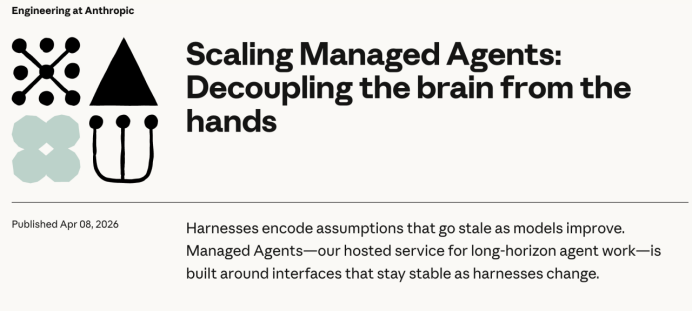
This April, it even released Claude Managed Agents earlier than OpenAI. Session, Harness, and sandbox were separated into three independent layers: Anthropic handles hosting the harness and long tasks, and the sandbox can either be provided by Anthropic or integrated with other execution environments. This idea is already quite close to today’s Agents API, which Anthropic describes as "a hosted service for long-term Agent tasks."
So, in a sense, OpenAI is continuing along the path that Anthropic has already traversed, the only difference being that OpenAI has a more "productized" Codex at its disposal.
However, since Codex and Claude Code have long given people different product impressions, even though they tell the same story, the feelings they evoke are quite distinct. Claude Code feels more like allowing developers to sit at the terminal and code with the Agent, while Codex App initially emphasizes the interface of "supervising multiple long-term Agents" simultaneously.
By the way, Google has also long joined this route. At the I/O conference in May this year, the Gemini API launched Managed Agents, turning Antigravity Harness and sandbox into a hosted service. But Google's offerings go beyond that; we will discuss this more later.
However, having said that, who goes first seems to not be so important... In the end, whoever can turn their Harness into the default layer for developers will take the largest slice of the cake.
1
Who is the big winner?
Ultimately, why are model companies now all starting to compete for Harness?
Just like the equation provided by DSH, Agent = Model + Harness, the model can tell the Agent what to do next, but to carry a task from start to finish, it also needs to know where the files are, which tool to invoke, how to recover from errors, and where to write the results.
In other words, the model determines the upper limit of the Agent's capabilities, while the Harness increasingly determines whether it can actually complete the task.
And once the competitive dimension shifts from "intelligence" to "execution power," the ones most at an advantage are not necessarily the best AI companies that produce models.
Because once the Agent really starts working, the necessities—emails, documents, meetings, communication, account permissions, etc.—are often held by traditional platform companies.
The recent "office Agent battle" heating up domestically is, in fact, a very typical example: the resources accumulated by major companies during the era of internet platforms were more just parts of their respective ecosystems before, but in the Agent era, these resources are just what Agents need to invoke to get work done.
Now that everyone is creating office Agents, on the surface, it seems like it's a competition over which AI employees are smarter and more capable, but behind the scenes, it's also about reusing one's past platform advantages. Whoever has more enterprise data, documents, tools, and permissions is more likely to enable Agents to actually get things done.
Model companies need to gradually connect to the entrances they lack, while those companies that have been in the office software and internet platform space for over a decade already hold those entrances.
In other words, AI companies must reconnect to the real world, while platform companies already possess a whole pile of keys.
Looking forward along this path, if one had to find the player with the most advantage in an "all-in-one" offering, Google might be the most exaggerated one.
From TPU, cloud infrastructure, Gemini, to Search, Workspace, Chrome, and Android, Google nearly covers all key elements of AI from underlying technology to final users. Products like Search, Gmail, Calendar, Drive, YouTube, Maps naturally create a digital environment that can be invoked by Agents. These assets, which were once individual entrances in the previous generation of the internet, can be reorganized under the same task in the Agent era.
In fact, Google has begun to gather the Agent capabilities scattered across various products into a unified execution system at the foundational level. Gemini Spark, Managed Agents in Gemini API, and some Agent experiences in Search are gradually sharing the same Antigravity Harness.
However, on the user end, things still seem a bit messy.
Today, Google has Gemini Spark, Workspace Studio, Antigravity, Gemini Enterprise, and Information agents in Search all at once. They face different users and scenarios, but for the average person, when they want to delegate a complicated task to Google, they still don't know who to ask.
For Google, while it already possesses most of what is needed to accomplish all this, what it lacks is just a sufficiently simple product answer.
And if Google can get this right—whether creating a unified Agent workspace or allowing the same Agent execution system to penetrate the entire Google ecosystem, making users accustomed to saying "ask Google for help"—the competitive landscape of the global Agent market might change again.
That said, even if Google indeed packs this "all-in-one" offering into an Agent, domestic users will likely only be able to watch for now.
Let's wait and see how the domestic Agent battle will unfold next.
免责声明:本文章仅代表作者个人观点,不代表本平台的立场和观点。本文章仅供信息分享,不构成对任何人的任何投资建议。用户与作者之间的任何争议,与本平台无关。如网页中刊载的文章或图片涉及侵权,请提供相关的权利证明和身份证明发送邮件到support@aicoin.com,本平台相关工作人员将会进行核查。


