

Can a judgment that conforms to investment discipline be based on a set of rules that are expiring?

Author | Pu Fan
Source | Investment Island
This Thursday, "Dabeiyao 14F" updated an episode discussing embodied intelligence. This episode was recorded on August 28, just one week after Yushu's IPO, titled "I Also Rejected Yushu's BP Back Then"—this is actually a classic joke in the investment circle, mainly used for self-deprecation about one's lack of a wealthy fate, or to lament the rapid changes in technology cycles. The two guests of the discussion "fortunately" became one of the witnesses and thus vividly restored the feelings at that time.
One point that can be clarified is that neither of them felt regret, for very practical reasons. Looking back to 2024, a small fund, faced with a Yushu that had already reached a high valuation and where the product was still rapidly changing, needed to consider its fund size, return requirements, and risk tolerance. Based on the information available at that time, giving up did not violate investment discipline. Even if given a chance to choose again, they would likely still make the same decision.
However, when Yushu completed its IPO, the issue became quite subtle.
In the past, a company typically needed to first create a product, find customers, and establish stable revenue before investors had enough information to determine its value. Yet, Yushu entered the public market while its products, technology, and applications were still not fully converged, and early investors also found an exit opportunity ahead of time. Although this outcome cannot prove that the rejection back then was wrong, it raised a more troublesome question for all VCs: Can a judgment that conforms to investment discipline be based on a set of rules that are expiring?
Therefore, that podcast episode merely used "why I didn't invest in Yushu back then" as an entry point. We want to discuss more about how embodied intelligence is rewriting everything familiar to venture capitalists: when to place bets, what to use for verification, how to calculate returns, and whether a company's industrial progress and capital progress will still move forward according to the same clock.
At that time, I certainly didn't expect that on the very day the episode was released, Shao Tianlan, who had just sent Meikaman into the Hong Kong stock market, would post a highly topical moment on social media. The kind of anxiety repeatedly simulated in the show suddenly transformed from a hypothetical situation in the podcast to an open controversy in the industry.
Shao Tianlan questioned that some embodied intelligence companies had not yet proven that their products could be purchased repeatedly by the market, yet they rushed to use large projects, large orders, and IPO plans to prove themselves. He further brought the issue to revenue: if customers, investors, local platforms, and supply chains are in the same circle, how much independent demand do these orders really indicate?
The two things that are easiest to conflate here are whether an order has truly been signed and whether a revenue can explain that the product has been repeatedly purchased by someone. Contracts and payments can be real; if customers always come from the same familiar circle, this money still struggles to answer the second question. Data collection centers and demonstration projects may also be necessary infrastructure for the industry, but once they undertake financing, implementation, revenue, and valuation tasks simultaneously, investors need to reassess whether this is the market voting for the product or the participants completing tasks for each other.
What makes VCs most uncomfortable is that both sets of rules can be explained at present. Adhering to old rules while waiting for customers and revenue, star companies may complete the next round during due diligence, or even go straight to IPO; following new rules, considering financing, data, and scenarios all as progress, can easily lead to viewing an internal cycle as market validation.
This week's VC WEEKLY is focused on the rules rewritten by embodied intelligence: when the technology is not yet mature, how far can capital push the company; whether a seemingly impressive revenue has brought a second payment from unfamiliar customers; and what else investors can use to distinguish a reasonable rush from a mutually persuasive prosperity.
This week's key recommendation: AI companies need to move from selling tools to taking over entire segments of work.
On September 6, Lenny’s Podcast invited Anish Acharya, a partner at Silicon Valley venture capital firm a16z, to discuss the topic "Why Companies are Becoming a Set of Continuously Operating Cycles."
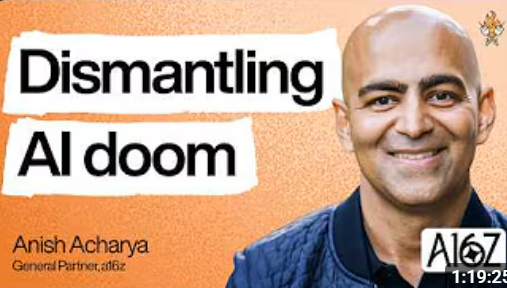
Acharya founded the social gaming company SocialDeck and sold it to Google, where he was responsible for products at both Google and Credit Karma. After being an entrepreneur, product manager, and investor, he found that AI is changing the most fundamental business models of software companies.
In the past, software typically served a single role. Sales used customer relationship management software, programmers used coding tools, and customer service used ticket systems. Software helped people complete a few steps, while the remaining judgment, communication, and handoff were still handled by humans; therefore, software companies were used to charging based on the number of users.
Now, with the advent of AI, software has the capability to take over longer workflows. For example, in the case of fixing software bugs, a complete workflow includes receiving user feedback, reproducing problems, finding code, completing modifications, running tests, submitting for review, releasing new versions, and notifying users. In the past, these steps were scattered among customer service, product, development, and testing teams. An AI agent can work continuously towards the same goal, deciding what to do next based on the results of the previous step. Acharya refers to this structure as “cycles”.
Cycles have one very critical difference from the automated processes we are familiar with. Automated processes operate according to pre-written rules and stop to wait for human intervention when encountering unexpected issues; AI can observe the results, adjust actions, and try again. Humans are responsible for handling exceptions that it cannot currently solve, and those handling methods are later entered into the system.
A useful example is the Mexican second-hand car trading platform Kavak. When the AI customer service cannot resolve a user's problem, it hands the conversation over to a human. After the human completes refunds, modifies orders, or handles exceptions, the system records the operation. When similar issues arise again, the AI can now complete them independently. Exceptions that previously required human intervention are gradually integrated into the product.
This critical difference will change the boundaries of AI startups. Previously, they sold an assistant to customer service departments; now they can take over the entire process from user inquiry to problem resolution directly; previously, they sold coding tools to programmers; now they can go from receiving fault reports all the way to repairs and deployments. The unit of purchase for clients will also shift from software accounts to a single problem solved, a single review completed, or a deliverable result.
Acharya explains this change by citing the electrification of factories. When electric motors first emerged, factories simply replaced steam engines with them, without changing the machines' positions, production processes, or management methods. Only when factories reconfigured production lines around electricity did efficiency begin to increase significantly. Today, many companies are purchasing AI tools; they merely add an assistant to existing roles. The bigger opportunity lies in rethinking and breaking down entire sections of work and handing them to a system capable of continuously operating.
Specifically regarding this week's discussion on embodied intelligence, robots similarly need to complete a cycle: receiving tasks, recognizing environments, executing actions, checking results, handling failures, and then beginning the next task. Orders and shipment volumes can only prove that robots have entered the site. The amount of human intervention required for each exception, whether processed exceptions can be solved automatically next time, and whether new deployments require reset and reconfiguration will determine if this cycle can get moving.
This also explains why two robot companies with similar revenues may have entirely different businesses. One company's revenue grows with the number of machines it adds along with the number of operators and on-site engineers; the other company continuously shortens the human intervention time, allowing the same team to support more and more devices. The former's revenue grows alongside labor, while the latter begins to gain the scale effects of a software company.
In the software era, startups competed for the budget of a single role's tools. In the AI era, a company has the chance to take away the entire segment of a job's revenue. VCs now need to reassess not just how many customers a product has sold, but also how many steps it has taken over, how much labor it has left behind, and whether it can continue to expand this boundary after each operation.
This week's other recommendations: Even with 60 million users, it may still be overtaken by stronger newcomers.
On September 5, 20Sales invited Cliff Weitzman, co-founder and CEO of the voice AI company Speechify, to update on "How to Build Your Own Data Center, and What I Learned After ElevenLabs Overtook Us." Speechify was originally a reading tool developed by Weitzman to solve his own reading difficulties, and now boasts over 60 million users.

According to the most popular saying in AI startups, models will gradually become widespread, and user and distribution are the barriers for application companies. However, Speechify's experience has disproven this: they have a large user base but are still being overshadowed by the later-founded ElevenLabs, which has captured attention in the voice model space. Weitzman admitted that failing to keep pace with the most advanced models was the most serious strategic mistake since founding Speechify.
The lesson from Speechify is that user scale cannot automatically bridge model gaps. When voice quality shows generational differences, developers will switch interfaces, and corporate clients will reselect suppliers. Subsequently, Speechify began to purchase chips, invest millions of dollars in building data centers, and enter increasingly costly competition for AI talent.
A software company that started from consumer applications has thus been forced to delve deeper into models, computing power, and infrastructure. AI application companies will not necessarily become lighter as models mature. Once the model directly dictates product experience, the costs originally meant for cloud providers may turn into the company's own servers, data rooms, and R&D teams.
This episode leaves VCs with a very real valuation question: How many users an AI company has only explains where it stands today; the gap between it and the strongest models, and how much capital is needed to catch up will determine how long existing advantages can be maintained.
On September 8, Invest Like the Best invited historian and Wall Street Journal columnist Walter Russell Mead to update on "God, Gold, and Silicon." Mead has long studied U.S. foreign policy, and this discussion extended from artificial intelligence to trade, war, and global power.

Mead believes that the international institutions led by the U.S. after World War II are loosening, but the technological, financial, and commercial networks accumulated by the U.S. have not disappeared. In the great power competition over the past few centuries, both Britain's and America's advantages stemmed from a set of interlocking capabilities: technology creates new production tools, finance provides capital for expansion, trade connects markets, and military power protects this network's ongoing operation.
Silicon Valley has previously preferred to describe itself as an innovative force distant from the government. However, after artificial intelligence, chips, satellites, drones, and data centers quickly became part of national competition, tech companies have found it increasingly difficult to maintain this position. Mead refers to a group that is forming as "tech Hamiltonians": they believe that industry, finance, technology, and national capability must grow together, and tech entrepreneurs should also directly engage in public affairs.
This will change the environment in which VCs operate. Export controls may dictate which companies a chip manufacturer can sell to; government procurement may become the earliest major clients for robotics and unmanned systems, and supply chain positioning may affect a company's financing and exit. While the technological direction is still driven by engineers, the boundaries of companies are increasingly shaped by national power.
This week's special recommendation: The company that most resembles an embodied intelligence winner may not even make robots.
Embodied intelligence is often most easily remembered through robots that can run, jump, or fold clothes. Applied Intuition hardly provides such imagery. It does not produce cars, mining trucks, tractors, or humanoid robots, yet it aims to give all these machines the ability to operate autonomously.
On July 27, Business Breakdowns invited Applied Intuition’s two co-founders Qasar Younis and Peter Ludwig to update on “Applied Intuition: Giving a Billion Machines Intelligence.” The company was founded in 2017, and Younis and Ludwig had previously worked in self-driving companies. They chose to leave these noteworthy vehicle competitions to build their company on the layer all machines might need.
Training a self-driving car cannot rely solely on it making mistakes in real roads. Because some dangerous situations may only occur once every few years, one error can lead to accidents. The products Applied Intuition initially sold were a suite of software to simulate these extreme scenarios. Vehicle manufacturers can let their self-driving systems experience torrential rain, suddenly crossing pedestrians, broken-down vehicles, and complex intersections in a virtual environment and check how they would react.
This capability soon exceeded automobiles. Mining trucks need to navigate through dust and rugged terrain, agricultural machines need to identify crops from obstacles, and military vehicles face even less predictable environments. The appearance and tasks of machines differ, yet the development processes are highly similar: establishing virtual environments, generating abnormal scenarios, testing control systems, locating failure causes, and then re-implementing the modified systems back into the scenarios for validation.
Applied Intuition continued to expand along this developmental chain. The company initially sold individual testing tools, then transitioned into operating systems and self-driving software, and later launched the smart platform Dana for developing and deploying autonomous systems. Clients can retain their own algorithms while only purchasing testing and development tools or directly adopt the complete self-driving capabilities offered by Applied Intuition.
This positioning gives the company a rare choice. The automotive industry bets on end-to-end models; tools still need to test how models perform in extreme situations; robots adopt bipedal, wheeled, or tracked structures; developers still need to simulate environments and validate control systems; and a terminal manufacturer lagging in the competitive landscape will not take away the whole market for tools.
The two founders also adhere to a rather restrained business model: clients purchase software on an annual basis, embedding Applied Intuition into long-term R&D processes. The company does not need to manufacture large quantities of vehicles, nor take on hardware inventories and on-site operations for every single machine. The uncertainties brought by cutting-edge technology are encapsulated in a business model that is closer to traditional enterprise software.
Applied Intuition has raised $1 billion, and the two founders mentioned in the show that this money has hardly been utilized. The funding preserved the company's ability to enter new industries, acquire technologies, and cope with long-term competition, while daily expansion is still supported by revenue. Companies in embodied intelligence typically require continuous funding to complete R&D, mass production, and delivery, whereas Applied Intuition showcases another path: technology can be aggressive, while a company’s cash flow can be prudent.
When investors discuss embodied intelligence, it is easy to focus on who can create the most versatile robots. The physical pathways of robots are still evolving, with wheels, bipedal structures, mechanical arms, and specialized devices contending for scenarios; Applied Intuition serves the development processes that all pathways must navigate. Terminal winners have not yet emerged, but it has already begun charging all participants.
Author Pu Fan
免责声明:本文章仅代表作者个人观点,不代表本平台的立场和观点。本文章仅供信息分享,不构成对任何人的任何投资建议。用户与作者之间的任何争议,与本平台无关。如网页中刊载的文章或图片涉及侵权,请提供相关的权利证明和身份证明发送邮件到support@aicoin.com,本平台相关工作人员将会进行核查。


