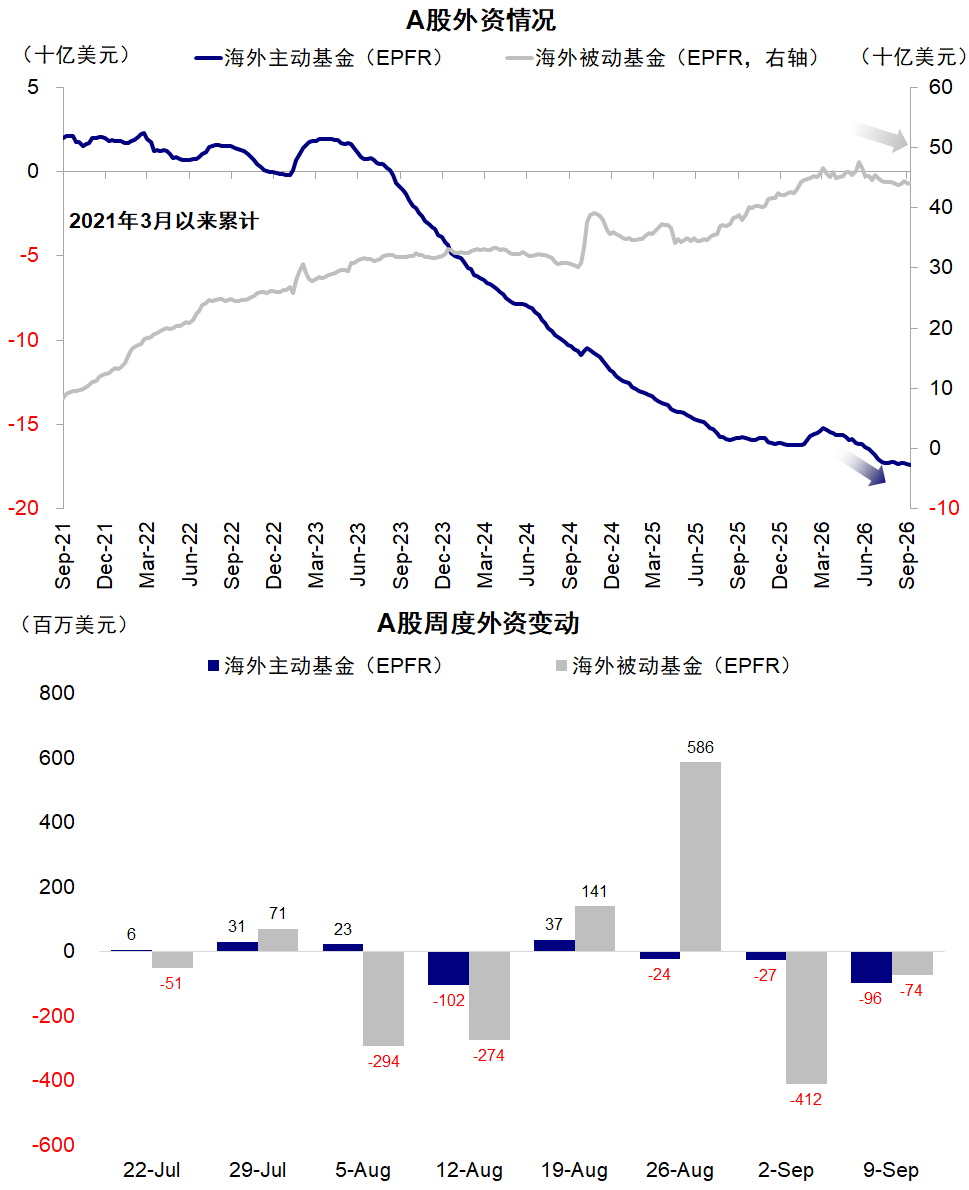
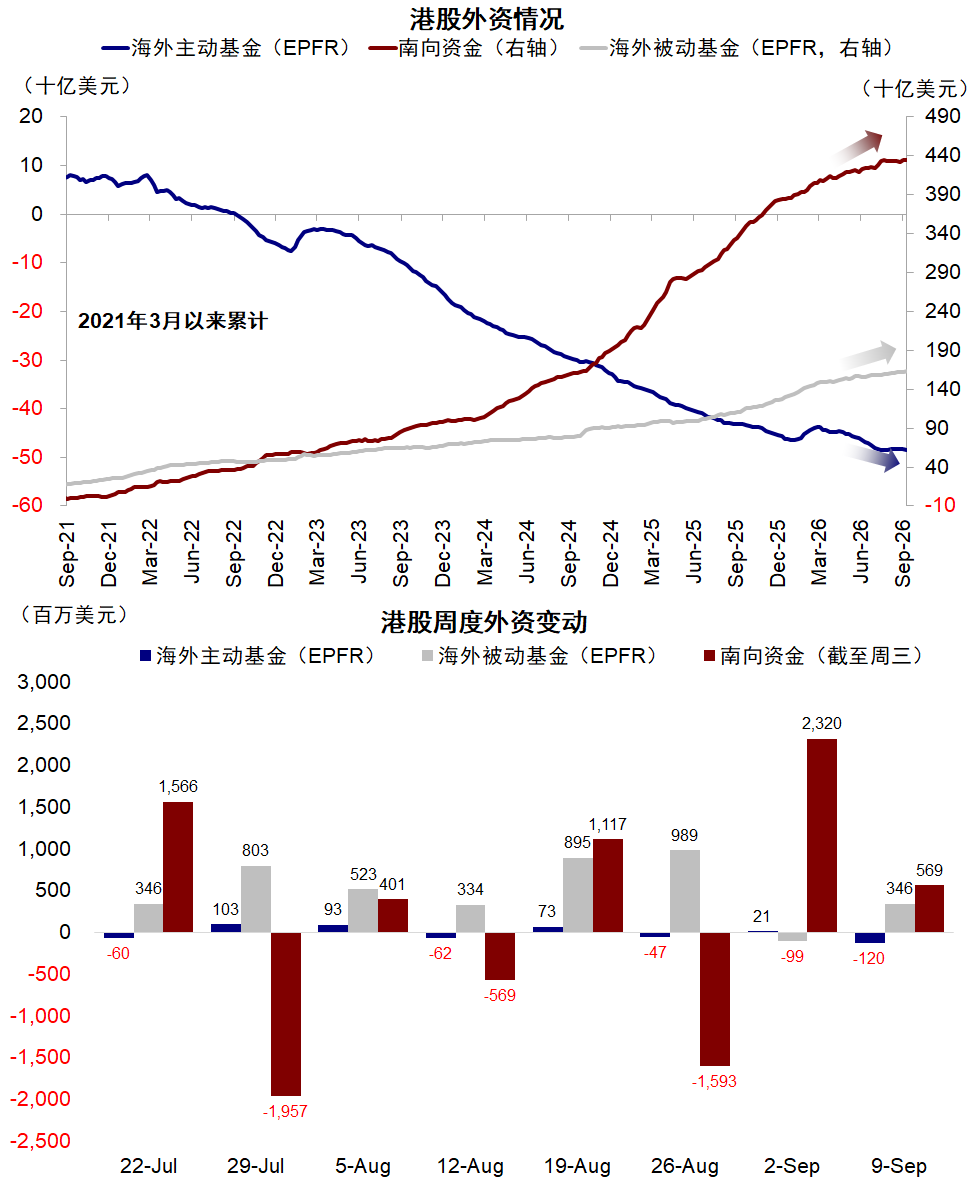
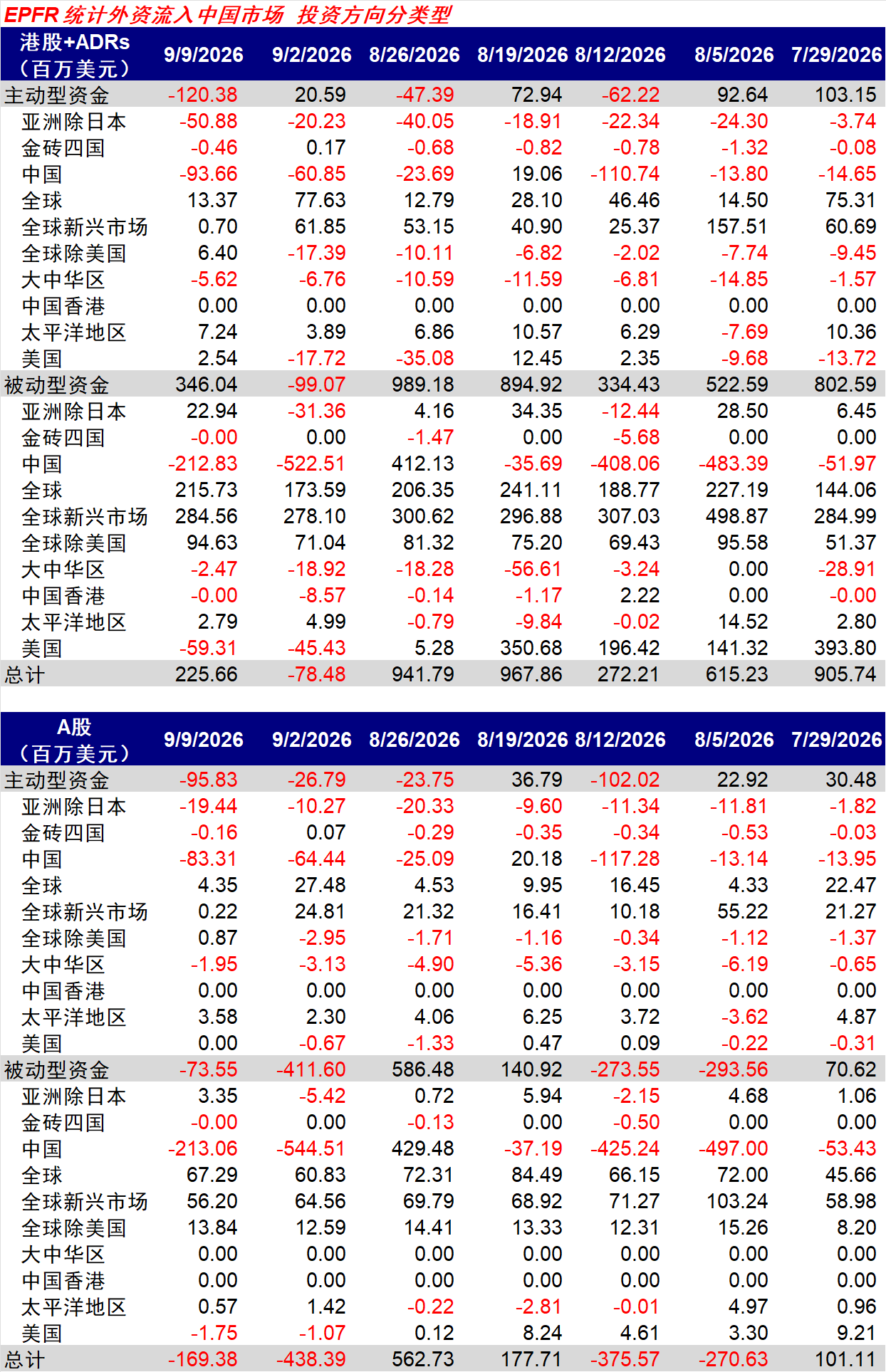
1️⃣ Foreign capital: Active foreign capital outflow from Hong Kong stocks of 120 million USD (vs. inflow of 20 million last week), outflow from A-shares of 100 million USD (vs. outflow of 30 million last week). Focused global and emerging market fund inflows narrowed, while focused China fund outflows accelerated.
Passive foreign capital inflow into Hong Kong stocks of 350 million USD (vs. outflow of 100 million last week), outflow from A-shares of 70 million USD (vs. outflow of 410 million last week) <a class="wx_img_refer_link" data-seq="2" data-refer="Figure 2" style="">Figure 2</a><a class="wx_img_refer_link" data-seq="3" data-refer="Figure 3" style="">Figure 3</a><a class="wx_img_refer_link" data-seq="4" data-refer="Figure 4" style="">Figure 4</a>.
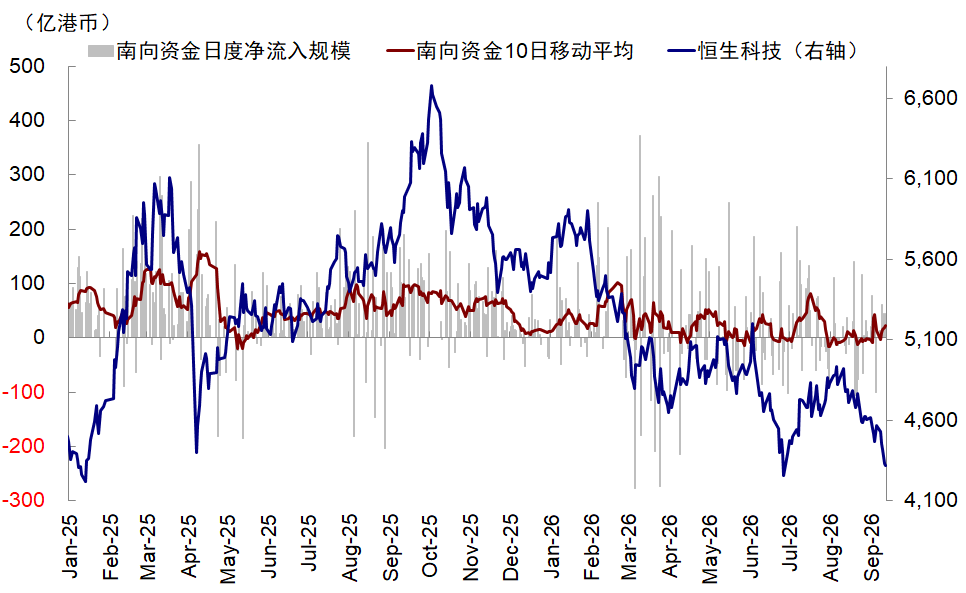
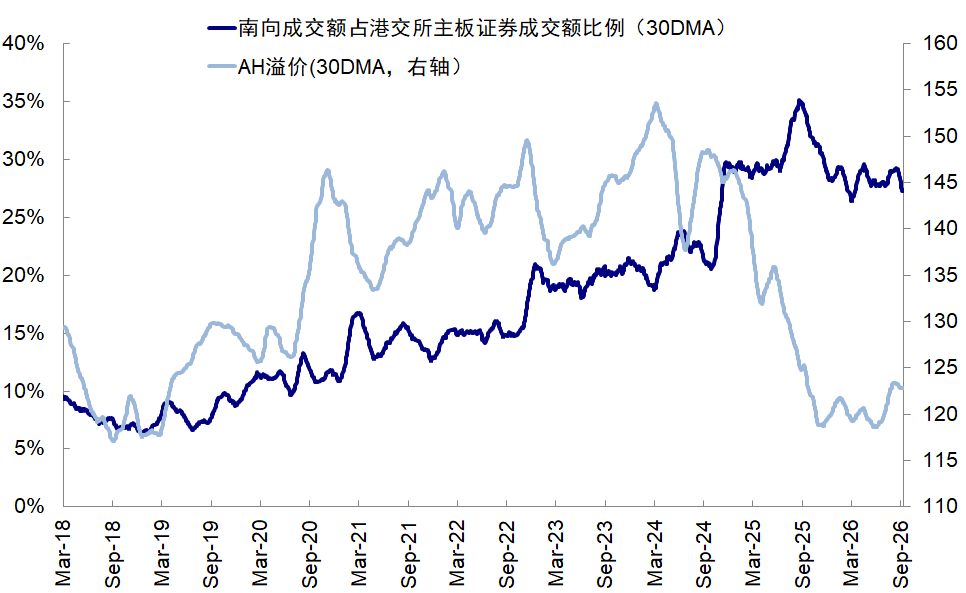
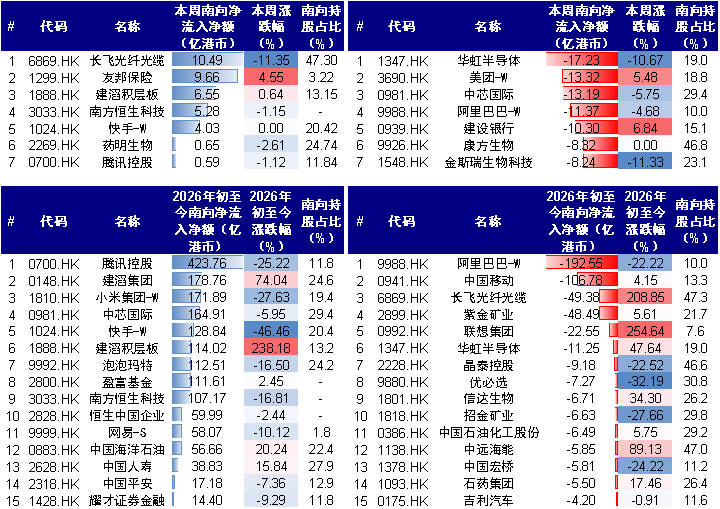
2️⃣ Southbound: Inflow of 20.1 billion HKD (vs. inflow of 7.36 billion last week), daily average inflow of 4.02 billion HKD (vs. daily average inflow of 1.47 billion last week) <a class="wx_img_refer_link" data-seq="5" data-refer="Figure 5" style="">Figure 5</a>. Buying Xiaomi, Baidu, Alibaba, etc., selling SMIC, Sinovac Biotech, Hua Hong Semiconductor <a class="wx_img_refer_link" data-seq="7" data-refer="Figure 7" style="">Figure 7</a>.
🏵️ Several changes this week are noteworthy:
First, southbound inflows accelerated, while overseas outflows accelerated. According to our整理 in <a href="https://mp.weixin.qq.com/s?__biz=MzA3NjU1NTQwMA==&amp;mid=2649792384&amp;idx=1&amp;sn=c1d7882a5093c29db59fc68aa03f9c40&amp;scene=142#wechat_redirect" class="normal_text_link mp_article_text_link" target="_blank" data-itemshowtype="">Who is the "smart money"</a>, if the trend of accelerated southbound inflows continues, it could serve as a signal that the bottom of Hong Kong stocks is approaching in the short term.
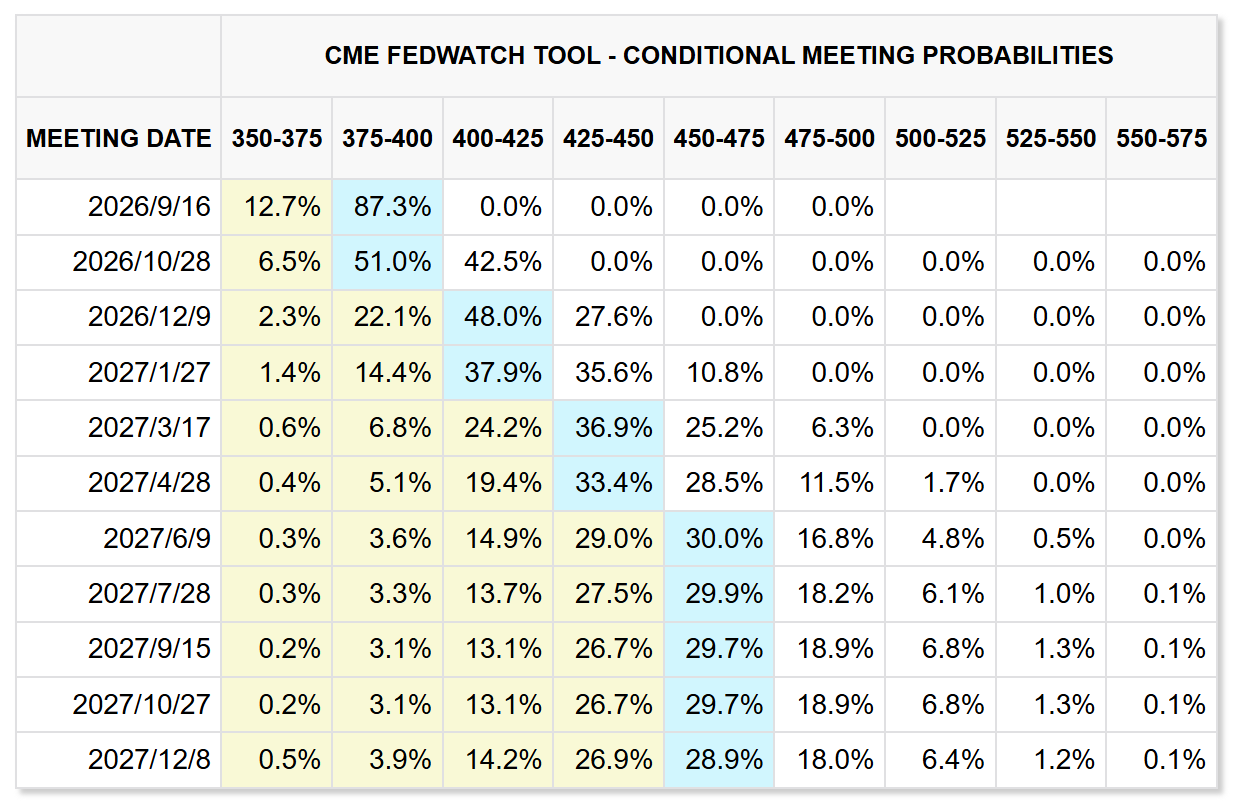
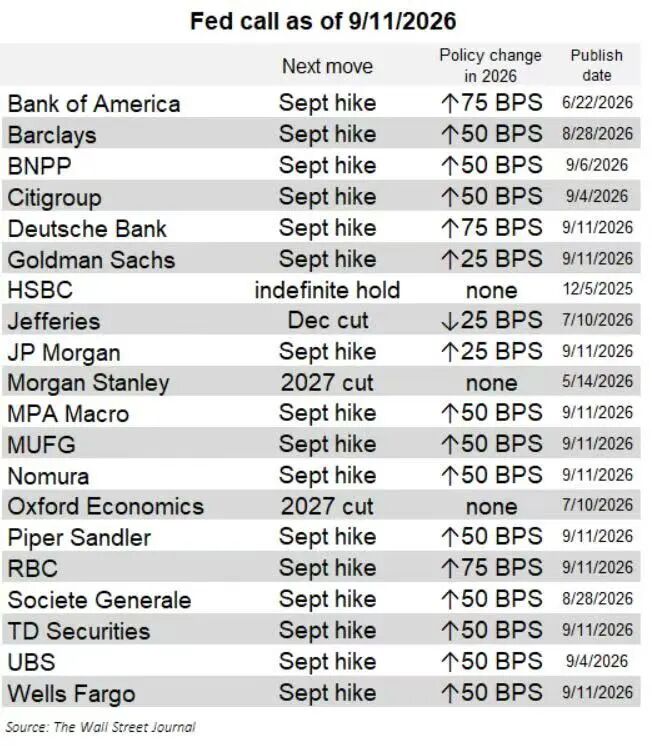
Second, the Federal Reserve is raising interest rates. On Friday, the CPI exceeded expectations, giving the Federal Reserve the final blow to raise rates <a href="https://mp.weixin.qq.com/s?__biz=MzA3NjU1NTQwMA==&amp;mid=2649792463&amp;idx=1&amp;sn=fda7990d400b5c17ddaf4cdb201a9036&amp;scene=142#wechat_redirect" class="normal_text_link mp_article_text_link" target="_blank" data-itemshowtype=""> August CPI: The Federal Reserve is cornered </a>, now there is basically no choice: 1) CME futures pricing shows a 87% probability of a rate hike next week <a class="wx_img_refer_link" data-seq="8" data-refer="Figure 8" style="">Figure 8</a>; 2) Major Wall Street investment banks also predict a rate hike in September <a class="wx_img_refer_link" data-seq="9" data-refer="Figure 9" style="">Figure 9</a>.
What does this mean? 1) If they stick to not raising next week, the market may panic more, worrying that the credibility of the Federal Reserve and Mr. Walsh will be further damaged, leading to uncontrollable U.S. debt, weakening of the dollar, and a surge in gold. 2) If they raise rates, with such a high level of consensus, how many expectations are not yet factored in? The market may trade as though the bad news is fully priced in, and may even trade a peak in U.S. debt interest rates under the assumption of the Federal Reserve's credibility recovery, strengthening the dollar, putting gold under short-term pressure.
Unless, not only do they need to raise rates, but to raise them consecutively.
Currently, there may not be a basis for continuous large rate hikes, as traditional demand will soon feel the suppression of high rates, so rate hikes may end up leading to an inability to continuously raise rates, which sounds complicated, it's the reflexivity of high rates. Therefore, there is only one scenario, which is if oil prices completely spiral out of control. If the average price maintains above 100, then inflation will not go down. Regarding this issue, let’s trust Trump once again.
Therefore, a rate hike is not necessarily a bad thing, and not raising is not necessarily a good thing. Brief rate hikes or cuts are often in the "opposite direction," and realization is often a turning point, with rate cuts in 2024 and 2025 being like this, and the 1997 rate hike being similar.
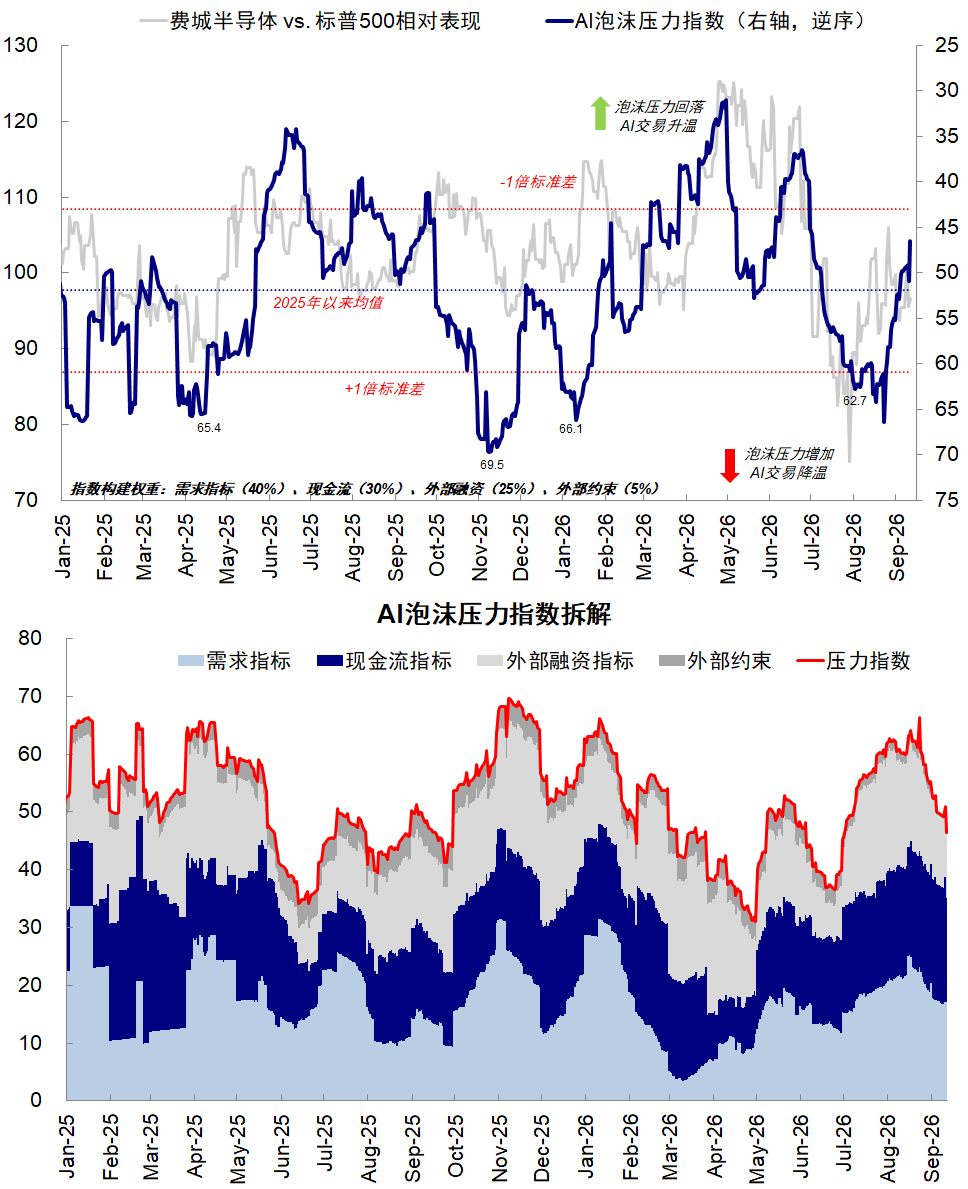
Third, AI progress. Our own 【AI Bubble Pressure Index】 continued to improve this week, and the fundamentals are still recovering <a href="https://mp.weixin.qq.com/s?__biz=MzA3NjU1NTQwMA==&amp;mid=2649792190&amp;idx=1&amp;sn=b3177b9aaf6c91f392c4c1e00fb1ca03&amp;scene=142#wechat_redirect" class="normal_text_link mp_article_text_link" target="_blank"></a>How to characterize the degree of AI bubble?</a>. However, Dario from Anthropic's post about regulating the pace of frontier AI development has attracted attention, especially during the expected transitional period. Although he does not mean to stop AI model training, but rather to allow time for risk prevention measures to keep pace with technological advances, how the market interprets it still needs to be observed. Does it mean that the investment in model training will slow down? Will model iteration slow? Will new application catalysts be postponed? Coincidentally, OpenAI also mentioned that an IPO this year might not happen.
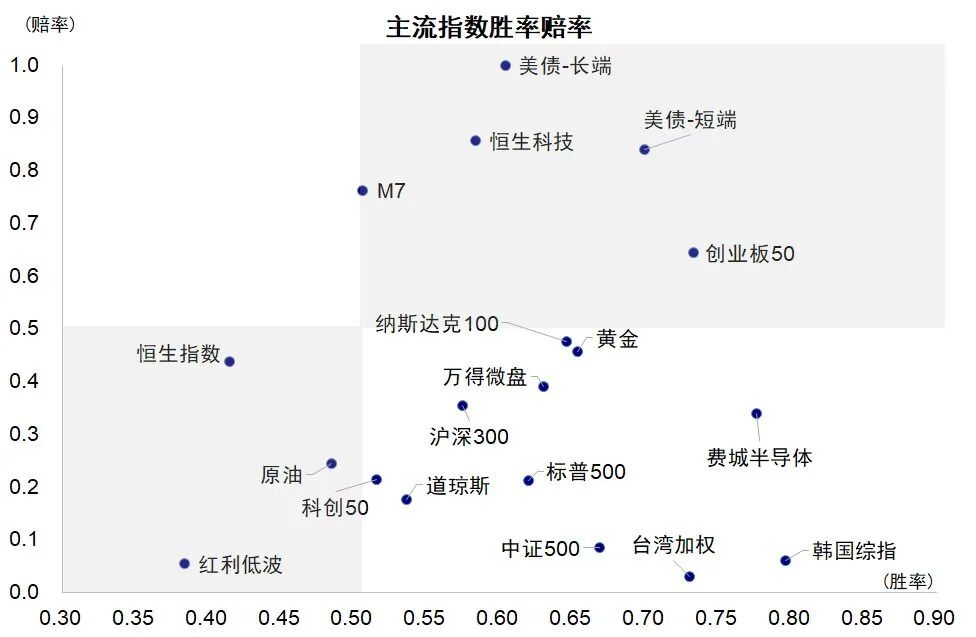
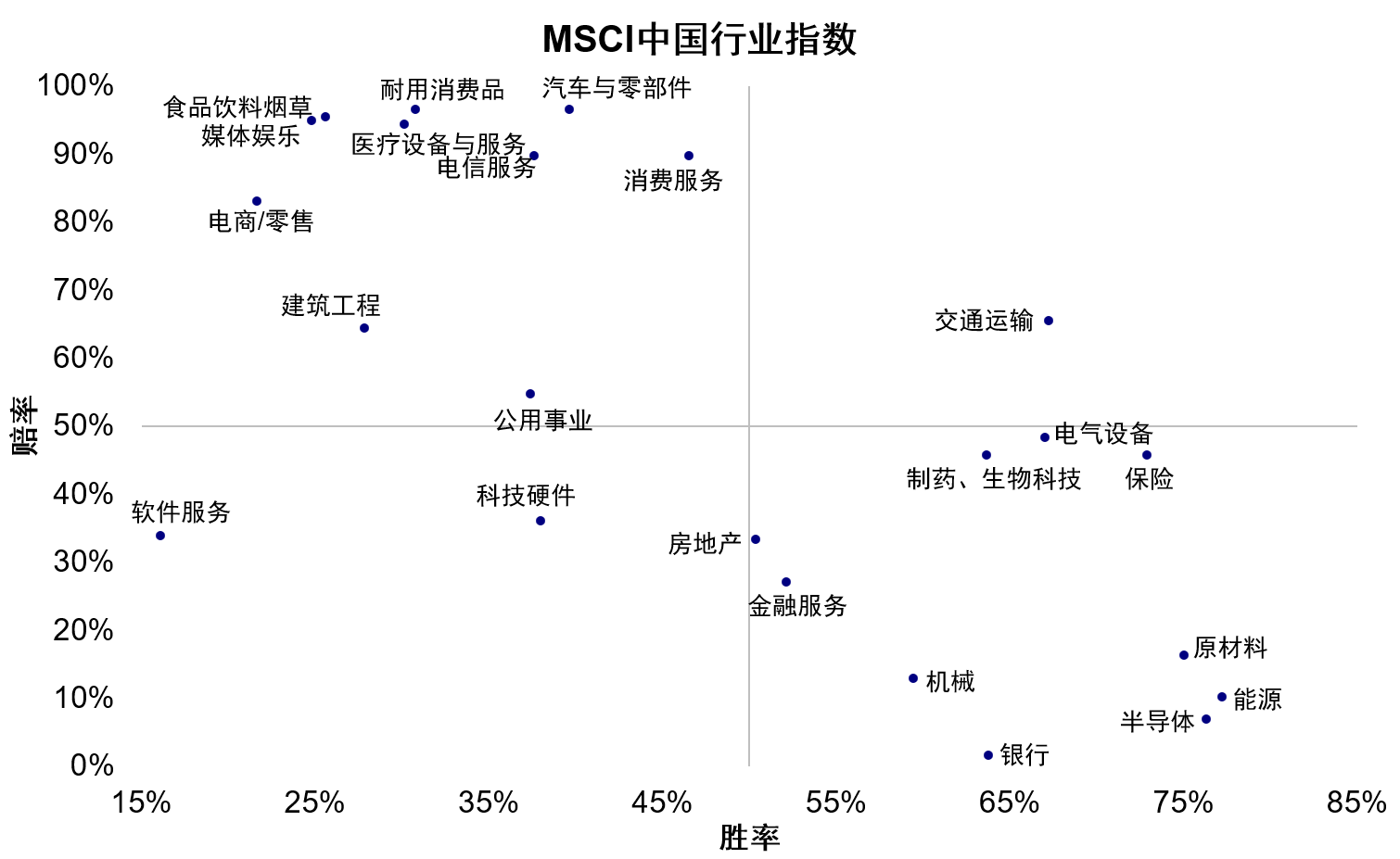
🏵️ Finally, our own 【Odds Victory Rate Framework】 update shows: 1) Short-term U.S. treasuries, long-term U.S. treasuries, Philadelphia semiconductor, South Korea composite index, Hang Seng Tech, Taiwan weighted index, and ChiNext scoring high <a class="wx_img_refer_link" data-seq="9" data-refer="Figure 9" style="">Figure 9</a>; 2) In terms of sectors, insurance, transportation, energy, materials, and semiconductors scored high <a class="wx_img_refer_link" data-seq="10" data-refer="Figure 10" style="">Figure 10</a>.
免责声明:本文章仅代表作者个人观点,不代表本平台的立场和观点。本文章仅供信息分享,不构成对任何人的任何投资建议。用户与作者之间的任何争议,与本平台无关。如网页中刊载的文章或图片涉及侵权,请提供相关的权利证明和身份证明发送邮件到support@aicoin.com,本平台相关工作人员将会进行核查。


