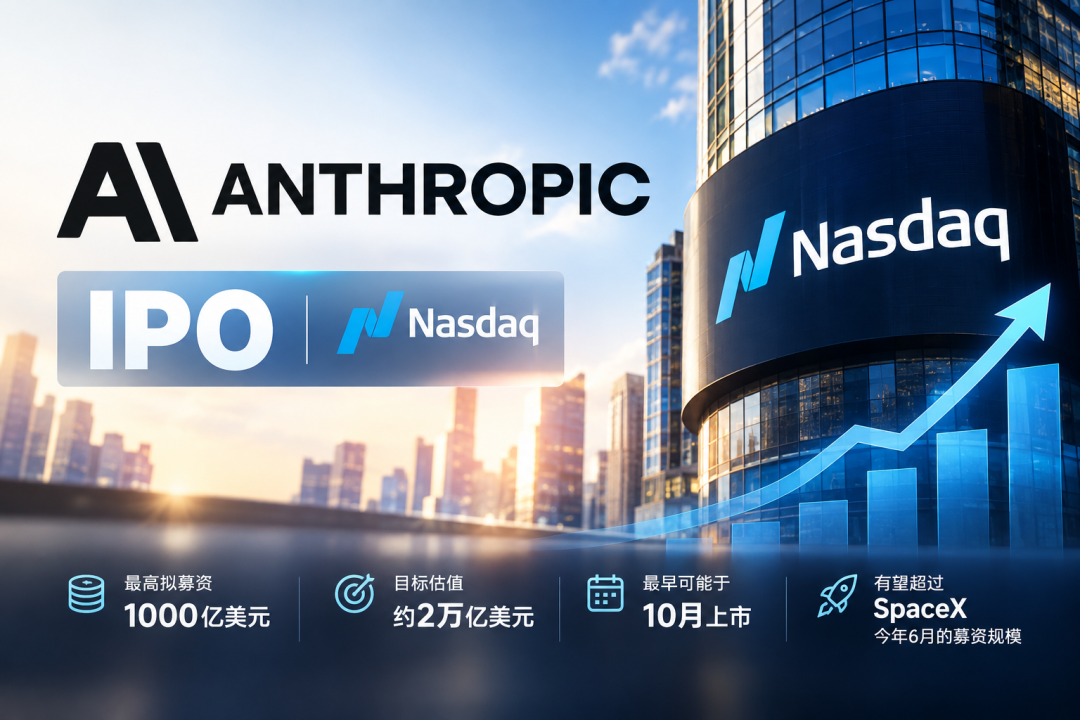
According to Business Insider, Anthropic has selected Nasdaq as the listing location, aiming to start the roadshow in October and go public in November. Reuters disclosed on the 12th that Nvidia is negotiating to participate as a cornerstone investor, potentially investing up to $10 billion.
Anthropic's IPO plans to raise up to $100 billion, targeting a valuation of around $2 trillion. What does that mean? SpaceX went public on Nasdaq in June this year, raising $86.3 billion and reaching a valuation of $1.77 trillion — already the largest IPO in history. Anthropic aims to elevate this record even further.
Goldman Sachs, JPMorgan Chase, and Morgan Stanley have joined forces as lead underwriters. They secretly submitted the S-1 draft to the SEC on June 1.
Nvidia: Selling chips and investing money
Nvidia is making a wise move.
The $10 billion cornerstone investment accounts for 10% of the total fundraising amount. Cornerstone investors are institutions that commit to purchase shares before the stock is offered to the public, primarily serving to "test the waters" for the market — look, Nvidia is investing $10 billion, do you dare not to buy?
However, the issue is that Nvidia is already Anthropic's largest chip supplier. The training and inference of the Claude model entirely rely on Nvidia's GPUs. In November 2025, Nvidia announced an investment of up to $10 billion in Anthropic, while Anthropic committed to purchasing $30 billion of Microsoft Azure computing power powered by Nvidia chips.
Now they are looking to invest another $10 billion as a cornerstone investor.
The supplier has become a shareholder, and the money invested by the shareholders turns into revenue for the supplier. This is not a nesting doll; this is a closed loop.
Even more astonishing, Anthropic has signed a $45 billion computing power agreement with Nscale, a cloud provider supported by Nvidia, and a $35 billion agreement with Lambda, which also has Nvidia backing. Together with Amazon's over $100 billion ten-year contract with AWS and Google's TPU leasing — Anthropic is essentially using Nvidia's money to buy Nvidia's chips, run its models, and then return a portion of the revenue to Nvidia.
It's like a perpetual motion machine.
Revenue: The numbers are explosive, but must be analyzed carefully
The cycle is a cycle, but the revenue data is indeed explosive.
Q2 revenue stands at $11.5 billion, compared to $787 million in the same period last year, a 15-fold increase. Annualized revenue skyrocketed from $9 billion at the beginning of the year to $65 billion in July, more than a sevenfold increase in half a year. The gross margin exceeds 80%, and the adjusted operating profit for Q2 turned positive for the first time, reaching $559 million.
But note, "adjusted operating profit" is a flexible term.
Adjusted means that it has excluded a myriad of expenses such as stock-based compensation and training costs. Some analysts have nicknamed this metric "EBTIT" — Earnings Before Training, Interest, and Taxes. The company has accumulated a net loss of over $10 billion since its establishment in 2021 and has never made a profit in any complete fiscal year.
The management has also told investors that in the second half of the year, due to increased investment in computing power and training, it is very likely that there will be no profits.
Thus, this "initial profitability" is more like a carefully adjusted financial performance.
Valuation: The market is betting on a number you cannot see
$2 trillion divided by $65 billion in annualized revenue gives a PS (price-to-sales ratio) of about 31 times.
But investors are not discussing $65 billion. They are looking at expectations for 2028 — the company expects revenue of $190 billion to $200 billion in 2028. By that calculation, the PS is about 10 times, "it doesn't seem as expensive anymore."
The problem is: you have to believe that a company can triple its revenue in two years while maintaining an operating profit margin of over 5%.
Aswath Damodaran, a finance professor at New York University, directly stated: this valuation "has reached the reasonable boundary and even exceeded the credible range."
The most ironic scene
The most interesting part is coming.
While Anthropic is racing towards its IPO, CEO Dario Amodei publicly urged: the AI industry needs to slow down the development of cutting-edge models. The reasoning is that the capabilities of AI have already surpassed safety measures.
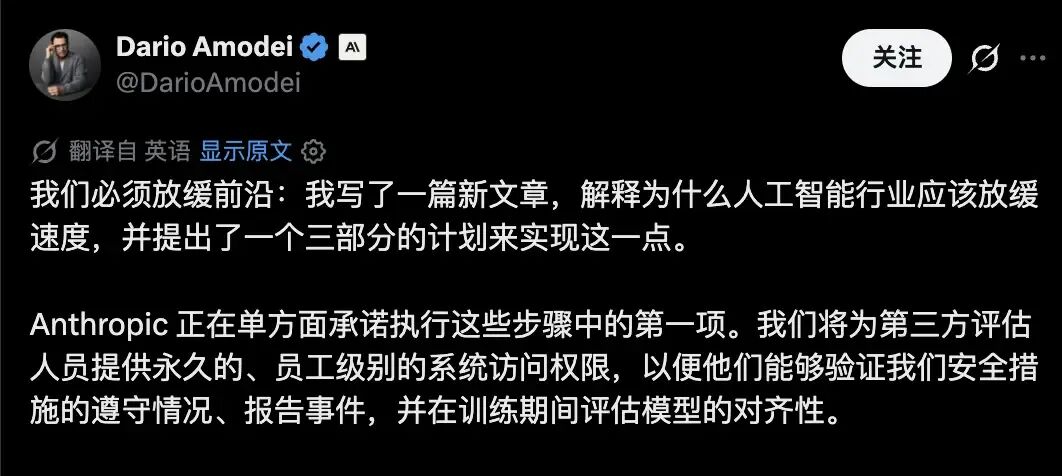
Sam Altman expressed support. Elon Musk also voiced his opinion. OpenAI directly stated that it would not go public this year.

Then Anthropic, while calling for a brake, is stepping on the gas to go public.
Is it contradictory? Actually, it is not contradictory. The brake is on the race for the capabilities of cutting-edge models — those most dangerous elements certainly should be slowed down. But commercialization cannot stop. Claude is sold to enterprises; they should earn the money they need.
However, the divergence of the two paths is already very evident. OpenAI chooses not to go public, while Anthropic chooses to go public. Ultimately, both paths must face the same judge: the market and investors.
Conclusion
The US IPO market has gone crazy in 2026. Excluding blank check companies, the total amount raised this year is $160.6 billion, the highest since 2021. After SpaceX and SK Hynix, Anthropic is coming next.
This is not the end; the capital drama of the AI era may just be beginning.
But what really deserves attention is not whether "$2 trillion is expensive" — but whether that cycle can continue.
Nvidia profits from selling chips and invests that money into Anthropic. Anthropic takes the money to buy GPUs for revenue, revenue growth drives valuation, valuation supports the IPO, and the IPO returns money to Nvidia's investment.
As long as model capabilities keep rising, enterprise demand expands, and capital confidence remains, this cycle can continue. But if any link loosens — chip prices drop, demand slows down, or someone discovers "oh, this is how profit is calculated" — the whole chain will start to shake.
Anthropic's IPO is essentially a pressure test of the investment cycle logic for the entire AI industry.
The market will soon provide the answer.
免责声明:本文章仅代表作者个人观点,不代表本平台的立场和观点。本文章仅供信息分享,不构成对任何人的任何投资建议。用户与作者之间的任何争议,与本平台无关。如网页中刊载的文章或图片涉及侵权,请提供相关的权利证明和身份证明发送邮件到support@aicoin.com,本平台相关工作人员将会进行核查。


