Written by: Rita
Dario Amodei, CEO of Anthropic, published an article over the weekend proposing a "rhythm framework," advocating for a slowdown in the pace of improvement in AI model capabilities. Bernstein noted in a report released on September 14, 2026, that the market might misinterpret this statement as a signal of slowing AI spending. The firm believes that spending plans will not change as a result. The semiconductor sector has risen 67% since the beginning of the year but is still down about 19% from the June peak, rebounding about 13% from the July low.
Dario's proposal includes three steps. The first step is to embed independent third-party evaluators to verify and report compliance with practices and commitments by companies; Anthropic commits to implementing this step immediately. The second step is democratic coordination, meaning U.S. regulation covers all U.S. AI companies, regardless of whether they agree. The third step is global rhythm, reaching some form of cooperation or coordination with China.
Bernstein analyst Stacy Rasgon posed a key question in the report: Does slowing the pace mean slowing spending? The firm believes that slowing the pace does not imply slowing spending. Dario is discussing limiting training computing power, the nature of training runs, and using internal AI to improve AI, without mentioning stopping training. He suggested reducing from "very fast" to "somewhat fast," still very fast at the current scaling rate.
Inference demand can no longer be satisfied
Bernstein pointed out that AI semiconductor demand is increasingly driven by inference, especially after the emergence of agent use cases. The computing power consumption of agent use cases is several times that of traditional inference, and the current computing power is far from sufficient to meet the needs of existing models, let alone potential new models that may be introduced in the future. The firm doubts that recent AI revenue targets have reflected spending plans, and the possibility of substantial changes to these plans is very low.
This is not the first time there have been calls for AI standards and oversight. Google DeepMind head Demis Hassabis made similar suggestions in July. Bernstein believes that these discussions will not change the actual spending pace of companies because inference demand has already transformed into definitive orders and capacity planning.
The China factor is the driving force behind
Dario clearly stated in the article that U.S. restrictions cannot come at the expense of allowing China to take the lead. He proposed measures to maintain the gap with China, including continuing to prohibit the sale of advanced AI chips or semiconductor equipment to China, and cracking down on unauthorized distillation and preventing the theft of model weights. Bernstein noted that recent news showed that Chinese labs are secretly using unauthorized Claude distillation to train models. Dario reiterated these points in an interview with CBS.
Bernstein believes that the proposal is driven by concerns over recursive self-improvement and safety alignment, but the concerns regarding China may be a greater driving force. U.S. AI companies hope that the regulatory framework can limit competitors while not slowing their own computing power expansion.
Safer AI is easier to adopt
Bernstein pointed out that safer AI is easier to adopt. The firm is not a staunch believer in a "Skynet" scenario, but also does not want it to happen. Establishing an AI safety plan may benefit long-term industry adoption and help alleviate political and social anxieties about AI. The current call mainly focuses on third-party evaluation, and Bernstein believes the direction is reasonable.
The firm believes that it is now too late to put the AI genie back in the bottle; instead, it is better to find a safer way to let it out. The establishment of a safety framework will reduce policy risks, thereby supporting long-term investments in AI infrastructure.
NVIDIA and Broadcom remain top choices
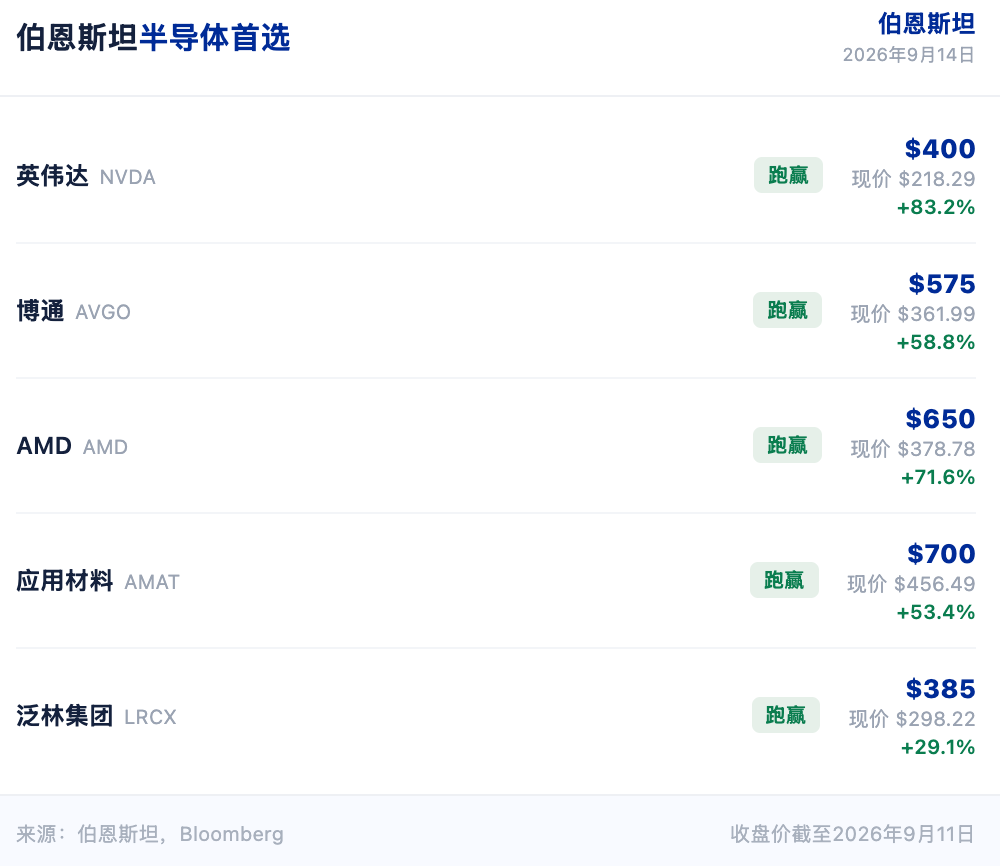
Bernstein maintains a positive outlook on AI construction prospects. NVIDIA (NVDA), Broadcom (AVGO), and semiconductor equipment are the firm's top picks. NVIDIA is rated outperform with a target price of $400. Broadcom is rated outperform with a target price of $575. AMD is rated outperform with a target price of $650. Applied Materials (AMAT) is rated outperform with a target price of $700. Lam Research (LRCX) is rated outperform with a target price of $385. KLA (KLAC) is rated outperform with a target price of $250. PDF Solutions (PDFS) is rated outperform with a target price of $65.
As of the market close on September 11, 2026, NVIDIA's stock price was $218.29, Broadcom's stock price was $361.99, AMD's stock price was $378.78, Applied Materials' stock price was $456.49, Lam Research's stock price was $298.22, and KLA's stock price was $180.64.
Whether Dario's proposal will change AI spending plans or become a catalyst for industry adoption is only the first observation point from Monday's reaction.

Disclaimer
This article is a summary and interpretation of a third-party brokerage research report (Bernstein, September 14, 2026) by Chao Xiang Research, combined with the organization of publicly available market information. The ratings, target prices, earnings forecasts, and related judgments quoted in this article represent the views of the brokerage analyst and solely reflect the position of their institution, not the views of Chao Xiang Research, and do not constitute any investment advice.
The market has risks, and decisions should be made independently. This article should not be used as the basis for buying or selling any securities.
免责声明:本文章仅代表作者个人观点,不代表本平台的立场和观点。本文章仅供信息分享,不构成对任何人的任何投资建议。用户与作者之间的任何争议,与本平台无关。如网页中刊载的文章或图片涉及侵权,请提供相关的权利证明和身份证明发送邮件到support@aicoin.com,本平台相关工作人员将会进行核查。


