Before the end of September, the market may maintain a volatile rhythm.
According to the thermometer prepared by Guolian Minsheng Securities, the manager of Banjiaojia Investment Advisors, as of last Friday, the A-share temperature fell below 70 degrees, and the global thermometer also hit a recent low. The market's dullness is something that everyone can feel; today, the trading volume is 1.64 trillion, which is 20 billion less than last Friday, marking the second lowest this year (only after April 7).
However, this somewhat cold style of a range is actually quite comforting for me—if it were a fiery market like in May or June, I would be warning of risks every day, like a clown; and if there were another sharp decline like in July, my account would suffer huge losses, and I might not be able to massage it back. So, the current market situation is just right, slowly washing out impatient and complaining funds, and leaving enough space for patient investors to sow seeds, as my overall judgment is not pessimistic about the future market; the index valuation is still reasonable, and the retreat is manageable—still as I mentioned earlier, from the perspective of the main economic entities' indexes, the A-shares have the best safety margin.
I have also created a column in the community for in-depth tracking of major asset categories and the thermometer; so far, I have completed global markets, core A-share assets, dividends, gold, fixed income+, and the depth interpretations of these five asset categories, as well as the thermometer framework. I have placed the collection at the end of the article, suitable for personal investors who truly want to “know what is and why it is,” and for wealth managers who need an analytical framework, ensuring it is all in plain language.
If you need it, please see the end of the article.
......
Back to today's market.
1. Today, the global AI sector fell together; the chart below, as of 3 PM, includes the A-share double innovation 50, Hong Kong's semiconductor, the Nasdaq 100 futures in the US, as well as four major AI leading companies in Japan and South Korea.
Tonight, I took a look, the US stock market opened, and the Philadelphia semiconductor index opened down over 5 points.
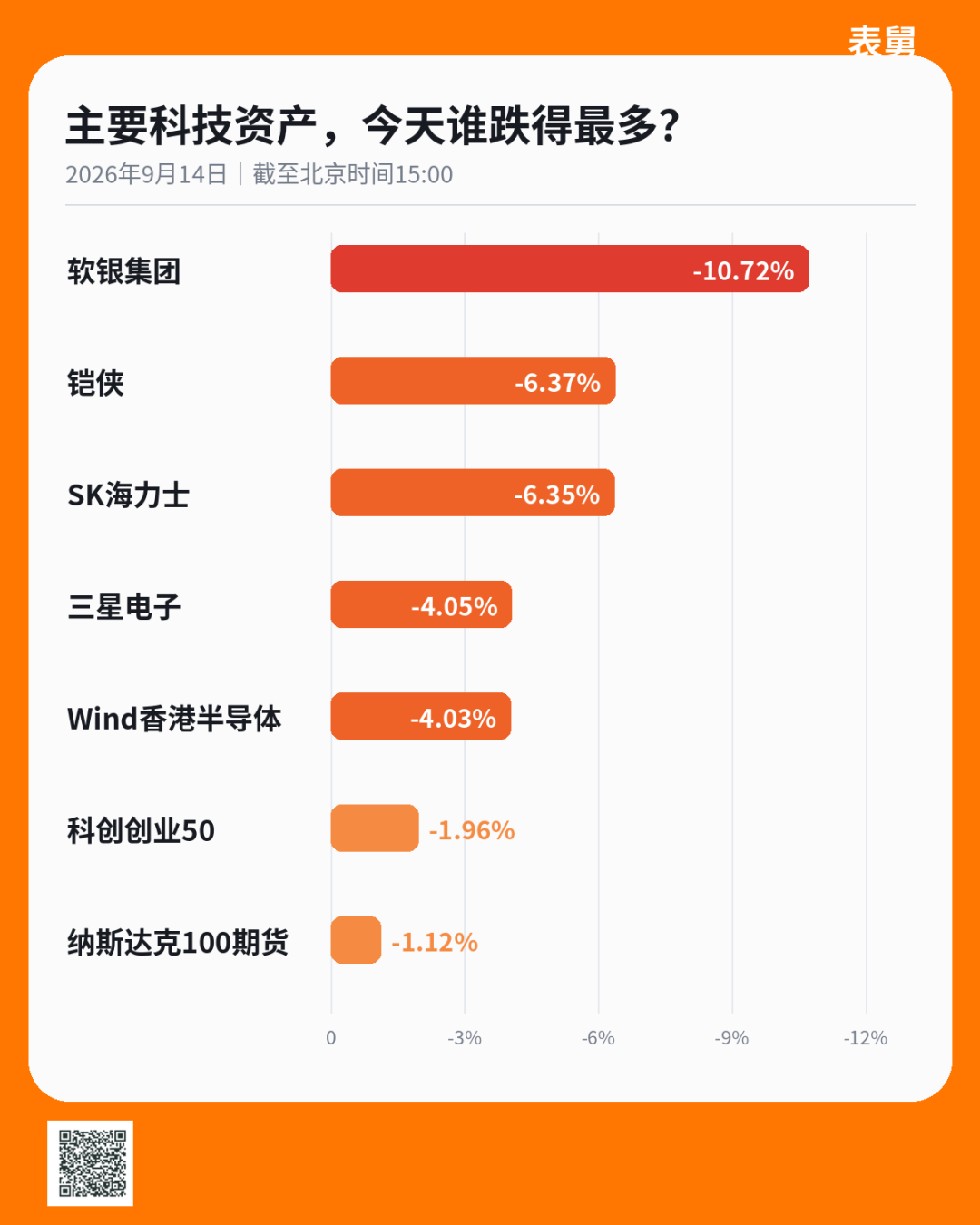
The reason is that Dario, the founder of the current strongest model company Anthropic, published an article titled “We Must Pace the Frontier” (the full text in both Chinese and English, as well as detailed interpretation, can be seen in the community post this weekend), calling for a slowdown in the development of cutting-edge AI models, strengthening regulation, and continuing to impose computing power restrictions on Dong University.
In the short term, this has lowered the market's expectations for AI capital expenditure and valuation, negatively impacting the chip and computing power supply chain; here in A-shares, Zhongji and New Xisheng in the optical module sector both fell 5-6 percent.
2. Dario's article can be compared to a scene in school—during the summer vacation between sophomore and junior years, because of Dario's unique talent and financial support from his family, he completed the junior year curriculum early and then began to advocate:
First, everyone shouldn’t push too hard in their junior year; it’s bad for your health; second, lights must go out at 8 PM, to prevent anyone from secretly studying, the school must enforce it, either by cutting off the electricity or arranging teachers to patrol;
Third, that Dong University in Class 3 is the most dangerous; even if the lights are out, he might still be under the covers reading by flashlight, and his flashlight has to be confiscated, and incidentally, his calculator too, forcing him to use an abacus to solve problems (which is his long-term call for a global ban on chip exports to China).
3. As an anti-China figure, Dario certainly can be described as petty.
Fortunately, we don’t need to scold him personally; there are voices to do it for us—David Sacks, called the AI Tsar, previously appointed by Trump as the head of AI and cryptocurrency policy at the White House, his words basically represent the government's stance.
He wrote a lengthy rebuttal to Dario yesterday, and to summarize the core ideas in plain language:
First, isn’t cutting-edge AI determined by you and OpenAI? If you’re really afraid of AI going out of control, why don’t you stop first, no one is stopping you, what's the point of being dramatic in your article?
Second, you’re not waiting for regulation; you’re trying to pressure the government into action with the “AI will cause problems” narrative;
Third, according to you Dario, it’s best if the rules for regulating AI development are set by you, right? Then the government publishes it, helping you fend off newcomers, while you monopolize and make money quietly?
Fourth, you claim to be saving humanity, but isn’t it really just “killing with a borrowed knife”? Using the emperor’s order to build your own moat?
In short, David Sacks means:
Phooey.
As soon as you lift your butt, I know what crap you're about to pull.
4. Of course, this matter requires us to have three clear understandings.
First, what is the core of AI? It is military hegemony, Dario has always said, whoever masters the strongest AI first may gain global military dominance (which is why he always mentions ideology), thus, the competition in AI cannot stop, and David Sacks also says, your words Dario are worthless, because Dong University cannot possibly adhere to what you say.
Second, if a senior critic considers you the greatest threat, it shows you indeed have strong competitiveness; this is the real competitive strength of our Dong University in AI at the moment.
Third, big models themselves are relatively poor business models; you see, even the leading big models are very anxious, guarding against others overtaking them on curves.
5. Looking specifically at the domestic market.
There are two hotspots to pay attention to, one about repurchases and the other about spending.
First, let's talk about Ning Wang’s repurchase.
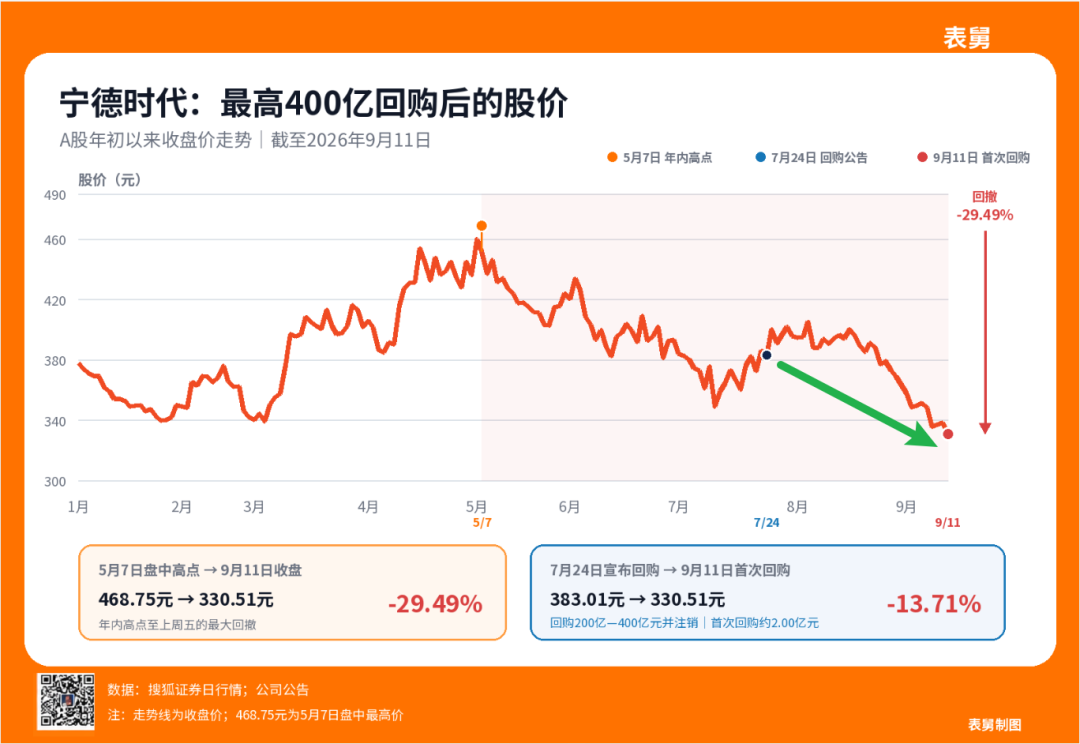
Last Friday after the market close, Ning Wang announced the initiation of the first repurchase.
In the chart below, let me help you note that Ning Wang announced a repurchase and cancellation of 20-40 billion on July 24, but there was no progress for a long time; consequently, by last Friday, the stock price had dropped 13% since the announcement of the repurchase, hitting a new low for the year, and having retreated nearly 30% from the peak. It was only after this that 200 million was repurchased for the first time.
Today, Ning Wang rose over 2%, offsetting some of the decline of the optical module leader.
6. The other hotspot is Zhizhu continuing to spend.
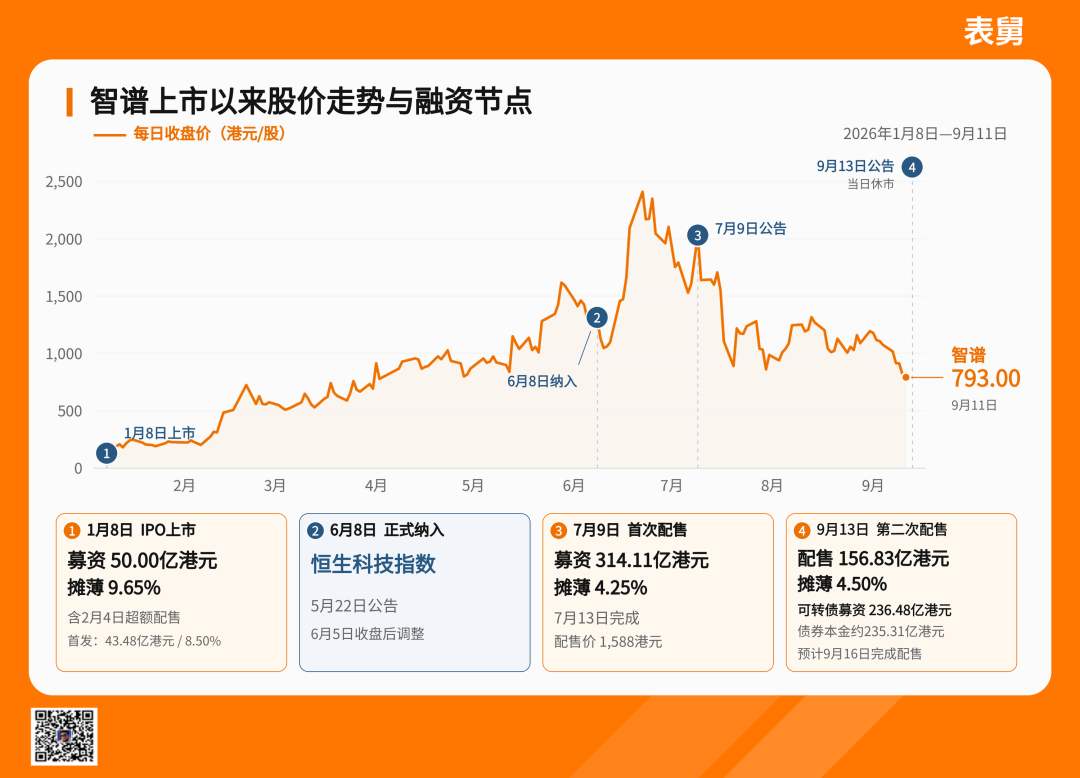
This weekend, Zhizhu announced the second placement since its listing, and simultaneously issued convertible bonds, with a total amount of nearly $50 billion.
In the chart below, look at a few landmark moments:
At the beginning of January this year, IPO, raising $5 billion (the following are all in Hong Kong dollars);
At the beginning of June, included in the Hang Seng Tech Index;
At the beginning of July, the first placement raised over $30 billion, diluting shares by more than 4%;
In just two months, they are financing again, including stock placements of more than $15 billion and convertible bonds of over $20 billion.
This business is really burning money.
Today, Zhizhu fell another 9%, with a total correction of -76% from the high.
I took a look, at the end of the first quarter, only 3 asset management companies held shares in Zhizhu and made it into the top ten; by the end of the second quarter, the number of asset management companies increased to 21, and products increased to 46—so far, all who increased their positions in the second quarter have been buried.
7. By the way, a similar situation raises another risk.
This Thursday, another leading domestic GPU company, MuX shares, will face its first significant lock-up expiration since listing.
Previously, when the first major lock-up expiration of MoEr occurred, it dropped -33% since then, which can be referenced. However, the market may have already noticed this risk, as MoEr started to drop around -28% immediately when the lock-up began.
8. Finally, the core of this week is still Super Central Bank Week, which includes:
Thursday at 2 AM, the Federal Reserve will announce its interest rate decision, with current expectations for rate hikes close to 90%;
Thursday at 7 PM, it's the turn of the Bank of England, with a high probability of no change in rates;
Friday morning, the Bank of Japan, with a high probability of increasing rates by 25 basis points, with a probability close to 100%.
Brace yourself; tonight it was reported that the Saudi east-west oil pipeline will be out of operation for several weeks, oil prices continue to soar, wait for the volatility in major asset classes to increase.
......
That’s all for now.
免责声明:本文章仅代表作者个人观点,不代表本平台的立场和观点。本文章仅供信息分享,不构成对任何人的任何投资建议。用户与作者之间的任何争议,与本平台无关。如网页中刊载的文章或图片涉及侵权,请提供相关的权利证明和身份证明发送邮件到support@aicoin.com,本平台相关工作人员将会进行核查。


