Author: Ethereum Foundation
Translation: Shenchao TechFlow
Introduction by Shenchao:The upcoming Glamsterdam upgrade of Ethereum brings a dual refactor of block construction methods and Gas billing. Any wallet, indexer, and estimator that hard codes Gas limits will directly crash. The foundation has opened the public test network in advance, allowing developers several months of window time, but the window does not wait for anyone.

tl;dr: Meet Platåberget: the early testing ground for the Glamsterdam (Gloas + Amsterdam) upgrade, now open to public participation. This upgrade will bring disruptive changes to application developers. Notably, any tools that rely on hard-coded maximum Gas limits (such as wallets, indexers, and Gas estimators) will fail and need updates. Please take advantage of this early opportunity to test!
Platåberget is a short-term test network designed for the community to test relevant changes. Unlike previous developer networks that existed for a very short time, Platåberget plans to run for several months, providing the community with a stable environment to experience Ethereum post-Glamsterdam and to have the opportunity to test and break things before the long-term test networks Sepolia and Hoodi launch.
What's in the Glamsterdam Fork
The Glamsterdam upgrade brings significant changes to both the consensus layer and the execution layer. Highlights include:
Built-in proposer-builder separation in the protocol: This is a significant change to the ways blocks are constructed, proposed, and validated, incorporating a new builder API process and PTC (load timeliness) checks. Infrastructure relying on block production and validation pipelines should expect to be affected.
Block-level access lists: Introducing mandatory block-level access lists that record accessed state locations and changes after transactions. Block-level access lists are stored separately from the block body and can be exchanged between execution layer nodes via eth/71.
Gas repricing: This is a set of coordinated changes in Gas costs aimed at lowering the Gas minimum to about 200 million. Any tools that hard code maximum Gas limits will be affected.
Larger contracts and initialization code: Increasing the maximum deployable contract size from 24KiB to 64KiB, and the maximum initialization code size from 48KiB to 128KiB.
Forward-compatible consensus data structure
The validator set of Platåberget is relatively small but publicly joinable. Anyone can deposit new validators and test their validator and builder deposit processes. ePBS is a significant change to the consensus layer, and we want to ensure that all independent stakers, DVT projects, custom software, and large-scale operators have ample opportunities to test their infrastructure. The Glamsterdam fork on the test network is scheduled for August 20, allowing enough time for deposits and preparing for the fork transition.
Another significant change in Glamsterdam is Gas repricing. These changes will impact a broader audience as they touch every wallet, indexer, and Gas estimator on the network. Please take this opportunity to identify which tools or assumptions in your system may be problematic before the fork goes live on the mainnet.
A complete list of included EIPs is tracked in the Glamsterdam meta EIP-7773.
Using Platåberget
Please check the Platåberget resource page for a summary of included EIPs, client support, and launch status; check the devnet-8 specification for network settings, configuration values, boot nodes, and client release information.
The Platåberget page provides a one-click add network process to configure your EL and CL clients, and there is a faucet providing testnet ETH for covering deposits and Gas fees.
Keep the following points in mind when running nodes:
The public will be able to submit validators or builder deposits via the Dora browser
The genesis validator set will not automatically pre-allocate staking to a few entities but will guide through public deposits and allocate some ETH at genesis to help with the launch.
Client releases: Releases from each client are optional; please check if the version is included in your selected client.
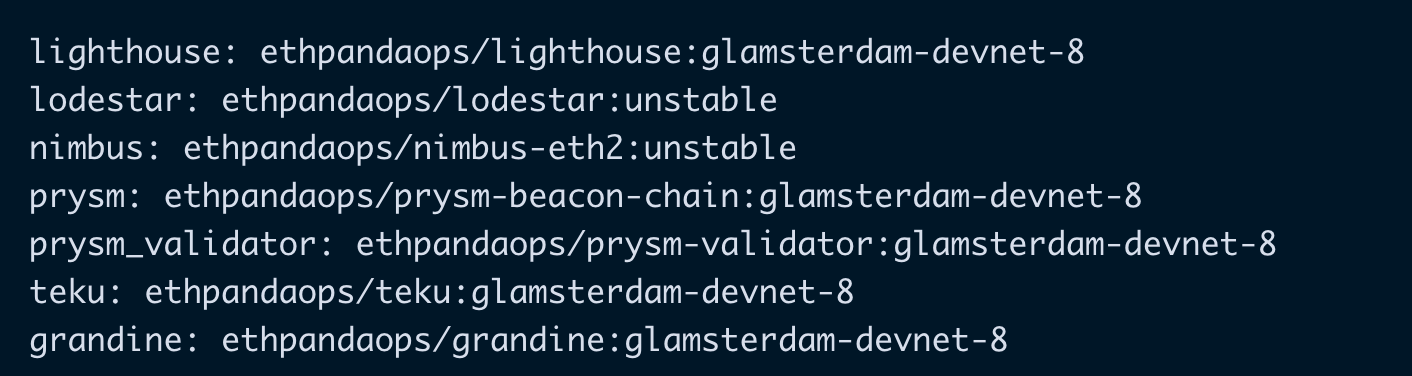
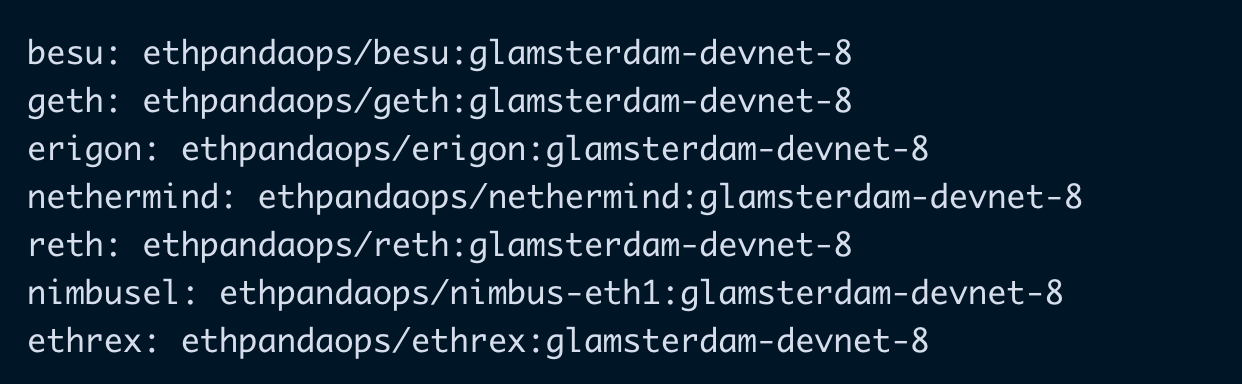
Client Images
Currently, before the client teams prepare labeled release versions, please use our ethPandaOps container images below.
Consensus Layer
Execution Layer
Support and Feedback
If you find errors or issues in the specifications, the best feedback channel is the Ethereum R&D Discord server. If you do not want to use Discord, you can also raise issues in the following specification repositories: consensus layer, execution layer, execution-apis, builder-specs, and beacon-APIs.
Platåberget provides the community with an opportunity to experience Ethereum after Glamsterdam and start discovering issues.
Gas repricing is particularly important for application developers: any tools that rely on hard-coded maximum Gas limits (such as wallets, indexers, and Gas estimators) will fail and need updates. We hope to see dApp and wallet developers testing on Platåberget with infrastructure operators as these changes are most likely to catch downstream tools off guard.
Repricing involves not just block Gas limits: the price of individual operations will also change, and EIP-8037 introduces a separate state Gas dimension for operations that create new states. Creating accounts, deploying code, or writing to new storage slots is now measured per state byte’s fixed cost (CPSB), charged at runtime instead of upfront. The actual consequence is that ordinary ETH transfers are no longer always a fixed 21,000 Gas: transferring to an existing account still costs 21,000 (now broken down into TXBASECOST + COLDACCOUNTACCESS + TXVALUECOST), but sending funds to a non-existent account will also incur a STATEBYTESPERNEWACCOUNT × CPSB state Gas fee at runtime. Any assumptions that 21,000 covers all transfers or estimates that assume a single Gas dimension will need to be revisited: see EIP-2780 for insights on the broken down intrinsic costs, and EIP-8038 for details on increased state access costs.
Once feedback is integrated into client software and specifications, a non-final developer network will follow within a month to test extreme consensus scenarios.
After these developer networks have been stable for some time, existing long-term test networks (Sepolia, Hoodi) will undergo the Glamsterdam fork. Once they finish upgrading and remain stable, the next step will be the transition of the Ethereum mainnet to Glamsterdam 🎊.
For those who want to track progress in more detail, the best channels are the Ethereum R&D Discord server, All Core Dev meetings, the Glamsterdam upgrade tracker, or the EthPandaOps Glamsterdam development network Github repository.
Platåberget say hi 🐻❄️!
免责声明:本文章仅代表作者个人观点,不代表本平台的立场和观点。本文章仅供信息分享,不构成对任何人的任何投资建议。用户与作者之间的任何争议,与本平台无关。如网页中刊载的文章或图片涉及侵权,请提供相关的权利证明和身份证明发送邮件到support@aicoin.com,本平台相关工作人员将会进行核查。


