Author|Luo Yihang
Email|tluo@pingwest.com
“Advanced companies use Feishu first,” is the most representative slogan of Feishu, which has been maintained for many years. Some emerging companies and established enterprises have been influenced greatly, unhesitatingly starting their digital transformation processes, while some enterprises mockingly question: by what means do you define a company’s advancement through digitalization, and by what means does Feishu determine the level of digitalization?
However, regardless, “advanced companies use Feishu first” corresponds to a round of collaborative office reform that Chinese enterprises have undergone over the past decade—
Communication shifted from emails and layers of transference to instant group chats, documents evolved from repeatedly sending attachments to collaborative editing, and project progress transitioned from verbal reports to online processes, with more and more internal systems that originally required IT departments to develop being constructed by business personnel through multi-dimensional forms.
During this phase, the core focus of Feishu has always been on people. It aims to create a more efficient, transparent, and more “smooth” working environment for enterprises and employees.
But things quickly changed. The corporate digital office environment built over the past decade was rapidly transformed into a completely different form by the development of AI in the past three years.
Feishu must systematically answer a key question: if the most critical element driving the future of enterprises is no longer just people, but AI Agents. Everything Feishu previously built around people as a digital working environment— is it a burden or ammunition? It is not a single question but a combination of a series of interconnected issues—
How do Agents enter enterprises? How do they acquire organizational identity? How do they understand context in group chats, documents, and meetings? How do they invoke corporate tools, participate in project processes, and deliver work results? How can enterprises restrict, supervise, and audit their behavior?
These issues point to a fundamental change in the identity of the Feishu product.
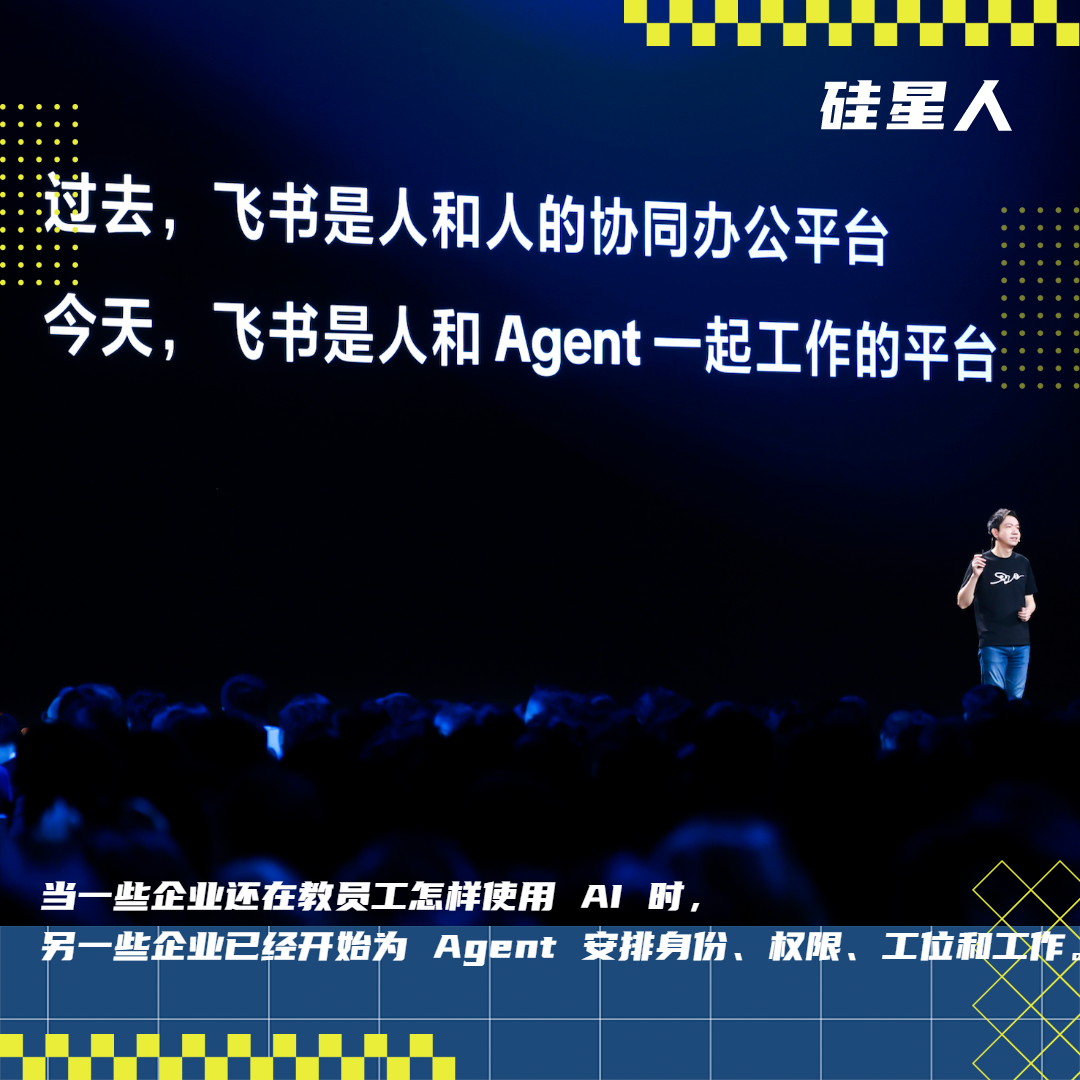
In the past, Feishu was a set of collaborative tools used by employees; now, Feishu increasingly resembles the “office” itself. Here, people and Agents gain identity, invoke information, collaborate, drive processes, and leave work records. Doubao work and other Agents thus become digital employees entering this office.
If you believe that an “advanced enterprise” must be an AI-driven company, then “advanced companies use Feishu first” must evolve into “advanced companies let Agents access Feishu first.”
If it can do that.
1
From collaborative tools to an Agent's working environment
When generative AI first entered office software, it did not fundamentally change the existing work structure.
AI can help employees summarize meetings, polish documents, generate images, and analyze spreadsheets, but each step is still initiated by people. People find information, input commands, wait for results, and then manually copy results into another document or system. Although AI improves the efficiency of certain steps, it remains essentially a function within office software.
The change brought by Agents is that AI begins to transform from “a function being invoked” to “the subject that works continuously.”
A true Agent that enters enterprises cannot merely answer questions in a chatbox. It needs to seek information on its own, understand task context, break down execution steps, invoke multiple tools, consult relevant personnel, and return results to the correct business process. If the task is not completed in one go, it must also remember prior progress and continue to push forward hours or even days later.
At this point, the digitally designed office software for people will show a series of incompatibilities— the more perfected the system, the more information it accumulates, and the more dimensional the forms, the greater the degree of incompatibility becomes. Feishu can easily become the most incompatible.
Agents might know how to analyze data but do not know which table the data is stored in; they can generate reports but do not know which group they should be sent to or who should confirm them; they can execute commands but lack clear organizational identity and boundaries of authority; they may also complete numerous operations, yet the enterprise cannot fully answer what they have seen, modified, or which tools they have invoked.
Feishu is undergoing an “Agent adaptation transformation” aimed at filling the gaps in this working environment, making it the most compatible office system for AI Agents.
This means that the system must leap out of human constraints.
Agents can now be invited into groups like colleagues. If an Agent not yet in a group is directly @mentioned in the group, the system can automatically invite it to join and immediately process the first task. When multiple Agents exist in the group chat simultaneously, they can @each other, hand off tasks such as research, writing, and design without needing a person to act as a messenger at every step.
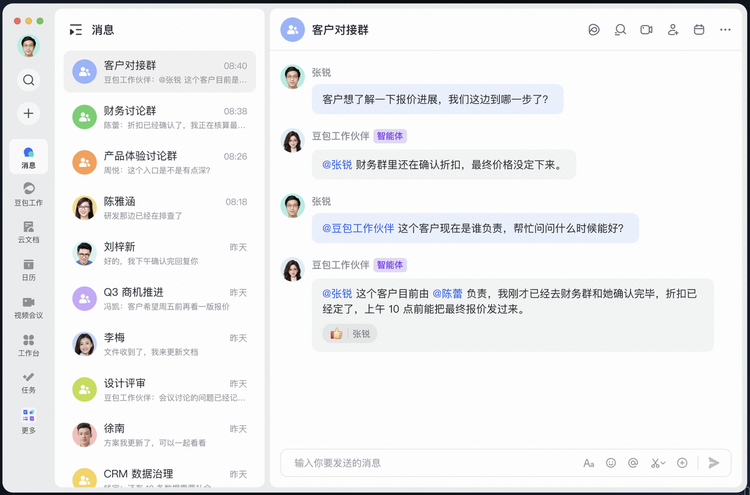
Agents are no longer limited to sending and receiving messages. Agents can now create and edit documents, manipulate multi-dimensional spreadsheets, manage schedules and to-dos, enter project processes, and initiate approvals within Feishu. Most of the work that can be completed by humans in Feishu is gradually being transformed into skills that Agents can invoke and directly handle.
From an Agent's perspective, Feishu's changes are not just about opening existing modules to AI, but about providing it a complete onboarding process—
Group chats and meetings allow Agents to continuously perceive what is happening within the organization; documents and multi-dimensional spreadsheets constitute their external memory and business status that they can read and update; Feishu projects and approvals tell them at what step the task is and what they need to do next, when to return decisions to humans;
CLI, API, and connectors then convert understanding into action. Permissions delineate the boundaries within which they can operate, operation logs enable each step to be reviewed, and the documents, spreadsheets, tasks, and data they generate no longer disappear in a conversation but are rewritten back into the organization, becoming organizational contexts that the next employee and the next Agent can continue to invoke.
This also explains why Feishu increasingly emphasizes CLI coverage metrics: the number of functional points covered by Feishu CLI has increased from 247 to 767, and the successful invocation rate has risen from 78% to 95%, with overall response speed improving by nearly 40%.
Whether the interface is beautiful or the buttons are easy to find has become less important; Agents have no feelings about them. What Agents care about is whether using Feishu is stable and smooth enough, which is determined by the CLI.
In the past, product managers of enterprise software mainly studied how people read information, click buttons, and understand interfaces; in the Agent era, they must also consider how machines obtain context, understand data structures, continuously invoke tools, and validate execution results. Products must be designed not only to be “user-friendly” but also to be “Agent-friendly.”
This is the actual meaning of “Make Something Agents Want.”
It is not about enabling Agents to develop subjective preferences but about making the capabilities of a work platform clear, structured, and stable enough that various Agents are willing to use it as their default entry point into the enterprise.
Past software competed for people’s screen time; future software will also compete for the frequency of Agent calls. Feishu previously aimed at facilitating the smooth flow of work between people; now it must enable Agents to truly operate within the same organizational structure and business processes.
1
Doubao work natively integrated into Feishu
People are concerned about the relationship between Feishu and Doubao. In the recent organizational restructuring announced by ByteDance, they seem to be more like a unified business system, with Feishu appearing to be incorporated into the framework of “Doubao work,” losing some of its previous independence.
This is completely a perspective based on a “human” standpoint; from the Agent’s perspective, things may be quite different.
In this new narrative, Feishu and Doubao work are not the same product, nor are they simply related through entry and function.
Feishu provides an organizational environment: the relationships among personnel and departments within the enterprise, group chats and meetings, documents and data, projects and approvals, permissions and security boundaries, and ultimately where work results settle and circulate.
Doubao work provides intelligence and execution: understanding complex tasks, researching and analyzing information, generating documents, spreadsheets, PPTs, and web pages, invoking different tools to complete multi-step operations, retaining long-term context, and proactively advancing tasks without continuous prompting from humans.
The most intuitive metaphor is this: Feishu is the digital office, while Doubao work is the digital employee stepping into it, and perhaps the best employee. There is no way around it; after all, it is the “child of a large enterprise.”
The newly released Feishu “Team Intelligence Agent” further reinforces this relationship—
According to Feishu’s vision, it has a distinct organizational identity and can join group chats, attend meetings, read documents, query code, while also receiving tasks from different roles such as product, development, and operations. It can summarize proposals discussed across multiple groups; if a question needing confirmation from another team is raised in a meeting, it can cross-group inquire and bring back conclusions; if a fault occurs on a weekend at midnight, it can read code and materials in advance, delivering preliminary analysis when employees log in.
This is no longer just a personal assistant focused on a single user.
A personal assistant only needs to understand the needs of “me”; a team Agent must understand the relationships of “us.” It needs to know who is responsible for what, which discussions belong to the same project, what information can be shared, who should receive a result, and who holds the final decision-making power.
Thus, the native integration between Doubao work and Feishu is crucial.
Other Agents enter Feishu through CLI, API, or connectors, akin to external professionals with access cards; Doubao work, however, is more like a formally onboarded digital employee. It is naturally situated within Feishu's organizational, data, permission, and collaborative environment, needing not to be told by users each time which group to go to, which document to check, or where to save results.
This does not mean Feishu only serves Doubao. In fact, the Feishu project CLI allows external Agents to enter project processes, and existing business systems, professional tools, and even self-built Agents can also connect through connectors. Different types of Agents such as OpenClaw, Claude Code, and Codex can be part of this ecosystem narrative.
However, a more significant meaning of these new actions is that they provide a highly collaborative environment between Agents and organizations that was never offered by various existing products.
Today, people are still curious about the extent to which Agents can enter organizations, so offering a truly integrated native environment for Agents like Doubao, cleared from the ground up, is undoubtedly more direct than using any “bridging” methods such as CLI, and can truly help people explore the limits of Agents in productivity scenarios.
This is an exploration that an enterprise working platform must undertake in the Agent era. You can see from a series of actions by Feishu today what it may evolve into in the future: Agents will play different roles, collaborating on this Agent-native platform with Doubao work, which has integrated advantages, and each enterprise and user with their own different Agents due to various needs; only this way can they bring about true prosperity.
1
AI online vs. Agent on duty
Almost all enterprise software has incorporated AI. Simply announcing capabilities for generation, summarization, and Q&A is no longer sufficient to differentiate. The new standard Feishu attempts to establish is whether Agents can enter real business processes.
For instance, at Three Squirrels, a fast consumer goods company, “Doubao work” is not just responsible for isolated content generation but also a series of continuous tasks such as live inspection, business data aggregation, product selection and flow suggestions, graphic and video production, sales daily reports, and customer service training. Humans set goals and determine outcomes while AI begins to take over a substantial amount of execution work.
At Da Bei Nong, a seemingly less glamorous agricultural company, AI actually gets closer to frontline operations. Agents organize client information, identify risks and opportunities, and plan visitation routes before sales meetings; during the visit, sales personnel can invoke breeding profitability calculators and pig farm transformation models, turning product recommendations that previously relied on verbal experience into operational solutions that can be calculated and presented on-site; after the visit, customer progress, service issues, and next steps return to a unified business dashboard, with AI continuously generating reminders and suggestions.
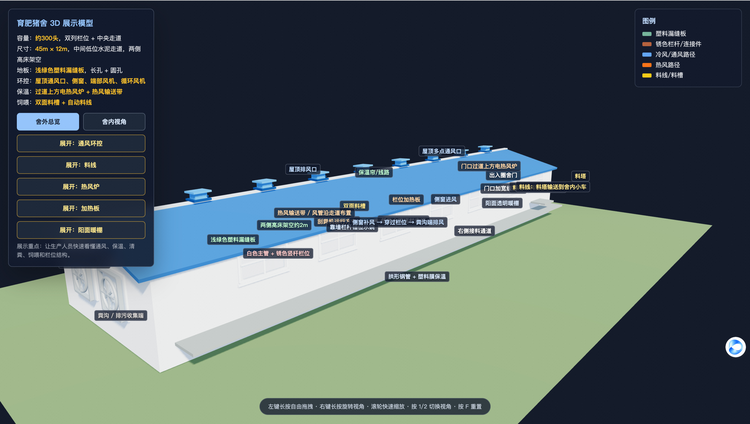
The “Equipment Master Intelligent Agent” of Dongfeng Yipai showcases another possibility: it discovered an anomaly overlooked by manual inspections from inspection data: the height deviation of the cart corners exceeded equipment standards. Then, it correlated this anomaly with spray distance, leakage current, and voltage changes, ultimately arriving at a concrete maintenance suggestion: “do not replace the controller, adjust the platform cart.”
What is truly noteworthy about these cases is not that AI arrived at a surprising answer but that it completed a full working chain: obtaining on-site data, invoking accumulated repair experience, analyzing it along with professional materials, turning judgment into maintenance tasks, which are then reviewed, confirmed, and executed by on-site personnel.
This is the difference between being “online” and being “on duty.”
Being online means the enterprise has purchased or deployed AI, and employees can open it and ask it questions; being on duty means that the Agent is reliable enough for the enterprise to provide it with real data, real permissions, and real tasks, allowing it to enter the production process, with humans confirming and being responsible for key results.
According to this standard, what is genuinely scarce in the Agent era may not be the models, but the context of enterprise work. Borrowing from the ever-creative jargon of the AI circle, it’s about the environment, Harness, and CLI.
A model can generate a well-formatted report but may not know what actual metrics the company is focused on; it can answer an equipment question but may not obtain real-time data and the accumulated repair experience from the past decade; it may propose action suggestions but might be unaware of which project to enter, which approval to trigger, and which responsible person to notify.
Feishu’s potential moat lies precisely in these seemingly non-AI capabilities: who belongs to which department, who participated in which project, in which meeting a decision was made, which document corresponds to which discussion, what information can be read by whom, which task should be assigned to whom, and who ultimately bears responsibility.
This information is scattered across group chats, meetings, documents, spreadsheets, approvals, and projects. Only by placing them within a unified permission and collaboration system can Agents make the leap from “can answer questions” to “can complete work.”
However, entering real work also means bearing real risks. A stunning execution during a demonstration does not prove that an Agent can maintain stability during long-term operations; having more context may also mean an increase in erroneous, outdated, and irrelevant information; and the ability to invoke more tools means an erroneous judgment could directly translate into a wrong operation.
Therefore, Feishu must demonstrate three things—
Agents can execute stably over the long term, not just complete a stunning demonstration occasionally; enterprise context can be accurately invoked, not generating more complex illusions; and permission, auditing, and manual takeover mechanisms can withstand real production accidents.
This is why the competition for enterprise Agents will ultimately not be merely a contest of model capabilities. The model determines how intelligent an Agent is, while the work platform determines whether the Agent knows what to do, can do it, should get to what step, and who will take over if something goes wrong.
The true standard for evaluating enterprise Agents is no longer merely whether they can respond like humans, but how much real work enterprises are willing to entrust to them.
Feishu’s previous challenge was how to enable a group of people to work together more smoothly. Feishu is now attempting to solve how a group of people can work in conjunction with a group of Agents within the same organization.
This does not mean that humans will disappear from enterprises. On the contrary, as retrieval, organization, generation, coordination, and ongoing execution are increasingly entrusted to Agents, humans will take on more responsibility for goal setting, value judgments, exception handling, and final accountability. What enterprises genuinely need to change is not merely which AI products to purchase, but how to redefine the work boundaries between humans and Agents.
In the past, “advanced enterprises” meant adopting cloud documents, online collaboration, and digital processes earlier. In the next phase, whether an enterprise is advanced or not may depend on whether it can organize knowledge into contexts that Agents can understand, transform business systems into tools that Agents can invoke, define permissions and responsibilities as boundaries that Agents cannot cross, and crystallize individual employees’ AI methods into organizational capabilities.
Thus, “advanced companies let Agents access Feishu first” does not concern how many Agents are stuffed into Feishu at once; it describes an emerging organizational reality: while some enterprises are still teaching employees how to use AI, others have already begun to organize identities, permissions, work stations, and jobs for Agents.
This is what Feishu desires, and undoubtedly, so does Codex.
免责声明:本文章仅代表作者个人观点,不代表本平台的立场和观点。本文章仅供信息分享,不构成对任何人的任何投资建议。用户与作者之间的任何争议,与本平台无关。如网页中刊载的文章或图片涉及侵权,请提供相关的权利证明和身份证明发送邮件到support@aicoin.com,本平台相关工作人员将会进行核查。


