Written by: Rita
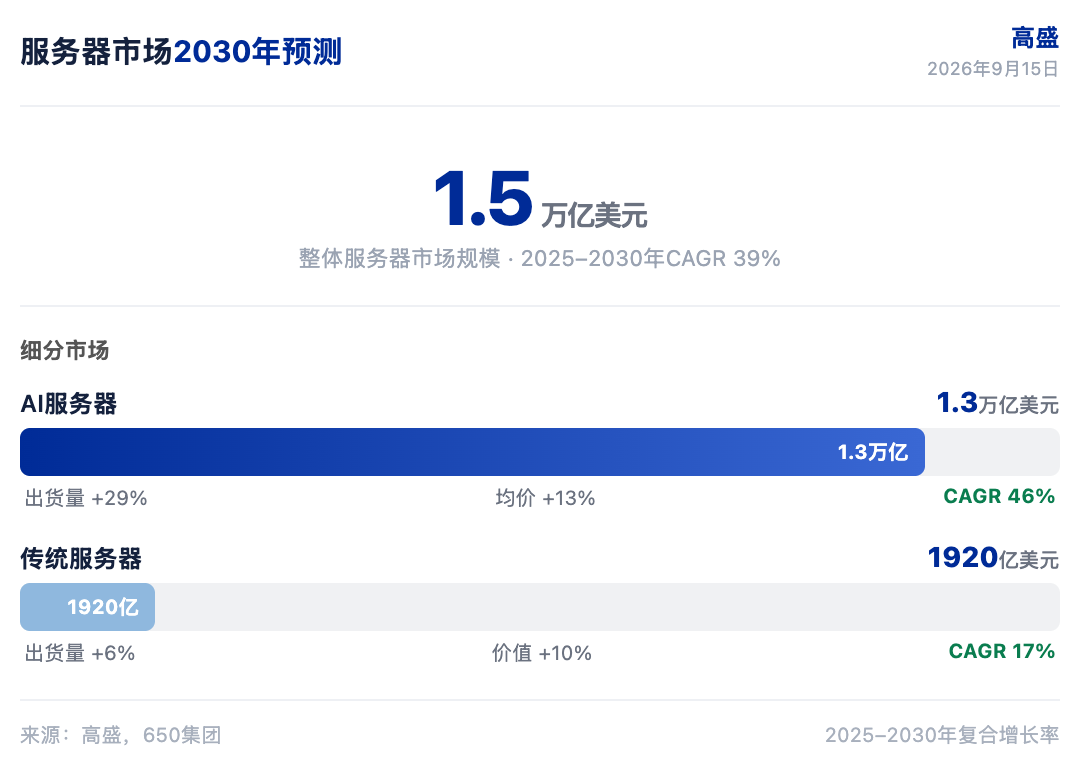
The market is focused on whether the growth rate of AI servers can continue, and Goldman Sachs has raised its forecast for the overall server market size in 2030 to $1.5 trillion. The 650 Group (a research firm focused on the server and storage market) has set the compound annual growth rate from 2025 to 2030 at 39%, with AI servers expected to reach $1.3 trillion and a compound growth rate of 46%. In a report released on September 15, 2026, Goldman Sachs updated its server market share model, showing annual growth in Dell's share of both traditional servers and AI servers.
Traditional servers experienced a year-on-year growth of 91% in the second quarter, with significant price-driven characteristics. The shipment volume and average selling price of AI servers are developing more evenly across various segments. Dell's share of traditional servers rose to 29%, while its share of AI servers rose to 17%. HPE and SMCI showed divergent shares in the AI server market.
Overall server market projected at $1.5 trillion
The 650 Group has raised its forecast for the server market, expecting the overall size to reach $1.5 trillion in 2030, with a compound annual growth rate of 39% from 2025 to 2030. The AI server market is expected to reach approximately $1.3 trillion, with a compound growth rate of 46%, driven by a 29% increase in shipment volume and a 13% increase in average selling price. The traditional server market is expected to reach about $192 billion, with a compound growth rate of 17%, a 6% increase in shipment volume, and a 10% increase in value.
In the second quarter, revenue from traditional servers grew 91% year-on-year, while shipment volume decreased by 9%, and the average selling price increased by 111%. IDC estimates traditional server revenue to have grown 81% year-on-year, with shipment volume increasing by 17% and the average selling price rising by 56%. AI servers saw a year-on-year growth of 94% in the second quarter, with shipment volume increasing by 20% and the average selling price rising by 62%. IDC estimates AI server revenue to have grown 43% year-on-year, with shipment volume increasing by 10% and the average selling price rising by 30%. The differences in estimates between the two institutions mainly stem from variations in definitions and sample coverage regarding accelerated computing servers.
Dell's traditional share rises to 29%
Dell's shares in both the traditional server and AI server markets have increased simultaneously. In the second quarter, traditional server revenue reached $11.3 billion, a 278% year-on-year increase, with shipment volume growing by 9% and the average selling price rising by 248%. Dell's share of the traditional server market rose to 29%, compared to 15% in the second quarter of 2025. Among these, the share in the new cloud service provider sector increased from 15% to 34%, while the share in the enterprise sector rose from 21% to 36%.
Dell's AI server revenue grew 146% year-on-year, with shipment volume rising by 80% and the average selling price increasing by 37%. Dell's share in the AI server market rose to 17%, compared to 13% in the second quarter of 2025. Its share in the new cloud market increased from 47% to 51%, and in the enterprise market, the share rose from 30% to 46%. The 650 Group estimates that Dell holds a 17% share in the AI server market, second only to NVIDIA's 42% and white-box manufacturers' 24%.
AI server growth rate of 46% over five years
The growth of the AI server market is driven by both shipment volume and average selling price, with a compound annual growth rate of 29% for shipment volume and 13% for average selling price. NVIDIA captures 42% of the AI server market, ranking first. White-box manufacturers hold 24%, Dell has 17%, and SMCI has 8%. This landscape indicates that the AI server market is still dominated by chip manufacturers and contract white-box providers, with limited market space for branded server manufacturers.
HPE's traditional server revenue grew 75% year-on-year in the second quarter, while shipment volume declined by 3% and the average selling price rose by 82%. HPE's share in the traditional server market is 12%, compared to 13% in the second quarter of 2025. HPE's share in the AI server market is 1%, down from 3% in the second quarter of 2025. SMCI's traditional server revenue grew 356% year-on-year, while shipment volume declined by 4% and the average selling price increased by 375%. SMCI's share of the traditional server market rose to 10%, compared to 4% in the second quarter of 2025. SMCI's share in the AI server market is 8%, compared to 9% in the second quarter of 2025.
Three hardware vendor ratings diverge
Dell and HPE received buy ratings, while SMCI received a sell rating. Goldman Sachs maintains a buy rating for Dell with a 12-month target price of $570, based on 18 times the next twelve months' earnings per share. Goldman Sachs also maintains a buy rating for HPE with a 12-month target price of $75, based on 14 times the next twelve months' earnings per share. Goldman Sachs maintains a sell rating for SMCI, with a 12-month target price of $34, based on 7.5 times the next twelve months' earnings per share. The differences in ratings among these three companies reflect Goldman Sachs' differing judgments about the sustainability of AI server share.
Dell's major risks include weaker-than-expected demand for consumer and commercial PCs, poor performance in enterprise IT spending, headwinds from the hybrid working model, macroeconomic weakness, pricing pressure due to excess channel inventory, rising raw material costs, intensified competition from white-box manufacturers, and a structural decline in demand for AI servers from the next generation of cloud service providers. HPE's risks include weaker-than-expected enterprise IT spending and data center capital expenditures, competition from white-box manufacturers, customer losses during the integration of Juniper Networks, higher-than-expected component costs, failure to achieve growth in storage business share, and underwhelming demand for enterprise and sovereign AI data centers. SMCI's upside risks include stronger-than-expected demand for AI servers, increased market share, improved core operating profit margins, and customer diversification.
If the growth rate of AI servers slows from 94% in the second quarter, where will the share competition among Dell, HPE, and SMCI lead? Whether hardware gross margins can be maintained will be the next point of observation.
Disclaimer
This article is an arrangement and interpretation of third-party brokerage research reports (Goldman Sachs, September 15, 2026) by Chaoxiang Research, compiled in conjunction with publicly available market information. The ratings, target prices, earnings forecasts, and related judgments quoted in this article represent the opinions of the analysts from that brokerage and do not represent the views of Chaoxiang Research, nor do they constitute any investment advice.
The market carries risks, and decisions should be made independently. This article should not be used as a basis for buying or selling any securities.
免责声明:本文章仅代表作者个人观点,不代表本平台的立场和观点。本文章仅供信息分享,不构成对任何人的任何投资建议。用户与作者之间的任何争议,与本平台无关。如网页中刊载的文章或图片涉及侵权,请提供相关的权利证明和身份证明发送邮件到support@aicoin.com,本平台相关工作人员将会进行核查。


