Author: Alea Research
Translation: ShenChao TechFlow
ShenChao Introduction: Coinbase listed stock tokens, Robinhood built its own chain, Circle launched Arc, and the three giants are all betting on "issuance," but what truly determines success or failure is whether users can access the assets they issue. This article breaks down Jumper routing data, revealing the astonishing speed at which the new chain consumed nearly 8% of cross-chain traffic in just 74 days and how LI.FI quietly collected tolls amidst the chaos of issuance from various parties.
Coinbase launched stocks on Base, Robinhood built a chain, and Circle opened Arc on September 16. All of them need (more) access.
Coinbase, Robinhood, and Circle's major releases significantly impact the crypto industry. Each release shares a common point: issuance. They have all made a bet this year (from tokenized stocks to stablecoins), and the returns on that bet only materialize when people can access the assets they issue. That's right, distribution is key. In the 30 days up to September 10, Jumper routed $934.6 million, a month-on-month increase of 40.3%, and its fastest-growing destination is a chain that was born just 74 days ago.
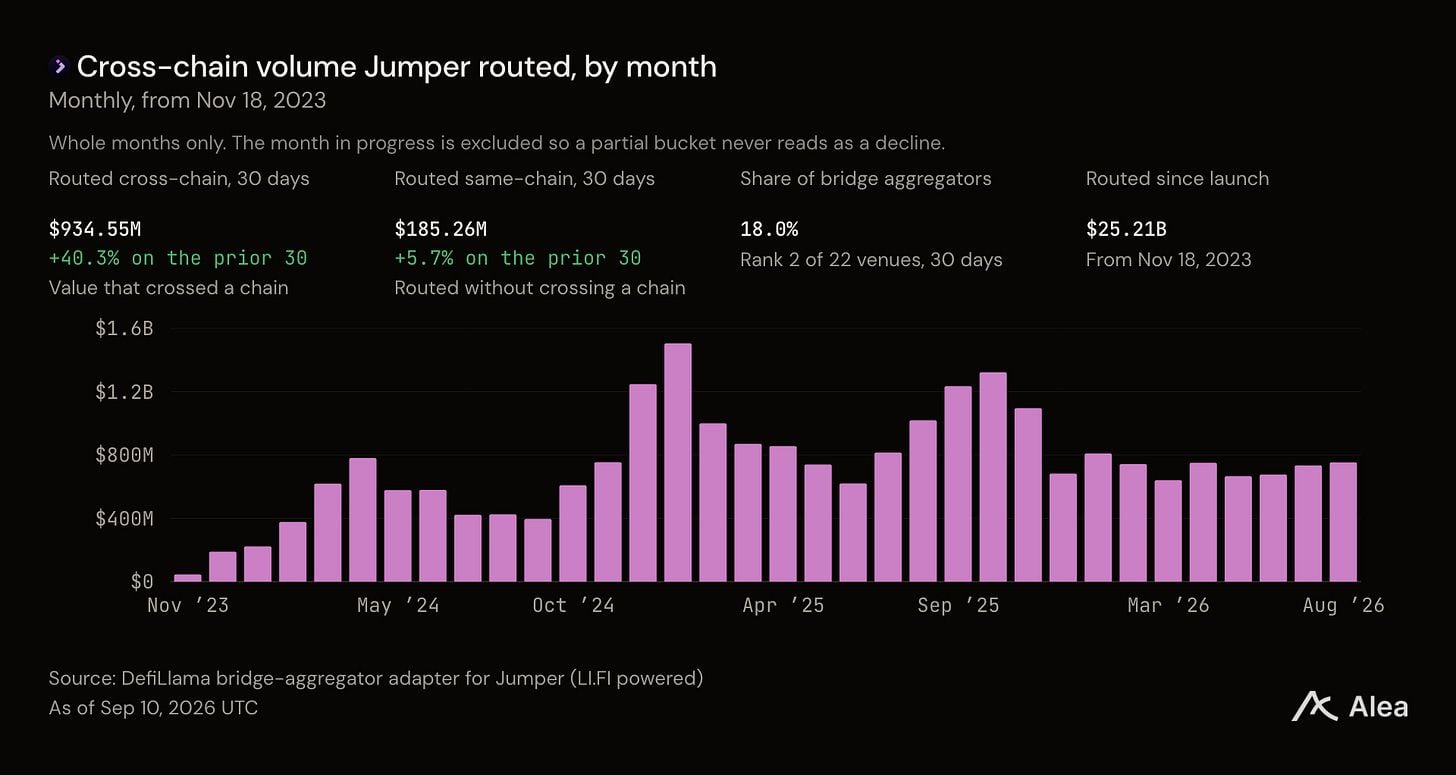
LI.FI distributed tokenized stocks from xStocks, Ondo, Backpack, Robinhood, and Coinbase. A single integration can access all issuers and bring them to over 1,000 applications and wallets.
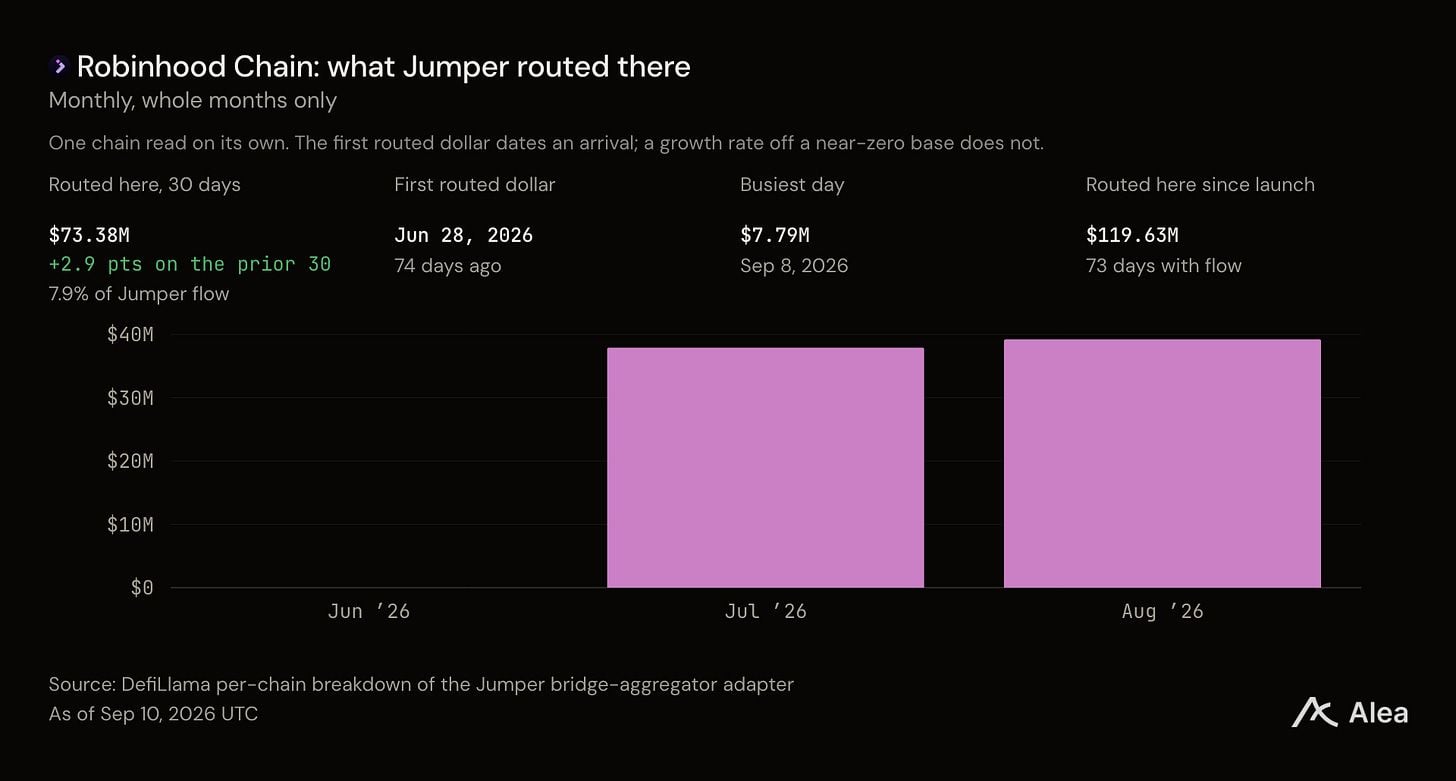
Robinhood Chain has gone from its first routed funds on June 28 to occupying 7.9% of Jumper's 30-day trading volume, an increase of 2.9 percentage points, the largest growth in destination share.
Intended transactions allow users to start on one chain using USDG and directly hold stock tokens on another chain without manual cross-chain transfers or exchanges.
Advance raised the median transfer amount by 39.1% in its first month, reaching $89.42.
Circle's Arc mainnet opened on September 16, and LI.FI integrated routing on the first day, similar to the operation Jumper executed on Robinhood Chain in June.
Five Issuers, One Integration
Tokenized stocks welcomed their issuers in 2026. Coinbase natively listed stocks on Base in August, and LI.FI is one of the earliest routing systems to support them. Robinhood built a whole chain around them. Ondo, xStocks, and Backpack are already online. Centrifuge signed on August 31. Circle's Arc opened on September 16.
Each of them faced the same problem on their launch day. If someone cannot access a tokenized stock from their already-held wallet, chain, and assets, it is worthless to them. Issuance is just the easy half.
This is the service LI.FI provides. Jumper is the consumer-grade frontend that runs on it. This router occupies 18.0% of a $5.14 billion cross-chain aggregator category, ranking second among twenty-two platforms, only behind its own LI.FI routing API, which has 23.2%. DefiLlama records them as separate protocols because Jumper's transfers lie outside and not within LI.FI's data lines, so the shares can be added together. LI.FI's tech stack routed 41.2% of that category.
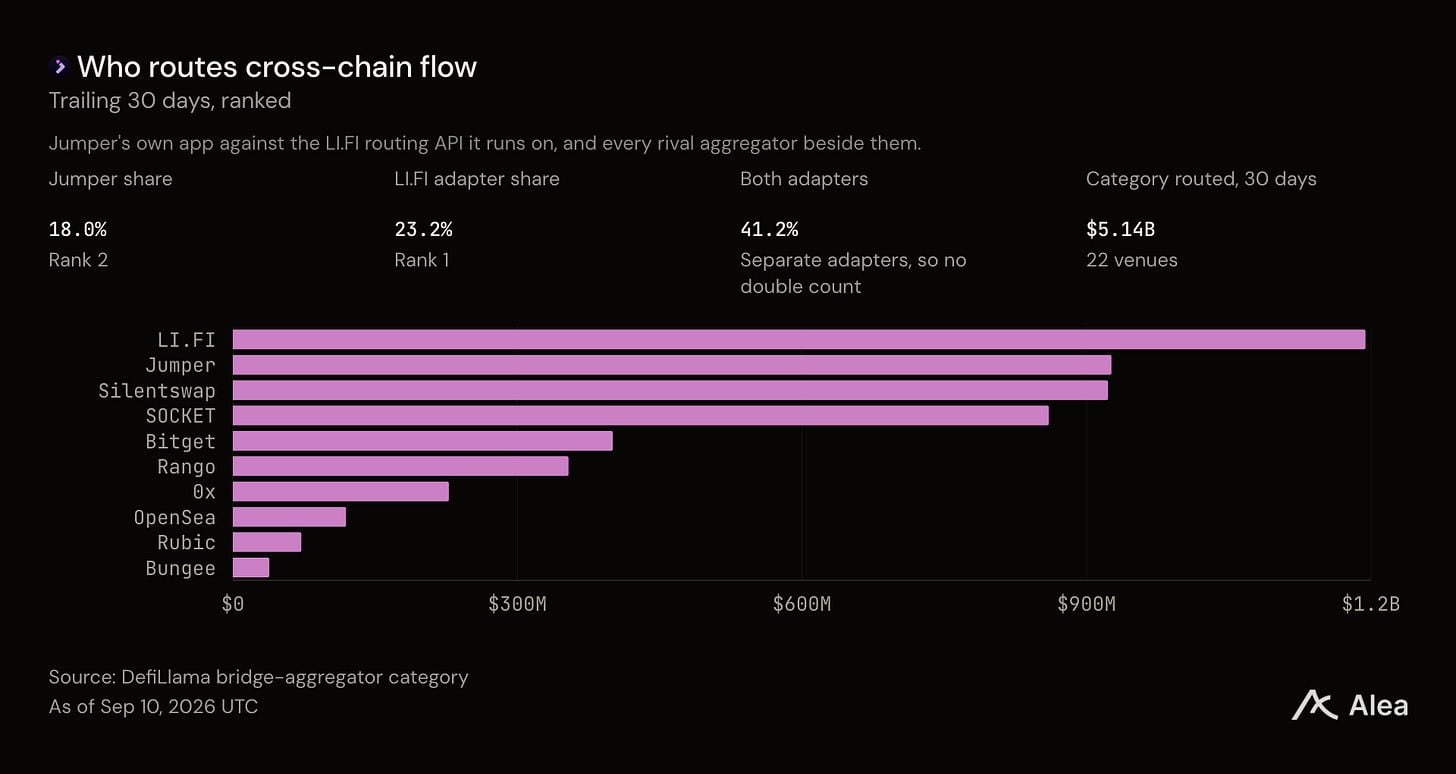
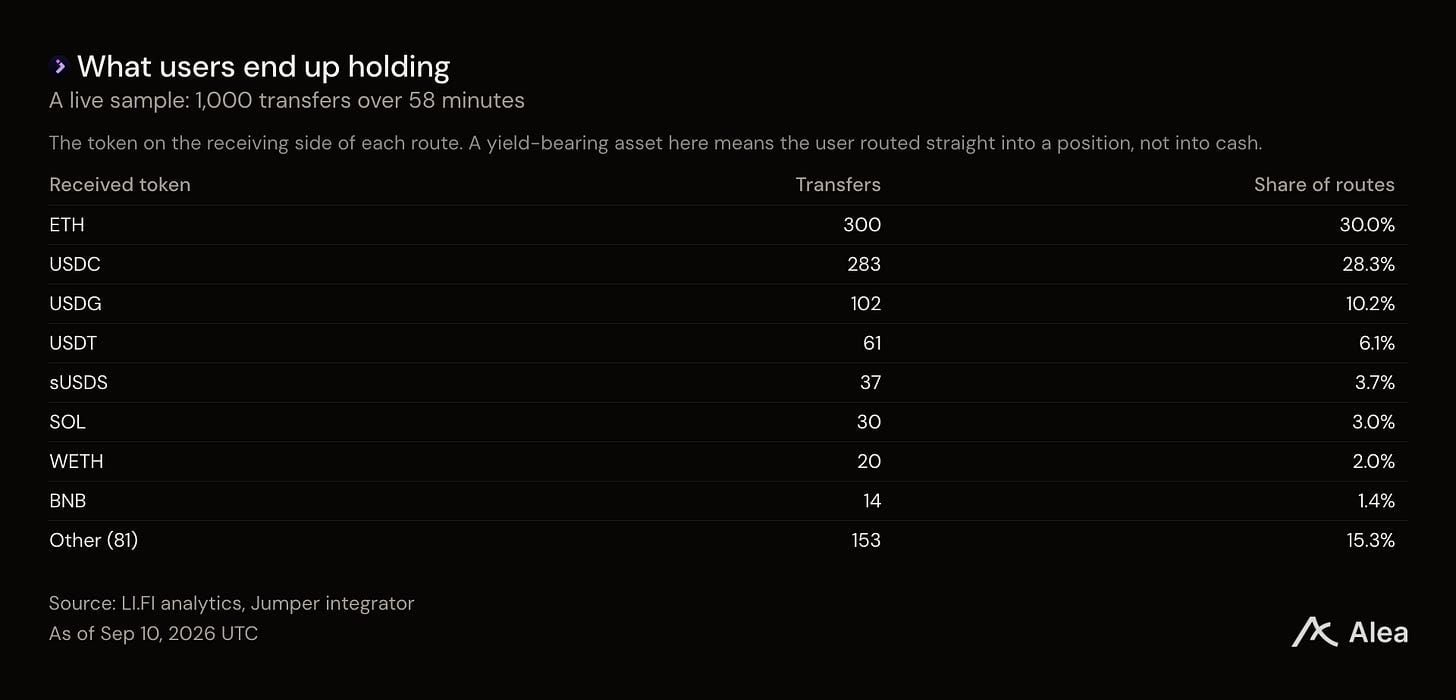
The median transfer amount is $91, with stablecoins accounting for about half of all receiving routes.
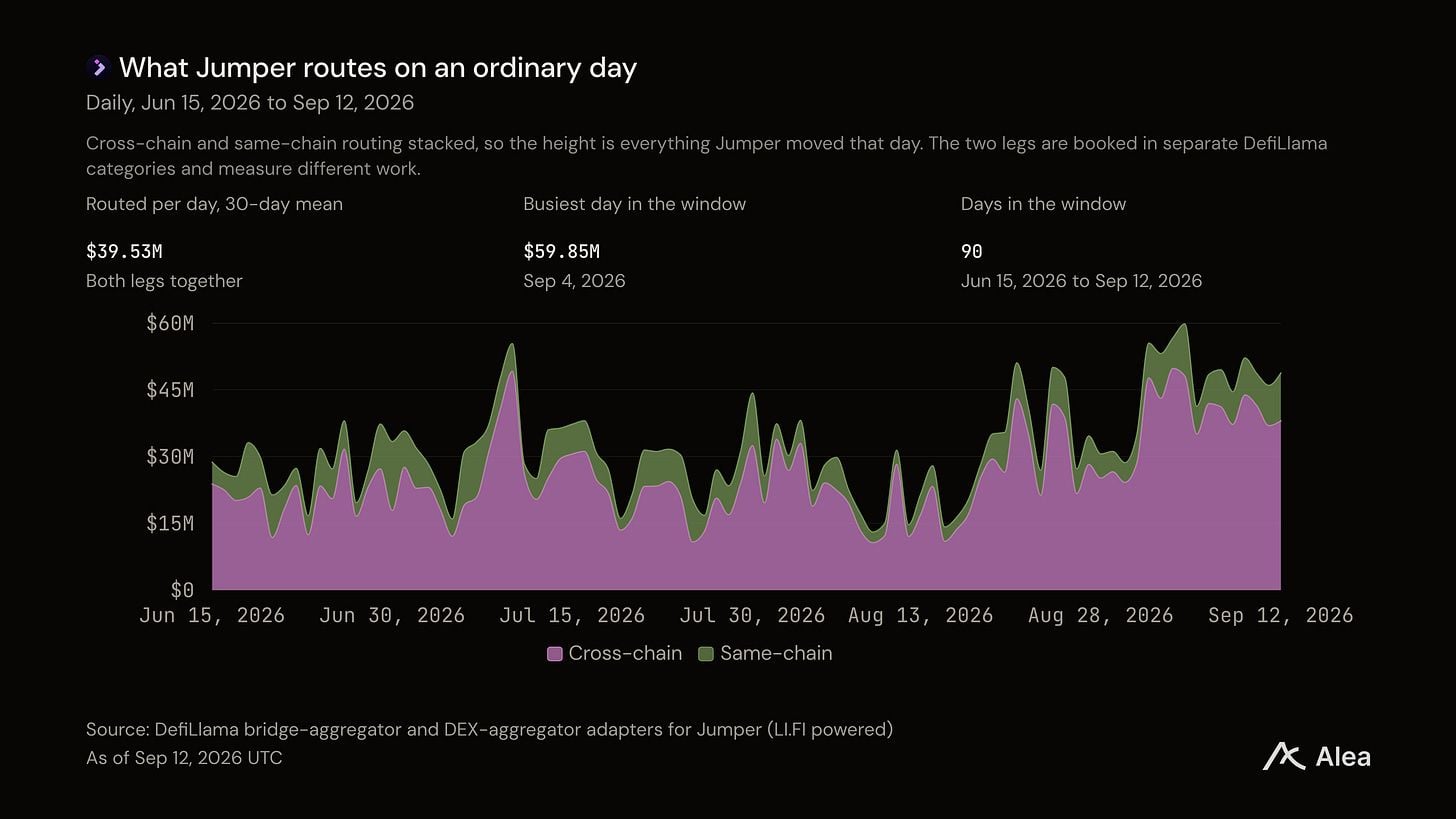
On average daily, this figure is a combined daily routing volume of $39.5 million, with the busiest day of the quarter being September 4, reaching $59.9 million. Since mid-August, the growth rate has been climbing.
Robinhood Chain Reached 7.9% in 74 Days
Robinhood Chain routed its first Jumper funds on June 28, 2026. Seventy-four days later, it accounted for 7.9% of Jumper's 30-day trading volume, making it the fifth largest destination behind Ethereum, Arbitrum, Base, and Solana. That is $73.4 million in 30 days, with a total of $119.6 million since launch.
It also had the largest growth in destination share, increasing by 2.9 percentage points. Ethereum increased by 1.3 percentage points, Ink increased by 1.2 percentage points from a much smaller base, and Solana increased by 1.1 percentage points. No chain lost more than one percentage point. Funds are flowing towards the recently opened places rather than concentrating behind a single winner.
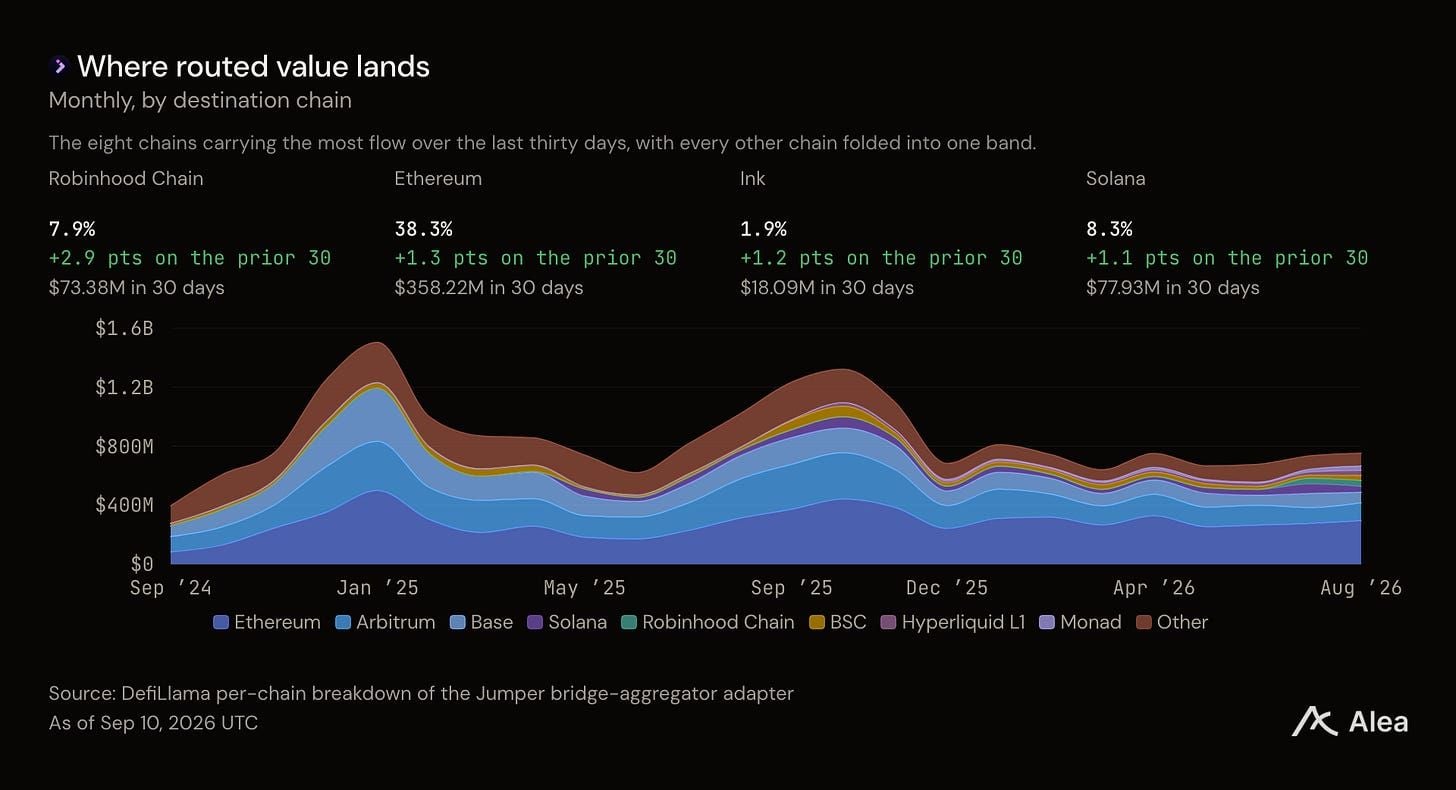
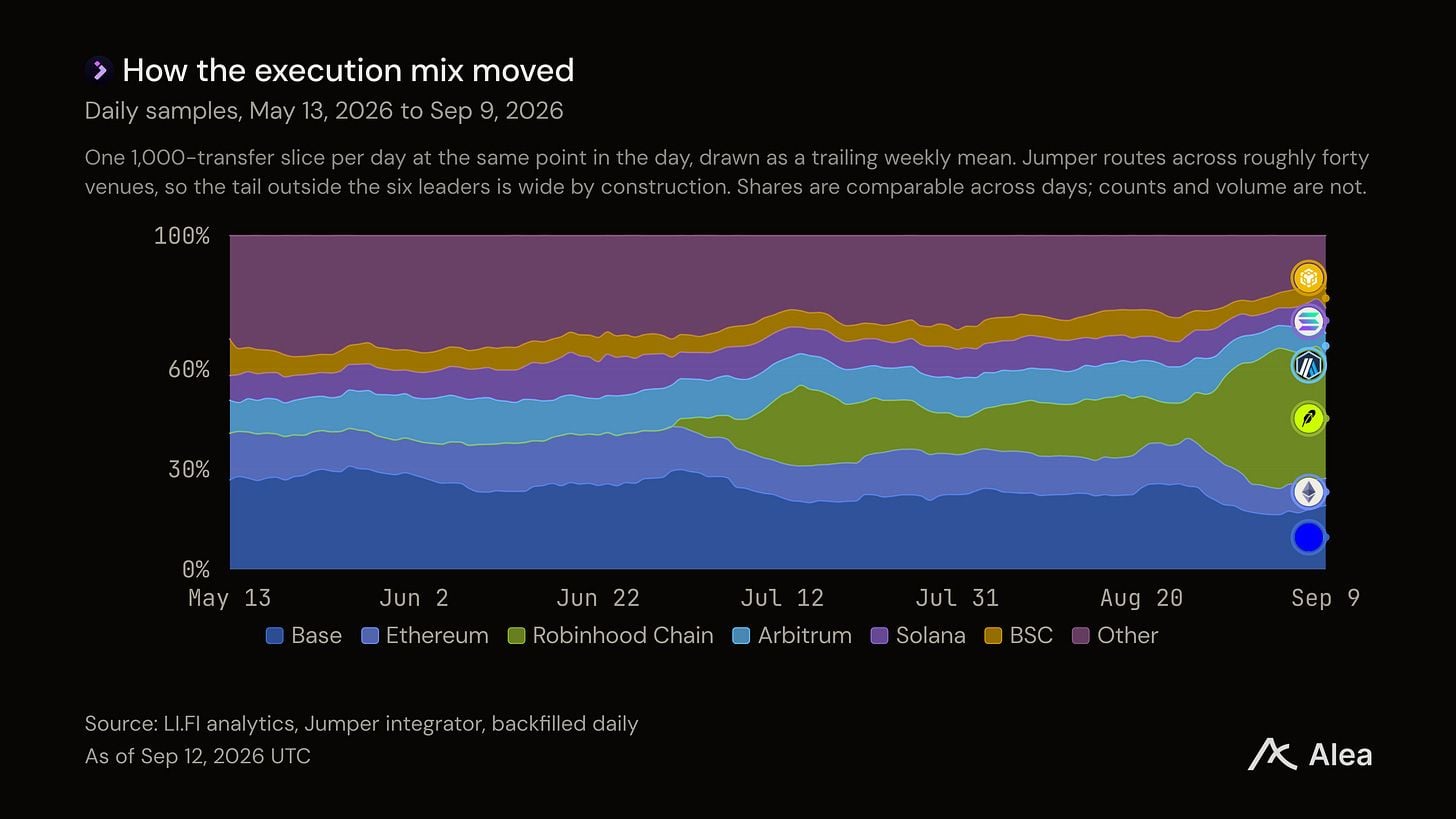
USD is one perspective, while routing quantity is another. Based on the routing share sampled daily by Jumper, Robinhood Chain's share is nearly 26%, whereas its dollar share is only 7.9%. This chain is absorbing a large number of small transfers rather than a few large ones, which is exactly what a retail platform looks like when it's operating normally.
Forty Types of Tokenized Assets and Their Routing
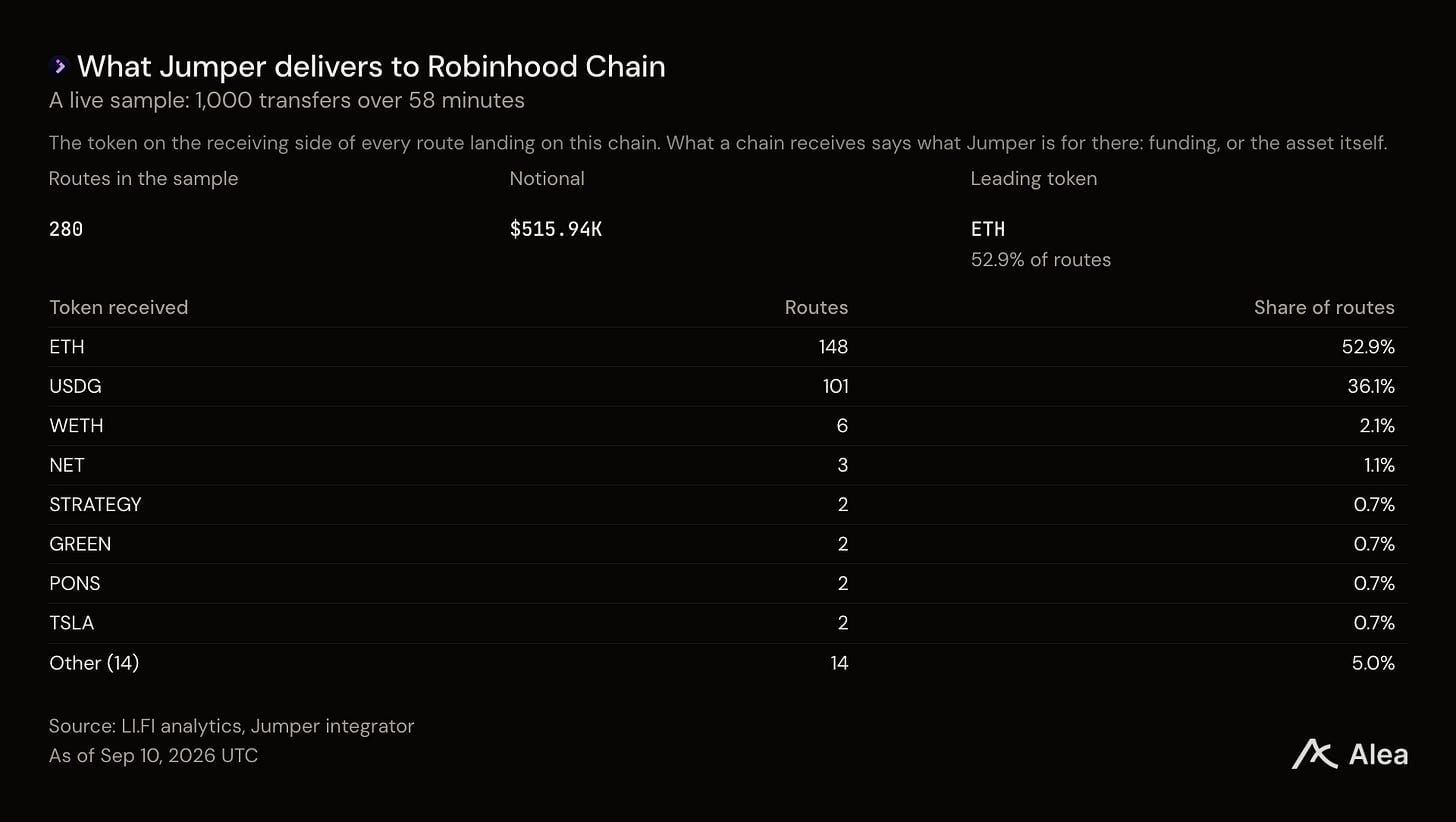
Robinhood Chain is built around tokenized stocks, while Jumper is one of its funding routers. Of the 280 landed transfers, 52.9% arrived in ETH form, and 36.1% in USDG form.
Each asset listed on Robinhood requires US dollars to trade, and Jumper is one of the routes bringing in those dollars.
Intended transactions can directly route stock token purchases. Users start with USDG on one chain and ultimately hold SPCX on Robinhood Chain, with solvers competing to complete the order.
Applications can access this routing without building their own solver infrastructure; LI.FI has delivered it to over 1,000 integrators, including Robinhood Wallet, MetaMask, and Phantom. Jumper also operates rwa.jumper.xyz separately, hosting about forty types of tokenized assets, from NVDA and SPY to gold and short-term treasury bonds.
Of the 120,000 routes generated through Jumper itself in four months, tokenized stocks only account for 34. Jumper’s own application is just one of multiple routes and the least likely to host that transaction. Building distribution before demand arrives is key. The default entry for asset classes is only worth occupying at a low price when asset classes are still very small.
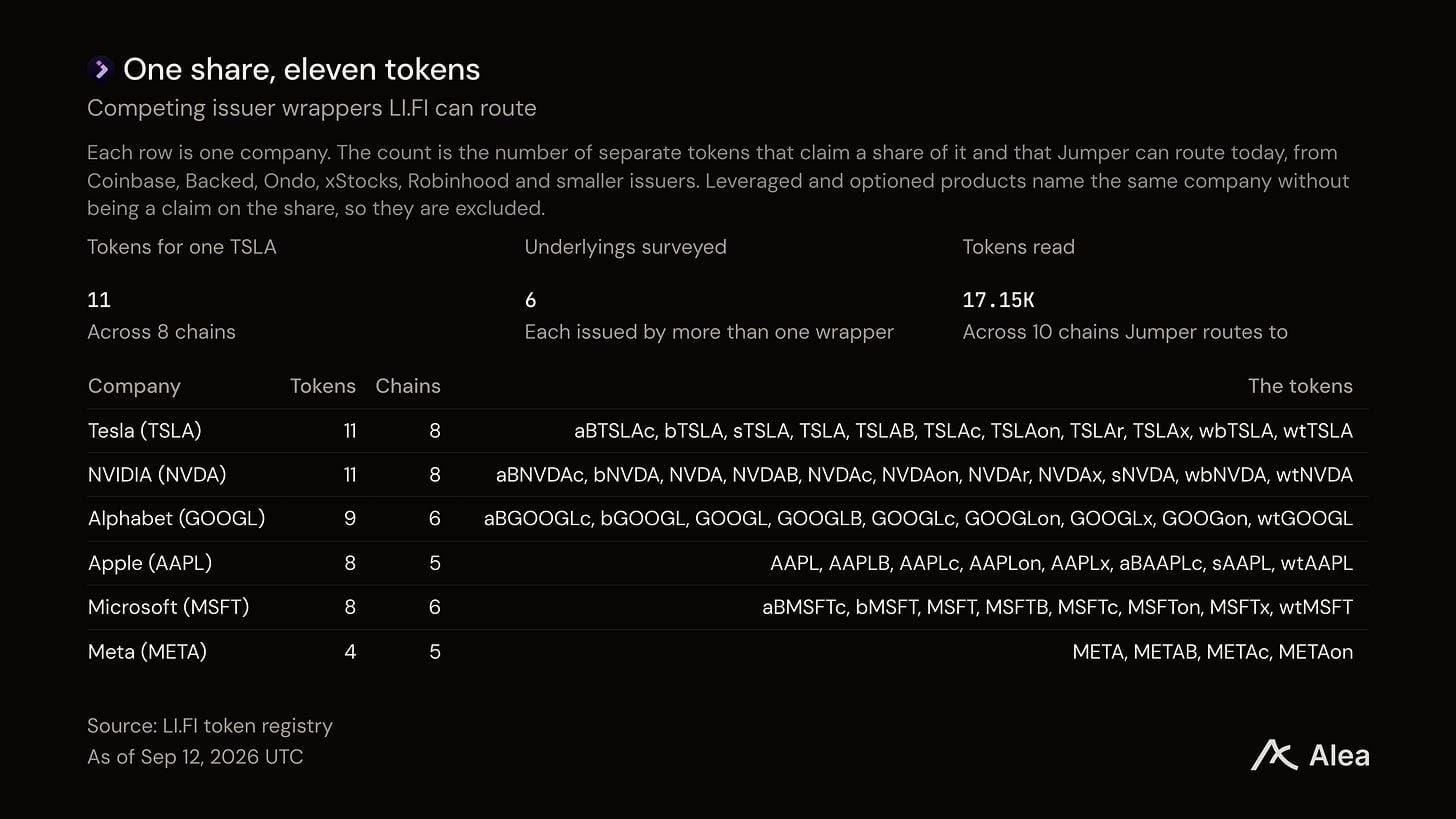
Fragmentation is more severe than the demand numbers indicate, and this is precisely why this layer can charge fees. One Tesla stock is registered as eleven independent tokens in LI.FI’s own registry, spread across eight chains, minted by Coinbase, Backed, Ondo, xStocks, Robinhood and smaller issuers. NVIDIA also totals eleven. Someone holding one cannot use it at another quoted place, so someone must make them interchangeable.
The Cost of Fund Flow
Jumper launched Advance in the first week of August: simulated trading, smart slippage, large order splitting, and limit orders achieved through CoW Swap and 1inch. During the launch period, the median transfer amount rose from $64.30 to $89.42. The high-end, on the other hand, moved in reverse. The 90th percentile dropped 10.8% to $2,116.34, while the share of transfers over $10,000 fell from 4.2% to 3.7%.
Both are valid since Jumper has achieved growth beneath it. The time needed to collect a thousand transfers fell from 2.65 hours to 1.97 hours. The number of large transfers increased, rising from about 380 a day to 445. Their growth rate lags behind all other parts, which is why, despite the number increasing, their share is actually decreasing.
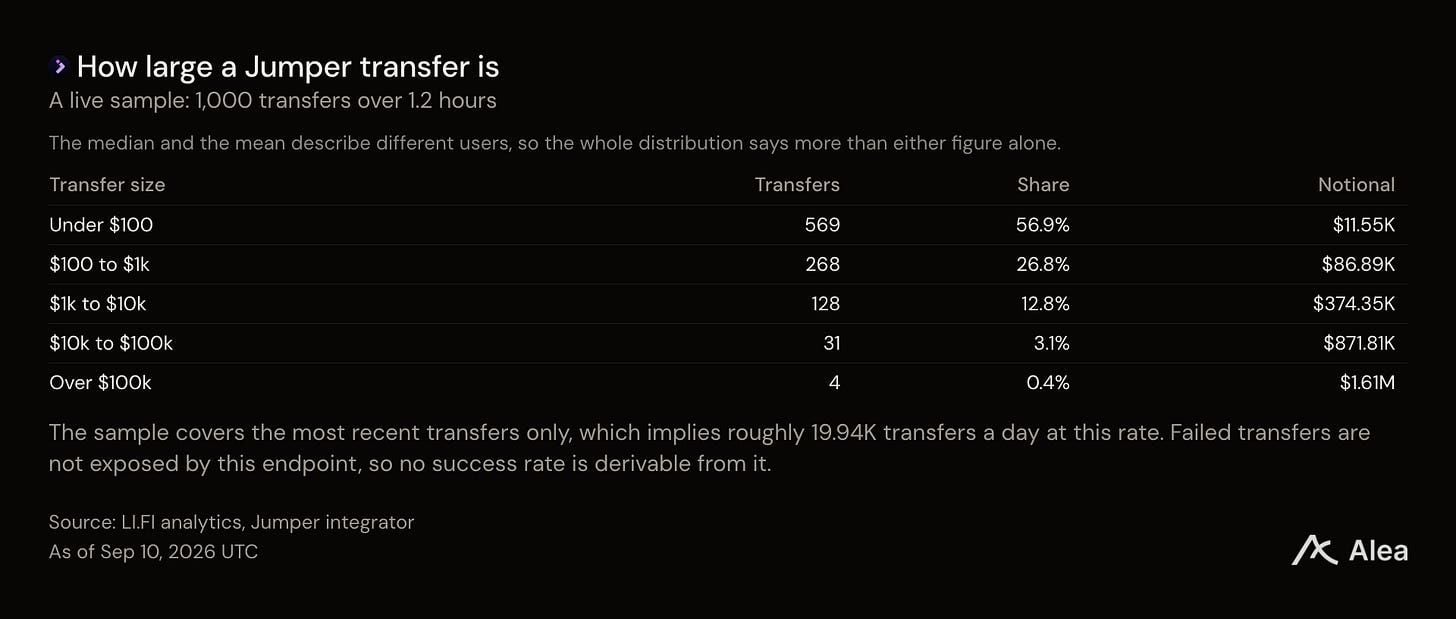
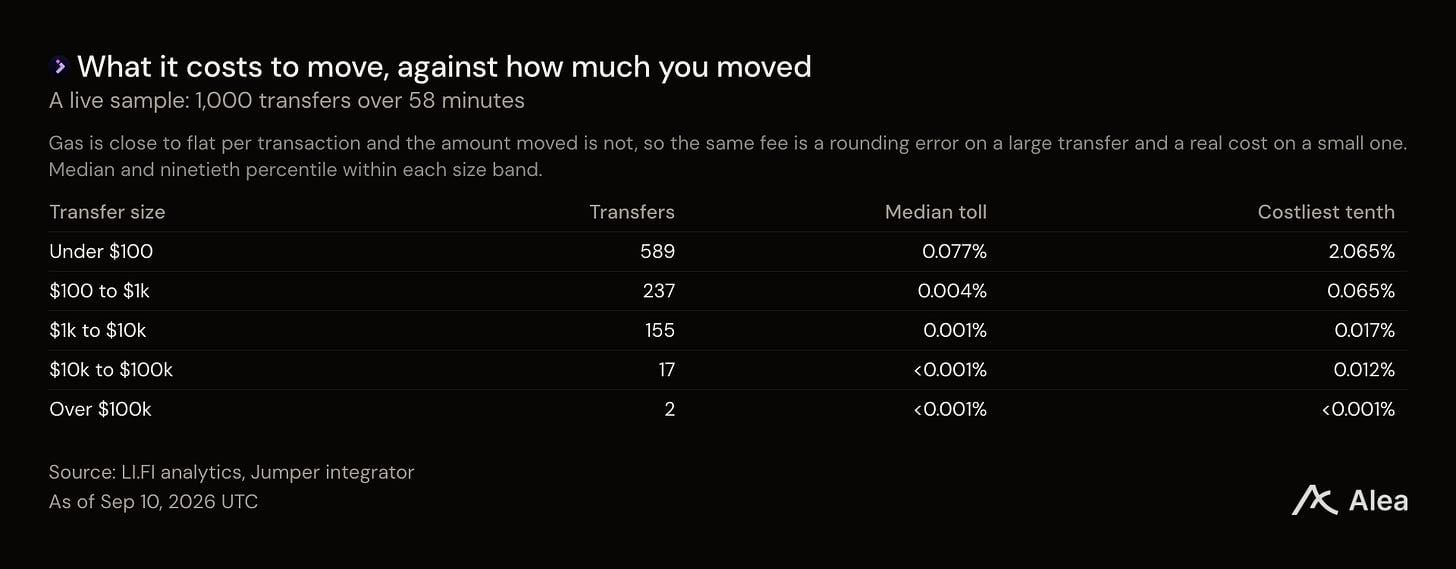
Gas fees per transaction are nearly flat, but transfer amounts are not; The median gas fee for transfers under $100 is 0.077% of the transfer amount, while the same rate for those over $10,000 is less than 0.001%. In terms of quantity, transfers under $100 account for the bulk of Jumper's traffic, with 589 out of every 1,000 transfers. Advance is built for the other end of the ledger.
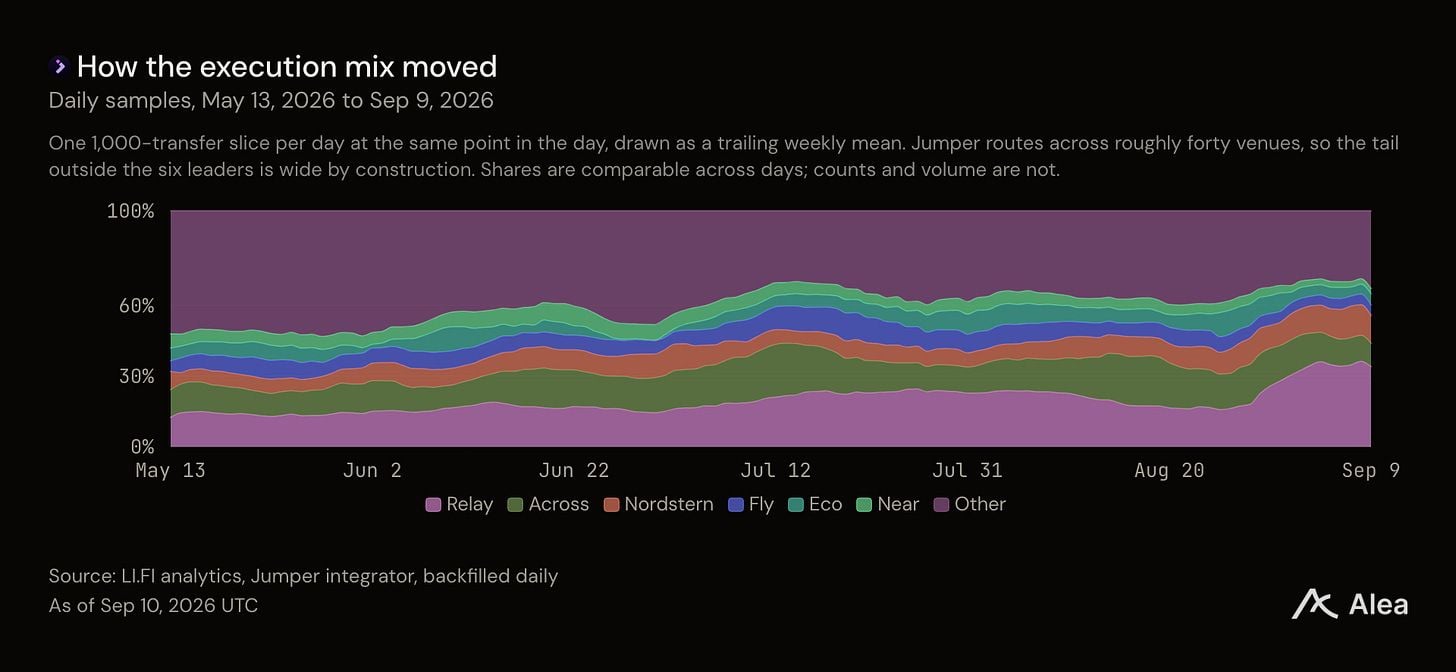
During the same period, routing choices tended to concentrate. According to the rolling weekly average, Relay's share in Jumper routing rose from 13.9% in mid-May to 34.0% on September 9, with the top six venues currently occupying about two-thirds of routing choices compared to about half in May.
LI.FI's own Intents venue currently has a share of 6.2%. LI.FI fully owns this venue.
Arc Opened on September 16
Circle’s Arc mainnet opened on September 16, and LI.FI was online from day one. One integration can bring on-chain trading on Arc, cross-chain bridging from all other supported ecosystems, and one-click deposits. This is similar to the actions Jumper took on Robinhood Chain in June and on Coinbase's Base in August.
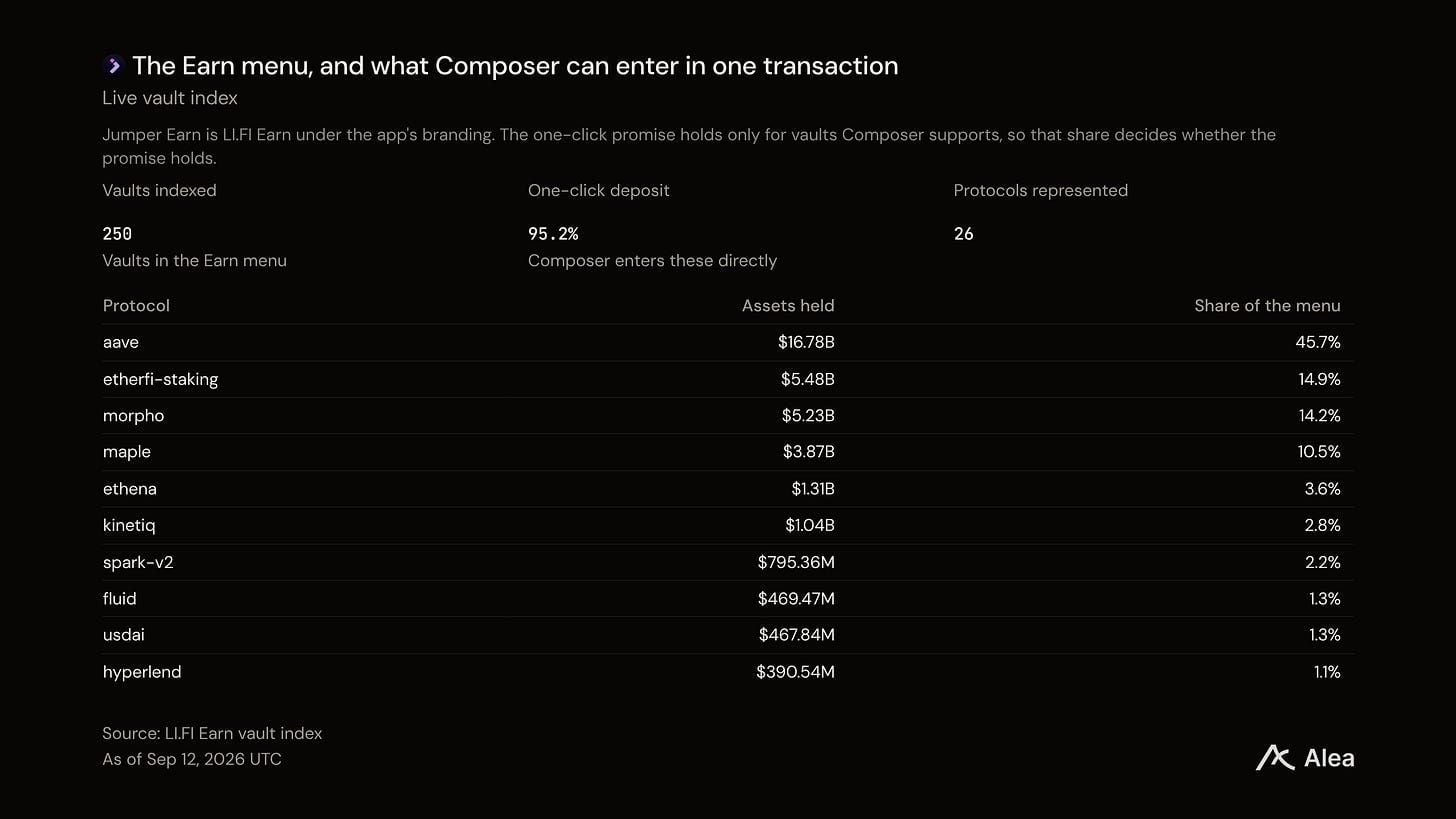
Earn is the configuration layer. It currently indexes 250 vaults across 26 protocols. Aave holds $16.8 billion of that, accounting for 45.7%. Composer can access 95.2% of the vaults in a single transaction. It added Compound, infiniFi and Apyx vaults in June, Plume's Nest in July, and a seven and thirty-day yield view and insurance risk labels in August. It is now integrated into MetaMask's Agent Wallet.
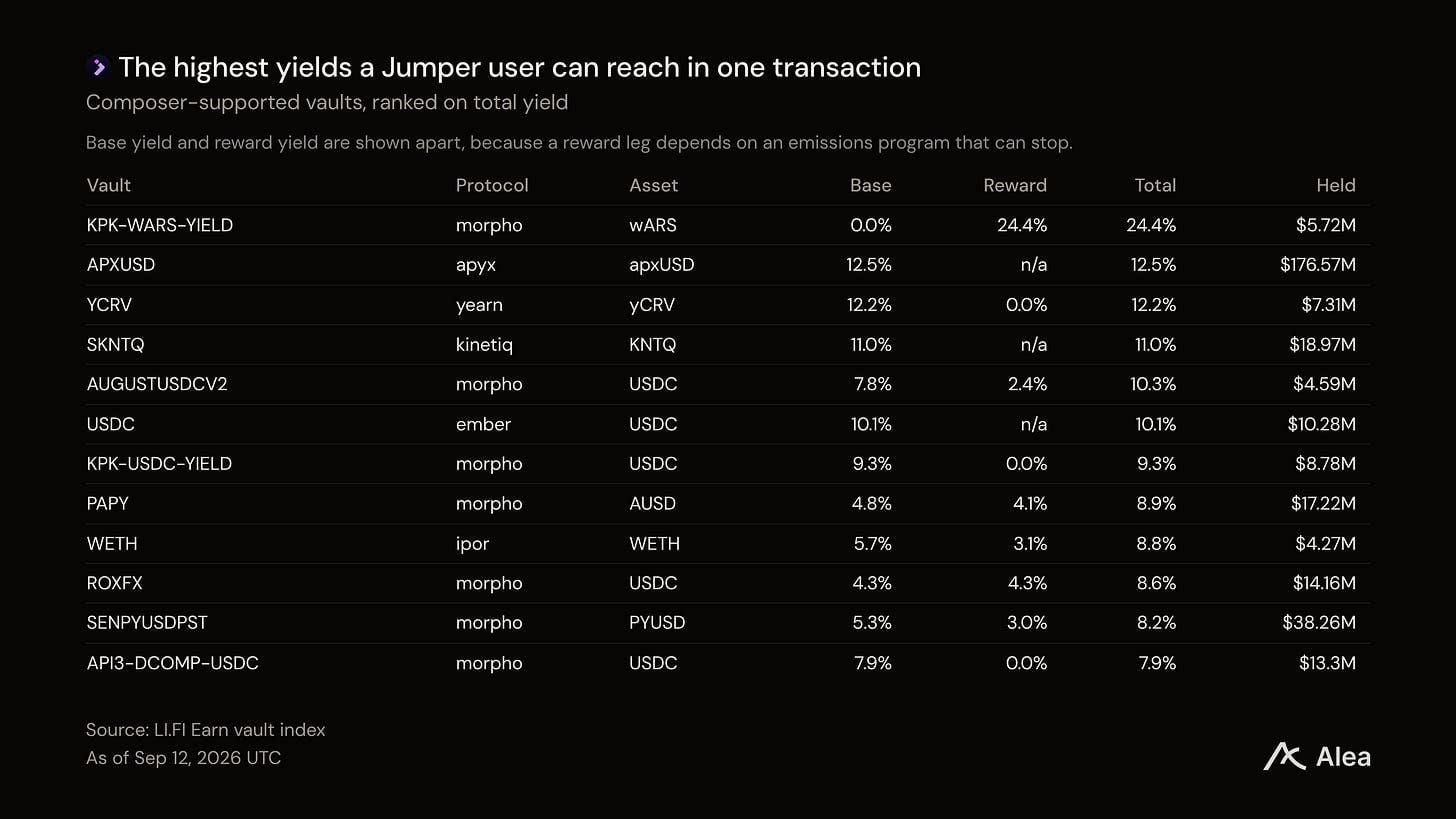
The yields users can earn today range from 7.9% from the USDC vault to 24.4% at the top of the list.
In 74 days, Robinhood Chain went from zero to occupying 7.9% of Jumper's trading volume. Arc opened on September 16, and the same routing is already in place. While new venues continue to emerge, this position continues to compound growth, and 2026 is not short of new venues.
免责声明:本文章仅代表作者个人观点,不代表本平台的立场和观点。本文章仅供信息分享,不构成对任何人的任何投资建议。用户与作者之间的任何争议,与本平台无关。如网页中刊载的文章或图片涉及侵权,请提供相关的权利证明和身份证明发送邮件到support@aicoin.com,本平台相关工作人员将会进行核查。


