Author: Rick Orford
Translator: Deep Tide TechFlow
Deep Tide Introduction: Broadcom has locked in shipments of about $350 billion in AI chips for the next two fiscal years; leading customers like Anthropic and OpenAI echo calls to "slow down AI," while still placing giga-scale custom chip orders. Rick Orford believes the demand narrative remains intact, and valuation multiples have clearly fallen with the profit revision, maintaining a strong buy rating while indicating that financing guarantees and memory costs are key risks.
Broadcom Inc. (AVGO) told investors that it expects to ship about $350 billion in AI chips over the next two fiscal years, with supply already locked in. This visible and clear path of demand illustrates how "green" the company's AI business currently is.
However, a notable opposing voice has just emerged. Anthropic (ANTHRO) CEO Dario Amodei recently proposed slowing down AI advancements for public safety; surprisingly, key figures from other AI companies, such as OpenAI's Sam Altman and SpaceX's Elon Musk, almost immediately agreed.
Nevertheless, I still do not believe this will pose a substantial threat to Broadcom's AI business immediately. The warnings pertain to controlling the pace of AI progress and managing risks, rather than calling for a halt; meanwhile, the demand for data centers to run and expand existing models still far exceeds supply.
Therefore, I believe Broadcom's chip demand narrative still holds, and the strong buy rating continues. The reasons are as follows.
In my previous analysis, my argument was that the market misread one "reiteration" as a "ceiling." Since then, management has raised FY2027 AI chip revenue estimates by 15%, added a yet non-existent FY2028 target of $230 billion, and revised the current fiscal year's AI revenue up to $58 billion.
The change now is that Broadcom has begun measuring demand in "gigawatts" rather than chip orders. This makes sense—what really holds up customers is how much electricity data centers can draw.
As confirmed in the third-quarter call, Anthropic will deploy 1 gigawatt of Ironwood chips this year, and will deploy the next-generation TPU totaling 5 gigawatts in 2027 and add another 10 gigawatts in 2028, making Anthropic Broadcom's largest custom chip customer next year.
Meanwhile, OpenAI has scheduled 1.3 gigawatts of Jalapeño chips for 2027, exceeding 5 gigawatts the following year. Meta (META) will consume three generations of MTIA chips before 2027, while Alphabet (GOOG/GOOGL) has signed a long-term agreement—Broadcom CEO Hock Tan described the scale as "hundreds of billions of dollars annually," which is very optimistic, but I would prefer to hear specific numbers.
Tan said that each gigawatt of computing power could bring Broadcom $20 to $30 billion in "content" revenue, expecting this ratio to remain roughly stable. Here, "content" refers to the dollar value of Broadcom's own products, mainly custom AI accelerators and networking chips, corresponding to the Broadcom value bought by customers for each 1 gigawatt of AI data center capacity built.
Bernstein's Stacy Rasgon pointed out that the targets of $115 billion and $230 billion, compared to about 30 gigawatts of demand mentioned in the call, only amount to about $11 billion or $12 billion per gigawatt. Tan's response was simple: not all 30 gigawatts will come online within those two fiscal years, as land, construction, and electricity all require time.
Let's do a rough calculation. Tan expects a total shipment of $350 billion in AI chips between FY2027 and FY2028. Using his own "content" figures, this roughly translates to the actual deployment of 12 to 17 gigawatts, while customers want 30 gigawatts.
This means management has already roughly cut the roadmap in half before giving the numbers. This contrasts with the typical writing style for multi-year chip forecasts—common practice is to first throw out the maximum number the market could theoretically absorb, and then assume most of it will turn into sales.
When a company gives such a large buffer in advance, this prediction reads more like a "floor": it will only fall short if the deployment is slower than what management has already assumed.
The order book I mentioned in July has already started to materialize: from having shipped $10.8 billion against $30 billion reserved, to $16.7 billion, then guiding to $21.7 billion - the same call confirmed this trajectory.
Management also said that Broadcom has started shipping Alphabet's TPU 8th generation before MediaTek's v8t, even though MediaTek started earlier. The competitive risk I previously cautioned about has not disappeared, but in this generation of chips, Broadcom is clearly the winner.
At that time, I viewed Broadcom's fabless model as a lasting advantage, evidenced by about $230 million in quarterly capital expenditures. That still holds, but the narrative needs fine-tuning: third-quarter capital expenditures reached $532 million, approximately 1.3 times higher than the previous quarter, with fourth-quarter guidance of $1.4 billion—this doubles in about two quarters.
Where is the money going? Management confirmed in the call that Broadcom is building a substrate factory in Singapore (the base material on which chips rely), while also tripling the capacity of the optical lasers used for inter-rack communication—once copper wire can't reach, these lasers will be relied upon.
Tan listed these two along with memory chips as bottlenecks in outlook, so the company is effectively "buying back" part of its own manufacturing process, tackling places that money alone cannot solve. This is a reasonable move to achieve revenue targets.
The scale remains controllable: the $1.4 billion capital expenditure guidance corresponds to a quarterly revenue guidance of $34.8 billion, accounting for about 4%. Broadcom cannot solve the memory issue on its own, so in July it signed a memory and manufacturing agreement worth over $20 billion with Samsung, extending to 2030. It is still just a memorandum of understanding, so I won't include it in my model; but it does read like Broadcom's covering for the only input it can't produce itself.
I also noted last time that the gross margin had slid to 77.1%, and then continued to decline. The third quarter reported 75%, with fourth-quarter guidance approaching 73%—compared to 78% in the same period last year—due to higher memory costs. Custom AI chips require more memory and are continuously rising as a proportion of sales structure: AI has now accounted for 56% of total revenue, whereas it was 49% in the second quarter.
Reports indicate that the contract prices for server memory have risen by up to about 270% this year. A significant portion of the decline in gross margin comes from the memory shortage being passed on to Broadcom's cost line, rather than the company losing pricing power.
A brighter side is: the company's operating margin reached a record 67.9%, with fourth-quarter guidance at 66%, in line with last year. Looking solely at the chip business, the operating margin reached 61%, as revenue grew 127%, far outpacing the 22% increase in operating expenses. When analysts asked how gross margins would trend moving forward, Tan told the audience to stop focusing on gross margins and instead look at operating margins—because the revenue growth rate has continuously outpaced the cost growth rate of operating the business.
Initially, I felt the CEO's comments during a gross margin decline were a bit "convenient," but the numbers hold up, and I acknowledge this point.
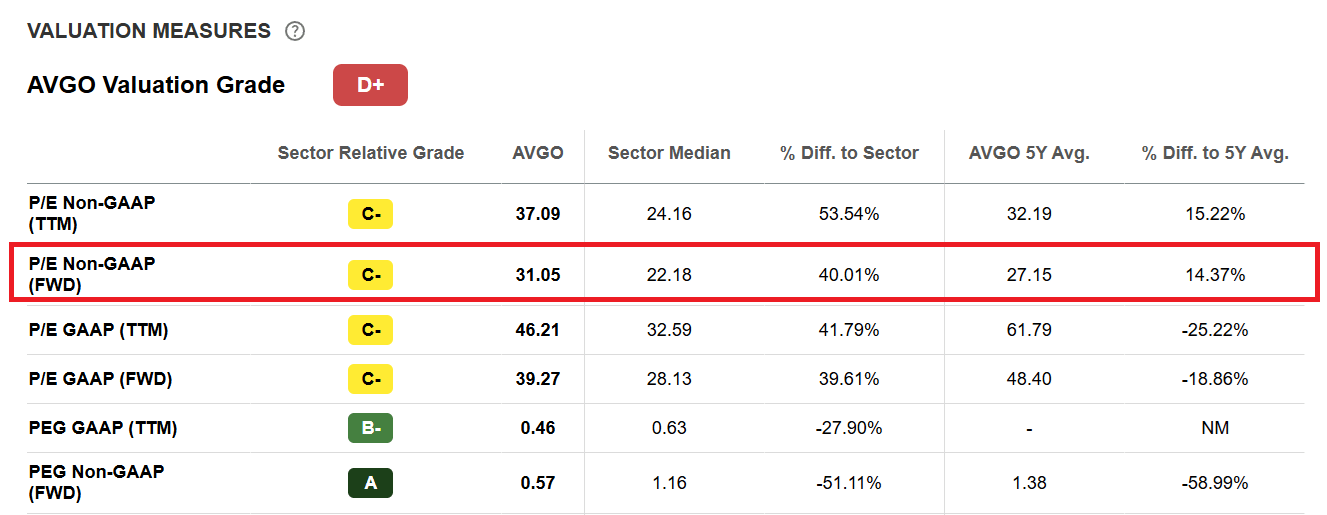
So how much is all this worth? Let's calculate the numbers. Revenue for the first three quarters has reached $71.1 billion, plus the fourth-quarter guidance of $34.8 billion, making FY2026 close to $106 billion, compared to last year's revenue of $63.89 billion, implying about a 66% growth rate.
Profits have accumulated via the same path. Broadcom recorded $7.81 per share in the first three quarters, with the fourth quarter looking to add about $3.80—using the guided 66% operating margin multiplied by the fourth-quarter revenue guidance of $34.8 billion, minus interest and taxes, one can roughly arrive at this figure.
This means FY2026 adjusted earnings are approximately $11.60. At the current share price of $344.72, the stock is trading at about 31 times forward earnings (non-GAAP).
If we extend the same calculations to FY2027—management claims the supply for that year is locked in—AI is expected to contribute $115 billion to the guidance, non-AI chip businesses about $17.5 billion, and software about $35 billion, totaling around $168 billion in revenue.
If the operating margin maintains at 66% and the tax rate at 16%, Broadcom could earn close to $18 per share; if the operating margin drops to 62% (memory costs could easily bite harder than currently expected), it would be approximately $17. At today's stock price, that's about 19 times the $18 scenario and slightly over 20 times the $17 scenario; all these assumptions come directly from the third-quarter call.
Tan went further, stating that Broadcom is moving towards a target of over $30 per share by FY2028, which at today's stock price corresponds to about 11.5 times—this is a target set by management itself. In July, I was writing about a forward multiple of about 42, compared to a five-year average of about 48; now the multiple has clearly fallen while the underlying profit base has risen.
I believe the market is no longer debating "whether demand exists." It is questioning whether Broadcom can convert that demand into receipts—this will be discussed in the next section.
That is the optimistic half. Now let's look at the less optimistic side. In June, Broadcom built the AI XPV platform with Apollo (APO) and Blackstone (BX), planning to finance over 20 gigawatts of computing power for AI labs by 2028; the first deal closed that month, with a scale of $35 billion, covering the previously mentioned Anthropic 1 gigawatt deployment.
Anthropic has so far lined up 16 gigawatts, but no one has clearly defined how much more financing is needed to complete it. The mechanism is worth understanding: large investors buy entire rack-mounted chips and then lease them to labs, so Broadcom does not lend a penny. What the company is doing is guaranteeing rent payments—this guarantee allows the safest part of the debt to receive a strong rating and lower financing costs.
Documents show that Broadcom could potentially lose $29 billion in the worst-case scenario in the first round—provided that the labs completely stop payment, and the equipment ultimately becomes worthless. When analysts asked if this was the eventual cost per gigawatt, the CFO refused to provide an upper limit.
In my view, the reason this $29 billion is "relatively soft" lies in the underlying assumptions: this number stands only if the equipment can retain residual value. However, Broadcom's own product roadmap is precisely undermining the resale value it just guaranteed.
The Ironwood TPU just shipped this season, and the next generation of Google chips is already in production—it's somewhat awkward to guarantee hardware value for five years while sitting next to a company that refreshes hardware every year; the secondary market for custom accelerators is at most very thin. Broadcom is essentially writing insurance for the resale of its own chips while simultaneously using each new design to lower that value.
Management's response is that Anthropic is moving towards an IPO, which will improve creditworthiness—this is where the discussion stops. An IPO will reduce the likelihood of customer defaults, but it does nothing to help with how much would be lost after a default, which is precisely the part borne by the residual value assumption of the equipment.
I am concerned not about customer defaults, but about: the reason cheap money is cheap is that Broadcom continues to stand behind it with guarantees; if they refuse to sign a guarantee, financing costs could rise, slowing down the deployment pace supporting the $115 billion AI revenue target, while there is almost no buffer elsewhere.
Although the CEO and department heads together call for "applying the brakes" on AI development, demand for Broadcom products should still be intact. Once again: the industry agrees to set speed bumps rather than completely halt AI development. Therefore, the bullish narrative still holds.
Ultimately, what matters is the price. Investors take on credit issues on the business edge but pay lower multiples compared to July, and correspond to a larger profit base. Considering all of the above, I maintain my strong buy rating for Broadcom.
免责声明:本文章仅代表作者个人观点,不代表本平台的立场和观点。本文章仅供信息分享,不构成对任何人的任何投资建议。用户与作者之间的任何争议,与本平台无关。如网页中刊载的文章或图片涉及侵权,请提供相关的权利证明和身份证明发送邮件到support@aicoin.com,本平台相关工作人员将会进行核查。


